Cabinet Type Forward
Centrifugal Fans
InAir Cabinet Type Forward Centrifugal Fans are designed for high-volume, low-noise commercial and industrial ventilation. The INA series forward-curved multi-blade design delivers high airflow at low noise levels, making these fans suitable for office buildings, hotels, theatres, auditoriums, basements, shopping malls, hospitals, and factories.
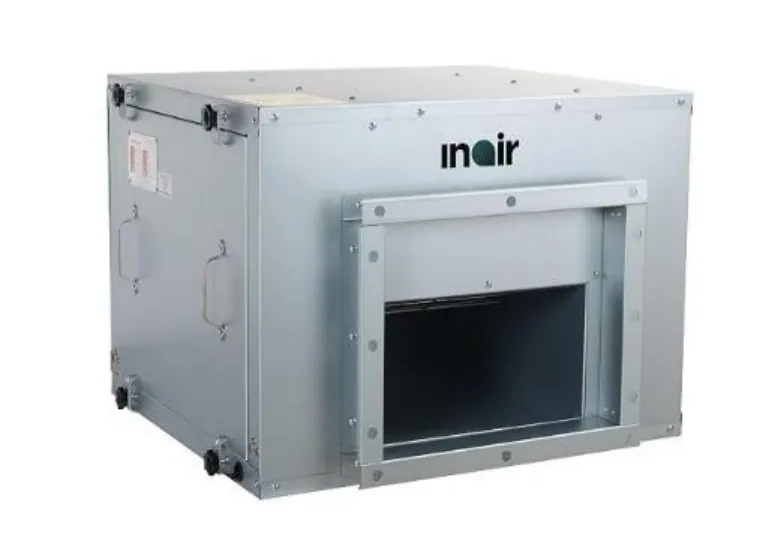
INA series: 13 models (250–1000), airflows 1,700–120,000 m³/h, total pressure up to 1,300 Pa. Belt drive, A/C/D transmission options. Request full technical datasheet and selection support for your project.
Typical applications
How is Cabinet Type Forward Centrifugal Fans sized?
Sizing starts from the air the space actually needs, not from the size of the room. For occupied spaces that means airflow per person under ASHRAE 62.1 — CO2 is produced by people, so a crowded small room needs more air than an empty large one. For process and extract duties it means the required air changes per hour for the activity. Once the airflow is fixed, the duct route sets the static pressure the unit has to overcome, and those two numbers together select the model.
Three things change the answer in India specifically: outdoor temperature at the design peak, which decides how much heat recovery is worth paying for; outdoor humidity, which decides whether passive recovery is enough or active dehumidification is needed; and local AQI, which sets the filter grade — MERV-13 for ordinary urban particulate, HEPA-13 where AQI regularly passes 200. The city pages give the design figures for fifteen Indian cities.
Where does it install?
Installation is cheapest and least disruptive during construction or renovation, when ducting is concealed inside the ceiling void and no finished surface is disturbed. In a completed interior the same result is reached with surface-run ducting in a boxed soffit, or with a standalone unit that needs only a core-cut through an external wall. A typical residential installation is commissioned in ten to twelve days from order.
Every installation includes a site survey, duct design, commissioning with measured airflow readings, and handover. Send a floor plan to sales@in-air.in and we will size it and quote it.
What does it cost to run?
Two figures matter. The fan draws continuous power, which is small — residential units run in the tens of watts. The larger figure is what the unit saves: recovering heat from the air being exhausted means the incoming air arrives closer to room temperature, so the air conditioner does less work. In a Hyderabad summer, incoming air at 44°C reaching the room at 26–28°C is the difference between an AC that copes and one that runs continuously. Filters are the recurring cost, changed on a schedule that depends on local AQI.