ERV maintenance and filter replacement
An ERV keeps working well when its filters are cleaned and changed on time; this guide sets out what to check, how often, and what the InAir service visit covers.
Last updated:
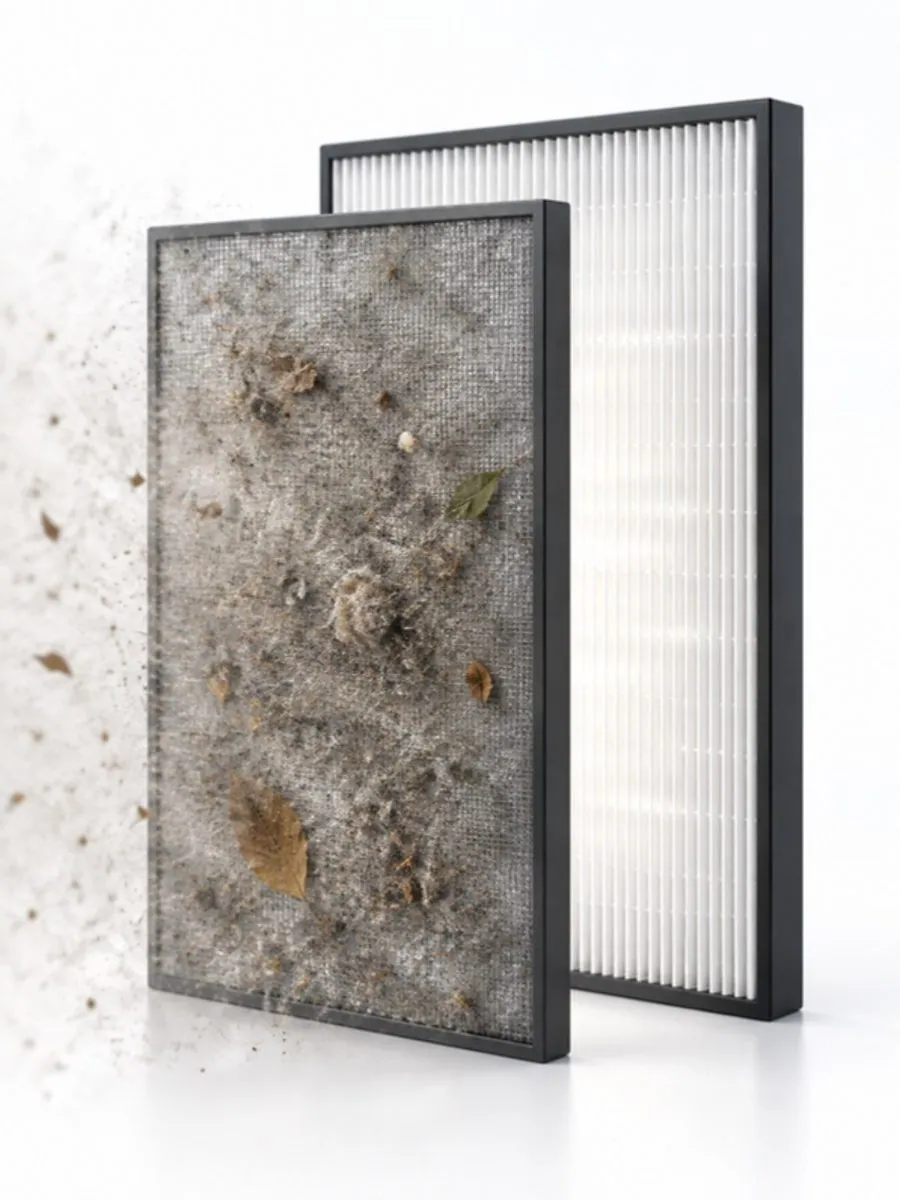
An ERV needs little routine care, but its filters do the hardest work and must be kept clean. In Indian cities, outdoor air carries dust and PM2.5 for much of the year, so filters load faster than in the countries where most ERVs were first designed. A clogged filter reduces airflow, and with less air the unit no longer clears CO₂ from the rooms.
What to check, and how often
| Part | What to do | Typical interval |
|---|---|---|
| Pre-filter | Vacuum or wash, let it dry fully, refit | Every 1–3 months, more often in dusty seasons |
| MERV-13 filter | Replace (not washable) | When the filter alarm shows, or about every 6–12 months |
| HEPA-13 filter | Replace (not washable) | When the filter alarm shows, or about every 12 months |
| Carbon filter | Replace | When odours return, or about every 6–12 months |
| Energy recovery core | Inspect and clean as the manual says | At the annual service |
| Drain and condensate tray | Check it runs clear | At the annual service, and before the monsoon |
| Outdoor grilles and louvres | Clear leaves, nests and dust | Every 3–6 months |
| Sensors and controller | Check readings and settings | At the annual service |
These are typical intervals. The real interval depends on the city, the season, the building's surroundings and the hours the unit runs. Your InAir service plan states the intervals for your unit.
Why filter grade matters
MERV-13 filters are tested under ASHRAE Standard 52.2 and capture at least 85% of particles of 1–3 µm and 90% of 3–10 µm [1]. HEPA-13 (H13) filters, classed under EN 1822, capture at least 99.95% of particles at their most penetrating size [2]. Fit a replacement of the same grade, or higher only if the unit's fans are rated for the extra resistance.
Signs the unit needs attention
- Less air from the diffusers than usual
- CO₂ readings on the sensor staying high when the room is occupied
- A filter alarm on the controller
- New noise or vibration from the unit
- Water around the unit or a musty smell during the monsoon
What the InAir service visit covers
An InAir service visit cleans or replaces the filters, inspects the energy recovery core, checks fans, drain, dampers and controls, and measures airflow at the outlets. Book a visit through the free site survey form or on WhatsApp.
Sources
- ANSI/ASHRAE Standard 52.2, Method of Testing General Ventilation Air-Cleaning Devices for Removal Efficiency by Particle Size (MERV ratings). https://www.ashrae.org/technical-resources/bookstore/standard-52-2
- EN 1822 / ISO 29463 high-efficiency filter classes (H13: at least 99.95% at the most penetrating particle size). https://airfiltration.mann-hummel.com/en-uk/insights/filter-classification/din-en-1822.html
How often should ERV filters be changed in India?
Can I wash an ERV filter?
What happens if I do not change the filter?
Does the ERV core need cleaning?
Our engineers assess your home or building, recommend the right system and the right filter grade for your city, and give you a clear cost estimate. No obligation.