HRV vs ERV for Indian climates: a zone-by-zone guide
In humid Indian weather most of the energy in outdoor air is moisture, which an HRV cannot recover; this guide works through the numbers for each climate zone.
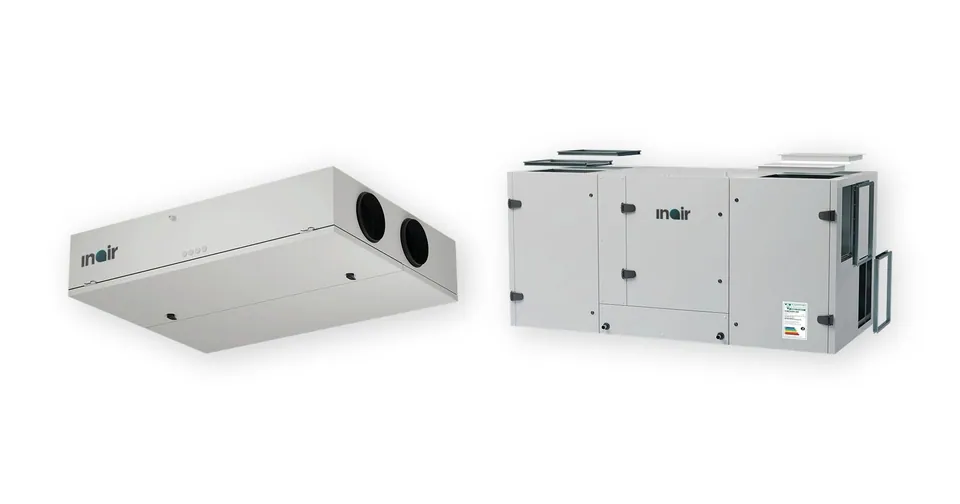
A heat recovery ventilator (HRV) and an energy recovery ventilator (ERV) look the same from outside. Both bring in outdoor air, push out room air, and pass the two streams through an exchanger so that the outgoing air pre-treats the incoming air. The difference is what crosses the exchanger. In an HRV only heat crosses. In an ERV heat and water vapour both cross.
The usual advice is "choose an ERV for India". That is mostly right, but the reason changes from city to city. This guide puts numbers on it.
Two kinds of heat in outdoor air
Outdoor air carries energy in two forms. Sensible heat is the part a thermometer reads. Latent heat is the energy held in water vapour, which an air conditioner has to remove by condensing that vapour on its cold coil.
How much of each there is depends on the weather. Take a room held at 25°C and 50% relative humidity. Using the standard vapour-pressure and mixing-ratio formulae [1][2] at sea-level pressure, that room air holds about 10 grams of water per kilogram of dry air. Now compare two kinds of outdoor air.
| Outdoor condition | Water in the air | Extra energy against the room | Share that is moisture |
|---|---|---|---|
| Humid coast, 34°C and 70% RH | about 24 g/kg | about 45 kJ per kg of air | about 80% |
| Dry summer, 42°C and 20% RH | about 10 g/kg | about 18 kJ per kg of air | about 7% |
Two things stand out. The humid 34°C day puts more than twice the load on the air conditioner that the dry 42°C day does, although it is 8°C cooler. And on the humid day four-fifths of that load is moisture.
These are worked examples that show the pattern. They are not design values for any city.
What that means for the exchanger
An HRV can only work on the sensible part. On the humid day above, that part is about one-fifth of the load. Even a perfect HRV would leave the other four-fifths for the air conditioner.
A study of a membrane ERV in Hong Kong's hot, humid climate found the same thing over a full year: the latent energy recovered was 6.9 times the sensible energy recovered, and the authors noted that high sensible effectiveness adds little unless latent heat is recovered too [3].
On the dry 42°C day the position reverses. Almost all the load is sensible, so an HRV and an ERV with the same sensible effectiveness would save nearly the same energy at that hour.
Zone by zone
India's building energy code divides the country into five climate zones: hot-dry, warm-humid, composite, temperate and cold [4]. The choice between HRV and ERV plays out differently in each.
Warm-humid: the coasts
This is where the moisture share is highest and lasts longest. InAir's city pages describe Chennai as humid all year, at 70–95% RH, and Mumbai as above 90% RH for more than four months of monsoon. An HRV here recovers a small fraction of the load.
An ERV is the right exchanger, but it is not a dehumidifier. If an ERV core transfers, say, 60% of the moisture difference, air arriving at 24 g/kg still enters the room at about 15 g/kg, well above the 10 g/kg the room is held at. The rest has to be removed by a cooling coil. That is why InAir's own recommendation for Chennai and Mumbai is the heat-pump energy recovery unit, which adds a refrigerant coil that cools and dries the fresh air after the exchanger. The 60% here is an illustration only.
Why it matters beyond the electricity bill: the US EPA advises keeping indoor humidity below 60%, and ideally between 30% and 50%, to limit mould [5], and a field study found that homes kept below 51% RH had dust-mite allergen levels more than ten times lower than humid homes [6].
Hot-dry: the desert and semi-arid interior
In peak summer the load is nearly all sensible, so this is the zone where an HRV comes closest to an ERV on energy. Two points still favour the ERV. First, very dry outdoor air dries the room; an ERV passes some of the room's moisture back to the incoming air, which InAir's Jaipur page notes as a comfort benefit. Second, dry-zone cities are not dry for all twelve months.
Composite: Delhi and the northern plains
Composite climates have three distinct seasons, and one machine has to serve all of them.
- Dry summer. Around 42°C and 20% RH the load is sensible, and either exchanger handles it.
- Monsoon. Around 33°C and 75% RH the air holds about 24 g/kg and roughly 80% of the load is moisture. An HRV does little.
- Winter. Around 8°C and 80% RH, outdoor air holds only about 5 g/kg. The exchanger now works in reverse and warms the incoming air. An ERV also keeps some indoor moisture from being lost.
An HRV suits one of those three seasons well. An ERV covers all three. In Delhi the filter matters as much as the exchanger; InAir specifies HEPA-13 there.
Temperate: Bengaluru and similar plateaus
Outdoor conditions sit close to indoor conditions for much of the year. At 28°C and 60% RH the outdoor air carries only about 14 kJ/kg more energy than the room, a third of the coastal figure. Any exchanger saves less here. The case for mechanical ventilation in this zone rests mainly on filtered air and CO₂ control in closed, air-conditioned rooms. When outdoor air is cooler than the room, passing it through an exchanger warms it up, which is the opposite of what is wanted.
Cold: the hills
Here the heating season is long and the indoor-outdoor temperature difference is large, so sensible recovery does most of the work and an HRV is at its strongest. An ERV still has one advantage, since heated winter air is dry and an ERV keeps some moisture indoors. In freezing weather any exchanger can ice up on the exhaust side.
Where an HRV still makes sense
Two cases follow from the reasoning above: the cold zone, and rooms where the aim is to remove indoor moisture while the outdoor air is drier, since an ERV would carry part of that moisture back in. Neither describes an ordinary air-conditioned home in the plains or on the coast.
Three questions to ask any supplier
- What are the sensible and latent effectiveness figures, stated separately, and at what test condition? InAir publishes 80–90% thermal energy recovery for its plate-type exchanger and describes the Revita range as sensible and latent recovery.
- In monsoon weather, what humidity will the supply air have after the exchanger, and what removes the rest?
- Which filter grade is fitted, and is it matched to the city's dust and PM2.5 levels?
Sources
- US National Weather Service, "Vapor Pressure" (calculation note). https://www.weather.gov/media/epz/wxcalc/vaporPressure.pdf
- US National Weather Service, "Mixing Ratio" (calculation note). https://www.weather.gov/media/epz/wxcalc/mixingRatio.pdf
- Niu J, Zhang L. "Potential energy savings for conditioning fresh air with a membrane-based energy recovery ventilator." ASHRAE Transactions 2002;108(1):54–63. Abstract: https://research.polyu.edu.hk/en/publications/potential-energy-savings-for-conditioning-fresh-air-with-a-membra/
- "Energy Conservation Building Directive – 2018 (based on ECBC 2017)", presentation prepared by Pacific Northwest National Laboratory with the Alliance for an Energy Efficient Economy, citing the Bureau of Energy Efficiency. https://www.grihaindia.org/sites/default/files/pdf/ECBC-Code.pdf (This document uses "moderate" for the temperate zone. The National Building Code 2016 and the ECBC 2017 code text were not consulted directly.)
- US Environmental Protection Agency, "Mold Course Chapter 2". https://www.epa.gov/mold/mold-course-chapter-2
- Arlian LG et al. "Reducing relative humidity is a practical way to control dust mites and their allergens in homes in temperate climates." Journal of Allergy and Clinical Immunology 2001;107(1):99–104. https://doi.org/10.1067/mai.2001.112119
Note on the worked figures: moisture content and energy were calculated from the formulae in [1] and [2] at 1013 hPa, with the usual moist-air enthalpy relation (1.006 × T + W × (2501 + 1.86 × T), T in °C, W in kg/kg). City humidity and temperature figures quoted for Chennai, Mumbai and Jaipur are from InAir's existing city pages.
Is an ERV always better than an HRV in India?
Does an ERV dehumidify?
I live in a dry city. Do I need moisture recovery?
How do I find the right unit for my city?
Our engineers assess your home or building, recommend the right system and the right filter grade for your city, and give you a clear cost estimate. No obligation.