Basement car park ventilation with jet fans
A basement car park needs steady exhaust to clear vehicle fumes and a separate fire mode to clear smoke; jet fans do both without a network of ducts.
Last updated:
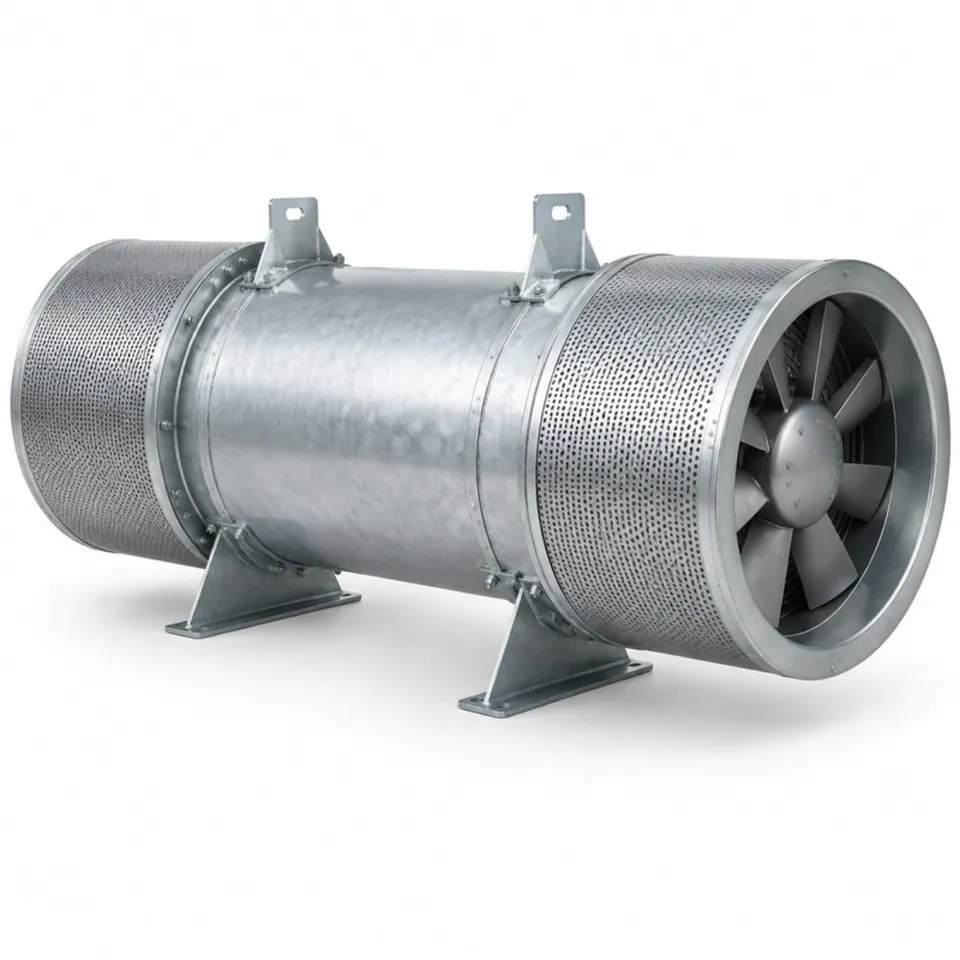
A basement car park needs mechanical ventilation for two reasons: to remove carbon monoxide and other exhaust gases from vehicles in normal use, and to clear smoke for people and firefighters if a car catches fire. A jet fan system does both by pushing air along the car park towards extract fans, instead of carrying it through ducts.
What the ventilation has to do
In normal use, the system keeps carbon monoxide and nitrogen dioxide from vehicle exhaust at safe levels. ASHRAE 62.1 lists an exhaust rate of 0.75 cfm per square foot for enclosed parking garages [1]. Carbon monoxide sensors across the car park let the fans run slowly when there is little traffic and speed up at peak times.
In a fire, the system switches to a fire mode that clears smoke towards the extract points and keeps escape routes clear. The air change rates for normal and fire modes, and the fire mode itself, are set by the National Building Code of India 2016 and the local fire authority [2]. They are confirmed with the project's fire consultant before design starts.
Jet fans or ducted extract?
A ducted system draws air through a network of ducts hung below the slab. It needs ceiling height, takes space from services, and is costly to install over a large floor.
A jet fan system uses a few large extract fans at the shafts, a supply or natural inlet at the opposite side, and rows of jet fans under the slab. Each jet fan produces thrust that drags the surrounding air forward, so air and smoke move across the whole floor towards the extract. The fans are mounted directly on the slab, with no duct runs between them. British Standard BS 7346-7 sets out a code of practice for smoke and heat control in car parks, including impulse (jet fan) systems [3].
How a jet fan system is designed
- Map the car park: floor area, clear height, ramps, columns, beams and the location of extract shafts.
- Set the extract and supply airflow for normal mode and fire mode from the code and the fire consultant's brief.
- Lay out the jet fans so that air moves along clear paths towards the extract, with no dead zones behind beams or ramps.
- Check the layout with a computer airflow (CFD) model, for both CO dilution and smoke clearance.
- Connect the fans to CO sensors and the fire alarm panel, so they switch between modes automatically.
Sources
- ANSI/ASHRAE Standard 62.1, Ventilation and Acceptable Indoor Air Quality (exhaust rate for enclosed parking garages). https://www.ashrae.org/technical-resources/bookstore/standards-62-1-62-2
- Bureau of Indian Standards, National Building Code of India 2016. https://bis.gov.in/others/national-building-code/
- BS 7346-7:2013, Components for smoke and heat control systems. Code of practice on functional recommendations and calculation methods for smoke and heat control systems for covered car parks. https://knowledge.bsigroup.com/products/components-for-smoke-and-heat-control-systems-code-of-practice-on-functional-recommendations-and-calculation-methods-for-smoke-and-heat-control-systems-for-covered-car-parks
What is a jet fan in a car park?
How much exhaust does a basement car park need?
Are jet fans used for smoke control?
Can CO sensors reduce running cost?
Our engineers assess your home or building, recommend the right system and the right filter grade for your city, and give you a clear cost estimate. No obligation.