ERV brands in India compared: how to choose
Several brands sell energy recovery ventilators in India; this guide sets out what each offers and the questions that separate them for Indian homes and buildings.
Last updated:
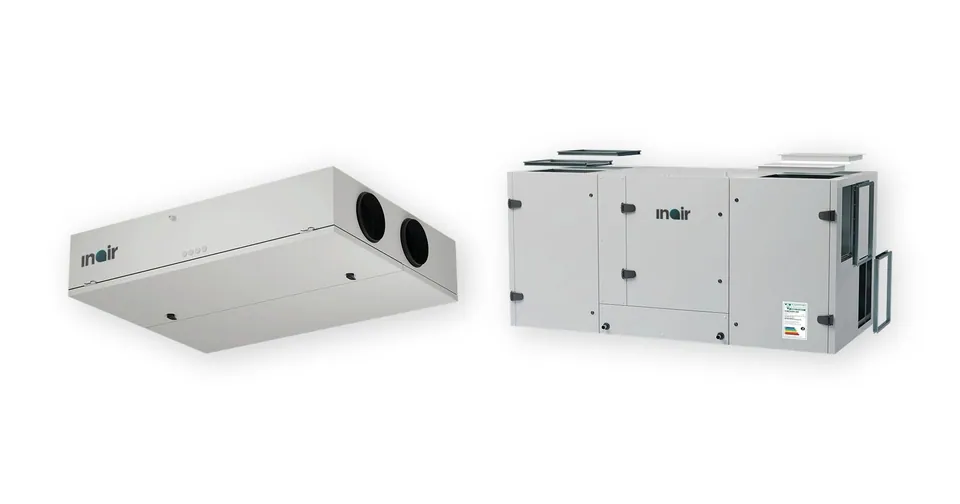
Several established brands sell energy recovery ventilators (ERVs) in India, and on paper they look alike: two fans, a recovery core, filters. The differences that matter in Indian conditions are moisture recovery, filtration grade, humidity control in the monsoon, how efficiency was tested, and who will service the unit after installation. This guide sets out what each brand offers, from its own published information, and the questions to ask before buying.
Brands selling ERVs in India
| Brand | ERV range in India | What the brand highlights |
|---|---|---|
| Daikin | VAM heat reclaim ventilation, 150–2,000 m³/h | Runs on its own or integrated with Daikin Sky Air and VRV systems [1][2] |
| Mitsubishi Electric | Lossnay energy recovery ventilators | Paper recovery core; used in offices, public buildings and department stores [3] |
| Delta Electronics | Ceiling-mounted ERV | Brushless DC motor and three-stage filtration against PM2.5 [4] |
| InAir | Revita (150–1,317 m³/h), Ventura (to 15,000 m³/h), RHP heat pump ERV (800–8,000 m³/h) | MERV-13 as standard, HEPA-13 optional; heat pump option for humid cities; survey, installation and service by one team |
Model ranges change; check each brand's current catalogue before specifying.
Questions that separate one ERV from another
- Does it recover moisture as well as heat? In humid Indian weather most of the energy in outdoor air is moisture. An ERV core (sensible and latent) suits India better than a heat-only HRV core.
- How was efficiency tested? Ask for sensible and latent (or enthalpy) efficiency at stated test conditions. Some brands quote results certified to AHRI Standard 1060 [5].
- What filter grade is fitted as standard? For Indian cities, look for MERV-13 at minimum and a HEPA-13 option where AQI regularly runs high.
- What happens in the monsoon? An ERV alone cannot dry monsoon air enough in Mumbai, Chennai or Kochi. Ask whether the brand offers a heat pump ERV or a dehumidifying stage.
- How is noise stated? Ask for sound pressure at a stated distance, measured at the speed the unit will actually run.
- Does it work with your AC? Some ERVs are built to integrate with one brand's VRV system; others run independently alongside any AC.
- Who services it in your city? Filters need changing every few months in Indian conditions. Check who supplies filters and visits for service.
How InAir fits
InAir sizes every system from a free site survey, to ASHRAE 62.2 for homes and ASHRAE 62.1 for other buildings, and offers the RHP heat pump ERV for humid cities. Full figures for each model are on the InAir spec sheets.
Sources
- Daikin, VAM-FC heat reclaim ventilation (airflow 150 to 2,000 m³/h, stand-alone or integrated with Sky Air or VRV). https://www.daikin.co.uk/en_gb/products/VAM-FC.html
- Daikin India, HRV heat reclaim ventilation brochure. https://www.daikinindia.com/sites/default/files/Download%20Brochure/HRV_brochure_0.pdf
- Mitsubishi Electric India, Can an air conditioning system improve air quality indoors? (Lossnay energy recovery ventilators). https://in.mitsubishielectric.com/en/feature/partneringindia/can-an-air-conditioner-improve-air-quality.html
- Electronics Era, interview with Delta Electronics India on its ceiling-mount energy recovery ventilator. https://electronicsera.in/?p=34424
- Daikin, VAM energy recovery ventilator product flyer (performance certified to AHRI Standard 1060). https://daikinac.com/docs/default-source/energy-recovery-ventilator/pf-vam_gvju.pdf
Which is the best ERV brand in India?
Is an ERV better than an HRV in India?
Can an ERV work with any air conditioner?
What filter should an ERV have in India?
Our engineers assess your home or building, recommend the right system and the right filter grade for your city, and give you a clear cost estimate. No obligation.