Fresh air system for a 3BHK apartment: how to size and choose one
A 1,600 sq ft 3BHK needs at least 133 m³/h of fresh air under ASHRAE 62.2; InAir usually fits about 350 m³/h so that closed bedrooms stay near 800 ppm of CO₂ overnight.
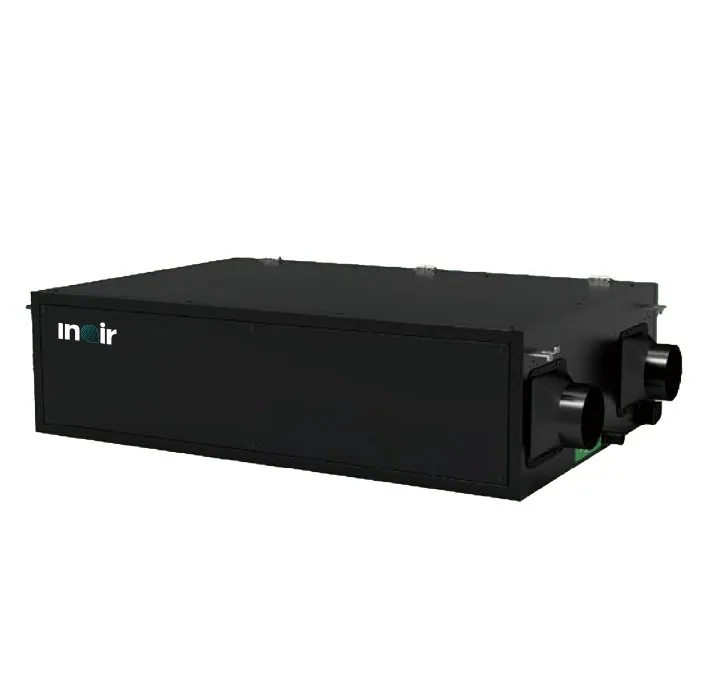
A 3BHK is the most common home InAir is asked about. The questions are nearly always the same: how much fresh air the flat needs, whether it can be fitted in a home that is already finished, and what the filter does on a bad air day. This guide answers them with the figures InAir uses.
How much fresh air a 3BHK needs
For homes, ASHRAE 62.2 sets the minimum continuous whole-house rate: 0.03 cfm per sq ft of floor area plus 7.5 cfm per occupant, taking occupants as bedrooms plus one [1]. For a 1,600 sq ft 3BHK with four people that comes to 78 cfm, or about 133 m³/h.
| Home | ASHRAE 62.2 minimum | Minimum (m³/h) | Typical InAir selection |
|---|---|---|---|
| 2BHK, 1,100 sq ft (3 people) | 56 cfm | 95 m³/h | Revita INA-MFQR-250 |
| 3BHK, 1,600 sq ft (4 people) | 78 cfm | 133 m³/h | Revita INA-MFQR-350 |
| 4BHK, 2,400 sq ft (5 people) | 110 cfm | 187 m³/h | Revita INA-MFQR-500 |
The ERV sizing calculator works the same figure for any floor area and number of bedrooms.
Why the unit fitted is larger than the minimum
The code figure is a whole-house minimum. It does not say how the air is shared between rooms. Two people asleep behind a closed bedroom door raise CO₂ through the night, and controlled studies have measured lower cognitive and decision-making scores at around 1,000 ppm compared with 550 to 600 ppm [2][3].
InAir therefore checks each bedroom against a CO₂ target and sizes the supply so that a closed bedroom stays near 800 ppm overnight. For a 3BHK that usually means a unit of about 350 m³/h, the Revita INA-MFQR-350, with the air divided between the bedrooms and the living room. InAir's Hyderabad 3BHK case study records the result [4].
Why not just open a window
In most Indian cities, outdoor PM2.5 sits far above the WHO 24-hour guideline of 15 µg/m³ [5]. In Delhi the 2024–25 winter average was about 175 µg/m³ [6]. An open window lets that dust in along with heat and monsoon humidity. An air conditioner does not help with fresh air either: it cools and recirculates the air already in the room.
A ducted energy recovery ventilator brings in the same outdoor air through a filter, and passes it across the outgoing air so that it is pre-cooled before it reaches the AC.
Under construction or already finished
The right system depends on the state of the flat.
| Your flat | What fits |
|---|---|
| Under construction or being renovated, with a false ceiling | A ducted Revita ERV with flat ducts to each bedroom and the living room |
| Finished, with no ceiling void | A standalone fresh air unit in each room, with a single wall core-cut per room |
| In a humid coastal city (Mumbai, Chennai, Kochi) | An RHP heat pump ERV with active dehumidification |
The best time to decide is before the false ceiling goes in, while duct routes are still open.
Which filter for your city
Incoming air passes a pre-filter and then a MERV-13 filter. MERV-13 captures at least 85% of particles between 1 and 3 µm and 90% of particles between 3 and 10 µm under ASHRAE 52.2. In high-AQI cities such as Delhi NCR, Lucknow and Kolkata, a HEPA-13 stage is added on the supply. H13 filters capture at least 99.95% of particles at their most penetrating size [7].
InAir publishes the recommended unit and filter for fifteen cities on its city pages.
What happens from survey to handover
- Free site survey. An InAir engineer visits, measures the flat, notes occupancy and checks routes for ducts and outdoor intakes.
- Airflow sizing. Fresh air and exhaust are sized to ASHRAE 62.2 and checked against the bedroom CO₂ target.
- Equipment and filter selection. The unit and filters are selected for the city's outdoor air, and a written proposal is shared.
- Installation and commissioning. The team installs, then measures and balances supply and exhaust airflow at each outlet before handover.
- Monitoring and service. Optional sensors track CO₂, PM2.5 and humidity, and filters are changed on a scheduled service plan.
Sources
- ANSI/ASHRAE Standard 62.2, Ventilation and Acceptable Indoor Air Quality in Residential Buildings. https://www.ashrae.org/technical-resources/bookstore/standards-62-1-62-2
- Allen JG et al. (2016). Associations of cognitive function scores with carbon dioxide, ventilation, and VOC exposures in office workers. Environmental Health Perspectives 124:805–812. https://doi.org/10.1289/ehp.1510037
- Satish U et al. (2012). Is CO2 an indoor pollutant? Direct effects of low-to-moderate CO2 concentrations on human decision-making performance. Environmental Health Perspectives 120:1671–1677. https://doi.org/10.1289/ehp.1104789
- InAir case study: 3 BHK apartment, Hyderabad. https://www.in-air.in/case-studies/hyderabad-3bhk-apartment-erv/
- World Health Organization (2021). WHO global air quality guidelines: PM2.5, PM10, ozone, NO2, SO2 and CO. https://www.who.int/publications/i/item/9789240034228
- Centre for Science and Environment winter 2024–25 analysis, reported by Down To Earth. https://www.downtoearth.org.in/amp/story/air/winter-pollution-worsens-across-indias-megacities-finds-cse
- EN 1822-1 / ISO 29463 high-efficiency filter classes (H13 at least 99.95% at MPPS). https://airfiltration.mann-hummel.com/en-uk/insights/filter-classification/din-en-1822.html
How much fresh air does a 3BHK need?
Will a fresh air system replace my AC?
Can it be fitted in a finished 3BHK?
Does it let outdoor pollution in?
Our engineers assess your home or building, recommend the right system and the right filter grade for your city, and give you a clear cost estimate. No obligation.