Air filter grades explained: MERV, HEPA H13, ISO 16890 and F7
MERV-13, ePM1 70%, F7, H13: four labels, four different tests. Here is what each grade means, how they compare, and which one Indian homes need.
Last updated:
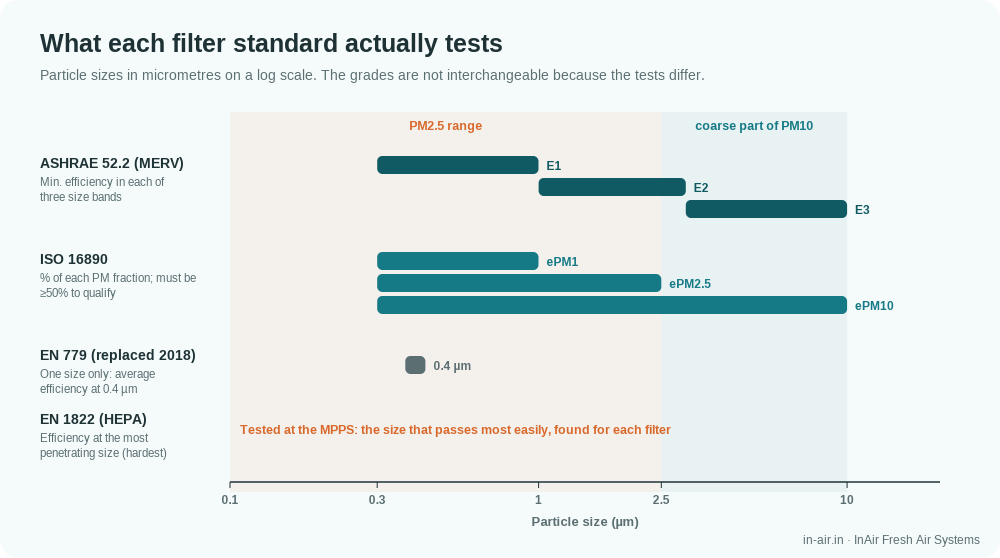
Building air filters are graded on three main scales. ASHRAE 52.2 gives a MERV number from 1 to 16. ISO 16890 gives the percentage of PM1, PM2.5 and PM10 caught, and replaced Europe's EN 779 (G4, F7) in 2018. EN 1822 grades HEPA filters from E10 to U17. For Indian homes, MERV-13 is a sensible minimum on fresh air, with HEPA H13 in smoggy cities.
Key points
- MERV-13 (ASHRAE 52.2): at least 50% of 0.3–1 µm, 85% of 1–3 µm and 90% of 3–10 µm particles.
- ISO 16890 labels like "ePM1 70%" give the share of that particle fraction caught, rounded down to 5%. A filter needs 50% to earn an ePM class.
- EN 779 classes such as G4 and F7 were replaced by ISO 16890 from July 2018. There is no exact conversion, only rough guides.
- HEPA H13 under EN 1822 means at least 99.95% at the most penetrating particle size; H14 means 99.995%.
- No standard covers a washed HEPA filter. Wash pre-filters; replace MERV, HEPA and carbon filters.
- Better filters resist airflow more. The fan must be rated for the filter you fit.
MERV: the ASHRAE 52.2 scale
MERV stands for Minimum Efficiency Reporting Value. The test in ASHRAE Standard 52.2 measures how much of each of three size bands a filter catches: E1 (0.3–1 µm), E2 (1–3 µm) and E3 (3–10 µm). The MERV number depends on how much of each band the filter catches. The US EPA recommends at least MERV-13 for homes, or as high as the system's fan and filter slot can take.
| MERV | 0.3–1 µm (E1) | 1–3 µm (E2) | 3–10 µm (E3) | Note |
|---|---|---|---|---|
| 8 | – | ≥20% | ≥70% | Mostly coarse dust |
| 11 | ≥20% | ≥65% | ≥85% | |
| 13 | ≥50% | ≥85% | ≥90% | EPA's suggested minimum; standard on InAir ERVs |
| 14 | ≥75% | ≥90% | ≥95% | |
| 16 | ≥95% | ≥95% | ≥95% | Highest MERV |
A US "HEPA" filter is outside the MERV scale. The EPA defines it as at least 99.97% efficient at 0.3 µm, a different test from Europe's EN 1822.
ISO 16890: ePM1, ePM2.5 and ePM10
ISO 16890 tests filters across 0.3–10 µm and reports the share of three particle fractions they remove: PM1 (0.3–1 µm), PM2.5 (0.3–2.5 µm) and PM10 (0.3–10 µm). A filter must catch at least 50% of a fraction to be classed in that group. The result is rounded down to the nearest 5%, so a label reads, for example, "ISO ePM1 60%". A filter that catches less than 50% of PM10 goes into the "ISO Coarse" group.
There is one more difference from the old test. Some filter media carry an electrostatic charge that raises their efficiency. ISO 16890 reports an average of the efficiency with and without that charge, so the label does not rest on the charge alone.
| ISO 16890 group | Size fraction | To qualify | Reads as |
|---|---|---|---|
| ISO ePM1 | 0.3–1 µm | ≥50% of PM1 | e.g. ePM1 55%, 70%, 85% |
| ISO ePM2.5 | 0.3–2.5 µm | ≥50% of PM2.5 | e.g. ePM2.5 65% |
| ISO ePM10 | 0.3–10 µm | ≥50% of PM10 | e.g. ePM10 60% |
| ISO Coarse | Coarse dust | Below 50% of PM10 | ISO Coarse group |
G4, F7, F9: the old EN 779 grades
Indian quotations and spec sheets still use EN 779 names: G1–G4 for coarse filters, M5–M6 medium and F7–F9 fine. EN 779 tested efficiency at a single particle size, 0.4 µm, using a test dust, and was replaced by ISO 16890 from 1 July 2018. Manufacturers stress that there is no direct, one-to-one conversion between the two.
The European industry body Eurovent publishes a rough guide (Guideline 4/23, January 2022) showing the range of ISO 16890 results measured on filters that had been sold under each EN 779 class. Use it only to compare old and new quotes, never to specify a filter.
| Old EN 779 class | ePM1 measured | ePM2.5 measured | ePM10 measured |
|---|---|---|---|
| M5 | 5–35% | 10–45% | 40–70% |
| M6 | 10–40% | 20–50% | 60–80% |
| F7 | 40–65% | 65–75% | 80 to 90% |
| F8 | 65–90% | 75–95% | 90–100% |
| F9 | 80 to 90% | 85–95% | 90–100% |
The ranges are wide. Two "F7" filters could catch anywhere from 40% to 65% of PM1. A G4 pre-filter is a coarse filter; under ISO 16890, any filter below 50% on PM10 sits in the ISO Coarse group. If a quote says only "F7" or "G4", ask for the ISO 16890 or MERV test result.
HEPA: EN 1822 classes E, H and U
HEPA and finer filters are graded under EN 1822. The test finds the particle size that passes through that filter most easily, the most penetrating particle size (MPPS), and measures efficiency there. Since every other size is caught better, it is a conservative rating.
| EN 1822 class | Overall efficiency at MPPS | Local efficiency (leak scan) | Group |
|---|---|---|---|
| E10 | ≥85% | – | EPA |
| E11 | ≥95% | – | EPA |
| E12 | ≥99.5% | – | EPA |
| H13 | ≥99.95% | ≥99.75% | HEPA |
| H14 | ≥99.995% | ≥99.975% | HEPA |
| U15 | ≥99.9995% | ≥99.9975% | ULPA |
| U16 | ≥99.99995% | ≥99.99975% | ULPA |
| U17 | ≥99.999995% | ≥99.9999% | ULPA |
H, U classes also have a local efficiency limit, checked by scanning the filter face for leaks; E classes do not. Words like "HEPA-type" or "HEPA-like" have no class behind them. If there is no EN 1822 class or test report, treat the filter as unrated.
Why "washable HEPA" isn't a thing
An EN 1822 class describes a filter as manufactured and tested. No part of the standard tests a filter after it has been washed and dried, so a washed HEPA has no rating anyone can check. HEPA media are made of very fine fibres, and there is no way to check at home whether washing has opened paths through them. A washed filter can look clean and still leak.
So the rule is simple. Pre-filters are made to be washed or vacuumed. MERV-13, HEPA-13 and carbon filters are replaced. InAir's ERV maintenance and filter replacement guide sets out the same rule.
Pressure drop: a better filter needs a stronger fan
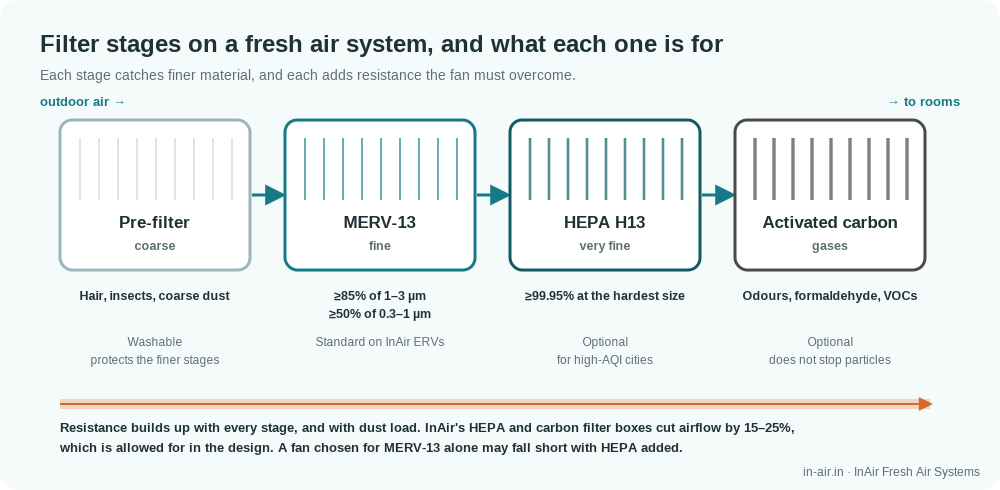
Finer filters resist airflow more, and resistance rises as they load with dust. If the fan was chosen for a lower grade, fitting a HEPA can cut the fresh air the system delivers, and with less air, CO₂ rises in the rooms. That is why the EPA's advice is the highest MERV the system's fan and filter slot can take, not simply the highest MERV.
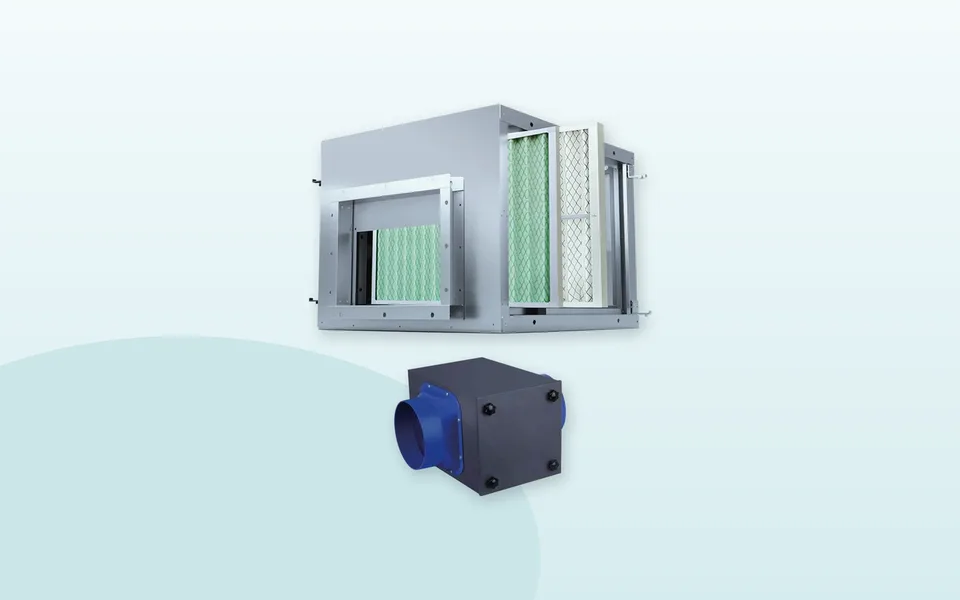
InAir publishes this for its own add-on filter boxes: a HEPA and carbon filter box reduces airflow by 15–25%, and that is factored into the system design. When upgrading filters in an existing unit, fit the same grade, or higher only if the fan is rated for the extra resistance.
How often to replace filters in India
Indian outdoor air carries more dust and PM2.5 for more of the year than the countries where most fresh air equipment was first designed, so filters load faster. These are the typical intervals InAir uses; your unit's filter alarm and your city's season decide the real one.
| Filter | What to do | Typical interval |
|---|---|---|
| Pre-filter | Vacuum or wash, dry fully, refit | Every 1–3 months; more often in dusty seasons |
| MERV-13 | Replace (not washable) | When the alarm shows, or about every 6–12 months |
| HEPA-13 | Replace (not washable) | When the alarm shows, or about every 12 months |
| Carbon | Replace | When odours return, or about every 6–12 months |
A Delhi home in winter, when the city averaged 175 µg/m³ of PM2.5 in 2024–25 according to CSE, will load filters far faster than a Bengaluru home at 37 µg/m³. See PM2.5 vs PM10 for what those particles are, and the Indian AQI explained for how the numbers are reported.
Which grade for your city
| Situation | Fresh air filter | Why |
|---|---|---|
| Most Indian cities | Pre-filter + MERV-13 | Catches most fine particles at a manageable pressure drop |
| AQI regularly above 200 (Poor or worse) | Add HEPA H13 | ≥99.95% at the hardest size for smoke and winter smog |
| Odours, traffic fumes, new interiors | Add activated carbon | Particles filters do not stop gases |
| Coastal and dusty sites | Robust pre-filter, checked often | Protects the fine stages from loading early |
All InAir ERVs come with a pre-filter and MERV-13, with HEPA-13 as an option. Revita and Ventura units recover 89–90% (tested) of the heat or cooling in the outgoing air, so filtered fresh air does not cost the AC much. The Revita spec sheets give the figures for each model.
How InAir checks this at the site survey
- Your city's PM2.5 through the year, and local dust or smoke sources near the intake.
- Whether MERV-13 is enough, or HEPA H13 and carbon stages are worth adding.
- The extra resistance of the chosen filters, and whether the unit's fan has the pressure to carry it.
- Access to the filters for cleaning and replacement, so maintenance actually happens.
- A filter replacement schedule that suits your city and the hours the system runs.
What it costs
InAir fresh air filter boxes with pre-filter, HEPA H13 and activated carbon, for 100–250 mm ducts, start from ₹14,800 each, before GST and installation. Replacement filters are quoted separately.
Tentative pricing: actual prices may vary based on the site survey.
Common mistakes
- Comparing "F7" on one quote with "MERV-13" on another as if they were the same test.
- Buying "HEPA-type" filters with no EN 1822 class.
- Washing HEPA or MERV filters and refitting them.
- Fitting a HEPA into a unit whose fan was sized for a coarse filter, and losing fresh air.
- Relying on a carbon filter to stop dust, or a particle filter to stop smells.
- Waiting for the filter to look dirty instead of following the alarm or the schedule.
Sources
- US EPA, What is a MERV rating? (ASHRAE 52.2 efficiency table; US HEPA definition). epa.gov
- Camfil, The international test standard ISO 16890 for air filters for general ventilation. camfil.com
- Freudenberg Filtration Technologies, ISO 16890 (with Eurovent Guideline 4/23 comparison table, January 2022). freudenberg-filter.com
- MANN+HUMMEL, DIN EN 1822 filter classes (E10–U17). mann-hummel.com
- CSE, winter 2024–25 air pollution analysis for six megacities. cseindia.org
Is MERV-13 the same as HEPA?
What is ePM1 in ISO 16890?
What is the MERV equivalent of F7?
Can I wash a HEPA filter?
How often should fresh air filters be changed in India?
Will a HEPA filter reduce airflow?
Our engineers assess your home or building, recommend the right system and the right filter grade for your city, and give you a clear cost estimate. No obligation.