PM2.5 vs PM10: what is the difference, and which matters more?
Both are dust you breathe, but they come from different places and go to different parts of your lungs. Here is what separates them, with Indian data.
Last updated:

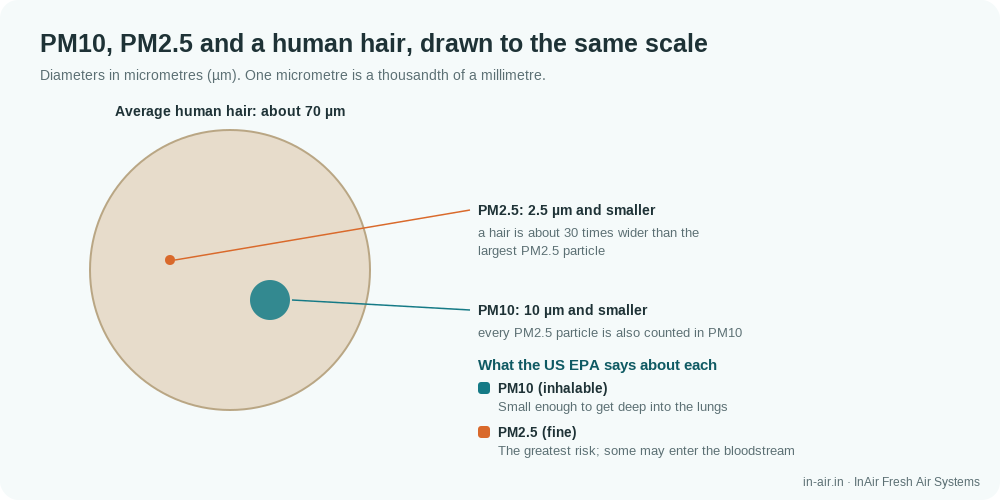
PM10 is all airborne particles 10 micrometres (µm) across or smaller; PM2.5 is the fine fraction, 2.5 µm or smaller. So PM2.5 is part of PM10. The smaller particles matter more for health because they travel deeper into the lungs. India limits PM2.5 to 60 µg/m³ and PM10 to 100 µg/m³ over 24 hours.
Key points
- A human hair is about 70 µm wide, roughly 30 times the largest PM2.5 particle.
- In Delhi, road dust is 56% of PM10 emissions but 38% of PM2.5; vehicles are 9% of PM10 but 20% of PM2.5 (IIT Kanpur, 2016).
- Limits: CPCB 60 (PM2.5) and 100 (PM10) µg/m³ over 24 hours; WHO 2021 guidelines 15 and 45.
- A MERV-13 filter catches at least 85% of 1–3 µm particles and 90% of 3–10 µm; a HEPA-13 catches at least 99.95% at its weakest size.
- An N95 respirator filters at least 95% of airborne particles, but only if it seals to the face.
- Indoors, PM2.5 comes in through gaps and from cooking and burning; indoor PM10 also comes from settled dust stirred up again.
What PM2.5 and PM10 actually are
PM stands for particulate matter: a mix of solid particles and liquid droplets in the air. The number is the size cut-off in micrometres. The US EPA describes PM10 as inhalable particles, generally 10 µm and smaller, and PM2.5 as fine inhalable particles, generally 2.5 µm and smaller. Both are measured as a mass, in micrograms per cubic metre of air (µg/m³).
Because the PM10 measurement includes everything up to 10 µm, it always reads at least as high as PM2.5 at the same place and time. The difference, particles between 2.5 and 10 µm, is called the coarse fraction.
| PM10 | PM2.5 | |
|---|---|---|
| Size | 10 µm and smaller | 2.5 µm and smaller |
| Typical make-up | Road and soil dust, construction dust, fly ash, plus all the PM2.5 | Combustion smoke and soot, vehicle exhaust, particles formed in the air from gases (sulphate, nitrate, ammonium) |
| Health relevance (US EPA) | Inhalable; can get deep into the lungs | Greatest risk; some may reach the bloodstream |
| CPCB limit (24 h / annual) | 100 / 60 µg/m³ | 60 / 40 µg/m³ |
| WHO 2021 guideline (24 h / annual) | 45 / 15 µg/m³ | 15 / 5 µg/m³ |
| Indoor target, IGBC classes A / B / C | 50 / 75 / 100 µg/m³ | 15 / 20 / 25 µg/m³ |
Where PM2.5 and PM10 come from in Indian cities
The best-known source study is IIT Kanpur's 2016 report for the Delhi Pollution Control Committee. Its emission inventory shows how differently the two sizes behave. Dust dominates the coarse particles; burning matters more for the fine ones.
| Top sources in Delhi's annual emissions | Share of PM10 | Share of PM2.5 |
|---|---|---|
| Road dust | 56% | 38% |
| Vehicles | 9% | 20% |
| Industrial point sources | 10% | 11% |
| Concrete batching | 10% | not in top four |
| Domestic fuel burning | not in top four | 12% |
Season changes the picture. In Delhi's summer, crustal material (soil, road dust and fly ash) made up about 40% of PM10 but about 20% of PM2.5. In winter the same study found the main contributors to both sizes were secondary particles formed from gases (25–30%), vehicles (20–25%), biomass burning (17–26%) and municipal waste burning (8–9%), with dust playing a smaller part.
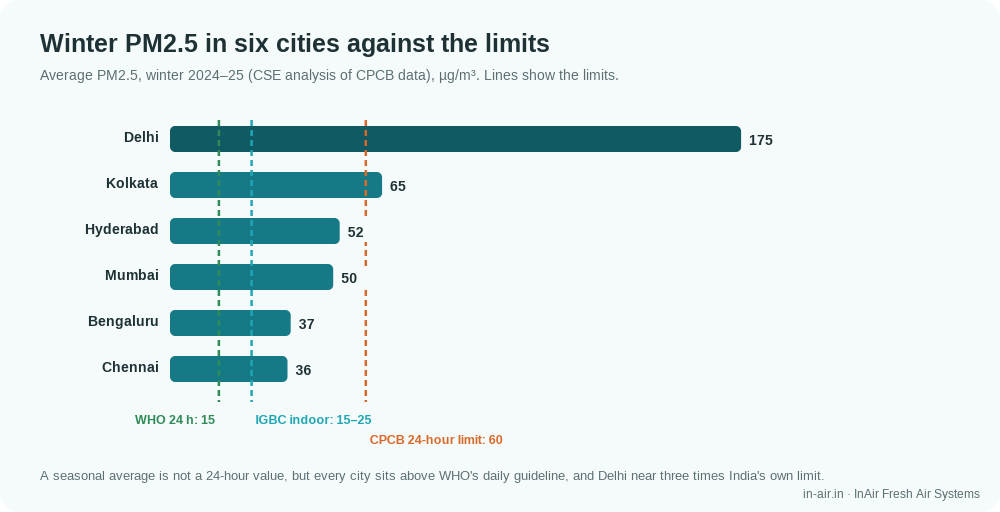
Other cities have different mixes: coastal cities get sea salt and less stagnant winter air, while cities in the Indo-Gangetic plain trap smoke under low winter inversions. The Centre for Science and Environment's analysis of winter 2024–25 found average PM2.5 of 175 µg/m³ in Delhi against 36–65 µg/m³ in Chennai, Bengaluru, Mumbai, Hyderabad and Kolkata. Our Indian AQI explained explains how those concentrations become an AQI number.
Why PM2.5 is the bigger health worry
Size decides how far a particle gets. The EPA notes that particles under 10 µm can get deep into the lungs and some may enter the bloodstream, and that PM2.5 poses the greatest risk. It links particle exposure to aggravated asthma, reduced lung function, irregular heartbeat, non-fatal heart attacks and premature death in people with heart or lung disease. Children, older adults and people with heart or lung disease are most affected.
WHO estimates that outdoor air pollution caused 4.2 million premature deaths worldwide in 2019, and treats PM as a common proxy indicator for air pollution. Its 2021 guidelines reflect the size difference: 15 µg/m³ for 24-hour PM2.5 against 45 µg/m³ for PM10. CPCB's AQI health statements warn about prolonged exposure from the Poor band upwards.
PM10 still matters. High dust days cause coughing, eye irritation and asthma flare-ups, and dust settles on surfaces and AC coils. But if you can only reduce one, reduce PM2.5.
What filters and masks catch
Filters are tested against particle sizes, not against "PM2.5" as a label. The ratings below come from the test standards. Our air filter grades guide explains each scale in more detail.
| Filter or mask | Rating and test | PM10 (coarse dust) | PM2.5 (fine) |
|---|---|---|---|
| Pre-filter (coarse) | Catches larger dust; InAir's pre-filters target particles above 5 µm | Good | Little |
| MERV-13 | ASHRAE 52.2: ≥90% of 3–10 µm, ≥85% of 1–3 µm, ≥50% of 0.3–1 µm | Very good | Good |
| HEPA H13 | EN 1822: ≥99.95% at the most penetrating particle size | Excellent | Excellent |
| N95 respirator | NIOSH: filters ≥95% of airborne particles; protection depends on a tight seal | Very good if fitted | Very good if fitted |
Two practical points follow. A coarse pre-filter alone does little for PM2.5, so a fresh air unit with only a pre-filter will bring smoke inside. And the fit of a mask matters as much as its rating: air leaking past the edges is not filtered at all.
PM2.5 and PM10 indoors
Indoor particle levels depend on outdoor levels, how much air leaks in, the ventilation and filters you have, and what you do inside. The EPA's guidance is that in homes without smoking or other strong sources, indoor PM is the same as or lower than outdoors. Indian kitchens, incense and mosquito coils are strong sources, and a Delhi study of thousands of homes found indoor PM2.5 more than 20 times WHO levels and higher than at the nearest outdoor monitor.
- Fine particles get in through gaps. Window frames, AC pipe holes and exhaust openings let PM2.5 in even with the windows shut.
- Coarse particles settle. Indoor PM10 is often dust tracked in and stirred up again by walking, sweeping and fans. Damp mopping and a doormat help.
- Cooking makes both. Frying and tempering release fine particles; a hood vented outside removes them at the source.
- Purifiers clean, but do not ventilate. A room purifier reduces particles but adds no fresh air. See ventilation vs air purifier.
More on this in why indoor air is polluted with the windows closed.
How InAir checks this at the site survey
- The PM2.5 and PM10 history of your nearest CPCB station, and which season is worst.
- Local coarse-dust sources (construction, unpaved roads) and fine-particle sources (traffic, burning) around the building.
- Where an outdoor air intake can be placed away from roads, kitchen exhausts and dust.
- Whether MERV-13 is enough or a HEPA-13 filter box should be added, and the airflow loss that comes with it.
- Indoor sources: kitchen exhaust, prayer room, open balconies, bathroom fans.
What it costs
InAir fresh air filter boxes with a pre-filter, HEPA H13 and activated carbon start from ₹14,800 each. Revita energy recovery ventilators, which come with a pre-filter and MERV-13 filter (HEPA-13 optional), start from ₹2.1 lakh for a 1–2 BHK. Prices are before GST and installation.
Tentative pricing: actual prices may vary based on the site survey.
Common mistakes and myths
- "PM10 is worse because the number is bigger." PM10 includes PM2.5, so it is always the bigger number. The fine part is the bigger health risk.
- "If I can't see dust, the air is clean." PM2.5 is invisible as single particles; you only see it as haze at high levels.
- "Any filter stops PM2.5." A coarse pre-filter catches little PM2.5. Look for MERV-13 or HEPA-13 ratings.
- "A loose mask is better than nothing, so it protects me." Unsealed air bypasses the filter. An N95 works only when it seals.
- "Indoors is always safer." Only if indoor sources are controlled and the air coming in is filtered.
Sources
- US EPA, Particulate Matter (PM) Basics: size definitions, hair comparison, health effects. epa.gov
- IIT Kanpur for Delhi Pollution Control Committee (2016), Comprehensive Study on Air Pollution and Greenhouse Gases in Delhi: emission inventory and source apportionment. PDF
- CPCB, National Ambient Air Quality Standards (2009), Annexure 2 of the 2019 status report. PDF
- WHO, Ambient (outdoor) air pollution fact sheet (2024) and Global Air Quality Guidelines (2021). who.int
- CSE, winter 2024–25 air pollution analysis for six megacities. cseindia.org
- US EPA, What is a MERV rating? (ASHRAE 52.2 efficiency table) and Indoor Particulate Matter. epa.gov
- CDC/NIOSH, Filtering facepiece respirators. cdc.gov
- Greenstone, Lee and Sahai (2021), Indoor Air Quality, Information, and Socio-Economic Status: Evidence from Delhi. BFI working paper
What is the difference between PM2.5 and PM10?
Which is more harmful, PM2.5 or PM10?
What is a safe PM2.5 level in India?
Does a HEPA filter remove PM2.5?
Does an N95 mask protect against PM2.5?
Why is PM2.5 high inside my home with the windows closed?
Our engineers assess your home or building, recommend the right system and the right filter grade for your city, and give you a clear cost estimate. No obligation.