How to choose an air quality monitor for your home in India
Most home monitors show five or six numbers. Two of them can be trusted, two need care, and one is often an estimate. Here is how to tell them apart before you buy.
Last updated:
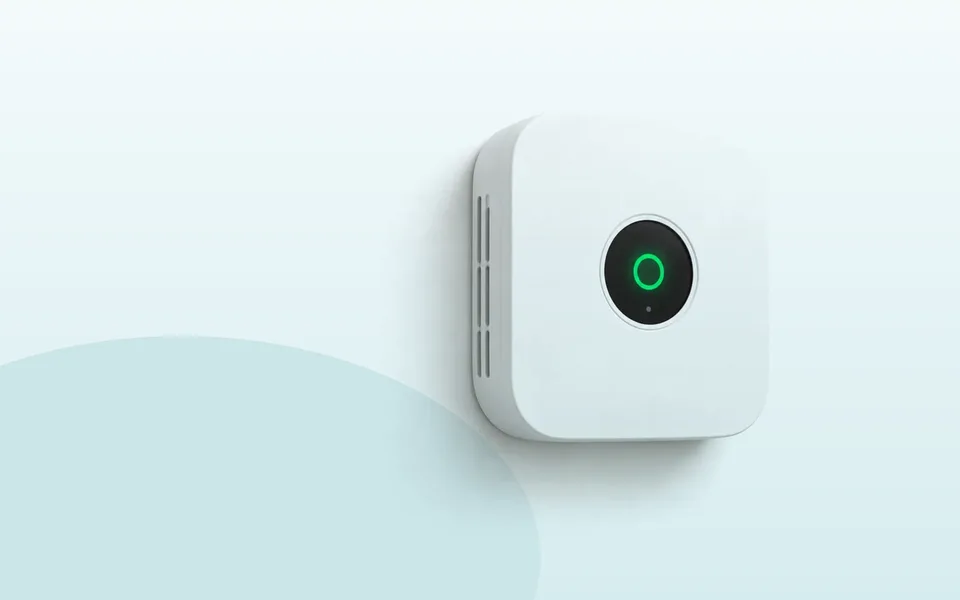
Choose a home air quality monitor with a true NDIR carbon dioxide (CO₂) sensor, a laser PM2.5 sensor that also reports humidity, and temperature and humidity readings. Treat "eCO₂" and TVOC numbers as rough indicators only. Then place it where you breathe, away from windows, stoves and AC vents, and judge readings against Indian indoor targets.
Key points
- CO₂ tells you whether a room gets enough fresh air. Only an NDIR (infrared) sensor measures it; "eCO₂" is an estimate from other gases.
- A good NDIR sensor, such as Sensirion's SCD40, is specified at ±(50 ppm + 5% of reading): ±100 ppm at 1,000 ppm.
- Low-cost laser PM sensors read high, especially in humid air: about 40% high on average in a large US EPA study before correction.
- TVOC on home monitors is usually a relative index, not a concentration you can compare with a standard.
- Indoor targets used in India: CO₂ under about 775–955 ppm (outdoor +350 to +530), PM2.5 under 15–25 µg/m³, humidity 30–60%.
- A monitor tells you there is a problem. Fixing it takes fresh air, filtration or source control.
What a home monitor should measure
| Reading | What it tells you | Sensor to look for | Priority |
|---|---|---|---|
| CO₂ | Whether people in the room are getting enough fresh air | NDIR (infrared) or photoacoustic NDIR | Essential |
| PM2.5 | Fine particles from outside, cooking, incense, smoke | Laser scattering, with humidity correction | Essential |
| Humidity and temperature | Comfort, mould risk, and needed to correct the PM reading | Digital RH/T sensor | Essential |
| PM10 | Coarse dust | Same laser sensor (estimated) | Useful |
| TVOC | Spikes from cleaning, paint, new furniture, cooking | Metal-oxide (MOX) sensor, shown as an index | Indicator only |
| Formaldehyde, CO, NO₂ | Specific gases | Electrochemical cells; check the spec | Only if you have a reason |
If you can only measure two things, measure CO₂ and PM2.5. They answer the two questions most Indian homes have: is there enough fresh air, and is the air coming in clean? Our guide to PM2.5 vs PM10 explains why the fine particles matter more.
CO₂: NDIR sensor vs "eCO₂"
This is the most common trap in cheap monitors. An NDIR sensor shines infrared light through a small chamber; CO₂ absorbs part of it, and the loss gives the concentration. It responds to CO₂ and little else.
An "eCO₂" or "CO₂eq" reading comes from a metal-oxide gas sensor. Sensirion's datasheet for its SGP30, a widely used chip of this kind, says plainly that its TVOC and CO₂eq signals "are calculated from Ethanol and H2 measurements" using conversion and baseline algorithms. It never measures CO₂. It will jump when you spray deodorant or fry onions, and it cannot reliably tell you whether a closed bedroom is short of fresh air.
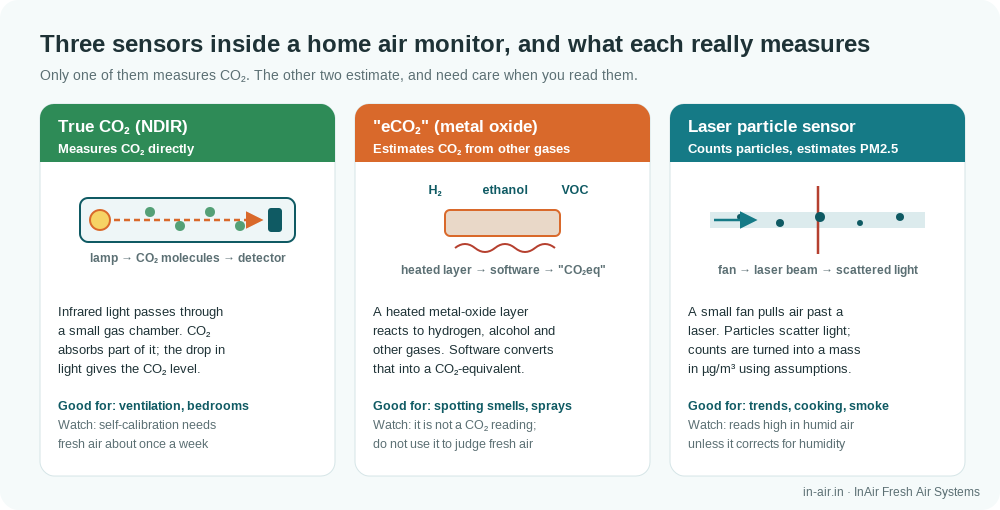
How accurate is a good NDIR sensor? Sensirion's SCD40 is specified at ±(50 ppm + 5% of reading) between 400 and 2,000 ppm. At 1,000 ppm that is ±100 ppm, plenty to tell a ventilated room from a stuffy one. Look for the sensor type and its accuracy in the specification. If a seller can't name either, assume it is an estimate.
CO₂ is a gauge of ventilation, not a poison at home levels. A room near 1,000 ppm is getting about 21 m³/h of fresh air per person. See bedroom CO₂ levels and sleep for what overnight readings mean.
PM2.5: laser sensors and the humidity problem
Almost every home monitor uses a laser particle sensor. A fan draws air past a laser, particles scatter light, and the device converts counts into a mass in µg/m³. That conversion assumes things about particle size and density that are not always true.
Humidity is the big one for India. A US EPA team compared PurpleAir sensors, which use this type of laser sensor, with reference monitors across 16 states. Raw readings overestimated PM2.5 by about 40%, and the overestimate grew as relative humidity rose from 30% to 80%. Adding a humidity term to the correction removed much of the error. In a Mumbai or Kochi monsoon, an uncorrected sensor can read well above the true value.
- Prefer a monitor that measures humidity and states that its PM reading is humidity-corrected.
- Use the PM number for trends and spikes in your own home: before and after cooking, windows open or shut, purifier on or off.
- Do not expect it to match the nearest CPCB station exactly. Station AQI uses 24-hour averages and reference instruments; see Indian AQI explained.
TVOC: useful for spikes, not for numbers
TVOC (total volatile organic compounds) sensors in home monitors are metal-oxide sensors, like the eCO₂ chip. Many now report a relative index rather than a concentration. Sensirion's VOC Index, for example, is referenced to the average of the last 24 hours in that room, with 100 meaning "typical" for that room; its own guidance says the scale does not represent absolute concentrations.
That makes TVOC good for spotting events, such as floor cleaning, a new sofa, paint or a gas leak smell, and poor for comparing against a standard. The IGBC indoor TVOC classes (500, 650 and 800 µg/m³) are lab-measured concentrations. A home monitor's TVOC number cannot be checked against them.
Calibration: what to check before you trust it
- CO₂ self-calibration. Most NDIR sensors re-zero themselves by assuming they see outdoor air at some point. Sensirion's SCD4x needs air at about 400 ppm at least weekly for this to work. Air the room fully, or take the monitor outside for a while, once a week.
- Warm-up. Metal-oxide gas sensors need time to settle: Sensirion's SGP30 needs 24 hours after switch-on to meet its specification. Ignore the first day's VOC readings.
- Side-by-side check. If you have two monitors, place them together for a day. Big, steady differences point to a faulty or uncalibrated unit.
- Outdoor sense check for PM. On a dry, stable day, readings outdoors should move up and down with the nearest CPCB station, even if the numbers differ.
Where to put it
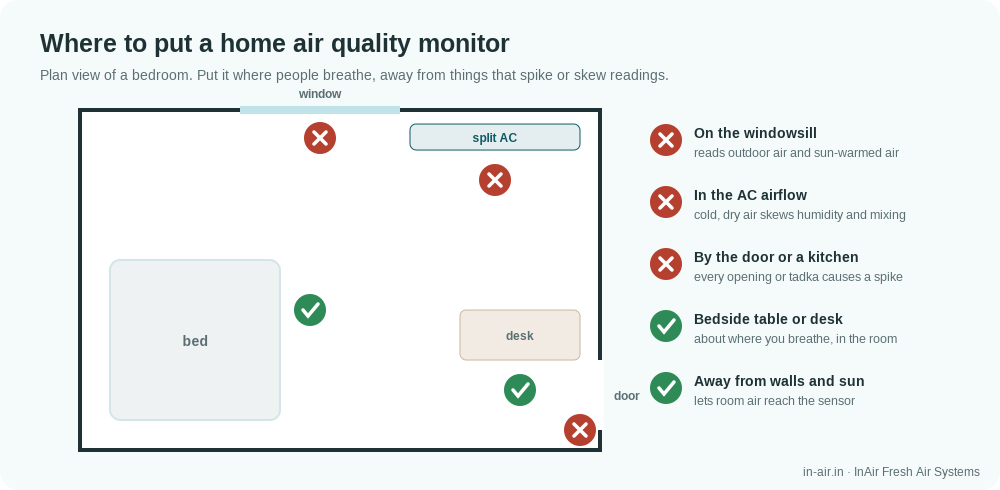
One monitor per main room is ideal; if you have one, start in the bedroom, where people spend eight hours with the door shut. Move it to the living room or a child's study later to compare.
What the readings mean
India has no legal indoor air standard, so buildings are designed to ISHRAE and IGBC classes. These are the targets to compare against; the full table is in indoor air quality standards in India.
| Reading | Good (Class A) | Acceptable (Class B) | Minimum (Class C) | What to do if higher |
|---|---|---|---|---|
| CO₂ (outdoor about 425 ppm) | below about 775 ppm | below about 865 ppm | below about 955 ppm | More fresh air per person |
| PM2.5 | 15 µg/m³ | 20 µg/m³ | 25 µg/m³ | Filter the incoming air; find indoor sources |
| PM10 | 50 µg/m³ | 75 µg/m³ | 100 µg/m³ | Dust control, filtration |
| Relative humidity (US EPA, not IGBC) | 30–50% ideal | below 60% | – | Exhaust at the source, dehumidify |
Readings that stay high tell you what to fix. High CO₂ with low PM2.5 means the room needs more fresh air. High PM2.5 with low CO₂ usually means the air coming in is not filtered, or something indoors is burning. High humidity in the monsoon points to exhaust and dehumidification. A demand-controlled ventilation system uses the same readings to adjust fresh air automatically.
InAir IAQ sensors
InAir's IAQ sensors and smart ventilation controls are built to drive a ventilation system, not just display numbers. The INA-SENSOR measures PM2.5 by laser particle counting, plus temperature, humidity and VOC, with Wi-Fi and an Android and iOS app. The INA-THE-SENSOR adds a thermostat controller (22–28 °C) and is required for InAir's heat pump ERV units. Both can work with motorised dampers and building management systems for room-level or zone-level demand-controlled ventilation. InAir confirms which sensor suits your system at the survey.
How InAir checks this at the site survey
- Which rooms matter most: bedrooms, a home office, a child's study.
- How fresh air will reach each of those rooms, and whether a sensor should control it.
- Indoor sources the monitor will pick up: kitchen, prayer room, bathroom without an exhaust.
- Whether you need a display-only monitor or a sensor wired into the ERV and dampers.
- Sensor locations away from supply diffusers, windows and direct sun.
What it costs
InAir's indoor air quality sensor (PM2.5, temperature, humidity and VOC, with a Wi-Fi app) and thermostat controller start from ₹53,100, before GST and installation. It is part of a ventilation system, so it is quoted with the system after the survey.
Tentative pricing: actual prices may vary based on the site survey.
Common mistakes
- Buying on the eCO₂ number and believing the room is well ventilated.
- Reading TVOC as a concentration and panicking over a meaningless figure.
- Placing the monitor on the windowsill, in the AC stream, or next to the stove.
- Never airing the room, so the CO₂ sensor's self-calibration drifts.
- Trusting monsoon PM2.5 readings from a sensor with no humidity correction.
- Buying a monitor and stopping there. It shows the problem; ventilation and filtration fix it.
Sources
- Sensirion, SGP30 datasheet (TVOC and CO₂eq calculated from ethanol and H₂ signals). PDF
- Sensirion, Transition Guide SGP30 to SGP40 (2020): switch-on time and VOC Index output. PDF
- Sensirion, SCD4x datasheet v1.5 (July 2023): photoacoustic NDIR accuracy and self-calibration. PDF
- Barkjohn, Gantt and Clements (2021), US-wide correction for PurpleAir PM2.5 data, Atmospheric Measurement Techniques. doi:10.5194/amt-14-4617-2021
- Sensirion, SGP40 VOC Index for Experts (2020): VOC Index relative to the last 24 hours. PDF
- IGBC Health and Well-being Rating System (indoor classes from ISHRAE 10001). igbc.in
- US EPA, A Brief Guide to Mold, Moisture and Your Home (humidity 30–50%, below 60%). epa.gov
Which air quality monitor is best for home use in India?
Is eCO₂ the same as CO₂?
How accurate are cheap PM2.5 monitors?
What CO₂ level is good indoors?
Where should I place an air quality monitor?
Does an air quality monitor clean the air?
Our engineers assess your home or building, recommend the right system and the right filter grade for your city, and give you a clear cost estimate. No obligation.