Indoor air quality standards in India: limits for CO₂, PM2.5, TVOC and more
India has no statutory standard for indoor air. Here are the limits Indian buildings are designed to, from ISHRAE, IGBC and GRIHA, alongside WHO and CPCB, in one table.
Last updated:
India has no statutory standard for indoor air. In 2022 the Environment Ministry told the National Green Tribunal that indoor norms exist only through the building code, and the Tribunal asked the Central Pollution Control Board to frame standards for public places; we have found none notified since. In practice, Indian buildings are designed and rated against ISHRAE Standard 10001 and the green building systems that use it, IGBC and GRIHA, with the WHO guidelines and CPCB outdoor standards as reference points. This page puts their limits in one table.
The limits in one table
| Pollutant | IGBC Class A / B / C (from ISHRAE 10001:2016) | WHO guideline | CPCB outdoor standard |
|---|---|---|---|
| CO₂ | Outdoor +350 / +440 / +530 ppm | None | None |
| PM2.5 | 15 / 20 / 25 µg/m³ | 15 (24 h), 5 (annual) | 60 (24 h), 40 (annual) |
| PM10 | 50 / 75 / 100 µg/m³ | 45 (24 h), 15 (annual) | 100 (24 h), 60 (annual) |
| TVOC | 500 / 650 / 800 µg/m³ | None | None |
| Formaldehyde | 30 / 100 µg/m³ (A / B) | 100 µg/m³ (30 min) | None |
| Carbon monoxide | 2 / 6 / 9 ppm | 4 mg/m³ (24 h); 10 mg/m³ (8 h) | 2 mg/m³ (8 h), 4 mg/m³ (1 h) |
| Nitrogen dioxide | 40 / 80 µg/m³ (A / B) | 25 (24 h), 10 (annual) | 80 (24 h), 40 (annual) |
| Ozone | 50 / 75 / 100 µg/m³ | 100 (8 h) | 100 (8 h), 180 (1 h) |
| Temperature | Summer 24.5 ± 2.5 °C; winter 22 ± 3 °C | – | – |
| Relative humidity | 30–70% | Avoid persistent damp | – |
Class A is the aspirational level, Class B acceptable and Class C the minimum acceptable. IGBC's Health and Well-being rating takes its values from ISHRAE 10001:2016; ISHRAE's own Class A figures match for CO₂, PM2.5, PM10, formaldehyde, CO, NO₂ and ozone, and its Class B and C CO₂ limits are outdoor +500 and +700 ppm. ISHRAE revised the standard in 2019; the 2016 figures are the ones the rating systems cite. The standards do not state averaging times for the indoor classes.
CO₂: what the classes mean in ppm
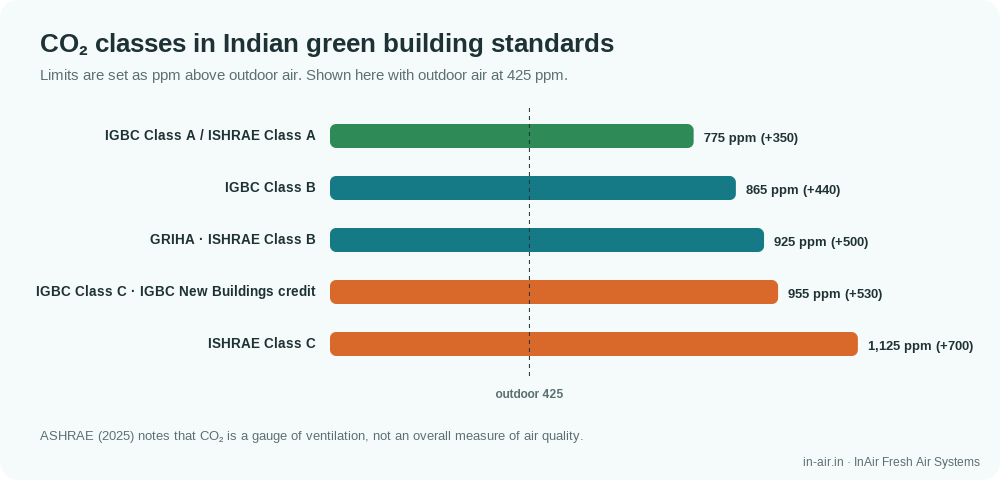
Indian standards set CO₂ as a difference above outdoor air, because outdoor CO₂ varies by place and year. Outdoor air now averages about 425 ppm, so IGBC Class A means staying below about 775 ppm indoors, Class C below about 955 ppm. GRIHA asks for outdoor +500 ppm, and IGBC's New Buildings rating gives a point for keeping the difference within 530 ppm.
CO₂ at these levels is a gauge of ventilation, not a pollutant limit. ASHRAE's 2025 position document says indoor CO₂ is not an overall indicator of air quality, and its ventilation standard 62.1 sets no CO₂ limit; the familiar 700 ppm above outdoor comes from an older body-odour criterion. A room near 1,000 ppm is getting about 21 m³/h of fresh air per person, the figure InAir uses for bedrooms (see bedroom CO₂ and sleep).
PM2.5: why Indian buildings must filter fresh air
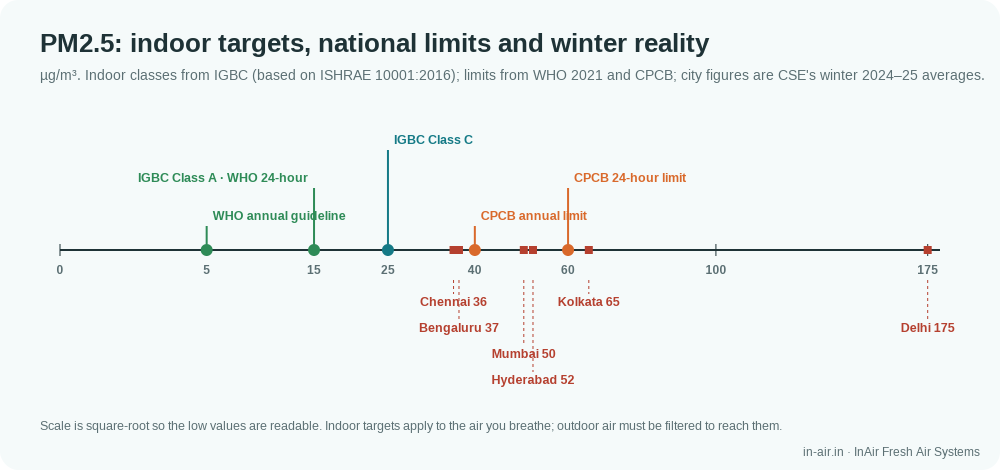
The indoor PM2.5 target of 15–25 µg/m³ sits far below what Indian outdoor air carries in winter. CSE's analysis of CPCB data put the October 2024–January 2025 average at 175 µg/m³ in Delhi, 65 in Kolkata, 52 in Hyderabad, 50 in Mumbai, 37 in Bengaluru and 36 in Chennai. Ventilating with unfiltered air, through windows or exhaust-driven leaks, imports that pollution.
To bring Delhi's winter average down to 15 µg/m³, incoming air has to lose more than 90% of its fine particles; in Hyderabad, about 70%. A MERV-13 filter captures at least 85% of particles of 1–3 µm under ASHRAE 52.2, and a HEPA-13 filter at least 99.95% at its most penetrating size under EN 1822. That is why InAir fits MERV-13 as standard and recommends HEPA-13 for Delhi NCR and the Indo-Gangetic plain. Real indoor levels also depend on how airtight the home is and on indoor sources such as cooking and incense.
TVOC and formaldehyde: new homes and fit-outs
Volatile organic compounds and formaldehyde come mainly from new furniture, plywood and MDF, paints, adhesives and cleaning products. IGBC's New Buildings rating asks for pre-occupancy tests showing TVOC within 500 µg/m³ and formaldehyde within 27 ppb, after a flush-out. GRIHA makes low-VOC, lead-free paint mandatory and requires composite wood free of urea-formaldehyde. WHO's indoor guideline for formaldehyde is 0.1 mg/m³ over 30 minutes.
For a home, the practical rule is to run extra fresh air for the first months after interiors are finished, and to choose low-VOC materials in the first place. See the home ventilation guide for the full list of indoor sources.
Temperature and humidity
IGBC, citing ISHRAE, sets 24.5 ± 2.5 °C in summer and 22 ± 3 °C in winter for air-conditioned spaces, with relative humidity between 30% and 70%. The US EPA advises keeping humidity below 60% to limit mould, ideally 30–50%, and ASHRAE 55 caps humidity at a dew point of about 16.8 °C for comfort. WHO sets no number for damp but says persistent dampness and mould should be avoided. In Indian monsoons the upper limit is the hard one; the city data in our home ventilation guide shows why.
What green building ratings require
| Rating | Indoor air requirements |
|---|---|
| IGBC Green New Buildings v3 | Fresh air to ASHRAE 62.1 (mandatory); CO₂ within 530 ppm of outdoor, with sensors (1 point); pre-occupancy tests: TVOC 500 µg/m³, formaldehyde 27 ppb, PM10 50 µg/m³, CO 9 ppm (2 points) |
| IGBC Health and Well-being | Indoor classes A/B/C for CO₂, PM, TVOC, formaldehyde, CO, NO₂, ozone, SO₂; temperature and humidity bands |
| GRIHA v2019, Criterion 12 | Fresh air meeting CPCB standards; ventilation to ASHRAE 62.1 or NBC 2016; continuous monitoring of CO, CO₂, temperature and humidity against ISHRAE 10001; low-VOC paints mandatory; urea-formaldehyde-free composite wood |
InAir's IAQ sensors monitor CO₂, PM2.5 and humidity and can drive the fresh air rate, as these ratings expect. The Bloomingdale school case study shows a monitored building.
Is there an official indoor air standard in India?
No. CPCB's National Ambient Air Quality Standards (2009) cover outdoor air only. In April 2022 the National Green Tribunal, hearing a petition on indoor air, recorded the Environment Ministry's view that guidelines rather than new standards were feasible for indoor air, and directed a joint committee led by CPCB to frame standards and protocols for public places. We have not found any notified since. Until there is one, ISHRAE 10001, IGBC and GRIHA are the references Indian engineers design to.
Sources
- IGBC Health and Well-being Rating System (pilot), IAQ credits 1 and 2. igbc.in
- IGBC Green New Buildings Rating System v3.0 (fifth addendum), IEQ mandatory requirement 1, credits 1 and 7. igbc.in
- ISHRAE Standard 10001:2016, Indoor Environmental Quality; class values as reported in ISHRAE RP1 research report (MNIT Jaipur, 2018). research.ishrae.in
- GRIHA v2019 Manual, Volume 1, Criterion 12: Indoor Air Quality. grihaindia.org
- Central Pollution Control Board, National Ambient Air Quality Standards, notification of 18 November 2009.
- World Health Organization, WHO global air quality guidelines (2021); WHO guidelines for indoor air quality: selected pollutants (2010); dampness and mould (2009).
- ASHRAE, Position Document on Indoor Carbon Dioxide (revised February 2025).
- US EPA, A Brief Guide to Mold, Moisture and Your Home; Report on the Environment: Indoor Air Quality.
- Centre for Science and Environment, winter 2024–25 air pollution analysis (18 March 2025).
- National Green Tribunal, Raja Singh v. Union of India, O.A. 206/2022, order of 19 April 2022. indiankanoon.org
- ANSI/ASHRAE Standard 52.2 (MERV); EN 1822 / ISO 29463 (HEPA).
Is there an indoor air quality standard in India?
What is a safe CO₂ level indoors in India?
What is the indoor PM2.5 limit?
What are the TVOC and formaldehyde limits for Indian buildings?
What indoor humidity is recommended in India?
Can ventilation alone meet indoor PM2.5 targets in Indian cities?
Our engineers assess your home or building, recommend the right system and the right filter grade for your city, and give you a clear cost estimate. No obligation.