TFA vs ERV: which fresh air unit suits an Indian building?
A TFA cools and dries outdoor air with its own coil; an ERV recovers heat and moisture from the air leaving the building. This guide shows where each one fits.
Last updated:
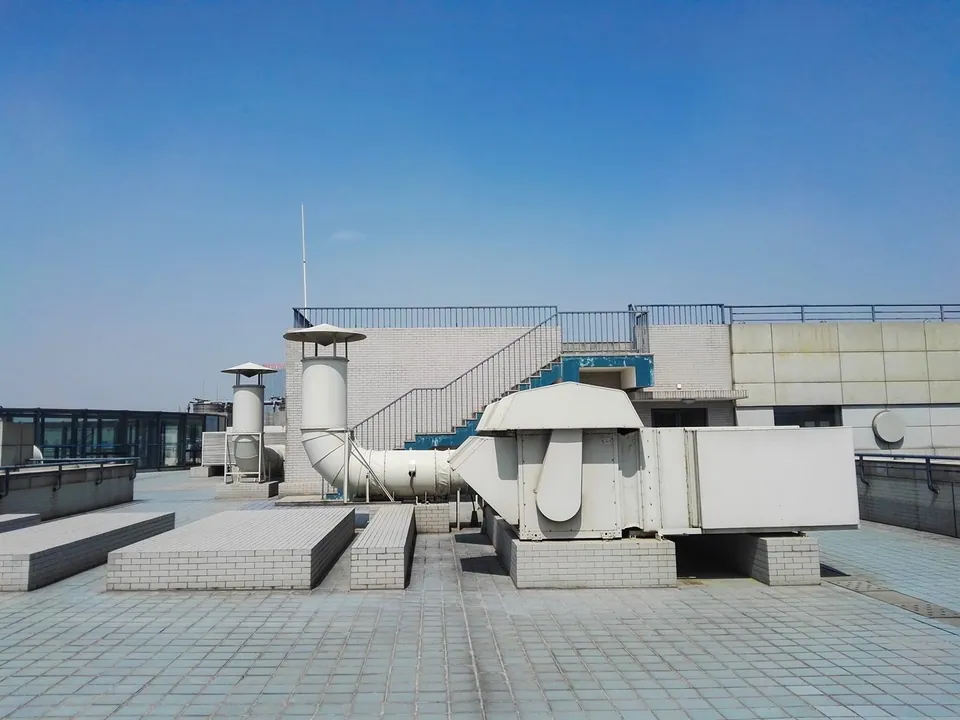
A treated fresh air unit (TFA) and an energy recovery ventilator (ERV) both bring outdoor air into a building, but they treat it in different ways. A TFA is an air handling unit that takes in 100% outdoor air and cools and dries it with its own chilled-water or DX coil. An ERV passes the incoming air through a core that transfers heat and moisture from the stale air being exhausted, so it pre-conditions fresh air without a cooling coil of its own.
How each one works
A TFA is common in Indian offices, hotels and hospitals that already have a chilled-water plant. It filters outdoor air, cools it through a coil and supplies it to the floors or to the indoor units. Most TFAs have no exhaust connection, so the energy in the air leaving the building is lost unless a heat recovery wheel is added.
An ERV has two fans, one for supply and one for exhaust, and a core between them. In summer the outgoing air, cooled by the building's AC, takes heat and moisture out of the hot incoming air before it reaches the rooms. The ERV uses fan power only. The AC or VRF units then handle the rest of the cooling.
A heat pump ERV, such as the InAir RHP range, combines the two: an energy recovery core first, then a DX coil that cools and dries the fresh air further.
Side by side
| TFA | ERV | Heat pump ERV (RHP) | |
|---|---|---|---|
| Cooling coil | Yes (chilled water or DX) | No | Yes (DX) |
| Recovers energy from exhaust air | Only with an added wheel | Yes | Yes |
| Controls humidity of fresh air | Yes | Partly | Yes |
| Needs a chilled-water plant | Chilled-water TFA only | No | No |
| Typical use in India | Large offices, hotels, hospitals | Homes, schools, small offices | Humid cities, villas, clinics, offices |
Which one to choose
For homes, apartments, schools and offices up to a few thousand m³/h of fresh air, an ERV is usually the simpler choice. It needs no chilled water, runs on fan power, and recovers energy from air that would otherwise be thrown away.
In humid coastal cities such as Mumbai, Chennai and Kochi, an ERV alone cannot bring monsoon air down to a comfortable moisture level. There, a heat pump ERV or a TFA with a cooling coil is needed so the fresh air arrives dry.
In large buildings with a central chilled-water plant, a TFA with a heat recovery wheel gives both: cooling from the plant and recovered energy from the exhaust. ASHRAE Standard 90.1 uses energy recovery with at least 50% enthalpy recovery ratio as the baseline for fan systems of 5,000 cfm (2,400 L/s) or more that supply 70% or more outdoor air [1].
Sizing comes first
Whichever unit is chosen, the fresh air quantity comes from the occupancy and floor area of each space under ASHRAE 62.1, or ASHRAE 62.2 for homes [2][3]. The unit is then selected to deliver that airflow at the duct system's pressure.
Sources
- ASHRAE Standard 90.1-2019, Addendum i, Section G3.1.2.10 Exhaust Air Energy Recovery. https://www.ashrae.org/file%20library/technical%20resources/standards%20and%20guidelines/standards%20addenda/90_1_2019_i_20201030.pdf
- ANSI/ASHRAE Standard 62.1, Ventilation and Acceptable Indoor Air Quality. https://www.ashrae.org/technical-resources/bookstore/standards-62-1-62-2
- ANSI/ASHRAE Standard 62.2, Ventilation and Acceptable Indoor Air Quality in Residential Buildings. https://www.ashrae.org/technical-resources/bookstore/standards-62-1-62-2
What is a TFA unit in HVAC?
Is an ERV better than a TFA?
Can a TFA recover energy from exhaust air?
Which unit does InAir recommend for a humid city?
Our engineers assess your home or building, recommend the right system and the right filter grade for your city, and give you a clear cost estimate. No obligation.