How to choose an exhaust fan in India: size, type, noise and duct
The right exhaust fan moves enough air through your duct, quietly, to the outside. Five checks get you there: airflow, pressure, fan type, noise and motor.
Last updated:
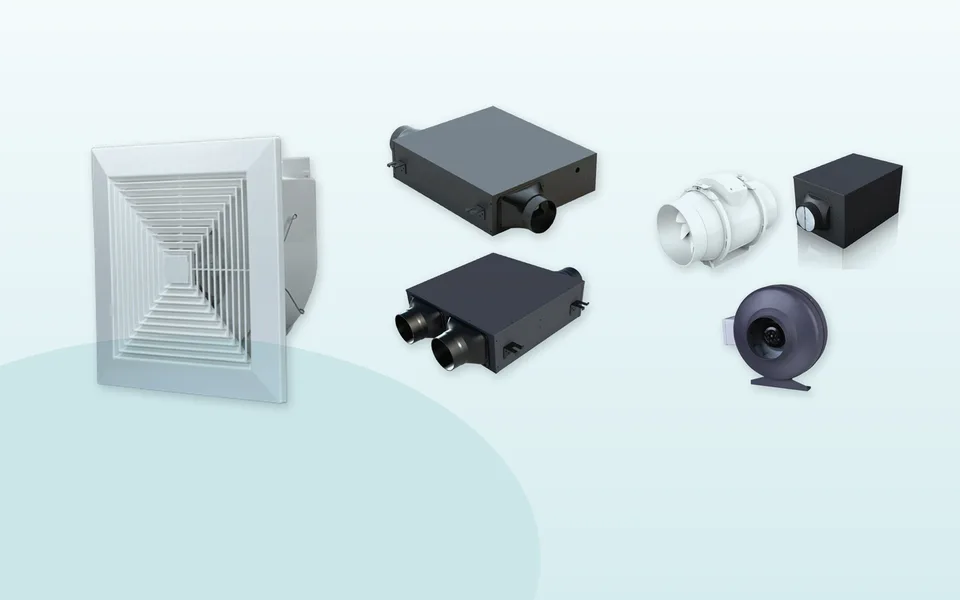
The right exhaust fan for an Indian bathroom or kitchen is the one that moves enough air through your duct, quietly, to the outside. That comes down to five checks: the airflow the room needs, the pressure your duct adds, the type of fan for that duct, the noise, and the motor. This guide takes them in order, with the published rates behind each number. The air changes and exhaust fan size calculator does the sums for your room.
The five checks
- Airflow: at least 85 m³/h (50 cfm) for a bathroom, 170 m³/h (100 cfm) for a kitchen hood, or the room's NBC air changes, whichever is higher.
- Pressure: pick the fan at the pressure of your duct, not its free-air rating.
- Type: wall fans for through-the-wall, ceiling or inline fans once there is a duct.
- Noise: continuous fans should be about 1 sone or quieter; occasional-use fans no more than 3 sones (ASHRAE 62.2).
- Motor: an EC (BLDC) motor gives speed control and uses less power than a plain AC motor.
1. How much air the room needs
India's National Building Code recommends 6–10 air changes per hour for toilets and bathrooms, 15–20 for shower rooms and at least 6 for kitchens. ASHRAE 62.2, the standard InAir uses as a minimum for homes, adds fan floors: 50 cfm (85 m³/h) for a bathroom fan used when needed, and 100 cfm (170 m³/h) for a ducted kitchen hood. Take whichever is larger.
| Room | Size | Volume | NBC air changes | By air changes | Choose at least |
|---|---|---|---|---|---|
| Small toilet | 1.5 × 1.2 × 2.7 m | 4.9 m³ | 8 | 39 m³/h | 85 m³/h |
| Standard bathroom | 2.4 × 1.5 × 2.7 m | 9.7 m³ | 8 | 78 m³/h | 85 m³/h |
| Large bathroom with shower | 3.0 × 2.0 × 2.8 m | 16.8 m³ | 10 | 168 m³/h | 168 m³/h |
| Home kitchen (fan) | 3.0 × 2.5 × 2.8 m | 21.0 m³ | 6 | 126 m³/h | 170 m³/h |
Bedrooms are different: they need fresh air for the people in them, not an exhaust fan. See air changes per hour by room and exhaust fan vs fresh air system.
2. The number on the box is not what you get
Fan airflow is rated at zero resistance, blowing into open air. As soon as you add a duct, a bend, a grille or a rain cowl, the fan has to push against pressure, and the airflow falls. The fall can be large: a fan rated at 200 m³/h can deliver about half that, or less, through a long, narrow duct with bends.
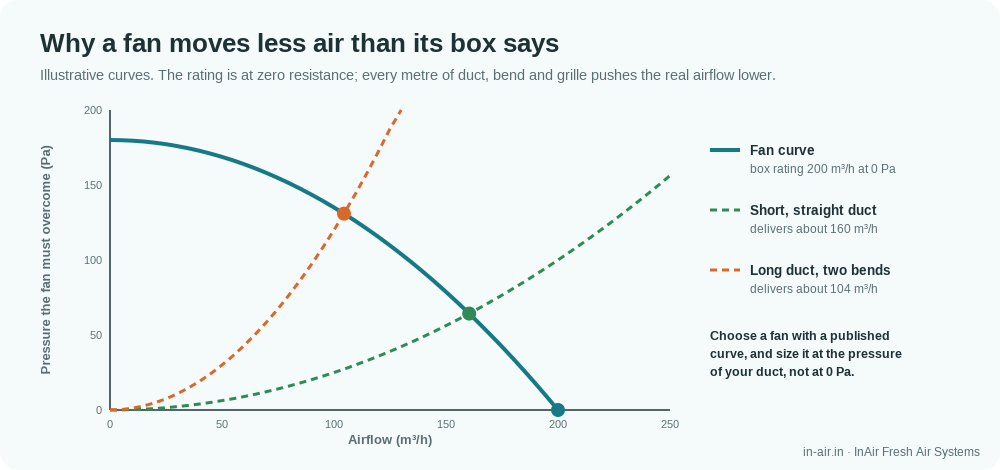
So ask for the fan's performance curve, or at least its airflow at a stated pressure, and choose it at the pressure your duct will add. InAir's inline fans, for example, are published with static pressure up to 382 Pa, which is what lets them push air through longer ducts. If the seller cannot give you a curve, the box rating is the best case, not the likely case.
3. Wall, ceiling, inline or centrifugal?
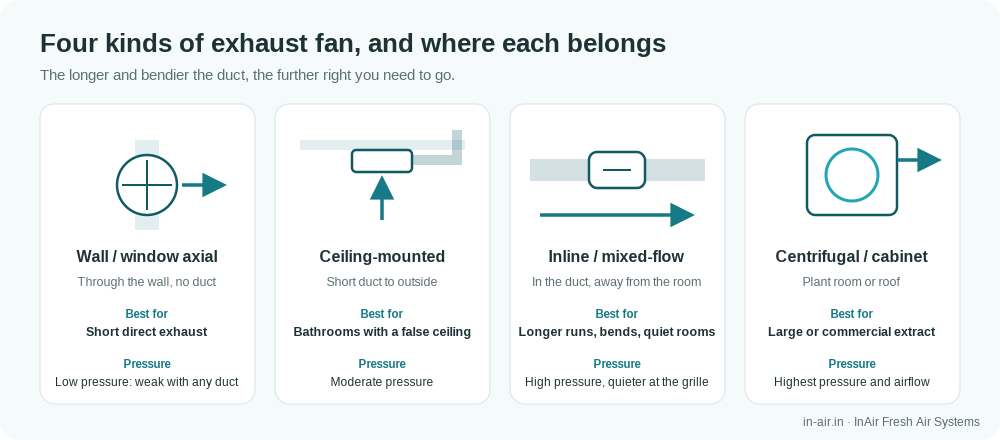
| Fan type | Use it when | Watch out for |
|---|---|---|
| Wall / window axial | The bathroom or kitchen has an outside wall and no duct | Loses most of its airflow with any duct; can be noisy |
| Ceiling-mounted | There is a false ceiling and a short duct to the outside | Check the airflow at the duct's pressure |
| Inline or mixed-flow | The duct is long, has bends, or serves two rooms; or you want it quiet | Needs access for servicing in the ceiling |
| Centrifugal / cabinet | Large toilets blocks, commercial kitchens, car parks | Sized by an engineer for the system |
InAir's toilet exhaust fans, inline and silent duct fans, mixed-flow, direct duct and circular fans and EC inline fans cover each of these.
4. The duct: size, route and outlet
A fan only performs if the duct is large enough and short enough. ASHRAE 62.2 gives minimum round duct sizes for short runs (under about 8 m, with no more than three bends):
| Fan airflow | Minimum round duct (rigid) |
|---|---|
| Up to 85 m³/h (50 cfm) | 100 mm (4 in) |
| Up to 170 m³/h (100 cfm) | 125 mm (5 in) |
| Up to 255 m³/h (150 cfm) | 150 mm (6 in) |
| Up to 340 m³/h (200 cfm) | 180 mm (7 in) |
- Use flexible duct one size larger, and pull it straight; sags and kinks add resistance.
- Always discharge outside the building, never into the false ceiling, a loft or an enclosed shaft next to a window or fresh air intake.
- Fit a backdraft shutter so outdoor air, rain and insects do not come back in when the fan is off.
- Seal duct joints; a leaking duct in a false ceiling just moves damp air into the ceiling.
5. Noise: sones and decibels
ASHRAE 62.2 limits fans that run continuously to 1.0 sone and fans used occasionally to 3 sones. A sone is a measure of perceived loudness: two sones sound twice as loud as one. Indian catalogues more often quote dB(A), measured at a stated distance. InAir's inline fans are rated from 21 to 45 dB(A) depending on model and speed. Putting the fan inline, in the duct away from the grille, is the simplest way to make a bathroom quieter.
6. Motor and running cost
Most budget exhaust fans use a plain AC motor at a fixed speed. EC (electronically commutated) motors, often sold as BLDC, run more efficiently and can be slowed down, so a fan can run gently all the time and boost when the room is in use. InAir's EC inline fans add a ten-speed control and an optional humidity sensor.
Running cost is small either way. A home exhaust fan draws in the tens of watts. A 30 W fan running four hours a day uses about 44 units a year, roughly ₹350 at ₹8 a unit; tariffs vary by state. Choosing an efficient, quiet fan matters more for comfort than for the bill.
7. Let air in so the fan can pull air out
A fan cannot remove air from a sealed room. Replacement air has to come in, usually under the door. The UK's ventilation rules ask for a door undercut equivalent to 10 mm on a standard 760 mm door; a louvred door or transfer grille does the same job. In the monsoon, that replacement air is humid, which is one more reason to run the fan only as long as needed, or on a humidity sensor.
What it costs
As a guide, InAir bathroom and toilet exhaust fans start from ₹3,300, mixed-flow inline fans from ₹6,600 and EC inline fans with speed or smart control from ₹15,000, before GST and installation. Pricing lists the range.
Tentative pricing: actual prices may vary based on the site survey.
Common mistakes
- Buying by the box airflow and then fitting a long, thin flexible duct.
- Venting into the false ceiling or a closed shaft.
- A sealed door with no undercut, so the fan just roars.
- Using one big kitchen fan instead of a ducted hood over the hob.
- Expecting a bathroom fan to ventilate the bedroom next to it.
Sources
- Bureau of Indian Standards, National Building Code of India, Part 8, Section 1: recommended air changes. SP 7:2005; reproduced for NBC 2016 in CSIR, Guidelines on Ventilation (2022).
- ASHRAE 62.2-2022 Addendum e: local exhaust rates and fan sound limits. ashrae.org
- ASHRAE 62.2-2016 Addendum u: Table 5.3, duct sizing. ashrae.org
- UK Approved Document F, Volume 1 (2021): door undercuts. gov.uk
- InAir product pages and price list (FY 2026–27).
What size exhaust fan do I need for a bathroom in India?
Which is better for a bathroom: a wall fan or an inline fan?
Why does my exhaust fan not clear the steam?
How many watts does an exhaust fan use?
Are BLDC exhaust fans worth it?
What does an InAir exhaust fan cost?
Our engineers assess your home or building, recommend the right system and the right filter grade for your city, and give you a clear cost estimate. No obligation.