Air changes per hour by room: NBC India and ASHRAE rates for toilets, kitchens and bedrooms
Toilets, kitchens and utility rooms need a set number of air changes an hour. Bedrooms need fresh air per person instead. Here are the published rates, the formula and the duct sizes.
Last updated:
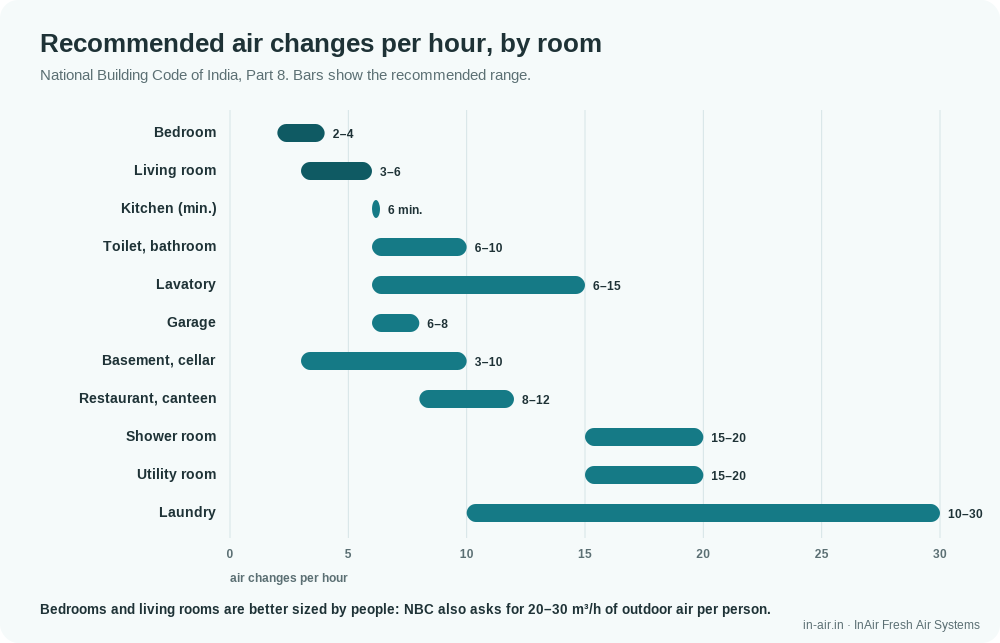
Air changes per hour (ACH or ACPH) is the number of times a room's whole volume of air is replaced in an hour. For toilets, kitchens and utility rooms in India, the National Building Code recommends 6 to 20 air changes an hour depending on the room. Bedrooms and living rooms are better sized by the number of people in them. This page sets out the published rates, how to use them and where they go wrong. The air changes and exhaust fan size calculator does the arithmetic for your room.
The formula
Airflow (m³/h) = room volume (m³) × air changes per hour. Room volume is length × width × height in metres. To convert: 1 cfm = 1.699 m³/h, and 1 litre per second = 3.6 m³/h.
Example: a toilet of 2.4 m × 1.5 m with a 2.7 m ceiling holds 9.7 m³. At 8 air changes an hour it needs 9.7 × 8 = 78 m³/h. ASHRAE 62.2 sets a minimum of 50 cfm (85 m³/h) for a bathroom fan used intermittently, so choose at least 85 m³/h.
Recommended air changes by room (NBC India)
| Room | NBC air changes per hour | Notes |
|---|---|---|
| Bedroom | 2–4 | Better sized by people: 20–30 m³/h per person |
| Living room | 3–6 | As above |
| Kitchen (home) | 6 minimum | Plus a ducted hood over the hob |
| Toilet, bathroom | 6–10 | |
| Lavatory (public) | 6–15 | |
| Shower room | 15–20 | High moisture |
| Utility room | 15–20 | Washing machine, drying |
| Laundry | 10–30 | Commercial laundries at the top of the range |
| Basement, cellar | 3–10 | NBC allows 50% more below ground |
| Garage (private) | 6–8 | Basement car parks follow fire rules |
| Restaurant, canteen | 8–12 | Commercial kitchens are sized by appliance load |
| Gymnasium | 6 minimum | |
| Factory, workshop | 8–10 | Fume sources need local extraction |
Source: National Building Code of India, Part 8, Section 1, table of recommended air changes, as printed in SP 7:2005 and reproduced for NBC 2016 in CSIR's 2022 ventilation guidelines. The NBC notes the rates can be raised by half where a room is below ground or heavily used.
Minimum fan rates (ASHRAE 62.2 and 62.1)
Air change rates give a target. Fan minimums make sure a small room still gets a fan that clears it quickly. India has no separate residential fan standard, so InAir checks every room against ASHRAE 62.2, the US standard for homes, and ASHRAE 62.1 for other buildings.
| Room | When in use (intermittent) | Running continuously |
|---|---|---|
| Bathroom or toilet (home) | 50 cfm (85 m³/h) | 20 cfm (34 m³/h) |
| Kitchen, ducted hood | 100 cfm (170 m³/h) | – |
| Enclosed kitchen, no hood | 300 cfm (510 m³/h) | 5 air changes per hour |
| Private toilet (other buildings) | 50 cfm (85 m³/h) | 25 cfm (42 m³/h) |
| Public toilet, per WC or urinal | – | 50 cfm (85 m³/h); 70 cfm for heavy use |
| Shower room, per showerhead | 50 cfm (85 m³/h) | 20 cfm (34 m³/h) |
| Commercial kitchen | – | 0.70 cfm per sq ft (12.8 m³/h per m²) |
| Janitor, trash rooms | – | 1.0 cfm per sq ft (18 m³/h per m²) |
Sources: ASHRAE 62.2-2022 Addendum e, Tables 5-1 and 5-2; ASHRAE 62.1-2022 Addendum x, Table 6-2. For comparison, the UK's Approved Document F (2021) asks for 15 l/s (54 m³/h) from a bathroom fan and 30 l/s (108 m³/h) from a kitchen hood ducted outside.
Why bedrooms should not be sized by air changes
Some guides size bedroom fresh air at 6–8 air changes per hour. That number belongs to toilets and kitchens, where smells and steam must be cleared quickly. In a bedroom, what builds up is the CO₂ and moisture people breathe out, so the fresh air needed depends on how many people are in it, not on the size of the room.
A resting adult breathes out about 12 litres of CO₂ an hour. With outdoor air at about 425 ppm, holding a bedroom near 1,000 ppm takes about 21 m³/h of outdoor air per person, and about 32 m³/h per person for 800 ppm. That sits inside the NBC's 20–30 m³/h per person.
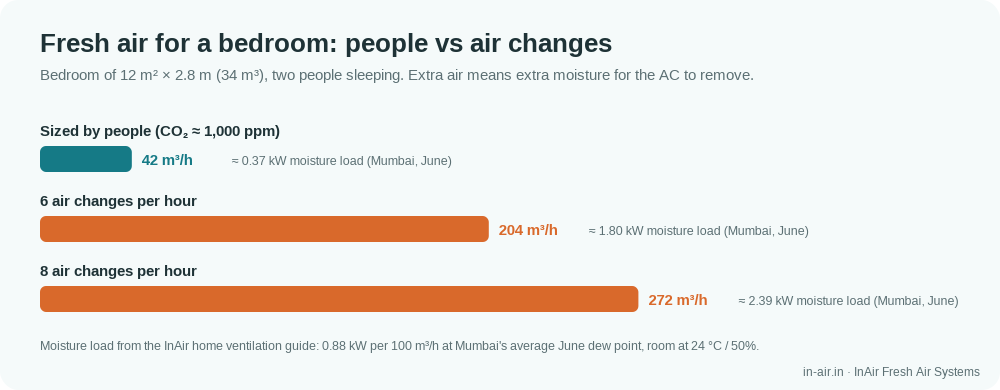
Bringing in more air than the room needs is not harmless in India. In the monsoon, every extra 100 m³/h of untreated outdoor air in Mumbai adds about 0.88 kW of moisture for the AC to remove (see the home ventilation guide). Sizing by people, with energy recovery, keeps the air fresh without that penalty. Bedroom CO₂ and sleep explains why the CO₂ target matters.
Duct size for the airflow
A fan only delivers its airflow if the duct is large enough. Size the duct so the air moves at a modest speed: about 3 m/s in short branch ducts for quiet running, up to about 5 m/s in a main duct. ASHRAE 62.2 gives minimum round duct sizes for small fans on runs under 8 m with no more than three bends:
| Fan airflow | Minimum round duct (rigid) |
|---|---|
| Up to 50 cfm (85 m³/h) | 100 mm (4 in) |
| Up to 100 cfm (170 m³/h) | 125 mm (5 in) |
| Up to 150 cfm (255 m³/h) | 150 mm (6 in) |
| Up to 200 cfm (340 m³/h) | 180 mm (7 in) |
| Up to 250 cfm (425 m³/h) | 205 mm (8 in) |
| Up to 450 cfm (765 m³/h) | 255 mm (10 in) |
| Up to 800 cfm (1,360 m³/h) | 305 mm (12 in) |
Flexible duct needs one size larger from 100 cfm upwards. Source: ASHRAE 62.2-2016 Addendum u, Table 5.3.
Three worked examples
- Toilet, 2.4 × 1.5 × 2.7 m: 9.7 m³ × 8 = 78 m³/h. ASHRAE minimum 85 m³/h. Choose a fan of about 85–120 m³/h on a 100 mm duct.
- Home kitchen, 3.0 × 2.5 × 2.8 m: 21 m³ × 6 = 126 m³/h. A ducted hood of at least 170 m³/h covers the hob; without a hood, size the wall or inline fan to at least 6 air changes and run it whenever cooking.
- Bedroom, two people: 2 × 21 = 42 m³/h of filtered outdoor air, about 1.2 air changes in a 34 m³ room. Supplied through an ERV, it keeps CO₂ near 1,000 ppm overnight without loading the AC.
Common mistakes
- Sizing the fan but not the duct, so a 150 m³/h fan delivers half that through a long 100 mm flexible pipe.
- Running a bathroom fan with no gap under the door, so it cannot pull air in.
- Using air changes for bedrooms and over-ventilating them.
- Using an exhaust fan to ventilate a bedroom. It pulls in unfiltered air through gaps; see exhaust fan vs fresh air system.
- Discharging bathroom exhaust into a shaft next to a fresh air intake.
Sources
- Bureau of Indian Standards, National Building Code of India, Part 8, Section 1: recommended air changes and fresh air per person. SP 7:2005
- CSIR, Guidelines on Ventilation v2.0 (2022), Table 1, reproducing NBC 2016 rates. niti.gov.in
- ASHRAE 62.2-2022 Addendum e, Tables 5-1 and 5-2. ashrae.org
- ASHRAE 62.1-2022 Addendum x, Table 6-2. ashrae.org
- ASHRAE 62.2-2016 Addendum u, Table 5.3, duct sizing. ashrae.org
- UK Approved Document F, Volume 1: Dwellings (2021), Tables 1.1 and 1.2. gov.uk
- IS 3103:1975, Code of practice for industrial ventilation. law.resource.org
How many air changes per hour does a toilet need in India?
How many air changes per hour does a kitchen need?
How many air changes per hour does a bedroom need?
How do I convert air changes per hour to m³/h or cfm?
Is 6–8 air changes per hour right for a bedroom?
Our engineers assess your home or building, recommend the right system and the right filter grade for your city, and give you a clear cost estimate. No obligation.