Why is my indoor air polluted even with the windows closed?
Shutting the windows feels like protection. It slows what comes in, but traps what you make inside. Here is what builds up, why, and what actually fixes it.
Last updated:
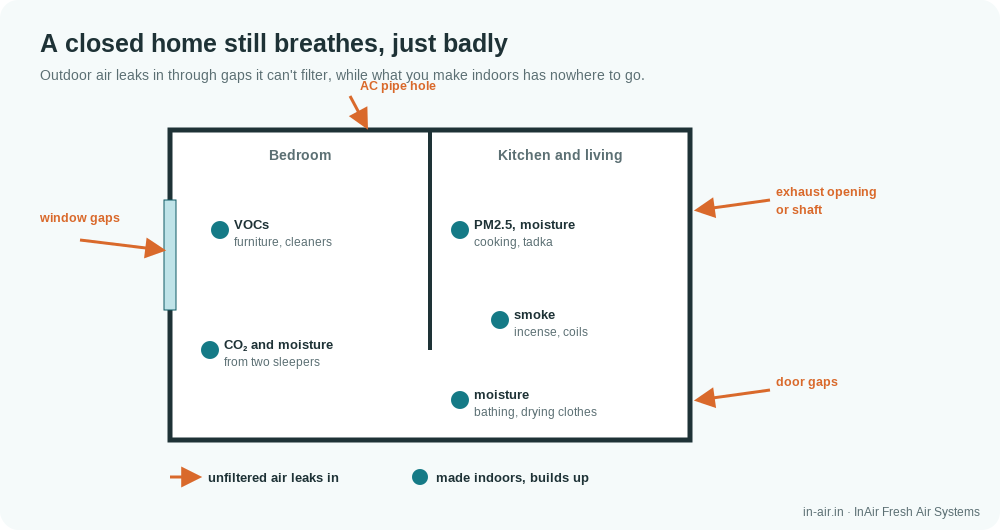
Closing the windows slows how fast outdoor air gets in, but it does not seal the house. Fine dust still leaks in through gaps, unfiltered. Meanwhile everything made indoors, such as CO₂ from breathing, cooking smoke, VOCs from furniture and cleaners, and moisture, has far less fresh air to dilute it. So it builds up.
Key points
- Outdoor PM2.5 enters through window frames, door gaps, AC pipe holes and exhaust openings, with no filter in the way.
- A study of thousands of Delhi homes in winter found indoor PM2.5 more than 20 times WHO levels, and higher than at the nearest outdoor monitor.
- US EPA studies found common organic pollutants 2 to 5 times higher inside homes than outside.
- Two people in a closed bedroom with little leakage can push CO₂ to around 3,680 ppm by morning (calculated).
- The fix is filtered fresh air plus control at the source, not just keeping windows shut or running a purifier.
Why closing windows does not keep pollution out
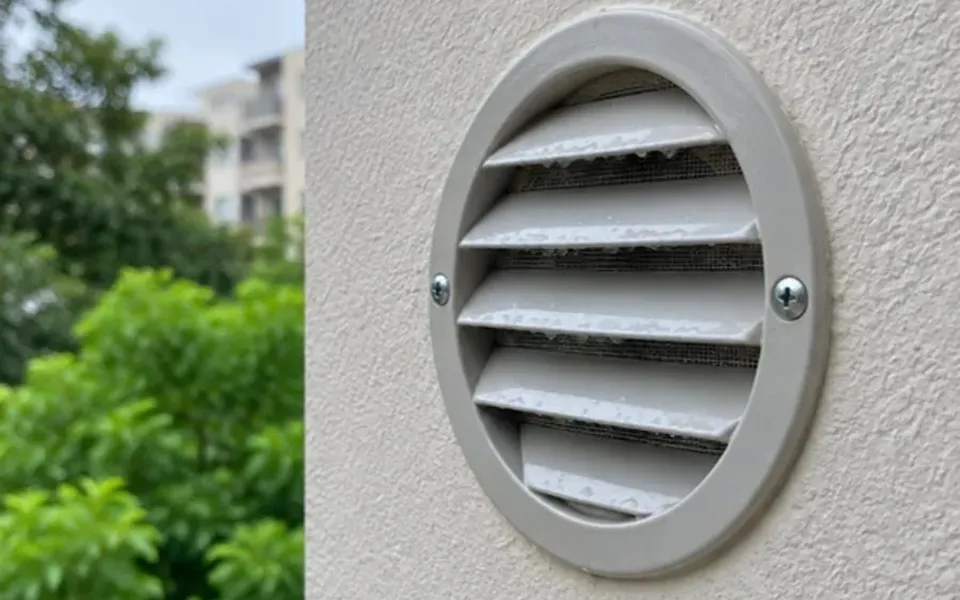
Every home leaks. Air moves in and out through gaps around window frames and doors, holes cut for AC pipes, kitchen and bathroom exhaust openings, and service shafts. The EPA lists the things that decide indoor particle levels: outdoor levels, infiltration, the type of ventilation and filtration, indoor sources, and what the occupants do. With windows shut, outdoor air still comes in. It just comes in slowly and without any filter.
Slow leakage cuts both ways. It brings in less pollution per hour than an open window. But it also takes out less of what you make inside. Over a day, a home with heavy indoor sources and low leakage can end up dirtier than the air outside.
This is not theory. Researchers placed indoor monitors in thousands of Delhi homes across income groups during the 2019–20 winter. Indoor PM2.5 was more than 20 times the WHO standard and significantly higher than the levels reported by the nearest outdoor government monitor.
Which pollutants build up, and where they come from
| Pollutant | Main sources with windows shut | What happens | What fixes it |
|---|---|---|---|
| PM2.5 | Leaks from outside; frying and tadka, incense, mosquito coils, candles | Rises with each cooking or burning event and stays for hours | Filtered fresh air; kitchen hood vented outside; purifier as a top-up |
| CO₂ | People breathing | Rises steadily while the room is occupied | Fresh air: about 21 m³/h per person keeps it near 1,000 ppm |
| VOCs | New furniture and boards, paints, cleaners, air fresheners, cosmetics | Accumulate; EPA studies found them 2–5 times higher indoors | Fresh air; choose low-emission products; ventilate during cleaning |
| Moisture | Breathing, cooking, bathing, drying clothes indoors | Damp walls, mould, musty smells, especially in the monsoon | Exhaust at the source; keep humidity under 60% |
| Combustion by-products | Gas hob, unvented heaters | Build up in a closed kitchen; the EPA advises venting all fuel-burning appliances outdoors | Hood or exhaust vented outdoors |
The EPA's advice on indoor particles is direct: vent fuel-burning appliances outdoors, and install and use exhaust fans vented to the outside when cooking. In homes without smoking or other strong sources, it expects indoor PM to be the same as or lower than outdoors. Indian kitchens, prayer rooms and mosquito coils are strong sources.
CO₂: the clearest sign a closed room is short of air
A resting adult breathes out about 12 litres of CO₂ an hour. With outdoor air around 425 ppm, a room needs about 21 m³/h of fresh air per person to hold CO₂ near 1,000 ppm. A closed bedroom with only leakage gets far less than that. The chart below works it out for a 29.4 m³ bedroom with two people, using assumed leakage rates for a tight and a leaky room.
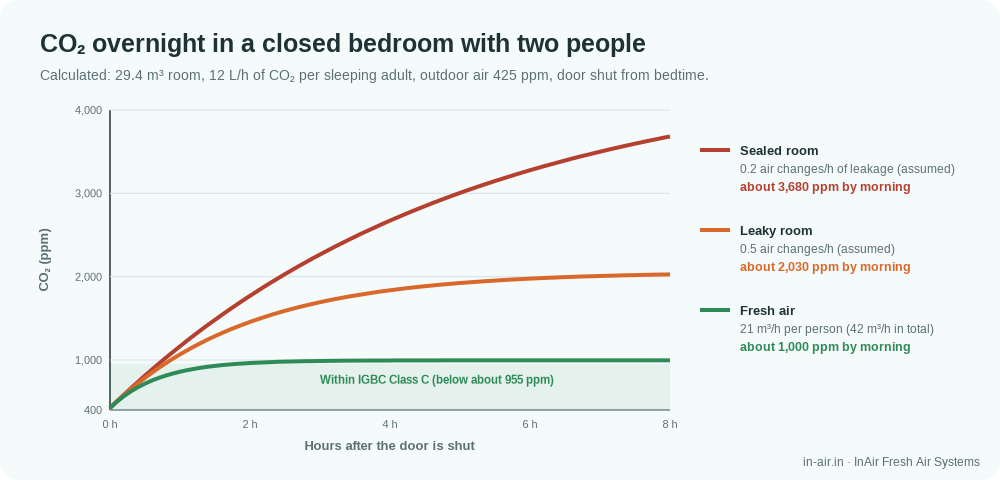
Indian green building classes aim to keep CO₂ within 350–530 ppm of outdoor air, about 775–955 ppm today. A sealed bedroom can be two to four times higher by morning. See bedroom CO₂ levels and sleep for what that means for rest, and the full limits in indoor air quality standards in India.
Moisture and VOCs: the slow build-up
Moisture comes from people, cooking, bathing and wet clothes. In a closed, air-conditioned flat in the monsoon, outdoor air is already humid, and indoor moisture has nowhere to go. The EPA advises keeping indoor humidity below 60%, ideally 30–50%, to limit mould. Bathroom and kitchen exhaust fans remove moisture at the source, before it spreads.
VOCs come from the house itself: furniture boards, paints, adhesives, mattresses, and from what we use, such as floor cleaners, sprays, incense and cosmetics. The EPA's long-running TEAM studies found about a dozen common organic pollutants 2 to 5 times higher inside homes than outside, and during activities like paint stripping, up to 1,000 times background outdoor levels.
So should I open the windows?
Sometimes. When the outdoor AQI is Good or Satisfactory, opening windows is the simplest way to flush out CO₂, moisture and VOCs. When it is Poor or worse, an open window swaps indoor pollution for outdoor PM2.5. InAir's free InAir Live app shows the cleanest two hours in the forecast for airing the house.
The lasting answer is to bring in outdoor air through a filter, all the time, and to take polluted air out at the source:
- Filtered fresh air. An energy recovery ventilator supplies filtered outdoor air and removes stale air, recovering most of the cooling. InAir's Revita and Ventura ERVs recover 89–90% (tested) and come with a pre-filter and MERV-13 filter, HEPA-13 optional.
- No ducting? A wall-mounted ERV needs only a core-cut through an outside wall.
- Exhaust at the source. A kitchen hood vented outdoors, and bathroom exhaust fans, remove smoke and moisture before they spread.
- A purifier is a top-up, not a fix. It cleans particles in one room but adds no fresh air, so CO₂ and moisture keep rising. See ventilation vs air purifier.
- Measure. A monitor with a real CO₂ sensor shows when a room is short of air. Our air quality monitor buying guide explains what to buy.
How InAir checks this at the site survey
- Where air leaks in now: window types, AC pipe holes, shafts, exhaust openings and door gaps.
- Indoor sources: kitchen layout and hood, prayer room, bathrooms without exhaust, where clothes dry.
- Which rooms are closed the longest, usually bedrooms and a home office, and how many people use them.
- Your city's outdoor PM2.5 and humidity through the year, to choose the filter grade and whether dehumidification is needed.
- Whether a ducted ERV or a wall-mounted unit suits the home, and the airflow each room needs.
What it costs
Revita ERVs for a 1–2 BHK start from ₹2.1 lakh, and the wall-mounted standalone ERV for finished homes without ducting starts from ₹1.4 lakh per unit, before GST and installation.
Tentative pricing: actual prices may vary based on the site survey.
Common myths
- "Closed windows keep pollution out." They slow it, without filtering it, and trap what is made inside.
- "The AC brings in fresh air." A split AC recirculates room air. It cools and dries, but adds no outdoor air.
- "An air purifier makes a closed room healthy." It reduces particles only. CO₂, moisture and most VOCs stay.
- "If it doesn't smell, the air is fine." CO₂ and PM2.5 have no smell at the levels found in homes.
- "Ten minutes of open windows in the morning is enough." It resets the room, but levels climb again within hours of closing up.
Sources
- Greenstone, Lee and Sahai (2021), Indoor Air Quality, Information, and Socio-Economic Status: Evidence from Delhi. BFI working paper
- US EPA, Indoor Particulate Matter: sources, infiltration and steps to reduce exposure. epa.gov
- US EPA, Volatile Organic Compounds' Impact on Indoor Air Quality (TEAM studies). epa.gov
- US EPA, A Brief Guide to Mold, Moisture and Your Home. epa.gov
- IGBC Health and Well-being Rating System (indoor CO₂ and PM2.5 classes from ISHRAE 10001). igbc.in
Why is my indoor air bad even with the windows closed?
Is indoor air cleaner than outdoor air in India?
Should I keep windows closed when the AQI is high?
Does an air purifier fix a closed room?
How high does CO₂ get in a closed bedroom?
What is the best way to get fresh air without letting pollution in?
Our engineers assess your home or building, recommend the right system and the right filter grade for your city, and give you a clear cost estimate. No obligation.