How quiet should a ventilation system be? dB(A), sones and bedroom noise explained
Aim for about 30 dB(A) in a bedroom. Here is what the noise numbers mean, where ventilation noise comes from, and what InAir's spec sheets actually say.
Last updated:
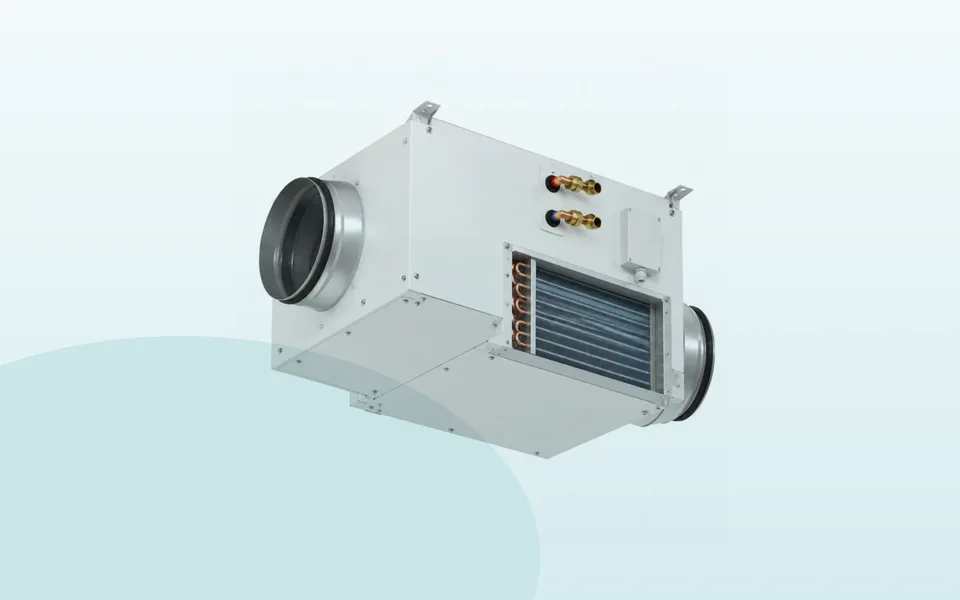
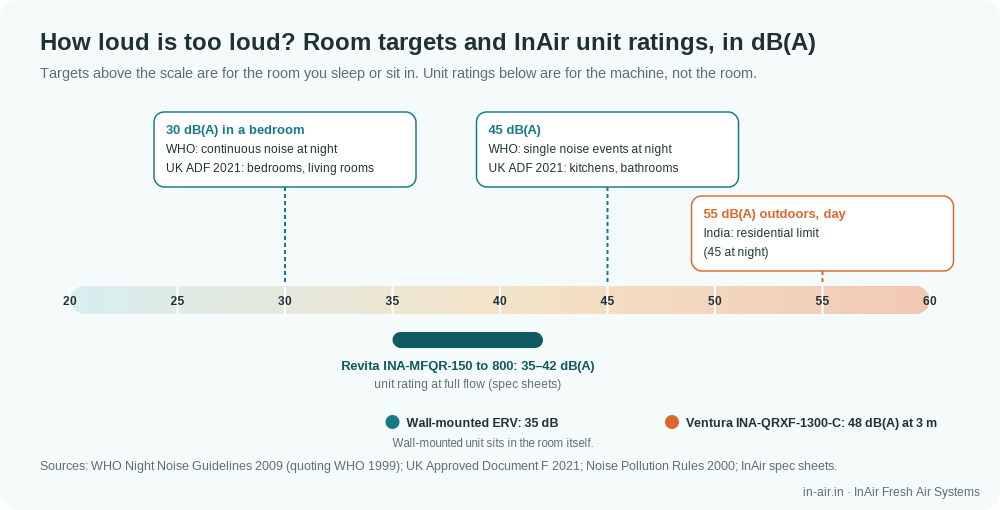
For a bedroom, aim for ventilation noise of no more than about 30 dB(A) in the room. That is the WHO level for continuous noise at night and the UK's guidance for ventilation in bedrooms. In the US, ASHRAE 62.2 asks for continuously running fans of 1 sone or less.
Key points
- Bedroom target: about 30 dB(A) from steady noise; single noise events above 45 dB(A) disturb sleep (WHO).
- Kitchens and bathrooms: up to 45 dB(A) is the UK guidance when fans run on boost.
- Sones: 1.0 sone or less for fans that run all the time, 3 sones for fans used now and then (ASHRAE 62.2). One sone is about a quiet fridge.
- The unit's dB figure is not the room's. Where the unit sits, the duct size, the grilles and the speed you run it at decide what you hear.
- Choose a unit that meets your airflow at a mid speed, not flat out. UK guidance says the same.
dB, dB(A), sones, NC and NR: what the numbers mean
Ventilation noise is quoted in several ways, and they are not interchangeable.
| Unit | What it measures | Where you see it | Watch out for |
|---|---|---|---|
| dB(A) sound pressure (LpA) | How loud it is at one spot, weighted to human hearing | Spec sheets, room targets | Only means something with a distance and a fan speed |
| dB(A) sound power (LWA) | Total sound the machine gives off | Commercial spec sheets | Always higher than sound pressure; do not compare it with a room target |
| Sones | Perceived loudness; 2 sones sounds twice as loud as 1 | US and HVI fan ratings, ASHRAE 62.2 | No fixed conversion to dB(A); it depends on the pitch of the noise |
| NC or NR curves | Background noise across low to high pitches | Acoustic specs for offices, hotels, studios | Used by consultants; rarely given for home fans |
InAir's own sheets show why the distance matters. The Ventura INA-QRXF-1300-C is listed at 59 dB(A) sound power and 48 dB(A) sound pressure at 3 m. Same machine, two very different numbers. Decibels also add in an odd way: two identical sources together are 3 dB louder than one, not twice the number.
How quiet is quiet enough?
There is no Indian standard for noise from home ventilation. The figures people use come from WHO and from building codes abroad:
| Guideline | Level | Applies to |
|---|---|---|
| WHO 1999, restated in the WHO Night Noise Guidelines 2009 | 30 dB(A) LAeq | Continuous noise inside a bedroom at night |
| WHO 1999 (same source) | 45 dB(A) LAmax | Single noise events at night; effects seen at 45 dB or less |
| WHO Night Noise Guidelines 2009 | 40 dB Lnight,outside (interim 55) | Average night noise outside the home |
| UK Approved Document F 2021 | 30 dB LAeq | Bedrooms and living rooms, continuous system on low rate |
| UK Approved Document F 2021 | 45 dB LAeq | Kitchens and bathrooms, on high rate or intermittent fans |
| ASHRAE 62.2 (via US DOE guide) | 1.0 sone / 3 sones | Continuous / intermittent fans |
| India: Noise Pollution Rules 2000 | 55 dB(A) day, 45 night | Outdoor ambient noise in residential areas, not indoor |
WHO also notes that a bedroom window left slightly open cuts outside noise by only about 15 dB. In a city where traffic runs late, a closed window plus mechanical fresh air is often the quieter way to get air at night.
What makes a ventilation system noisy
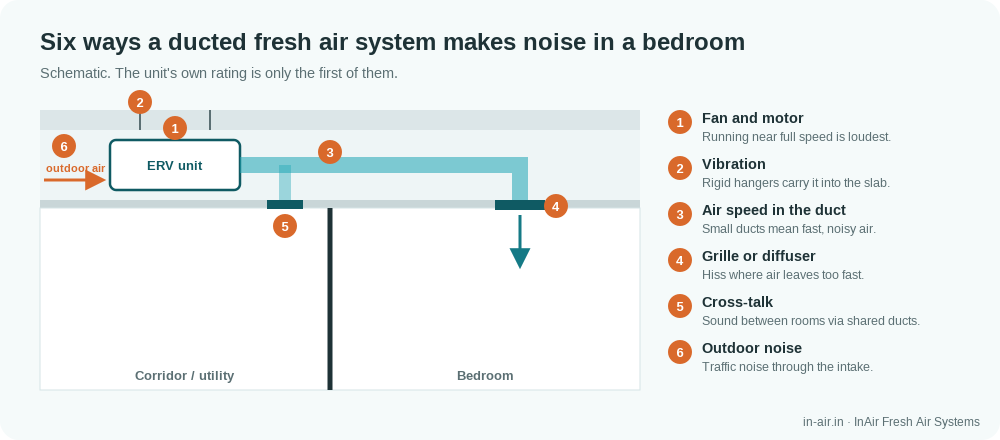
1. The fan running too hard
Fan noise rises steeply with speed. The UK guidance says fans should be sized so they do not run near maximum in normal mode. A unit that meets your airflow at medium speed is quieter than a smaller one at full speed.
2. Where the unit sits, and vibration
A unit above a bedroom's false ceiling is heard in that bedroom. Above a corridor, utility or toilet, it is mostly not. Rigid fixings carry vibration into the slab; resilient mountings and flexible duct connectors stop it.
3. Air speed in the duct
The same airflow moves faster through a smaller duct, and faster air is noisier at bends, branches and grilles. Our sums for round ducts:
| Airflow | 100 mm duct | 125 mm | 150 mm | 200 mm |
|---|---|---|---|---|
| 50 m³/h | 1.8 m/s | 1.1 m/s | 0.8 m/s | 0.4 m/s |
| 100 m³/h | 3.5 m/s | 2.3 m/s | 1.6 m/s | 0.9 m/s |
| 150 m³/h | 5.3 m/s | 3.4 m/s | 2.4 m/s | 1.3 m/s |
| 250 m³/h | 8.8 m/s | 5.7 m/s | 3.9 m/s | 2.2 m/s |
Published limits vary by source and building type, so we do not quote one figure. The pattern is the point: halve the airflow per duct or step up a size, and the air slows sharply. ASHRAE 62.2 duct size tables follow the same logic. More in the ventilation duct guide.
4. Grilles and diffusers
A grille that is too small for its airflow hisses, however quiet the unit. Size and type matter in bedrooms; see air diffusers and grilles.
5. Cross-talk and outdoor noise
Ducts that link two rooms can carry voices and TV sound between them. Fresh air intakes and exhaust terminals can let in traffic noise. Both are handled with layout and, where needed, silencers.
InAir noise figures, from the spec sheets
These are the published figures. We do not quote anything lower.
| Model | Airflow | Noise (spec sheet) |
|---|---|---|
| Revita INA-MFQR-150 | 150 m³/h | 35 dB(A) at full flow |
| Revita INA-MFQR-250 | 250 m³/h | 37 dB(A) at full flow |
| Revita INA-MFQR-350 | 350 m³/h | 38 dB(A) at full flow |
| Revita INA-MFQR-500 | 500 m³/h | 40 dB(A) at full flow |
| Revita INA-MFQR-800 | 800 m³/h | 42 dB(A) at full flow |
| Wall-mounted ERV INA-WERVG20-150CMH | 150 m³/h | 35 dB |
| Ventura INA-QRXF-1300-C | 1,317 m³/h | 48 dB(A) at 3 m; 59 dB(A) sound power |
Two honest notes. The Revita figures are for the unit at full flow; a ducted unit placed outside the bedroom and run below full speed is heard far less in the room, but how much less depends on the site, so we do not promise a room level. The wall-mounted ERV sits in the room itself and is rated at 35 dB at full flow, above the 30 dB(A) bedroom target used in UK rules; it runs quieter at lower speed, so ask how it will be run at night. See wall-mounted ERVs.
How InAir checks this at the site survey
- Which rooms are noise-sensitive: bedrooms, a study, a home theatre.
- Where the unit can go: a utility, corridor, loft or balcony ceiling rather than above a bed.
- The airflow each room needs, so the unit can meet it below full speed.
- Duct routes, sizes and the number of bends, and where grilles can sit away from the bedhead.
- Outdoor noise at the intake and exhaust points, and whether a noise reducer is worth adding.
- Existing exhaust fans: a loud bathroom fan on a shared shaft is often the real culprit.
What it costs
Noise reducers start from ₹4,400 each. A ducted Revita ERV for a 1–2 BHK starts from ₹2.1 lakh, and a wall-mounted ERV from ₹1.4 lakh per unit. Prices are before GST and installation. Tentative pricing: actual prices may vary based on the site survey.
Common mistakes
- Comparing dB figures without the distance. A sound power figure, or one measured at 1 m, cannot be compared with one at 3 m.
- Converting sones to dB(A) with a rule of thumb. There is no fixed conversion.
- Buying the smallest unit that just meets the airflow. It will run flat out, which is when it is loudest.
- Switching ventilation off at night for silence. Bedrooms need fresh air most at night; see bedroom CO₂ and sleep.
- Blaming the unit for grille hiss. Fast air at an undersized grille is a layout problem, not a fan problem.
Sources
- WHO Regional Office for Europe. Night noise guidelines for Europe (2009), quoting WHO Guidelines for community noise (1999). https://www.who.int/europe/publications/i/item/9789289041737
- UK Approved Document F, Volume 1, 2021 edition, paragraphs 1.5–1.7 (noise). https://assets.publishing.service.gov.uk/media/61deba42d3bf7f054fcc243d/ADF1.pdf
- US DOE Building America Solution Center (PNNL): continuous supply/exhaust fan ratings (ASHRAE 62.2 sone limits). https://basc.pnnl.gov/resource-guides/continuous-supplyexhaust-fan-ratings
- Noise Pollution (Regulation and Control) Rules, 2000, S.O. 123(E), Schedule. https://v1.wii.gov.in/node/1486
- Fantech: What is a sone? https://www.fantech.net/en-ca/expertise/fantech-5-hub/blog/comfort/what-is-a-sone
- InAir spec sheet INA-MFQR-350. https://www.in-air.in/spec-sheets/ina-mfqr-350/
- InAir spec sheet INA-QRXF-1300-C. https://www.in-air.in/spec-sheets/ina-qrxf-1300-c/
How many dB is quiet for a bedroom ventilation system?
What is a good sone rating for a ventilation fan?
How do I convert sones to decibels?
How loud is an InAir fresh air system?
Why is my ventilation system noisy?
Is it better to sleep with the window open or with mechanical ventilation?
Our engineers assess your home or building, recommend the right system and the right filter grade for your city, and give you a clear cost estimate. No obligation.