Air diffusers and grilles for homes: supply vs extract, sizing, noise and where to put them
Where fresh air enters a room decides whether it feels fresh, draughty or noisy. Here is how to choose and place diffusers and grilles.
Last updated:
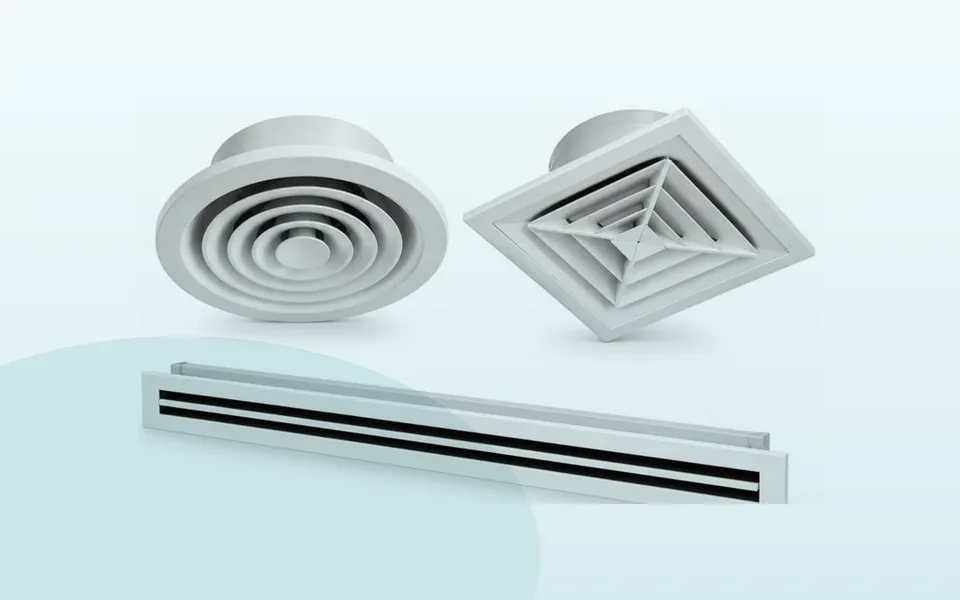
A supply diffuser throws fresh air into a room and mixes it without draught; an extract grille simply collects air and has little reach. Choose each by airflow, noise and pattern: keep the air speed through the diffuser neck low, mount supply diffusers at the ceiling, and place them so the jet slows down before it reaches anyone's head.
Key points
- Supply vs extract: supply diffusers create a jet and need careful placement; extract grilles collect air and should sit high, within 400 mm of the ceiling (UK Approved Document F).
- Throw: the distance until the jet slows to a stated speed, usually 0.25, 0.5 or 0.75 m/s. Too much throw and the jet drops onto the bed.
- Draught: the NBC recommends 0.13–0.23 m/s in the occupied zone for comfort and no more than 0.5 m/s.
- Noise: UK guidance asks for 30 dB(A) or less in bedrooms from continuous ventilation. Keep neck speed low; a diffuser maker's rule of thumb is below about 5 m/s.
- Size: each grille's free area should be at least 90% of its duct's (Approved Document F).
Supply diffusers and extract grilles do different jobs
Fresh air arrives through a supply diffuser as a jet. The jet pulls room air along with it, mixes, and slows down as it spreads. How far it travels and where it ends up decides whether the room feels fresh or draughty.
An extract grille works the other way: it draws air in from all around, so it has almost no reach. Its position matters for catching steam or smells at source and for making the fresh air cross the room before leaving. UK Approved Document F asks for extract terminals and fans as high as practicable, and no more than 400 mm below the ceiling.
In a home with a fresh air system, every bedroom and living room gets a supply diffuser, and kitchens and bathrooms get extract grilles. Approved Document F also says moist air from wet rooms must not recirculate into living spaces. Air moves from one to the other under doors or through transfer grilles; the same guidance gives 10 mm of door undercut on a standard 760 mm door. Our home ventilation guide explains the whole-house pattern.
Throw and draught: where the jet ends up
Diffuser catalogues give throw at three terminal speeds. A US diffuser maker, Nailor, describes throw as the distance a jet travels before slowing to 150, 100 or 50 feet per minute, about 0.75, 0.5 and 0.25 m/s. Its engineering note defines the occupied zone as up to 1.8 m above the floor and more than 0.6 m from the walls, and warns that jets above 0.25 m/s entering that zone are felt as draught.
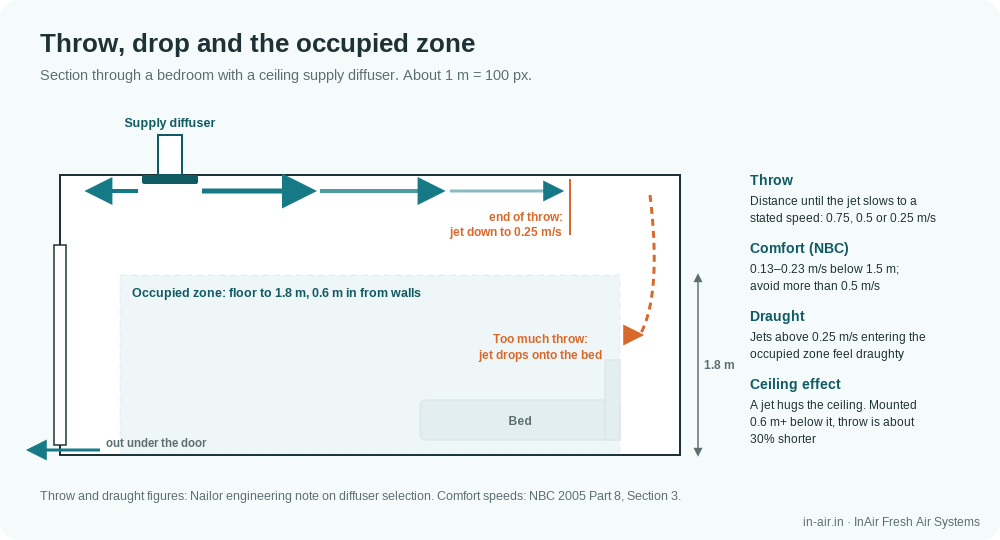
The National Building Code sets the comfort target for air-conditioned rooms: 0.13–0.23 m/s in the zone between the floor and 1.5 m, and generally no more than 0.5 m/s, except close to a supply or return grille. Two physical effects matter in Indian bedrooms:
- The ceiling effect: a jet blown along a ceiling clings to it and travels further before dropping. Nailor suggests reducing the catalogue throw by about 30% if the diffuser is more than 0.6 m below the ceiling, for example on a bulkhead.
- Cool air falls: air cooler than the room drops sooner. Fresh air from an ERV in summer is close to room temperature; air from a heat-pump ERV or an AC is cooler and needs more care.
- Two jets meeting mid-room collide and fall, which is a common cause of draught in rooms with two diffusers.
Noise: what to aim for in a bedroom
UK Approved Document F says continuous ventilation running at its normal low rate should not exceed 30 dB(A) in bedrooms and living rooms, and 45 dB(A) in kitchens and bathrooms. India's NBC lists 35–40 dB(A) as acceptable for homes overall. A diffuser adds to whatever noise the fan and duct deliver, so the quietest systems keep air slow all the way to the room.
- Keep the air speed through the diffuser neck low. Nailor's rule of thumb for low noise is a neck speed below about 1,000 feet per minute (about 5 m/s).
- Each doubling of identical diffusers within earshot adds about 3 points of noise criterion (NC), Nailor notes.
- The NBC advises placing grilles and diffusers well away from bends and branch take-offs, and avoiding volume dampers close to grilles in quiet rooms.
- See the quiet ventilation guide for fan noise and sones.
Sizing a diffuser by air speed
For round diffusers on round ducts, the simplest check is the air speed through the neck: airflow divided by the neck area. The table shows the speed for common airflows. Figures in bold are above the 5 m/s rule of thumb.
| Neck size | 30 m³/h | 60 m³/h | 100 m³/h | 150 m³/h |
|---|---|---|---|---|
| 75 mm | 1.9 m/s | 3.8 m/s | 6.3 m/s | 9.4 m/s |
| 100 mm | 1.1 m/s | 2.1 m/s | 3.5 m/s | 5.3 m/s |
| 125 mm | 0.7 m/s | 1.4 m/s | 2.3 m/s | 3.4 m/s |
| 150 mm | 0.5 m/s | 0.9 m/s | 1.6 m/s | 2.4 m/s |
| 200 mm | 0.3 m/s | 0.5 m/s | 0.9 m/s | 1.3 m/s |
A bedroom for two people needs about 40–60 m³/h of fresh air at the NBC's 20–30 m³/h per person. At 60 m³/h, a 100 mm diffuser runs at 2.1 m/s, comfortably quiet, while a 75 mm diffuser at the same airflow is near the limit. The neck is only part of it: the catalogue noise and throw at the actual airflow decide the final choice, and Approved Document F asks that the grille's free area is at least 90% of its duct's free area.
Linear, round or square?
| Type | Air pattern | Suits |
|---|---|---|
| Round ceiling diffuser | Radial, all round the diffuser | Bedrooms and living rooms with round ducts; the usual home choice |
| Square ceiling diffuser | Four-way | Grid ceilings and offices |
| Linear slot diffuser | Along the slot, one or two ways | Clean architectural lines, long rooms, along windows |
| Wall or floor outlet panel | Low, slow supply or extract | Flat duct systems where there is no false ceiling |
| Extract grille | Collects from all around | Bathrooms, kitchens, utility rooms |
InAir grilles and diffusers include ceiling vent diffusers from Φ75 to Φ200 mm (INAF69–INAF138), stainless steel sleek panels in wire-drawn and bronze finishes, and Y and T connectors for branching; floor and wall outlet panels are part of the flat duct range.
Where to put diffusers in a bedroom
- Supply at the ceiling, blowing along it, so the jet slows before it drops.
- Not directly above the bed head, and not where the throw ends over the bed.
- On the side of the room away from the door, so fresh air crosses the room before leaving under the door.
- Away from the AC indoor unit's throw, so the two jets do not collide.
- Clear of light fittings, curtains and wardrobes that block the jet.
Balancing: getting each room its share
A diffuser in the right place still fails if it gets too little air. Approved Document F sets out the commissioning method: set the 'index' terminal, the one hardest to supply, fully open, then adjust the others to their design airflows; if every terminal ends up nearly closed, turn the fan down and rebalance instead. InAir commissions with measured airflow readings at each room.
How InAir checks this at the site survey
- the airflow each room needs, from occupancy and use;
- ceiling type and height, and whether diffusers can sit at the ceiling;
- bed, desk and sofa positions, so throw ends away from people;
- where the AC indoor unit blows;
- door undercuts or transfer grilles for air leaving each room;
- finish and size that suit the interior design.
Book a free site survey, or size the whole system with the ERV sizing calculator.
What it costs
InAir diffusers, grilles, outdoor cowls and jet nozzles (75–200 mm) start from ₹1,500 each, and flat duct floor or wall outlet panels from ₹100 each, before GST and installation.
Tentative pricing: actual prices may vary based on the site survey.
Common mistakes
- Choosing the smallest diffuser that fits, then living with whistling air.
- A supply diffuser directly over the bed.
- Supply and extract grilles side by side, so fresh air leaves before it mixes.
- No door undercut, so air cannot leave a room with the door closed.
- Closing every diffuser damper halfway instead of slowing the fan.
- Ignoring the AC's own airflow when placing fresh air diffusers.
Sources
- Nailor Industries: how ceiling diffusers are selected: throw, drop, occupied zone, neck speed, NC addition.
- National Building Code of India 2005, Part 8, Sections 3 and 4: room air speeds, acceptable indoor noise, grille placement.
- UK Approved Document F, Volume 1 (2021): extract terminal height, noise levels, terminal free area, door undercuts, balancing.
- InAir product pages and price list (FY 2026–27).
What is the difference between a diffuser and a grille?
Where should a fresh air diffuser go in a bedroom?
What size diffuser do I need for a bedroom?
Why does my ceiling diffuser make a whistling noise?
Is a linear slot diffuser better than a round one?
How high should a bathroom extract grille be?
Our engineers assess your home or building, recommend the right system and the right filter grade for your city, and give you a clear cost estimate. No obligation.