Air purifier or fresh air system: which one does your home need?
A decision guide with room sizes and real cases: when a purifier is enough, when only fresh air will do, and how to use both.
Last updated:

Choose an air purifier if your problem is dust, pollen or smoke in one or two rooms that get aired every day. Choose a fresh air system if rooms stay closed for hours with people in them, because only outdoor air lowers CO₂ and stale moisture. In smoggy cities where windows stay shut all winter, most homes need both.
This is a decision guide, with room sizes and real cases. For the basic difference in what each machine does, read ventilation vs air purifier first.
Key points
- A purifier cleans the air already in a room. A fresh air system replaces it with filtered outdoor air.
- Purifiers are rated by CADR (clean air delivery rate). AHAM's suggested room size assumes 4.8 clean air changes an hour and an 8 ft ceiling.
- CADR measures particles only. It says nothing about CO₂, moisture or gases, and it is not the right measure for a fresh air unit.
- In our illustrative bedroom, two sleepers push CO₂ to about 2,000 ppm by morning with only leakage; 42 m³/h of fresh air holds it near 1,000.
- Using both is common: fresh air for the whole home, a purifier in the bedroom on the worst smog days.
The quick decision
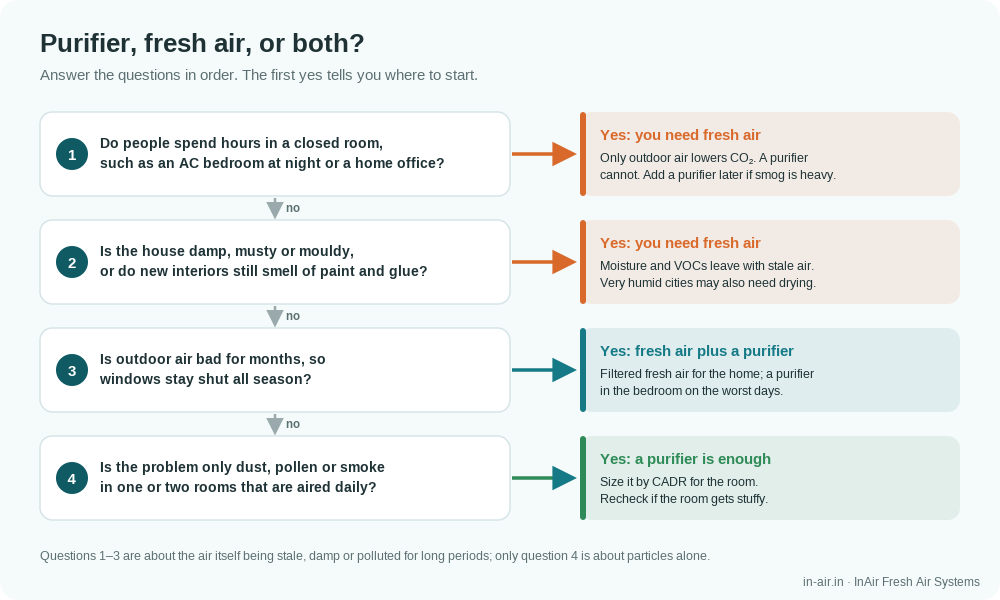
When an air purifier alone is enough
- The room is used for a few hours at a time, or its windows are opened daily when outdoor air is clean.
- The issue is particles: construction dust, pollen, pet dander, or smoke from a nearby kitchen or incense.
- You live in a city with moderate outdoor air for most of the year and only need help on bad days.
- You rent, and cannot make changes to walls or ceilings.
In those cases a correctly sized purifier with a true HEPA filter does the job, and costs little to run. The US EPA's guide to air cleaners says filtration can be an effective supplement to source control and ventilation, but adds that it does not replace the need to ventilate.
When you need fresh air
- A closed AC bedroom at night. Two people breathe out about 24 litres of CO₂ an hour. With the door and windows shut, CO₂ climbs all night, and no filter removes it.
- A home office or study used all day with the door closed.
- New interiors. Paint, plywood, MDF and adhesives give off VOCs for months. A purifier with a carbon stage helps a little; replacing the air helps more.
- Damp, musty rooms. Moisture from people, showers and cooking has to leave the house. The EPA advises keeping indoor humidity below 60%, ideally 30–50%. In very humid cities fresh air needs drying as well, see monsoon humidity and fresh air dehumidification.
- Rooms with no openable window. A purifier cannot help the stuffiness at all.
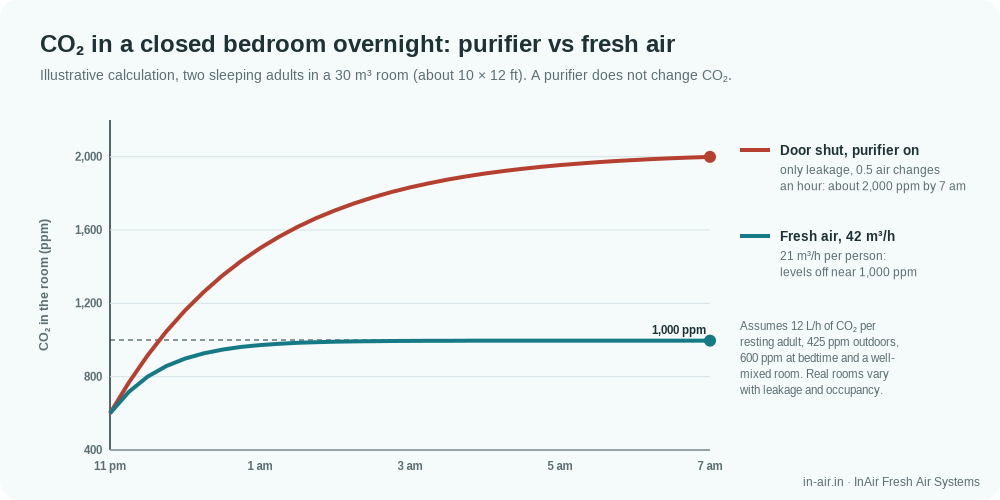
The red line is a closed bedroom with only air leaking in around the door and window. A purifier running in that room leaves the red line exactly where it is. The teal line is the same room with 42 m³/h of fresh air, which is 21 m³/h per person, the rate that holds CO₂ near 1,000 ppm. Our article on bedroom CO₂ and sleep covers what the research says about those levels.
CADR, explained
CADR, the clean air delivery rate, is the number that matters on a purifier box. It comes from the US appliance makers' association AHAM and its test standard ANSI/AHAM AC-1. A purifier runs in a sealed test chamber at its highest speed, and the test measures how fast it removes three kinds of particle: tobacco smoke (fine), dust (medium) and pollen (large). The result is the volume of particle-free air it delivers, in cfm or m³/h.
AHAM converts the smoke CADR into a suggested room size: room area in square feet equals smoke CADR in cfm × 1.55. That works out to 4.84 clean air changes an hour in a room with an 8 ft (2.4 m) ceiling, which AHAM rounds to 4.8. Many Indian rooms are taller, so you need more CADR than the label suggests. The table below uses a 2.7 m ceiling.
| Room | Size | Smoke CADR for 4.8 air changes an hour | People | Fresh air to hold CO₂ near 1,000 ppm |
|---|---|---|---|---|
| Small bedroom | 10 × 10 ft (9.3 m²) | 120 m³/h (70 cfm) | 2 | 42 m³/h |
| Bedroom | 10 × 12 ft (11.1 m²) | 140 m³/h (85 cfm) | 2 | 42 m³/h |
| Master bedroom | 12 × 14 ft (15.6 m²) | 200 m³/h (120 cfm) | 2 | 42 m³/h |
| Living room | 14 × 18 ft (23.4 m²) | 300 m³/h (180 cfm) | 4 | 84 m³/h |
| Whole 3BHK | 1,600 sq ft (149 m²) | about 1,900 m³/h (several purifiers) | 4 | about 130 m³/h (ASHRAE 62.2) |
Two things stand out. First, a whole home needs far more purifier capacity than one machine provides, which is why purifiers are bought room by room. Second, the fresh air a home needs is a much smaller airflow, because its job is different: replacing air, not scrubbing it repeatedly. Use the ERV sizing calculator for your own home.
Why CADR does not apply to a fresh air unit
CADR is a test of a machine that recirculates a room's air. A fresh air unit does something else: it brings outdoor air in through a filter and sends an equal amount of stale air out. Its useful measures are different:
- Airflow at the duct's pressure, in m³/h, which sets how much CO₂ and moisture it removes.
- Filter grade. MERV-13 captures at least 85% of 1–3 µm particles (ASHRAE 52.2); HEPA-13 at least 99.95% at the most penetrating size (EN 1822).
- Energy recovery, which decides how much heat and humidity the incoming air brings to your AC. InAir's Revita ERVs recover 89–90% (tested).
- Noise, from the spec sheet.
AHAM's own white paper notes that some references count filtered air as equivalent air changes and add it to outdoor air changes. You can think of a fresh air unit the same way: its clean air contribution is roughly its airflow multiplied by its filter's efficiency, but it adds something a purifier cannot, which is the removal of CO₂. Comparing an ERV's airflow with a purifier's CADR, number for number, compares two different jobs.
Real cases
| Home | What matters | Our suggestion |
|---|---|---|
| 2BHK in Bengaluru, windows open most mornings, one allergic child | Dust and pollen; CSE's winter average was 37 µg/m³ PM2.5 | A purifier in the child's room. Fresh air is worth it if the room is shut with the AC at night. |
| 3BHK in Delhi NCR, windows shut from October to February | Winter PM2.5 averaged 175 µg/m³; CO₂ in closed bedrooms | Filtered fresh air for the home, with HEPA-13; a purifier in the main bedroom for the worst days. |
| Flat in Mumbai, musty wardrobes in the monsoon | Moisture, not particles | Fresh air with energy recovery; consider active dehumidification. A purifier will not fix it. |
| Finished villa, owners will not open the ceilings | CO₂ in bedrooms, smog in winter | Wall-mounted ERVs in the bedrooms, plus a purifier where needed. |
| Office cabin, eight hours a day, no window | CO₂ and stuffiness | Fresh air first. A purifier alone will not help. |
Using both together
The two machines do not compete. A sensible arrangement in a polluted city is a fresh air system running all the time at a low, quiet speed, with a purifier in the main bedroom. On bad days the purifier polishes the room air; the fresh air system keeps CO₂ and humidity down. Keep windows shut on smog days so the filters are doing the work. An indoor air quality sensor showing PM2.5 and humidity helps you see whether either needs more speed; for CO₂ you need a monitor that measures it.
How InAir checks this at the site survey
The survey is free. An InAir engineer looks at:
- which rooms are closed for long periods and how many people use them;
- your city's air quality and humidity, which decide between MERV-13 and HEPA-13 and whether drying is needed;
- whether the false ceiling can take a ducted ERV, or whether wall-mounted units suit a finished home;
- where the outdoor intake and exhaust can go;
- whether a purifier you already own covers the particle problem, so we size the fresh air for CO₂ and moisture only.
If a purifier is all you need, we say so.
What it costs
InAir does not sell portable purifiers, so we do not quote prices for them; compare them by CADR, filter cost and noise. For InAir fresh air equipment, starting prices before GST and installation are: Revita ERV for a 1–2 BHK from ₹2.1 lakh, wall-mounted ERV from ₹1.4 lakh per unit, fresh air filter boxes from ₹14,800 each, and the IAQ sensor from ₹53,100. See the price guide.
Tentative pricing: actual prices may vary based on the site survey.
Common mistakes
- Buying a purifier by the room size printed on the box without allowing for a ceiling taller than 8 ft.
- Running a purifier with the window open on a smog day.
- Expecting a purifier to fix stuffiness, headaches on waking or condensation. Those are ventilation problems.
- Buying an air cleaner that makes ozone. The EPA advises avoiding cleaners that produce ozone on purpose.
- Not replacing filters, on either machine. A clogged filter cuts airflow.
- Relying on a bathroom exhaust fan for fresh air. It pulls replacement air through gaps, unfiltered.
Sources
- US EPA, Guide to Air Cleaners in the Home (2nd edition): CADR, particles only, ozone, filtration does not replace ventilation. www.epa.gov
- AHAM, Portable Air Cleaners and Air Changes per Hour (white paper, 2021): AC-1 test particles, room size = CADR × 1.55, 4.8 ACH. ahamverifide.org
- US EPA, A Brief Guide to Mold, Moisture and Your Home: humidity below 60%, ideally 30–50%. www.epa.gov
- ASHRAE 62.2-2022 Addendum e: whole-house ventilation rate. www.ashrae.org
- WHO global air quality guidelines (2021). www.who.int
- Centre for Science and Environment, analysis of CPCB data for winter 2024–25 (city PM2.5 averages), as summarised in InAir's home ventilation guide.
Is an air purifier enough for an Indian home?
Does an air purifier remove CO₂?
What CADR do I need for my bedroom?
Can I use an air purifier and an ERV together?
Why don't fresh air systems have a CADR rating?
What does a fresh air system cost compared with a purifier?
Our engineers assess your home or building, recommend the right system and the right filter grade for your city, and give you a clear cost estimate. No obligation.