Monsoon humidity at home: why AC rooms stay clammy, and how fresh air dehumidification fixes it
Monsoon air in coastal India holds twice the water of an AC room, and the AC is not built to remove it. Here is why rooms stay clammy, and what fixes it.
Last updated:

In an Indian monsoon an air-conditioned bedroom can feel cool and still feel sticky. Clothes in the wardrobe smell musty, and black spots appear behind furniture. The cause is moisture, not heat. Outdoor air in Mumbai, Chennai and Kolkata carries more than twice the water of a room kept at 24 °C and 50% humidity, and an AC is not designed to remove that much water. This guide explains why, what humidity to aim for, and the options from an AC's dry mode to fresh air dehumidification.
Key points
- Monsoon outdoor air in coastal cities holds about 19.9 g of water per kg of air; a room at 24 °C and 50% holds about 9.3 g.
- Keep indoor humidity below about 60% to limit mould (US EPA).
- An AC removes moisture only while its coil runs cold; in mild, wet weather it cycles off and the room stays humid.
- Fresh air brings that moisture in: about 40 litres of water a day for a 3BHK's minimum fresh air in a Mumbai June.
- An ERV reduces the moisture that comes in; a fresh air dehumidifier removes it, for homes in coastal and very humid cities.
How wet is monsoon air?
Dew point is the clearest measure of how much water the air holds. An air-conditioned room at 24 °C and 50% relative humidity has a dew point of about 13 °C. Across the monsoon months, the average outdoor dew point in Mumbai, Kolkata and Chennai sits around 24–26 °C. Chennai's dew point stays above 20 °C on 328 days a year, Mumbai's on 239, Kolkata's on 235.
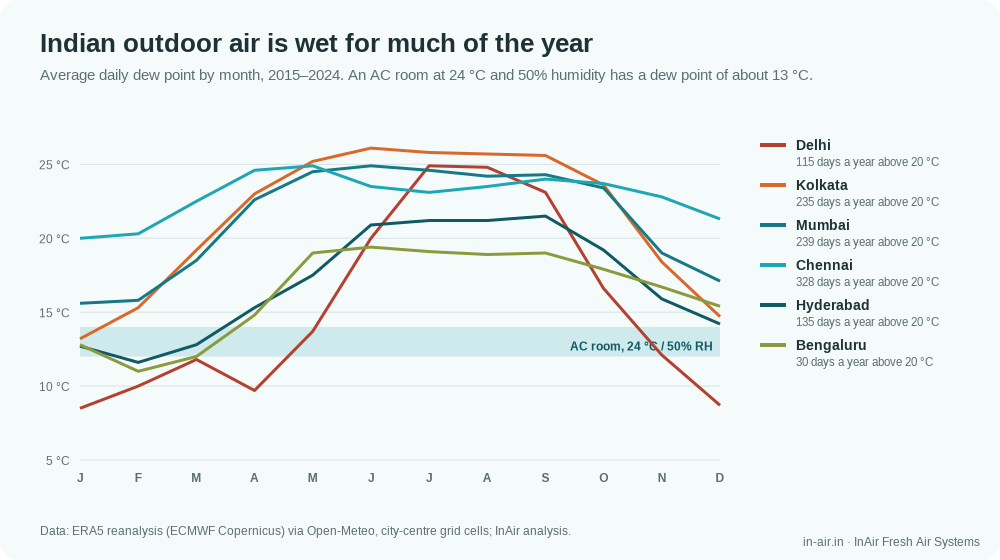
| City | Most humid month | Average dew point | Water in that air | vs a room at 24 °C / 50% |
|---|---|---|---|---|
| Kolkata | June | 26.1 °C | 21.5 g/kg | 2.3× |
| Mumbai | June | 24.9 °C | 19.9 g/kg | 2.2× |
| Chennai | May | 24.9 °C | 19.9 g/kg | 2.2× |
| Delhi | July | 24.9 °C | 20.4 g/kg | 2.2× |
| Hyderabad | September | 21.5 °C | 17.1 g/kg | 1.7× |
| Bengaluru | June | 19.4 °C | 15.8 g/kg | 1.5× |
Why the AC leaves the room clammy
An air conditioner removes moisture only when its indoor coil is colder than the dew point of the room air; water condenses on the coil and drains away. On a hot, dry afternoon the AC runs hard and the coil stays cold, so it dries the air as it cools it. On a mild, wet monsoon day the room needs little cooling, so the compressor slows down or switches off. The coil warms up, stops condensing, and some of the water already on it evaporates back into the room. The thermostat is satisfied; the humidity is not.
ACs are sized for the hottest afternoons, which makes this worse: a large AC reaches the set temperature quickly and then spends most of a monsoon night idling. The 'dry' mode on many split ACs helps by running the fan slowly so the coil stays colder, but it still treats only the air already in the room.
What humidity to aim for
The US Environmental Protection Agency advises keeping indoor humidity below 60% to limit mould, ideally 30–50%. IGBC's Health and Well-being rating, citing ISHRAE, allows 30–70% in Indian buildings. ASHRAE Standard 55 caps comfort humidity at a dew point of about 16.8 °C. In practice, an Indian home that stays below about 60% through the monsoon avoids most mould and musty smells. A simple hygrometer, or an IAQ sensor, tells you where you are.
Fresh air brings the moisture in
A sealed room still needs fresh air, for the people in it. But every cubic metre of untreated monsoon air brings its water with it. Per 100 m³/h of outdoor air, the moisture load on the AC is about 0.88 kW in a Mumbai June and 1.01 kW in Kolkata, more than the summer heat load in every city we analysed.
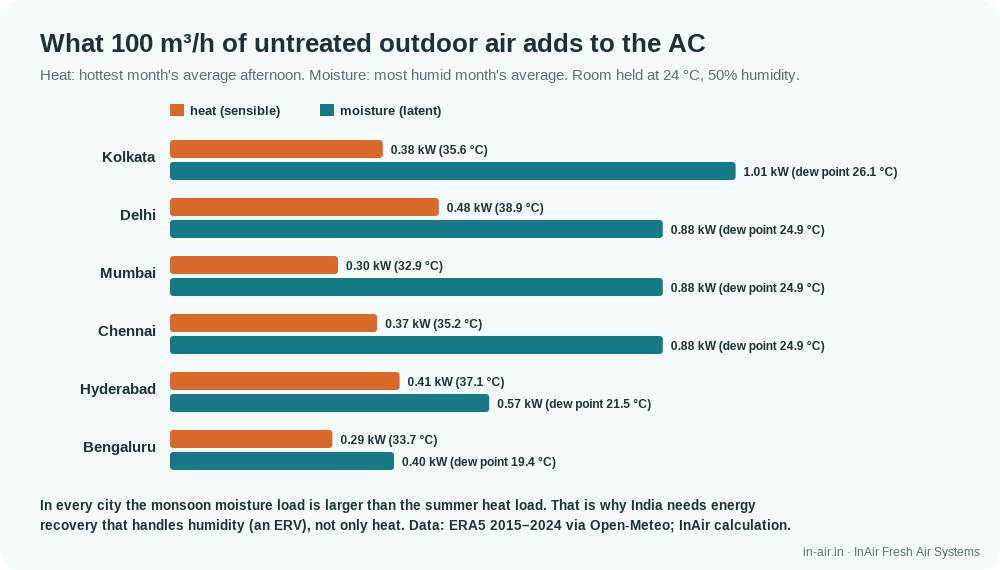
For a 3BHK's minimum fresh air of 133 m³/h under ASHRAE 62.2, a Mumbai June means about 1.17 kW of moisture load, or roughly 1.7 kg of water an hour: about 40 litres a day that something has to remove. Opening windows brings in the same water without any filtering.
Four ways to control monsoon humidity
| Option | What it does | Fresh air? | Best for |
|---|---|---|---|
| AC dry mode | Runs the indoor fan slowly so the coil stays cold and removes more water | No | Short humid spells in a single room |
| Portable dehumidifier | Removes water from the room's own air; tank or drain | No | A damp room or wardrobe area; adds heat |
| ERV | Brings in filtered fresh air; its core passes part of the moisture back out with the exhaust | Yes | Most Indian homes; less moisture enters than with plain fresh air |
| Fresh air dehumidifier | Filters, recovers heat and moisture, then actively dries the fresh air before it reaches the room | Yes | Coastal and very humid cities, villas, bedrooms that stay clammy |
Fresh air dehumidifiers, explained

A fresh air dehumidifier combines ventilation with active drying. InAir's INAV-HTRW30 filters outdoor air through G4 and H10 filters, passes it through a total heat recovery wheel that exchanges heat and moisture with the outgoing room air, dries it on a refrigerant evaporator and reheats it on the condenser so it reaches the room dry but not cold. It is rated at 300 m³/h with sensible heat recovery above 70% and an EC fan with six speeds. The INAD-CW30 and CW50 do the same job with a chilled-water coil and a plate heat exchanger, at 300–500 m³/h, where a building already has chilled water.
Both are wall-mounted and need a condensate drain. Because they dry the fresh air itself, the AC no longer has to deal with that moisture, and the room's humidity stays down even on nights when the AC idles.
Which option for which city?
| City type | Monsoon pattern | Usual recommendation |
|---|---|---|
| Mumbai, Chennai, Kolkata and other coastal cities | Dew point above 20 °C on 235–330 days a year | ERV for every home; add fresh air dehumidification for villas, ground-floor flats and bedrooms that stay clammy |
| Hyderabad and the Deccan | Humid June to September | ERV; AC dry mode in the wettest weeks |
| Delhi NCR and the north | Humid July to September, smoggy winter | ERV with HEPA-13 for winter; humidity control mainly July–August |
| Bengaluru | Mild, moderately humid | ERV; dehumidification rarely needed |
These are starting points. InAir sizes humidity control at the free site survey, from the home's layout, orientation and how it is used.
Stopping mould
- Keep humidity below about 60% through the monsoon, measured, not guessed.
- Run bathroom exhaust fans during and after showers, and dry clothes outdoors or in a ventilated utility area.
- Leave a gap behind wardrobes on outside walls, and keep air moving between rooms.
- Fix leaks and seepage first; no machine keeps up with a wet wall.
- Check that every drain, from the AC, ERV or dehumidifier, runs clear before the monsoon.
WHO's guidance on dampness and mould sets no numeric limit; it says persistent dampness and microbial growth should be avoided or minimised.
Sources
- Hersbach H. et al., The ERA5 global reanalysis (2020), via the Open-Meteo historical weather API; daily values 2015–2024; InAir analysis.
- US Environmental Protection Agency, A Brief Guide to Mold, Moisture and Your Home.
- ANSI/ASHRAE Standard 55, Thermal Environmental Conditions for Human Occupancy (humidity ratio limit 0.012).
- IGBC Health and Well-being Rating System; ISHRAE Standard 10001:2016.
- World Health Organization, WHO guidelines for indoor air quality: dampness and mould (2009).
- ASHRAE Handbook, Fundamentals: psychrometrics. ASHRAE 62.2: whole-house fresh air rate.
- InAir product brochures: INAV-HTRW30; INAD-CW30 / CW50.
Why does my AC room feel sticky in the monsoon?
What indoor humidity should I keep in the monsoon?
Does AC dry mode work?
Is an ERV enough for monsoon humidity?
What is a fresh air dehumidifier?
How much water does fresh air bring in during the monsoon?
Our engineers assess your home or building, recommend the right system and the right filter grade for your city, and give you a clear cost estimate. No obligation.