The home ventilation guide for India: how a house should breathe in Indian heat, humidity and smog
Most ventilation advice was written for cold countries. Indian homes face heat, monsoon humidity and smog, in rooms sealed for the AC. This guide uses ten years of climate data for six cities to show how a home here should breathe.
Last updated:

It is two in the morning in a third-floor flat in Hyderabad. The split AC is set to 24 °C, the bedroom door is shut, and the windows were closed at dusk to keep out mosquitoes and traffic noise. The room feels cool. But nothing in it has brought in outdoor air since evening, and two people have been breathing out carbon dioxide for five hours. By the time the alarm rings, the air they are breathing is the same air, cooled again and again.
That is the problem this guide is about. Most ventilation advice on the internet was written for cold countries, where the worry is losing heat in winter. Indian homes have the opposite problem: hot, wet, often dusty outdoor air, and rooms sealed for air conditioning. This guide sets out how an Indian home should breathe, using ten years of weather data for six cities, published standards and peer-reviewed research, and what it means for your home.
Key points
- Ventilation means replacing indoor air with outdoor air. An AC cools the same air and an air purifier cleans it, but neither replaces it.
- In all six cities we analysed, the moisture in monsoon air puts more load on the AC than the summer heat does: 1.01 kW against 0.38 kW per 100 m³/h in Kolkata.
- A typical 3BHK needs at least 133 m³/h of fresh air around the clock under ASHRAE 62.2; bedrooms need it most, at night.
- Windows and exhaust fans cannot filter, measure or pre-cool that air. A balanced energy recovery ventilator (ERV) does all three.
- Keep exhaust fans in toilets and kitchens; they remove smells and steam at the source. Fresh air for the rest of the home is a separate job.
What ventilation actually means
Ventilation is the deliberate exchange of indoor air for outdoor air: stale air goes out, an equal amount of fresh air comes in. It is the only way to remove the things that build up inside a home and that filters cannot catch, mainly carbon dioxide, moisture and many household gases.
It is easy to confuse with the two machines most Indian homes already have:
| Split AC | Air purifier | Ventilation (ERV) | |
|---|---|---|---|
| Brings in outdoor air | No; it recirculates room air | No; it recirculates room air | Yes, continuously |
| Removes CO₂ | No | No | Yes |
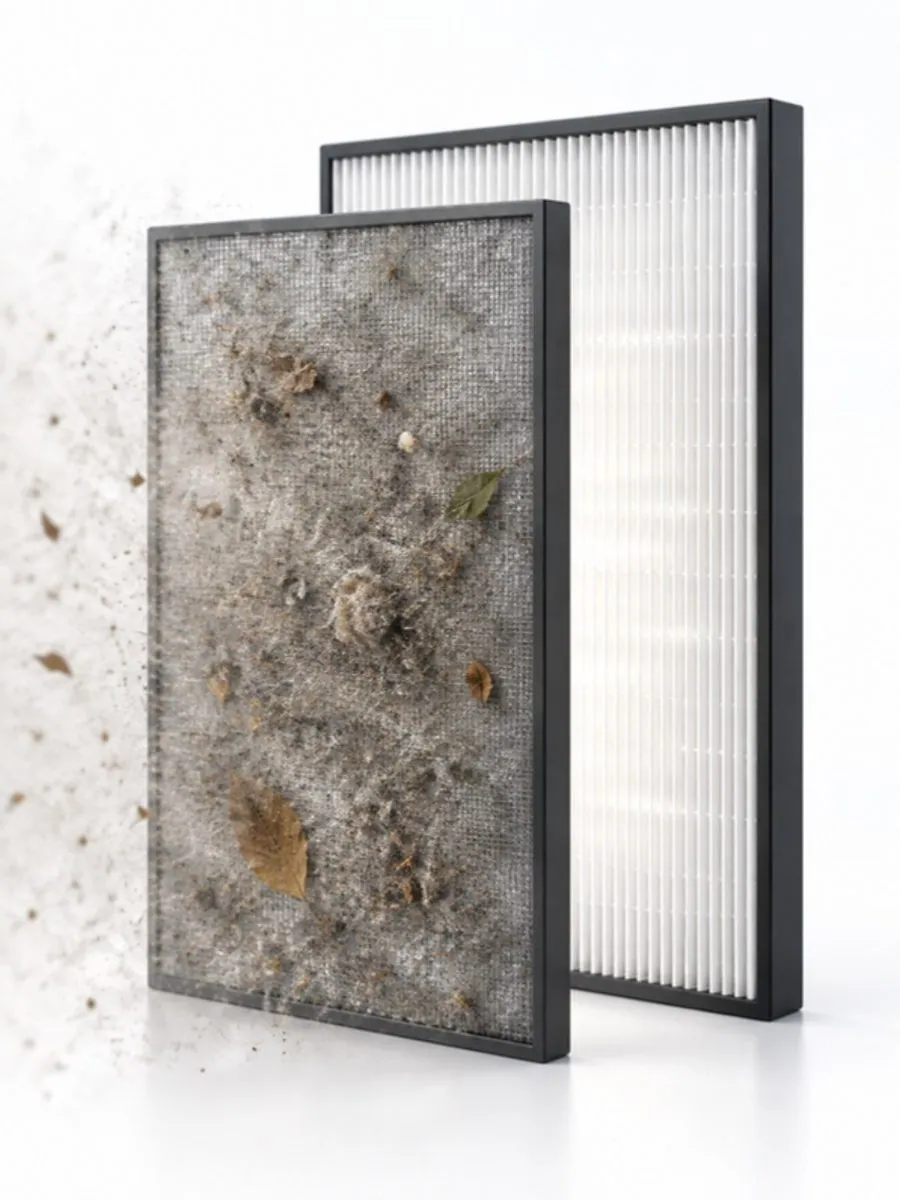
| Removes PM2.5 dust | Barely (coarse mesh filter) | Yes, from room air | Yes, from incoming air (MERV-13; HEPA-13 optional) |
| Removes moisture | Yes, while cooling | No | Removes stale damp air; ERV core limits incoming moisture |
| Controls temperature | Yes | No | Pre-cools incoming air with outgoing air |
So the three work together, not instead of each other. The AC handles temperature, a purifier can polish room air on bad days, and ventilation keeps the air from going stale. See ventilation vs air purifier for the detail.
Why Indian homes stopped breathing
Older Indian houses were built to breathe: high ceilings, jaalis, cross-ventilation, windows open most of the year. Three changes ended that.
- Air conditioning. Once a room has a split AC, it is kept shut. Every opening lets in heat and humidity the AC must remove.
- Tighter buildings. uPVC and aluminium windows with seals, glass façades and gypsum false ceilings close the gaps that once let air leak in.
- Outdoor pollution and noise. In much of the country, opening a window in winter lets in PM2.5; in every city it lets in traffic noise and mosquitoes.
The result is a home that is comfortable to the skin but short of fresh air. A closed bedroom with two sleepers can pass 1,500 ppm of CO₂ within hours; our CO₂ and sleep article works through the arithmetic and the research.
India's climate, in numbers
To design ventilation for India you have to start with Indian weather, not European weather. We took ten years of daily data (2015–2024) for six cities from the ERA5 climate reanalysis produced by the European Centre for Medium-Range Weather Forecasts for the EU's Copernicus programme, and worked out what matters for a home: how hot the afternoons get, how much moisture the air carries and how many days of each a year brings.
| City | Hottest month, average afternoon | Most humid month, average dew point | Moisture in that air | Days a year above 35 °C | Days a year with dew point above 20 °C | Winter PM2.5, µg/m³ (Oct 2024–Jan 2025) |
|---|---|---|---|---|---|---|
| Delhi | 38.9 °C (May) | 24.9 °C (July) | 20.4 g/kg, 2.2× an AC room | 91 | 115 | 175 |
| Kolkata | 35.6 °C (April) | 26.1 °C (June) | 21.5 g/kg, 2.3× an AC room | 47 | 235 | 65 |
| Mumbai | 32.9 °C (April) | 24.9 °C (June) | 19.9 g/kg, 2.2× an AC room | 11 | 239 | 50 |
| Chennai | 35.2 °C (June) | 24.9 °C (May) | 19.9 g/kg, 2.2× an AC room | 58 | 328 | 36 |
| Hyderabad | 37.1 °C (May) | 21.5 °C (September) | 17.1 g/kg, 1.7× an AC room | 71 | 135 | 52 |
| Bengaluru | 33.7 °C (April) | 19.4 °C (June) | 15.8 g/kg, 1.5× an AC room | 11 | 30 | 37 |
Temperature and moisture: ERA5 reanalysis 2015–2024, city-centre grid cells, via Open-Meteo; InAir analysis. Reanalysis cells average over about 30 km, so peak values read slightly below city weather stations. Winter PM2.5: Centre for Science and Environment analysis of CPCB monitoring data, 1 October 2024 to 31 January 2025. Moisture compared with a room at 24 °C and 50% relative humidity.
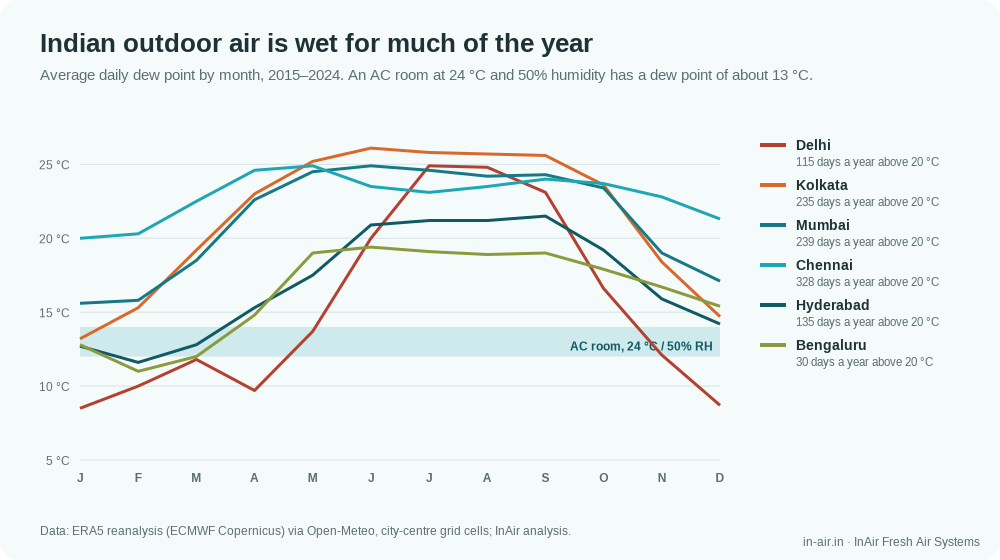
Three things stand out.
- Moisture, not just heat. In the monsoon, outdoor air in Kolkata, Mumbai, Chennai and even Delhi holds more than twice the water of an air-conditioned room. Chennai's dew point stays above 20 °C on 328 days a year.
- Heat is seasonal and northern. Delhi averages 91 days a year above 35 °C, Hyderabad 71; Mumbai and Bengaluru about 11.
- Pollution is seasonal too. Delhi's winter PM2.5 averaged 175 µg/m³ in 2024–25, nearly three times the national 24-hour standard of 60. Bengaluru and Chennai were in the mid-30s, still far above the WHO's annual guideline of 5.
The hidden cost of fresh air: moisture
Bringing in outdoor air is not free. Every cubic metre of hot, wet air that enters an air-conditioned home has to be cooled and dried by the AC. Most guides only count the heat. In India the moisture matters more.
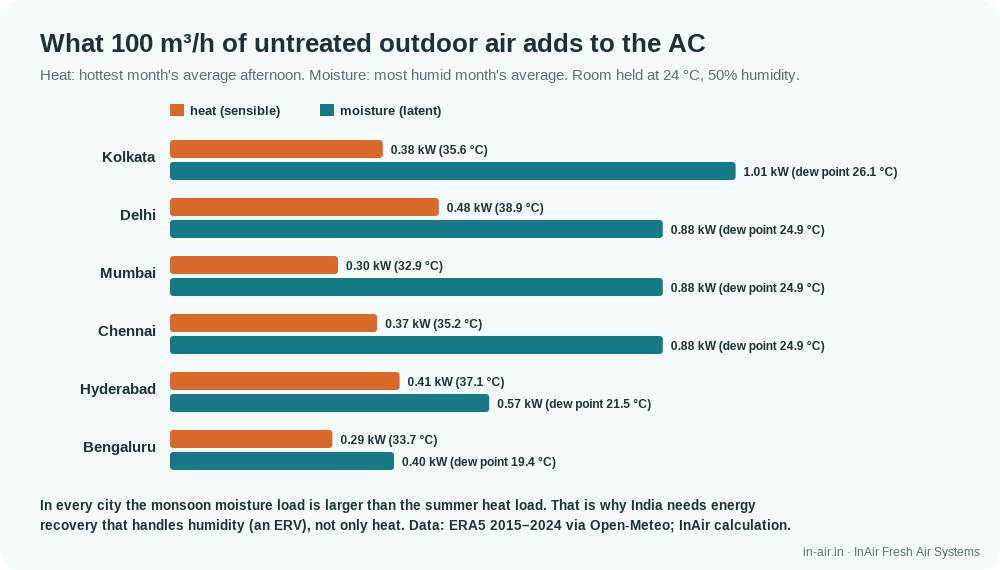
For every 100 m³/h of untreated outdoor air, roughly what a 2BHK needs, the AC must remove about 0.48 kW of heat on an average Delhi afternoon in May, but 0.88 kW of moisture on an average day in July. In Kolkata the moisture load reaches 1.01 kW. A split AC removes moisture only while its compressor runs and its coil is cold. On a mild, wet monsoon night it often cycles off with the room still clammy. That is why Indian bedrooms in the monsoon can feel cool but sticky, and why mould grows behind wardrobes.
This is the single most important difference between ventilating a home in India and in Europe. It is also why we recommend an ERV (energy recovery ventilator) over an HRV (heat recovery ventilator) for Indian homes: an ERV's enthalpy core passes some moisture as well as heat between the two airstreams, so less of the outdoor humidity reaches the rooms. HRV vs ERV in Indian climates explains the difference. Homes in very wet coastal cities may also need dedicated fresh air dehumidification.
What pollutes the air inside an Indian home
Some indoor pollution comes in from outside. Much of it is made at home, often by habits that are particular to India.

| Pollutant | Main sources at home | What removes it |
|---|---|---|
| Carbon dioxide (CO₂) | People breathing, especially in closed bedrooms at night | Fresh air only; no filter removes it |
| PM2.5 | Outdoor smog and traffic, tadka and frying, incense, mosquito coils | Filtered fresh air plus a kitchen hood; purifiers for room air |
| Nitrogen dioxide (NO₂) | Gas stoves, especially without a ducted hood | Kitchen hood ducted outdoors; fresh air |
| VOCs, formaldehyde | New furniture, MDF and plywood, paints, mattresses, cleaners, air fresheners | Fresh air; more of it in the first months after a fit-out |
| Moisture | Showers, cooking, drying clothes indoors, monsoon air | Bathroom and kitchen exhaust; ERV; AC |
| Mould spores | Damp walls and wardrobes when humidity stays above about 60% | Control moisture; fix leaks |
Burning a mosquito coil in a closed room deserves a special mention. One laboratory study found that a single coil gives off as much fine particle mass as 75 to 137 cigarettes. Incense sticks and dhoop add smoke in the same way. Both are fine with a window open or fresh air running; neither belongs in a sealed bedroom overnight.
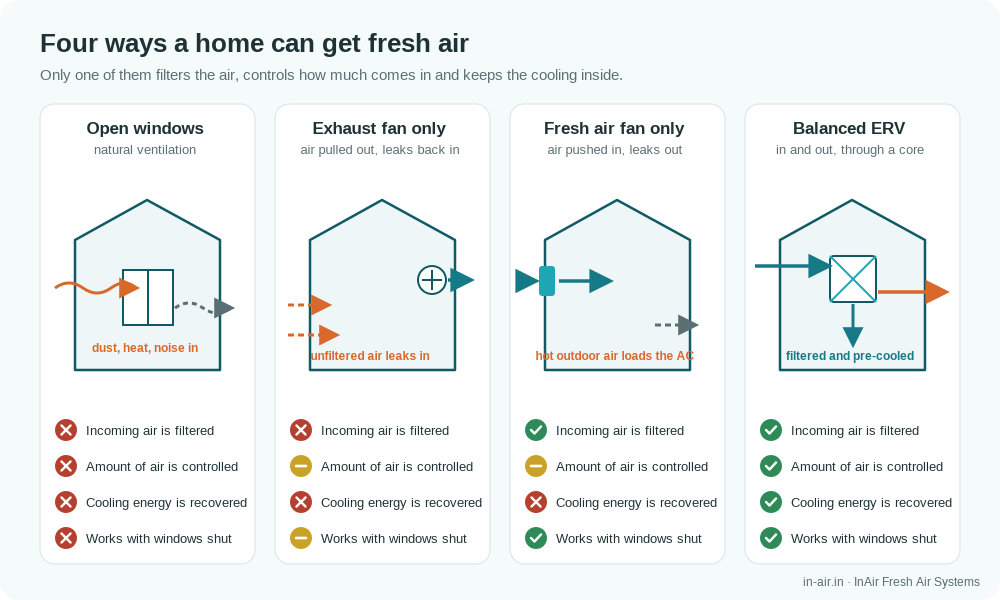
Four ways a home can get fresh air
1. Open windows (natural ventilation)
Free and effective when the weather allows: in Bengaluru for much of the year, on a breezy evening in Hyderabad, during a clear winter morning in Chennai. But the flow depends on wind and temperature, nothing is filtered, and an open window lets in noise, mosquitoes and smog. In an air-conditioned room it also lets out the cooling.
2. Exhaust fan only
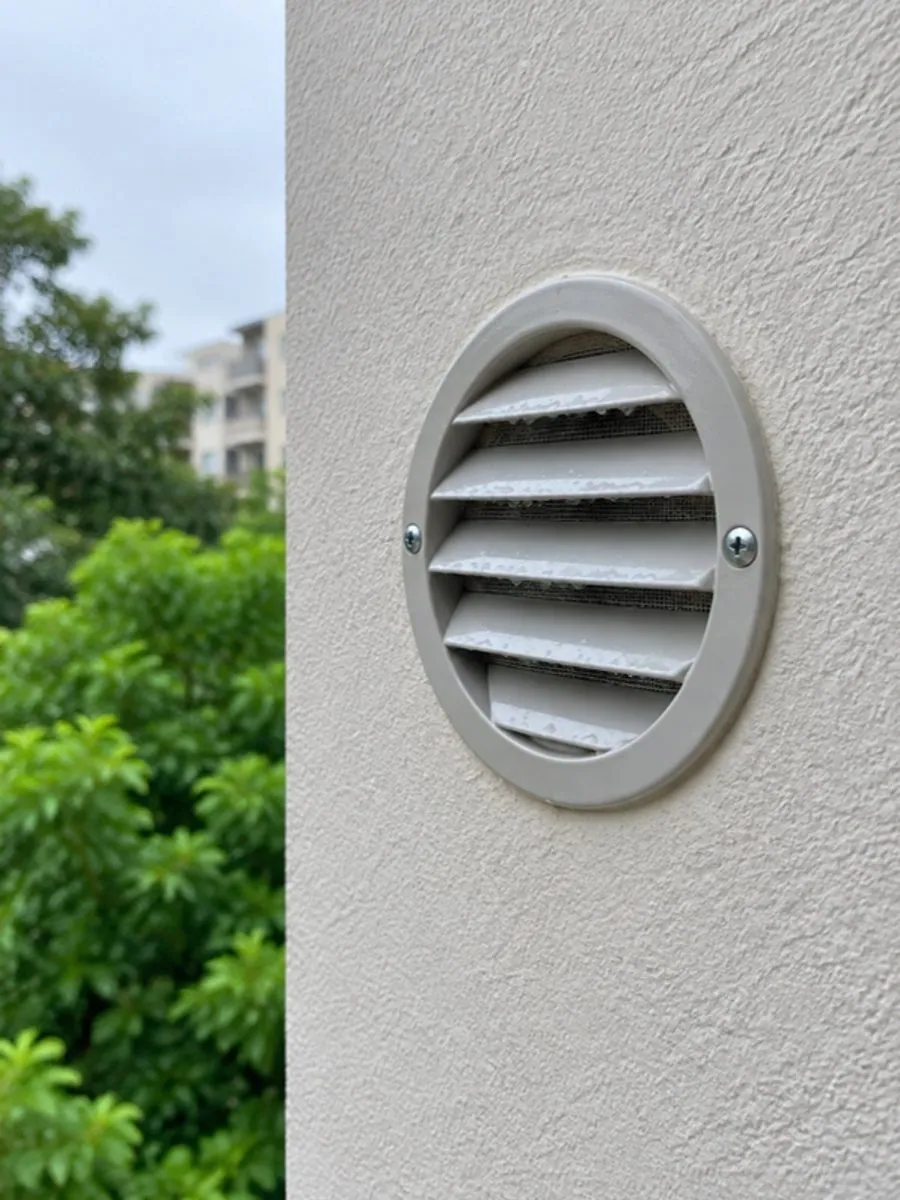
An exhaust fan pulls air out of one room, and the same amount leaks back in through gaps, door undercuts and shafts, unfiltered and unmeasured. It is the right tool for toilets and kitchens. It is not a way to ventilate a bedroom. Exhaust fan vs fresh air system explains why.
3. Fresh air fan only (supply-only)
A supply fan pushes filtered outdoor air in, and stale air escapes through gaps. This works for CO₂ and dust, but all the outdoor heat and moisture go straight to the AC, which, as the numbers above show, is costly in an Indian summer and monsoon. Treated fresh air (TFA) units used in commercial buildings are a large version of this; see TFA vs ERV.
4. Balanced ventilation with energy recovery (ERV)
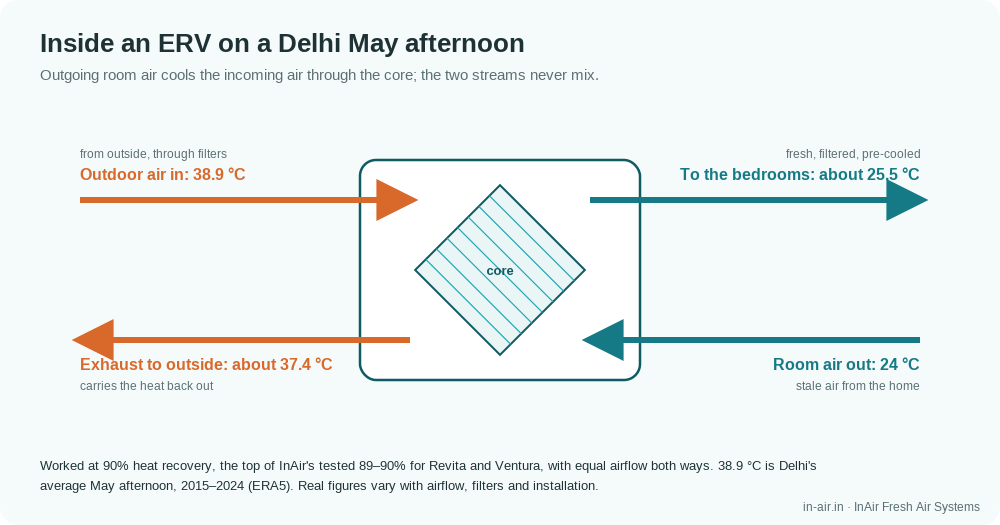
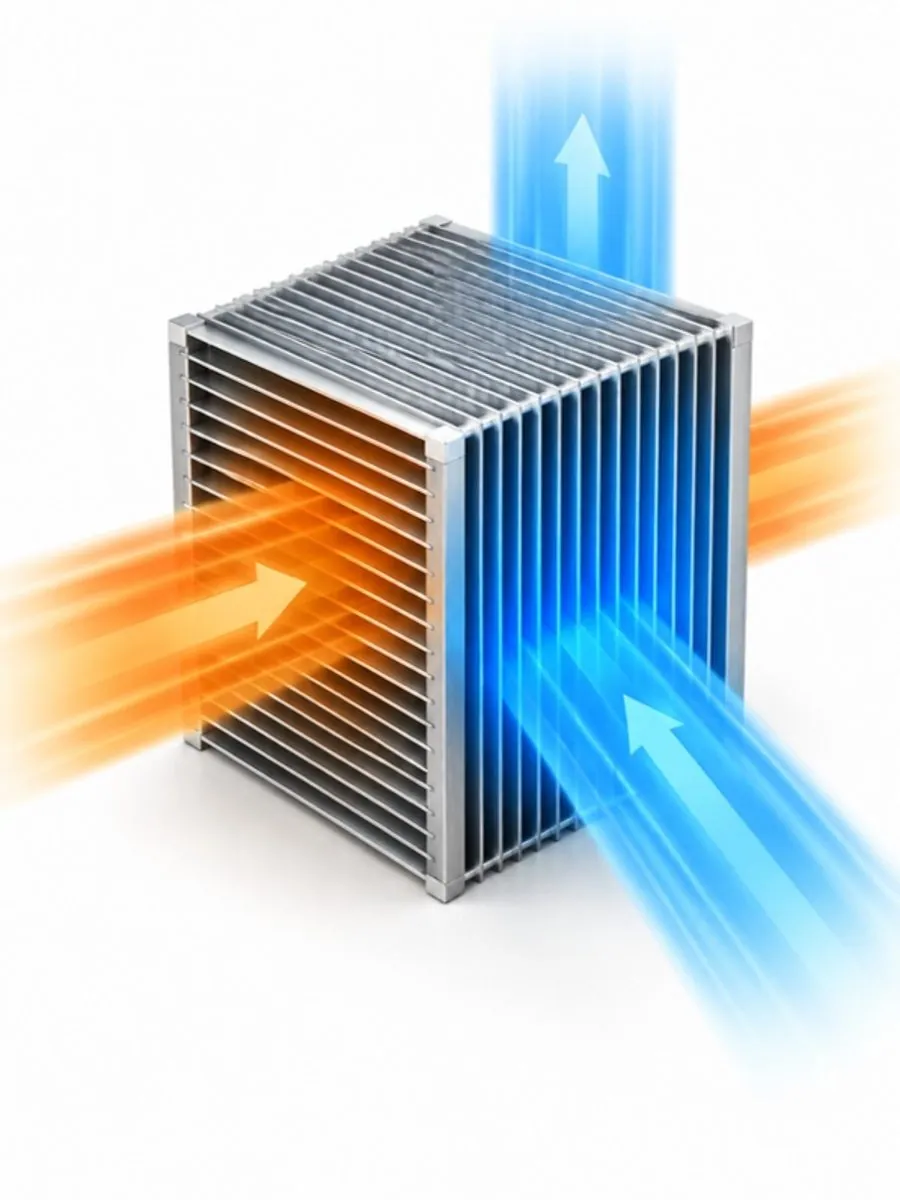
An ERV moves equal amounts of air in and out through a core where the two streams pass each other without mixing. The cool, dry air leaving the home pre-cools the hot air coming in. InAir's Revita and Ventura ERVs recover 89–90% of the heat in testing.
How much fresh air does a home need?
The standard for homes is ASHRAE 62.2. It sets a minimum continuous rate of 0.03 cfm per square foot of floor plus 7.5 cfm per person, counting people as bedrooms plus one. India's National Building Code 2016 (Part 8) covers mechanical ventilation and air conditioning in buildings, and InAir uses ASHRAE 62.2 for homes. Full tables are in fresh air requirements under ASHRAE and NBC.
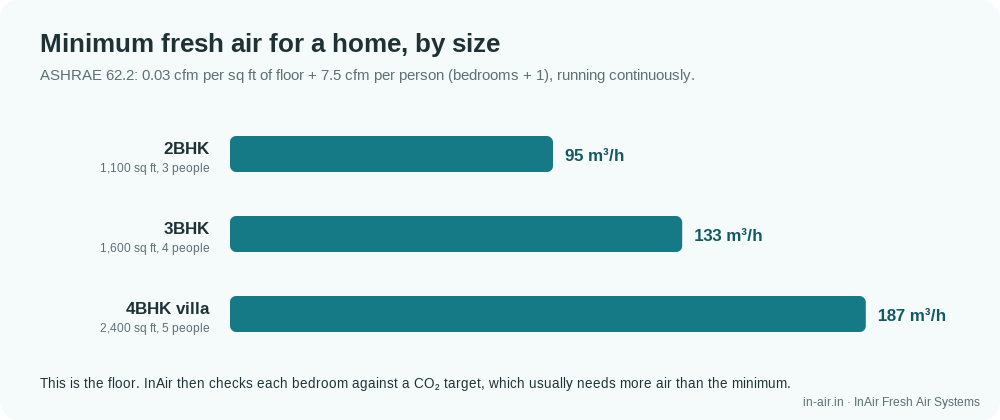
The whole-house figure is a floor, not a target. What matters is how much of that air reaches each bedroom at night, when doors are shut and the most people are breathing in the smallest rooms. A useful check is a CO₂ monitor:
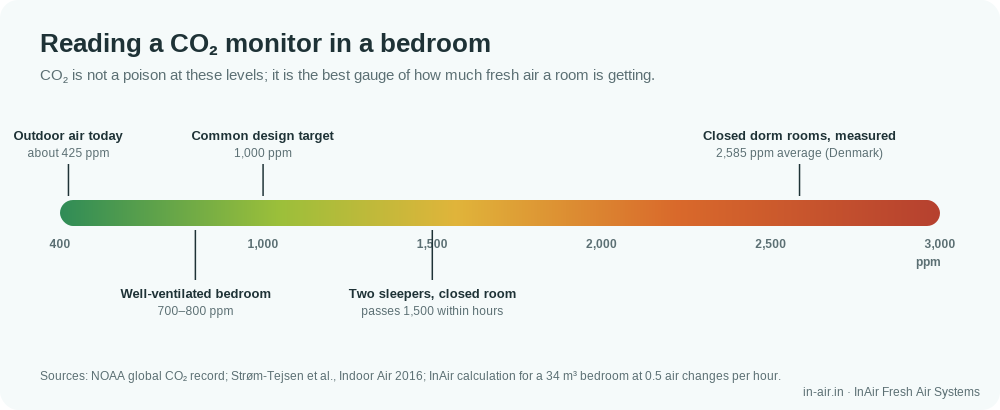
In a Danish study, students slept in rooms averaging 2,585 ppm with the window shut and 660 ppm with it open; with the lower CO₂ they slept better and did better on a test of logical thinking the next day. No published study has yet measured CO₂ overnight in Indian bedrooms. InAir is collecting its own readings, and the ERV sizing calculator gives a first estimate for your home.
Room by room
| Room | What it needs | How |
|---|---|---|
| Bedrooms | Steady fresh air all night, quietly | ERV supply to each bedroom; keep doors undercut or add transfer grilles |
| Living and dining | Fresh air when occupied; more during parties and pujas | ERV supply; CO₂ sensor can raise the speed |
| Kitchen | Remove smoke, steam and NO₂ at the stove | Hood ducted outdoors; ASHRAE 62.2 asks for 100 cfm (170 m³/h) when cooking |
| Toilets | Remove smells and moisture | Exhaust fan, 50 cfm (85 m³/h) when in use or 20 cfm (34 m³/h) continuously |
| Puja room | Clear incense and lamp smoke | Fresh air or a small exhaust; never burn incense in a sealed room |
| Home office | Stay below about 1,000 ppm CO₂ through the day | ERV supply; a CO₂ display helps |
| Wardrobes, storerooms | Avoid damp and mould in the monsoon | Keep relative humidity below about 60%; leave air paths |
On humidity, many guides recommend 30–50% relative humidity. That is realistic in a cold, dry climate. In India the practical aim is to stay below about 60%, the level above which the US Environmental Protection Agency warns that mould can grow.
Filtration for Indian air
Fresh air is only as clean as the filter it passes through. InAir systems use a washable pre-filter for coarse dust and a MERV-13 filter, which captures at least 85% of particles of 1–3 µm under ASHRAE Standard 52.2. In high-pollution cities a HEPA-13 stage, rated at 99.95% at the most penetrating particle size under EN 1822, can be added to the supply. For Delhi NCR, Kolkata and the Indo-Gangetic plain in winter, we recommend HEPA-13; our Delhi winter case study shows why.
Choosing a system for your home

- Being built or fully renovated: a ducted ERV above the false ceiling serves every room from one unit.
- Finished flat, no false ceiling: a wall-mounted ERV in each bedroom needs one wall opening and a power point; see wall-mounted ERVs in India.
- High-AQI city or allergies: add HEPA-13 on the supply.
- Smart control: CO₂ and PM2.5 sensors can raise and lower the airflow automatically; see demand-controlled ventilation.
- Keep local exhaust: toilets and kitchens still need their own fans and hood.
Sizing by home type is on the fresh air system for home page, and a Hyderabad 3BHK case study shows one installation from survey to handover.
What it costs
As a rough guide, InAir equipment starts from about ₹1.4 lakh per room for a wall-mounted ERV and from about ₹2.1 lakh for a ducted system for a home, before GST and installation. The figure for your home depends on its size, layout and city, and InAir confirms it after a free site survey. Pricing has more detail.
Tentative pricing: actual prices may vary based on the site survey.
Looking after it

A fresh air system needs little care, but its filters work hard in Indian air. Clean the pre-filter every one to three months, and replace MERV-13 and HEPA-13 filters when the filter alarm shows, typically every 6–12 months. The full schedule is in the ERV maintenance guide.
Five myths about home ventilation
| Myth | Fact |
|---|---|
| “A house needs to breathe through its gaps.” | Leaks are random, unfiltered and stop when the wind stops. Fresh air should be deliberate, filtered and measured. |
| “My AC brings in fresh air.” | A split AC recirculates room air. It brings in no outdoor air at all. |
| “An air purifier is enough.” | Purifiers remove particles but not CO₂ or moisture. A sealed room with a purifier still goes stale. |
| “Ventilation will push up my power bill.” | Untreated fresh air does add load, as the city chart shows. Energy recovery returns most of it. |
| “Fresh air means letting in the smog.” | Not when it passes a MERV-13 or HEPA-13 filter; open windows are the route by which smog gets in unfiltered. |
Home ventilation checklist
- Bedrooms get fresh air overnight with the door and windows shut.
- CO₂ in the bedrooms stays below about 1,000 ppm through the night.
- Incoming air passes a MERV-13 filter, with HEPA-13 in high-AQI cities.
- Every toilet has an exhaust fan ducted outdoors; the kitchen has a ducted hood.
- Indoor relative humidity stays below about 60% in the monsoon.
- The outdoor intake is away from kitchen exhausts, flues, drains and parking.
- Doors have an undercut or transfer grille so air can move between rooms.
- Pre-filters are cleaned every 1–3 months; main filters are replaced on time.
- Mosquito coils and incense are not burned in sealed rooms.
- Fresh air is increased for a few months after new furniture or painting.
Sources
- Hersbach H. et al., The ERA5 global reanalysis, Quarterly Journal of the Royal Meteorological Society, 2020; data accessed through the Open-Meteo historical weather API (CC BY 4.0). Daily values 2015–2024; analysis by InAir.
- Centre for Science and Environment, winter air pollution analysis of six megacities, 18 March 2025, based on CPCB data.
- Central Pollution Control Board, National Ambient Air Quality Standards (PM2.5: 60 µg/m³ 24-hour, 40 µg/m³ annual); World Health Organization, Global Air Quality Guidelines, 2021 (PM2.5 annual guideline 5 µg/m³).
- ANSI/ASHRAE Standard 62.2, Ventilation and Acceptable Indoor Air Quality in Residential Buildings. ashrae.org
- Bureau of Indian Standards, National Building Code of India 2016, Part 8, Section 3: Air Conditioning, Heating and Mechanical Ventilation.
- Strøm-Tejsen P. et al., The effects of bedroom air quality on sleep and next-day performance, Indoor Air, 2016.
- Liu W. et al., Mosquito coil emissions and health implications, Environmental Health Perspectives, 2003.
- US Environmental Protection Agency, A Brief Guide to Mold, Moisture and Your Home.
- NOAA Global Monitoring Laboratory, trends in atmospheric carbon dioxide.
- ANSI/ASHRAE Standard 52.2 (MERV ratings); EN 1822 / ISO 29463 (HEPA classes).
- ASHRAE Handbook, Fundamentals: psychrometrics (humidity ratio, latent heat of water vapour).
- InAir test data: Revita and Ventura ERVs, 89–90% heat recovery.
Method note: loads are for 100 m³/h of outdoor air brought to 24 °C and 50% relative humidity, using each city's elevation for air pressure. Heat uses the hottest month's average daily maximum; moisture uses the most humid month's average dew point. They are averages, not design peaks, which run higher.
What is the best way to ventilate a house in India?
How much fresh air does a 3BHK need?
Is an ERV or an HRV better for Indian homes?
Does an AC bring in fresh air?
What humidity should I keep my home at in India?
Is it safe to bring outdoor air in when the AQI is bad?
How much does a home ventilation system cost in India?
Our engineers assess your home or building, recommend the right system and the right filter grade for your city, and give you a clear cost estimate. No obligation.