What is HVAC? Heating, ventilation and air conditioning in Indian homes and buildings
Heating, ventilation and air conditioning, explained for Indian homes and buildings: what each part does, how split, VRF and chilled water systems differ, and where fresh air fits.
Last updated:

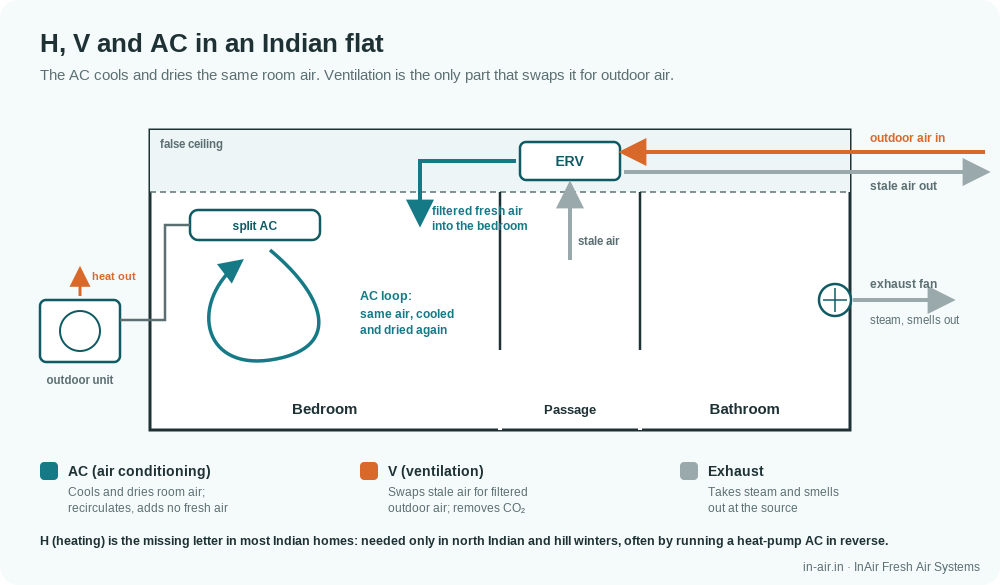
HVAC stands for heating, ventilation and air conditioning: the equipment that controls a building's temperature, humidity and air quality. In most Indian homes it means a split AC and two exhaust fans. Heating is rarely needed, and ventilation, the planned supply of clean outdoor air, is usually missing altogether.
That missing V is what this guide is about, alongside a plain explanation of the cooling systems Indian buildings use and what the building codes say. If you are fitting out a flat, building a villa or running an office, it will help you see which part of HVAC each quote actually covers.
Key points
- H, V and AC are three different jobs. An AC cools and dries air; ventilation replaces it; heating warms it.
- A split AC, VRF indoor unit or fan coil recirculates room air. The US EPA notes that most home heating and cooling systems do not bring in fresh air.
- Each adult breathes out about 12 litres of CO₂ an hour. About 21 m³/h of fresh air per person keeps a room near 1,000 ppm.
- India's National Building Code covers HVAC in Part 8; ECBC 2017 sets energy rules for larger commercial buildings and points to the NBC for fresh air.
- Adding the V to an existing home or office does not mean replacing the ACs. A fresh air unit works alongside them.
The three letters, one at a time
H: heating, the rare one
The Bureau of Energy Efficiency's residential code, Eco-Niwas Samhita 2018, starts from the fact that most of India has a cooling-dominated climate. ECBC 2017 divides the country into five climate zones, composite, hot-dry, warm-humid, temperate and cold, and only the cold zone and north Indian winters call for real heating. Where it is needed, the usual answer is a heat-pump split AC run in reverse, or an air handler with a heating coil. InAir's RHP units, for example, can heat as well as cool the fresh air.
V: ventilation, the forgotten one
Ventilation means taking stale indoor air out and bringing the same amount of outdoor air in. It is the only way to remove carbon dioxide, moisture and household gases that filters cannot catch. Each resting adult breathes out about 12 litres of CO₂ an hour; with outdoor air near 425 ppm, about 21 m³/h of fresh air per person holds a room near 1,000 ppm. A closed, air-conditioned bedroom with two people gets nowhere near that.
The US EPA puts it plainly in its guide to indoor air: most home heating and cooling systems do not mechanically bring fresh air into the house. India's National Building Code recommends 20–30 m³/h of fresh air per person, and ASHRAE 62.2, the reference for homes, sets a whole-house rate of 0.03 cfm per square foot plus 7.5 cfm per person. For a 1,600 sq ft 3BHK with four people, that is about 133 m³/h, around the clock.
Exhaust fans are part of the V too. The NBC asks for 6–10 air changes an hour in toilets and at least 6 in kitchens, to take steam and smells out at the source. But an exhaust fan pulls replacement air in through whatever gaps it can find, unfiltered. Our exhaust fan vs fresh air system guide explains the difference.
AC: air conditioning, the one everyone has
An air conditioner moves heat from indoors to outdoors and, while its coil is cold, condenses water out of the air. It treats the same room air over and over. That is efficient for cooling, but it means the AC does nothing for CO₂ or stale air.
AC use is growing fast. The India Cooling Action Plan (2019) projects the country's total cooling demand to grow about eight times between 2017–18 and 2037–38, and room air conditioners to rise from about 40% to about 50% of the energy used for space cooling. More sealed, air-conditioned rooms means the V matters more each year.
Split, VRF and chilled water: the cooling systems in brief
| System | How it works | Typical buildings | Where fresh air comes from |
|---|---|---|---|
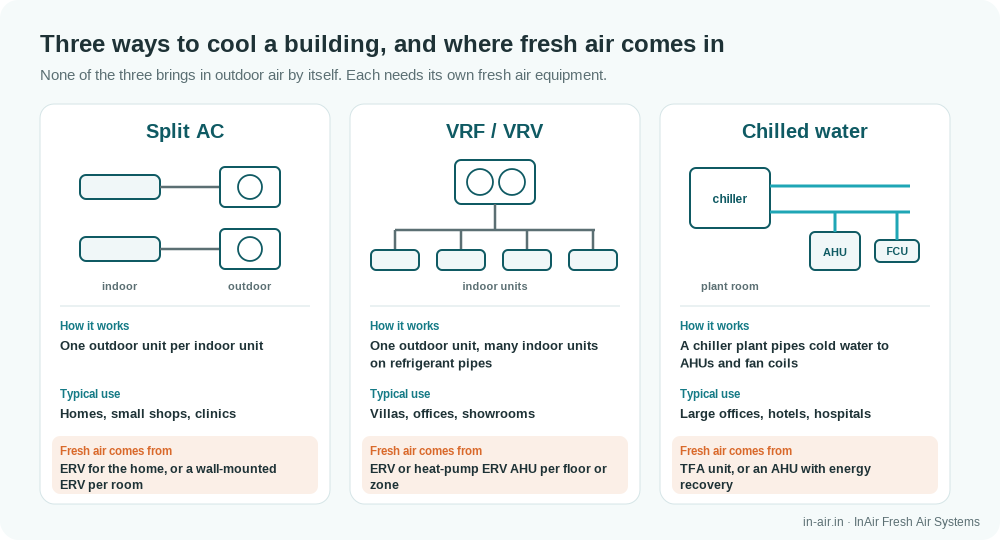
| Split AC | Each indoor unit has its own outdoor unit | Flats, independent houses, small shops and clinics | A fresh air ERV for the home, or a wall-mounted ERV per room |
| VRF / VRV | One outdoor unit serves many indoor units through refrigerant piping, varying the flow to each | Villas, offices, showrooms, schools | An ERV or heat-pump ERV AHU per floor or zone |
| Chilled water | A chiller cools water, which is pumped to air handling units and fan coil units | Large offices, hotels, hospitals, malls | A treated fresh air (TFA) unit, or an AHU with energy recovery |
Our explainer What is an AHU? covers the air handlers that sit in each of these systems.
Where fresh air fits, and why humidity matters
Fresh air has to be cooled and dried before it is comfortable, and in India the drying is the larger cost. From ten years of ERA5 weather data, InAir's analysis puts the load from 100 m³/h of untreated outdoor air at about 0.48 kW of heat on an average May afternoon in Delhi, but 0.88 kW of moisture on an average July day; 0.88 kW in Mumbai in June and 1.01 kW in Kolkata.
That is why a good fresh air system in India does two things: it filters the air, and it recovers energy from the outgoing air so the AC is not fighting the outdoor heat and humidity. InAir's Revita and Ventura ERVs recover 89–90% of the heat in the outgoing air (tested). In the most humid cities, a heat-pump ERV AHU such as InAir's RHP also cools and dries the fresh air to a set 22–28 °C.
- Flat or independent house: a ducted ERV in the false ceiling supplying bedrooms and living areas, or a wall-mounted ERV where the interiors are finished. The split ACs stay.
- Villa or office on VRF: an ERV or heat-pump ERV AHU per floor, with ducts to each zone.
- Large chilled-water building: a fresh air unit on each floor or in the plant room, ideally with energy recovery.
What the Indian codes say
National Building Code 2016 (NBC). Part 8, Building Services, covers HVAC in two places: Section 1 (Lighting and Natural Ventilation) sets ventilation requirements and the air change rates for rooms, and Section 3 (Air Conditioning, Heating and Mechanical Ventilation) covers the design of mechanical systems. BIS describes the NBC as a model code for adoption by government departments, local bodies and private builders.
Energy Conservation Building Code 2017 (ECBC). It applies to commercial buildings with a connected load of 100 kW or more, or a contract demand of 120 kVA or more; private homes are not covered. Its mandatory section requires every habitable space to be ventilated with outdoor air in line with the NBC (§5.2.1). It asks for CO₂-based demand control ventilation in large, crowded spaces, and for air-to-air heat recovery of at least 50% effectiveness in hotels and hospitals whose systems exceed 2,100 l/s with 70% or more outdoor air (§5.3.11). States adopt ECBC through their own notifications, so check what your local authority enforces.
Eco-Niwas Samhita 2018. The residential energy code. Part I deals with the building envelope, walls, roofs and windows, rather than HVAC equipment.
For the fresh air rates themselves, see fresh air rates under NBC and ASHRAE.
Common myths about HVAC
| Myth | What is actually true |
|---|---|
| My AC brings in fresh air | Split ACs, VRF indoor units and fan coils recirculate room air. The EPA notes most home heating and cooling systems do not bring in outdoor air. |
| HVAC is only for offices and malls | Every home with an AC and exhaust fans has HVAC. What it usually lacks is the V. |
| An exhaust fan ventilates the whole flat | It removes air from one room and pulls unfiltered replacement air through gaps. Bedrooms get little of it. |
| Fresh air will push my AC bill up | Untreated fresh air does add load. An ERV recovers most of it from the outgoing air, so the AC sees much less. |
| An air purifier does the same job as ventilation | A purifier removes particles from room air but cannot lower CO₂ or stale moisture. See air purifier or fresh air system. |
How InAir checks this at the site survey
The survey is free. An InAir engineer:
- lists the rooms, their use and how many people use them, to set the fresh air quantity;
- notes the cooling system already in place, split, VRF or chilled water, and where fresh air can join it;
- checks ceiling depth, the duct route and where an intake and exhaust can go on the outside wall, apart from each other;
- looks at the city's humidity and smog to choose between an ERV and a heat-pump ERV, and between MERV-13 and HEPA-13 filters;
- checks the power supply (RHP units need three-phase).
You get a written recommendation and a quote. If your home or office already gets enough fresh air, we tell you.
What it costs to add the V
InAir's Revita ERV for a 1–2 BHK starts from ₹2.1 lakh and for a 3–4 BHK from ₹2.6 lakh. A wall-mounted ERV for a finished room starts from ₹1.4 lakh per unit, and RHP heat-pump ERV AHUs start from ₹9.4 lakh. Prices are for the unit, before GST and installation; the price guide has the rest, and the ERV sizing calculator gives a first airflow for your home.
Tentative pricing: actual prices may vary based on the site survey.
Sources
- Bureau of Indian Standards, National Building Code of India 2016: contents of Part 8, Building Services. www.bis.gov.in
- Bureau of Energy Efficiency, Energy Conservation Building Code 2017 (Rev. 2019): scope, §5.2.1 ventilation, §5.3.11 energy recovery, climate zones. datacenters.lbl.gov
- Bureau of Energy Efficiency, Eco-Niwas Samhita 2018, Part I: Building Envelope. policy.asiapacificenergy.org
- US EPA, The Inside Story: A Guide to Indoor Air Quality. www.epa.gov
- Ministry of Environment, Forest and Climate Change, India Cooling Action Plan (2019). ozonecell.nic.in
- ASHRAE 62.2-2022 Addendum e: residential ventilation rates. www.ashrae.org
- CSIR, Guidelines on Ventilation of Residential and Office Buildings (2022): 20–30 m³/h per person, after NBC. niti.gov.in
What is HVAC in simple words?
Is AC the same as HVAC?
Does a split AC bring in fresh air?
What is the difference between split, VRF and chilled water systems?
Which Indian code covers HVAC?
Do I need to replace my ACs to add fresh air?
Our engineers assess your home or building, recommend the right system and the right filter grade for your city, and give you a clear cost estimate. No obligation.