Inline vs wall exhaust fan: which one should you choose?
A wall fan blows straight out; an inline fan pushes air through a duct. Which one you need depends mostly on the duct, then on noise.
Last updated:
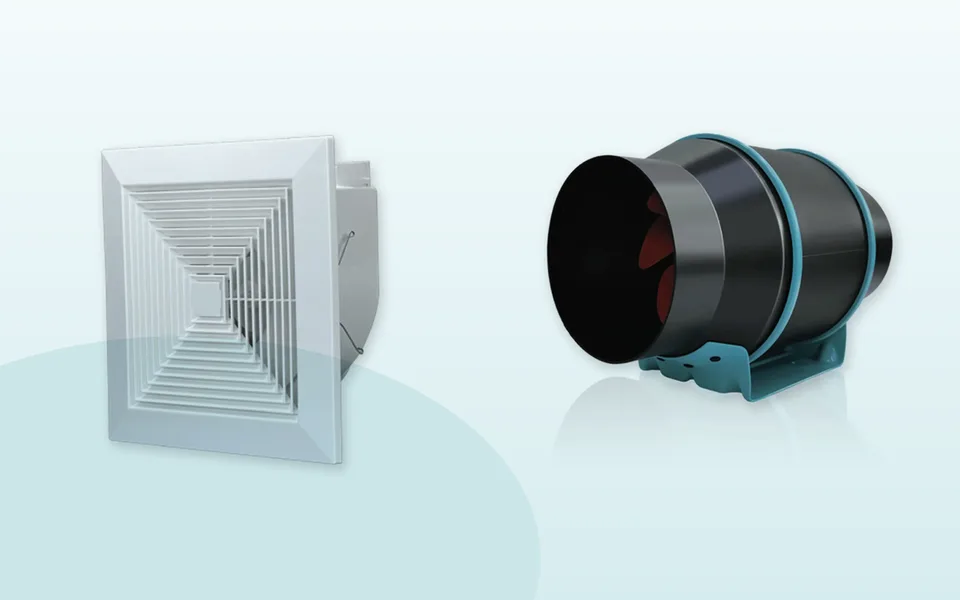
Choose a wall (or window) exhaust fan when the bathroom or kitchen has an outside wall and the fan can blow straight out, with no duct. Choose an inline fan when there is a duct: a windowless bathroom, a route through a shaft or false ceiling, bends, two rooms on one fan, or a room where quiet matters. Duct length is the deciding factor.
Key points
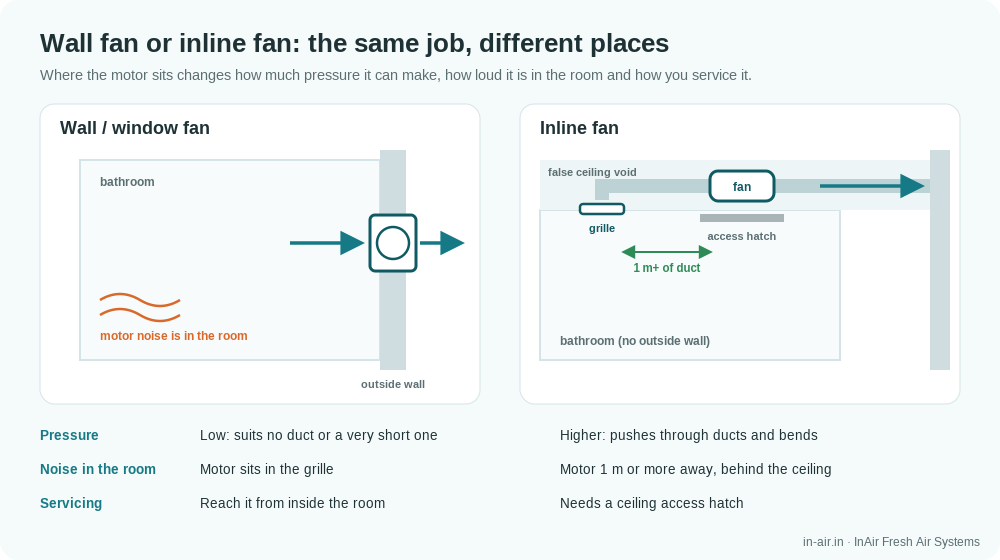
- Pressure: wall fans are usually axial, built for high airflow at low pressure. Inline fans are usually mixed-flow or centrifugal designs, which make more pressure. InAir's inline duct fans are published at up to 382 Pa.
- Duct: a wall fan works with no duct or a very short one. Once there is a duct of a few metres with bends, an inline fan keeps far more of its airflow.
- Noise: ASHRAE 62.2 exempts remote-mounted fans from its sound limits when there is at least 1 m of duct between the fan and the room grille, because the room hears much less of the motor.
- Installation and service: a wall fan needs a hole in an outside wall and is easy to reach. An inline fan needs a false ceiling and an access hatch.
- Cost: a wall fan is the cheaper fan; an inline fan adds duct, grille and terminal. Prices are near the end of this page.
If you are ventilating a bathroom from scratch, start with the bathroom ventilation guide for rates and duct routes, and the exhaust fan buying guide for sizing and noise. This page is the head-to-head.
What each one is
A wall fan (or window fan) is mounted in an opening in an outside wall or a window pane. The motor and blades sit in the opening; air goes straight from the room to the outdoors. Most are axial fans: a propeller on a motor.
An inline fan is fitted inside the duct, usually in the false ceiling or a service void. The room has only a grille; the duct carries air from the grille to the fan and on to an outside terminal. Inline fans are usually mixed-flow designs, in which air enters along the axis and leaves at an angle, or centrifugal designs. Both build more pressure than an axial fan of the same size. InAir's EC inline fans use a mixed-flow design.
Pressure: the difference that matters most
Every metre of duct, every bend, the grille and the outside cowl resist airflow. A fan has to make enough pressure to overcome that resistance, or its airflow collapses. Fan engineers group the types simply: axial fans suit high flow with low pressure rise, mixed-flow fans suit medium pressure and medium flow, and centrifugal (radial) fans suit high pressure.
A wall fan works because it has almost nothing to push against. Add a few metres of duct and it may still spin, but deliver a fraction of its rating. Inline fans are chosen for exactly that duty: InAir's inline and silent duct fans cover 120–920 m³/h with static pressure up to 382 Pa. ASHRAE 62.2 itself rates fan sound at no less than 25 Pa of static pressure, which reflects that a ducted fan never works at zero pressure.
Duct length and bends
ASHRAE 62.2 gives minimum duct sizes for short bathroom runs, of up to about 8 m with no more than three bends. Within those limits the right size of duct is enough for a reasonable fan. Beyond them, or with smaller ducts, the fan must make more pressure.
| Airflow | Minimum rigid round duct | Typical fit |
|---|---|---|
| Up to 85 m³/h (50 cfm) | 100 mm | Wall fan if through-wall; inline if ducted |
| Up to 170 m³/h (100 cfm) | 125 mm | Inline fan for any real duct run |
| Up to 255 m³/h (150 cfm) | 150 mm | Inline or mixed-flow fan |
Flexible duct should be one size larger than rigid, and pulled straight.
Noise at the grille
ASHRAE 62.2 limits bathroom fans used on demand to 3 sones and fans that run all the time to 1 sone. A sone is a measure of perceived loudness: two sones sound twice as loud as one. The standard then makes an exception that sums up the noise argument for inline fans: a remote-mounted fan outside the bathroom and living spaces, with at least 1 m (4 ft) of duct between the fan and the intake grille, need not meet those sound limits at all. The duct and the distance take care of it.
With a wall fan the motor sits in the grille, so whatever it makes, you hear. That is fine in a guest WC used for a few minutes; it is not fine in an en-suite next to a bedroom, or with a fan that runs continuously. InAir's inline fans are rated from 21 to 45 dB(A) depending on model and speed, and they sit behind the ceiling, away from the grille.
Installation
| Step | Wall fan | Inline fan |
|---|---|---|
| Opening | Core cut or window pane cut-out in an outside wall | Ceiling grille; wall or roof outlet at the end of the duct |
| Ceiling | Not needed | Needs a false ceiling or service void |
| Duct | None or very short | Sized to airflow; sealed joints; backdraft shutter |
| Where it suits | Existing bathrooms with an outside wall | New builds, renovations, windowless bathrooms |
| Disruption | Small | Easiest during construction or false-ceiling work |
Servicing
Any exhaust fan collects dust and, in a kitchen, grease. A wall fan is easy: switch off, remove the grille, clean the blades. Its weakness is the weather. It faces the outside directly, so it needs a shutter or cowl to keep rain, wind and insects out.
An inline fan is protected inside the ceiling, but you cannot service what you cannot reach. It needs an access hatch directly below it. The room grille still needs cleaning from inside. A well-placed inline fan is serviced less often, not never.
Which one wins: decision table
| Your situation | Choose | Why |
|---|---|---|
| Bathroom with an outside wall, fan can blow straight out | Wall fan | No duct, so low pressure is enough; cheapest and simplest |
| Windowless bathroom, duct to an outside wall or shaft | Inline fan | Needs pressure to push through the duct |
| En-suite next to a bedroom | Inline fan | Motor is away from the grille; quieter at night |
| Fan to run all the time at low speed | Inline EC fan | Quiet at low speed; speed control |
| Two adjacent bathrooms | One inline fan, if the duct route allows | One motor, two grilles; checked on site |
| Guest WC used briefly, outside wall | Wall fan | Short use; noise matters less |
| No false ceiling and no outside wall | Neither yet | Needs a route first; see the site survey section |
Not sure how much air the room needs? Use the air changes calculator first, then pick the fan type with this table.
How InAir checks this at the site survey
- Whether the room has an outside wall the fan can discharge through, and where the outlet would sit relative to windows.
- The length of the possible duct route, its bends, and whether there is a false ceiling deep enough for an inline fan and an access hatch.
- Whether one fan can serve two bathrooms on the same route.
- How quiet the room needs to be, and whether the fan should run continuously or on a timer or humidity sensor.
- After installation, the airflow measured at each grille.
What it costs
InAir bathroom and toilet exhaust fans (wall and ceiling mounted) start from ₹3,300. Mixed-flow inline fans start from ₹6,600, and EC inline duct fans with a speed or smart controller from ₹15,000. An inline installation also needs a grille and an outside cowl, from ₹1,500 each, and duct; flexible duct and noise reducers start from ₹4,400 each. Prices are before GST and installation. See pricing.
Tentative pricing: actual prices may vary based on the site survey.
Common mistakes
- Fitting a wall fan at one end of a long duct and expecting its box airflow.
- Fitting an inline fan with no access hatch, so nobody can service it.
- Placing the inline fan right above the grille, which gives up most of the noise benefit.
- Blowing either fan into a false ceiling or an enclosed shaft instead of outdoors.
- Leaving out the backdraft shutter on a wall fan, so monsoon rain and wind come straight in.
Sources
- ASHRAE 62.2-2022 Addendum e: local exhaust rates, fan sound limits and the exception for remote-mounted fans (Section 7.3). ashrae.org (PDF)
- ASHRAE 62.2-2016 Addendum u: Table 5.3, duct sizing. ashrae.org (PDF)
- Electronics Cooling, General aspects on fan selection and layout (2001): axial, mixed-flow and radial fan duties. electronics-cooling.com
- InAir product pages: inline and silent duct fans, mixed-flow fans, EC inline fans; InAir price list FY 2026–27.
Which is better for a bathroom, an inline fan or a wall fan?
Are inline exhaust fans quieter than wall fans?
Can a wall exhaust fan be connected to a duct?
Can one inline fan serve two bathrooms?
Does an inline fan need maintenance?
Is an inline fan more expensive?
Our engineers assess your home or building, recommend the right system and the right filter grade for your city, and give you a clear cost estimate. No obligation.