Inline duct fans explained: when to use one, how to size it and how to keep it quiet
An inline fan lives in the duct, not on the wall. Here is when that is the right choice, how to size one and how to install it so it stays quiet and serviceable.
Last updated:

An inline duct fan sits inside the duct, in the false ceiling or a service void, instead of on the wall of the room. It suits ducted ventilation: long or bent duct runs, several rooms on one fan, rooms with no outside wall, and bedrooms or bathrooms that need to stay quiet. Size it by airflow and duct pressure together, and leave access to service it.
Key points
- Where it wins: any duct longer than a short straight run, one fan serving several grilles, or a quiet room. Wall-mounted propeller fans make little pressure and are not meant for extensive ductwork (US DOE).
- Type: mixed-flow fans combine axial-style airflow with centrifugal-style pressure; centrifugal fans make the most pressure.
- Motor: an EC motor gives stepless speed control; at 80% speed a fan draws about half the power, by the fan laws.
- Sizing: choose at the airflow you need and the pressure your duct adds, from the fan's published curve.
- Service: an access panel under the fan, a silencer if the room is noise-sensitive, and sealed joints on the pressure side.
What an inline duct fan is
An inline fan has a casing with a round spigot at each end, so it fits into a duct run like a length of pipe. Air comes from one or more grilles, passes through the fan and leaves through an outdoor terminal. Because the motor sits away from the room, much of its noise stays in the ceiling. InAir's inline and silent duct fans cover 120–920 m³/h at noise ratings from 21 to 45 dB(A), depending on model and speed, with static pressure up to 382 Pa. If you are deciding between a wall fan and an inline fan for one bathroom, see inline vs wall exhaust fan.
Where inline fans beat wall fans
The US Department of Energy's fan sourcebook, written with the fan industry body AMCA, describes propeller fans, the type in most wall and window exhaust fans, as making high airflow at low pressure, and so usually not combined with extensive ductwork. Once a duct is involved, pressure decides how much air actually moves. Inline fans are built for that:
| Situation | Wall or window fan | Inline duct fan |
|---|---|---|
| Bathroom on an outside wall, no duct | Simple and cheap | Not needed |
| Bathroom in the middle of a flat, duct to a shaft or façade | Loses most of its airflow | Made for the duct's pressure |
| Two or three bathrooms on one duct | One fan per room | One fan, several grilles |
| Quiet en-suite next to a bedroom | Motor in the room | Motor in the ceiling, silencer possible |
| Fresh air supply to a room | Unfiltered | Can work with a filter box |
Mixed-flow or centrifugal?
Most inline fans in homes are one of two types. A technical note on RS DesignSpark explains that a mixed-flow fan takes air in axially and its impeller throws it out at an angle of around 45°, combining some of the high airflow of an axial fan with some of the pressure of a backward-curved centrifugal fan. The DOE sourcebook describes centrifugal fans as capable of high pressures with high efficiency.
| Type | Strength | Typical use |
|---|---|---|
| Mixed-flow inline | Good airflow at moderate pressure, compact, quiet | Bathroom and kitchen extract in homes, small offices |
| Forward-curved centrifugal | Quiet at low speed; DOE gives 55–65% efficiency | Fresh air and extract units, cabinet fans |
| Backward-inclined centrifugal | Highest efficiency; DOE gives over 85% for airfoil blades | Larger systems, longer runs, filters |
| Axial (tube or vane) | High airflow at medium pressure; vane types reach higher pressure | Larger ducted extract and supply |
InAir's range includes mixed-flow, direct duct and circular duct fans and inline AC fans with forward-inclined double-suction impellers. For larger commercial duties, InAir cabinet centrifugal fans reach 1,700–120,000 m³/h and up to 1,300 Pa.
EC or AC motor?
An AC fan runs at a fixed speed, or a few steps. An EC (electronically commutated) fan, often sold as BLDC, has electronics that let it run at any speed. That matters because of the fan laws. The DOE sourcebook states that airflow changes in step with fan speed but power changes with the cube of speed. Run a fan at 80% speed and it moves about 80% of the air for about half the power; at 50% speed, about one-eighth.
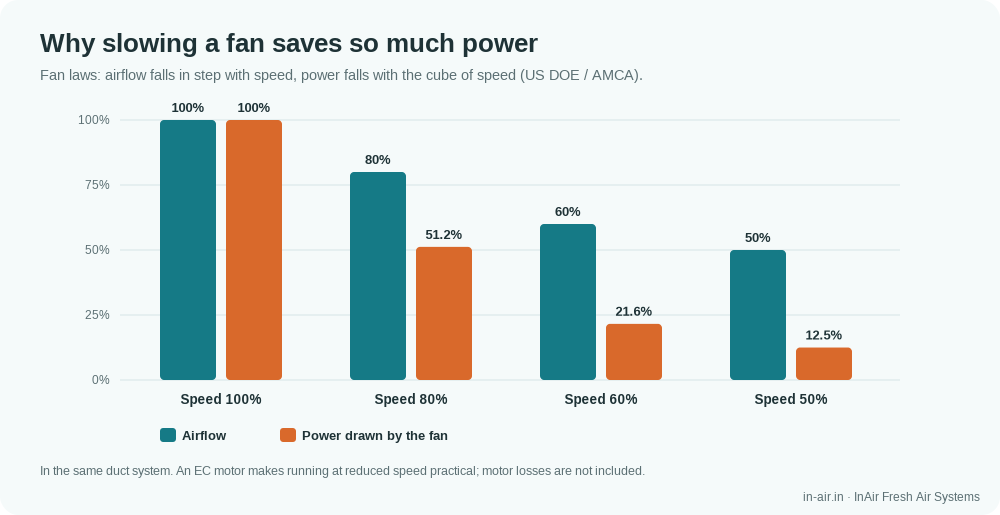
That is why a continuously running fan with an EC motor can run gently most of the time and boost when the room is used. InAir's EC inline duct fans use PWM speed control with a 10-speed controller, an optional temperature and humidity sensor, and BMS connection. The DOE also notes that motor efficiency falls significantly below half of a motor's rating, so a fan oversized and throttled back on a fixed-speed motor wastes energy.
Sizing: airflow and pressure together
Start with airflow. For bathrooms, India's National Building Code recommends 6–10 air changes an hour, and ASHRAE 62.2 at least 85 m³/h (50 cfm) for an intermittent fan or 34 m³/h (20 cfm) continuous; for public toilets, ASHRAE 62.1 gives 50 cfm (85 m³/h) per WC. The air changes calculator does this for each room. Add up the rooms on the same fan.
Then the pressure: the duct, bends, grilles, silencer, backdraft shutter and outdoor cowl all add resistance, rising with the square of air speed. Find the airflow you need on the fan's published curve, at the pressure your system adds, not at zero pressure. The fan selection guide walks through reading a fan curve.
Silencers and noise
Putting the fan in the ceiling is the first noise step. The second is a duct silencer between the fan and the room grilles, or between fan and outlet if the noise is heard outdoors. The NBC's noise guidance for ventilation systems says to choose silencers that do not significantly increase the fan's pressure, to select fans that run near their peak efficiency because an oversized or undersized fan can be much louder, and to isolate vibration where the fan is fixed to the structure.
For the room itself, UK Approved Document F sets 45 dB(A) as the limit for kitchens and bathrooms when an intermittent fan runs, and 30 dB(A) for bedrooms with continuous ventilation on its low rate. ASHRAE 62.2 limits continuous fans to 1.0 sone and intermittent ones to 3 sones. Our quiet ventilation guide explains these units.
Access for service
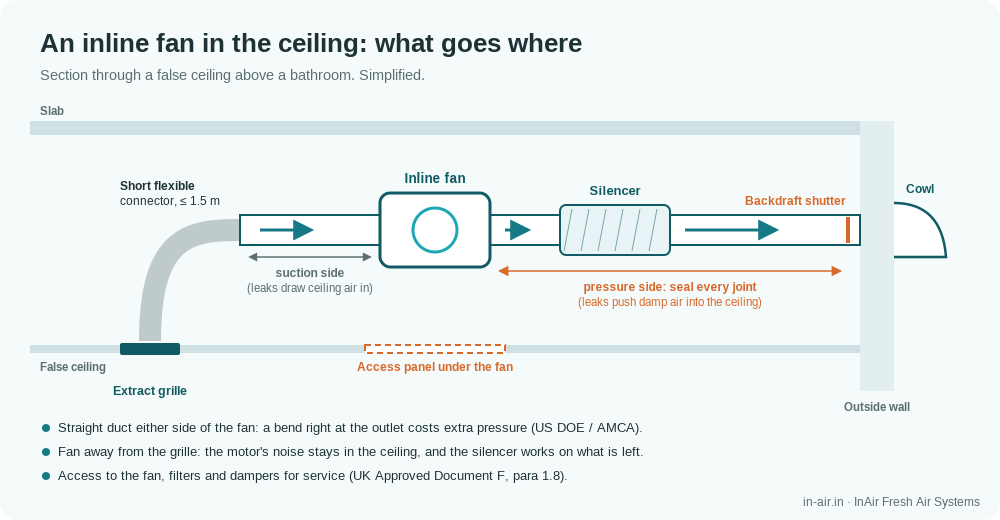
An inline fan hidden above a sealed gypsum ceiling cannot be cleaned, repaired or replaced. Approved Document F asks for reasonable access to replace filters, fans and coils, and access points for cleaning ductwork. In practice that means an access panel directly under the fan, big enough to lower it out, and clips or flexible connectors that let it be removed without cutting the duct.
Inline fans also put part of the duct under pressure. Between the grille and the fan, the duct is under suction and any leak draws ceiling-void air in. After the fan, it is under pressure, and a leak pushes damp, smelly bathroom air into the ceiling. Those joints need to be both mechanically fixed and sealed.
How InAir checks this at the site survey
- the airflow each room needs, and which rooms can share one fan;
- the duct route, length and bends, and so the pressure the fan must make;
- space and access in the ceiling at the fan position;
- whether a silencer is needed for an adjoining bedroom;
- the outlet position and terminal, with a backdraft shutter;
- controls: timer, humidity sensor, speed controller or BMS link.
Every InAir installation includes commissioning with measured airflow readings. Book a free site survey.
What it costs
InAir mixed-flow inline fans start from ₹6,600, circular duct fans from ₹13,600, EC inline duct fans with speed or smart controller from ₹15,000 and direct duct fans from ₹17,100. Noise reducers start from ₹4,400 each. Prices are before GST and installation.
Tentative pricing: actual prices may vary based on the site survey.
Common mistakes
- Choosing the fan by its free-air rating and fitting it to a long duct.
- A bend right at the fan outlet.
- No access panel, so a small fan repair becomes a ceiling demolition job.
- Unsealed joints after the fan, leaking damp air into the ceiling.
- An oversized AC fan run on a speed regulator instead of a correctly sized EC fan.
- No backdraft shutter at the outlet.
Sources
- US DOE and AMCA, Improving Fan System Performance: A Sourcebook for Industry: fan types, efficiencies, fan laws, system effect, motor part-load.
- RS DesignSpark: why choose a mixed-flow (diagonal) fan.
- National Building Code of India 2005, Part 8, Section 3, Annex G: noise control in ventilation systems.
- UK Approved Document F, Volume 1 (2021): access for maintenance, noise levels.
- ASHRAE 62.2-2022 Addendum e: bathroom exhaust rates and fan sound limits.
- InAir product pages and price list (FY 2026–27).
What is an inline duct fan used for?
Is an inline fan quieter than a wall exhaust fan?
What size inline fan do I need for a bathroom?
Mixed-flow or centrifugal inline fan: which is better?
Are EC inline fans worth the extra cost?
Where should an inline fan be installed?
Our engineers assess your home or building, recommend the right system and the right filter grade for your city, and give you a clear cost estimate. No obligation.