How to ventilate a bathroom in India: rates, ducts, shafts and damp
A bathroom fan only works if the air goes outside, fresh air can get in, and the fan runs long enough. This guide covers all three for Indian homes.
Last updated:
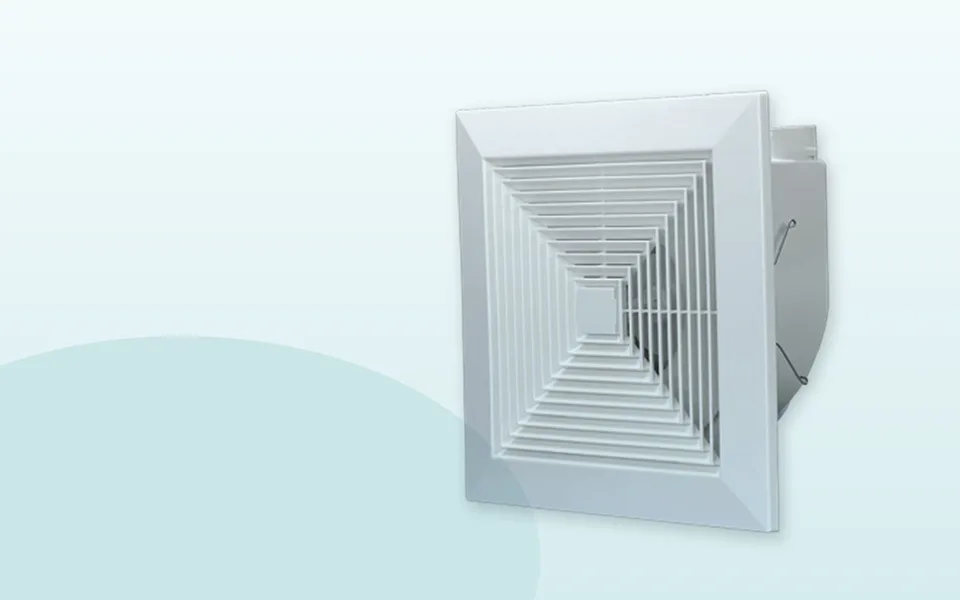
An Indian bathroom needs its air pulled out to the open air at 6–10 air changes an hour (15–20 for a shower room), and never less than about 85 m³/h. That air must leave through a duct that ends outside, not in a shaft or false ceiling. Air must be able to come in under the door, and the fan should keep running for about 15 minutes after you leave.
Key points
- Rate: NBC asks for 6–10 air changes an hour for toilets and bathrooms and 15–20 for shower rooms. ASHRAE 62.2 sets a floor of 85 m³/h (50 cfm) for an on-demand bathroom fan, or 34 m³/h (20 cfm) if it runs all the time.
- Outlet: the duct must end outdoors. A fan that blows into the false ceiling or an enclosed shaft just moves the problem.
- Windowless bathrooms depend entirely on the fan, so it needs a run-on timer that keeps it going for at least 15 minutes after you leave (UK Approved Document F).
- Make-up air: a fan cannot empty a sealed room. A 10 mm gap under a standard door is the usual allowance.
- Monsoon: outdoor dew points sit near 25 °C in Mumbai, Kolkata, Delhi and Chennai, so ventilation alone cannot dry a bathroom below that. Fast extraction and dry replacement air matter most.
This guide is about ventilating the bathroom as a room: how much air, where it goes and where it comes from. Choosing the fan itself is covered in our exhaust fan buying guide. If you are deciding between a through-the-wall fan and a ducted one, see inline vs wall exhaust fan.
How much air does a bathroom need?
Three published standards answer this. India's National Building Code (NBC) gives air changes per hour; ASHRAE 62.2 (US homes) and the UK's Approved Document F give fixed minimum airflows.
| Standard | Bathroom | WC only | If the fan runs all the time |
|---|---|---|---|
| NBC (India) | 6–10 air changes an hour; shower rooms 15–20 | 6–10 air changes an hour | Not stated separately |
| ASHRAE 62.2-2022 | 50 cfm (85 m³/h) | 50 cfm (85 m³/h) | 20 cfm (34 m³/h) |
| UK Approved Document F (2021) | 15 l/s (54 m³/h) | 6 l/s (about 22 m³/h) | 8 l/s (about 29 m³/h) for a bathroom |
For an Indian home, take the higher of the NBC rate and 85 m³/h. The table below works this through for common bathroom sizes. Use the air changes calculator for your own room.
| Room | Size | Volume | Air changes used | By air changes | Design at least |
|---|---|---|---|---|---|
| Small WC | 1.2 × 1.0 m, 2.7 m high | 3.2 m³ | 10 | 32 m³/h | 85 m³/h |
| Standard bathroom | 2.4 × 1.5 m, 2.7 m high | 9.7 m³ | 8 | 78 m³/h | 85 m³/h |
| Large bathroom | 3.0 × 2.4 m, 2.8 m high | 20.2 m³ | 10 | 202 m³/h | 202 m³/h |
| Shower room with enclosure | 2.4 × 1.8 m, 2.7 m high | 11.7 m³ | 15 | 175 m³/h | 175 m³/h |
These figures are the air the fan must move through the duct, not the number on its box. A fan rated at 150 m³/h in open air may deliver far less once you add a duct, a bend and an outside cowl.
Bathrooms with a window, an outside wall, or neither
Indian flats have three kinds of bathroom, and each needs a different approach.
- Window on an outside wall. The easiest case. A fan in the window pane or the wall next to it, discharging straight out, needs no duct. Keep the window shut while the fan runs, or the fan just pulls outdoor air through the window instead of drawing bathroom air.
- Outside wall but no window. Common in newer towers. A short duct from a ceiling grille to a wall outlet works well. The fan is the only ventilation, so a run-on timer matters.
- No outside wall at all. The internal bathroom, often opening onto a shaft or with only a ceiling void above it. The fan must push air through a longer duct to the outside. That usually means an inline fan with real pressure, and a careful route.
For windowless bathrooms the UK guidance is useful because it is specific. It says a wet room with no external walls should be extracted at four air changes an hour as a minimum, and that in a room without an openable window the fan should keep running for at least 15 minutes after the room is vacated. We cover rooms like this in more detail in how to ventilate a room without windows.
Shafts and false ceilings: why venting into them fails
Many Indian buildings have a ventilation shaft that bathroom windows open onto. The NBC allows this. Clause 8.2.5(b) of Part 3 says that bathrooms and WCs that do not open onto an outside open space shall open onto a ventilation shaft, and sets a minimum size by building height.
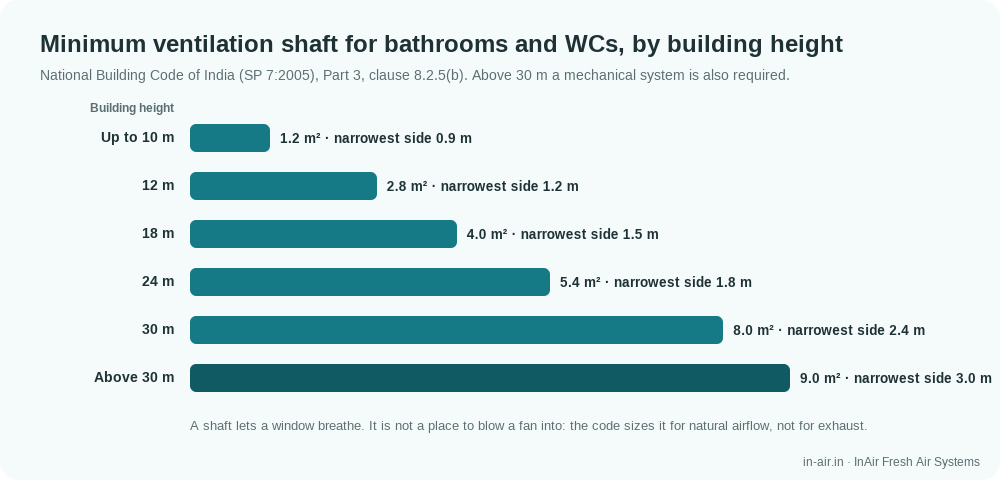
A shaft is sized for windows to breathe into, slowly, by natural movement of air. It is a shared enclosure. When ten bathroom fans blow steam and odour into it, that air has to go somewhere, and the nearest exits are other flats' bathroom windows. The UK guidance states the principle plainly: exhaust outlets should not discharge into courtyards or enclosures.
The false ceiling is worse. A fan that blows into the ceiling void is not ventilating anything. Warm, wet air spreads above the gypsum board, meets cooler surfaces such as the slab, AC pipes or ducts, and condenses. The WHO's dampness guidelines name cold water plumbing and cool parts of air-conditioning units as typical places where surfaces fall below the dew point and dampness starts. You see the result months later as stains, sagging board or a musty smell from the light fittings.
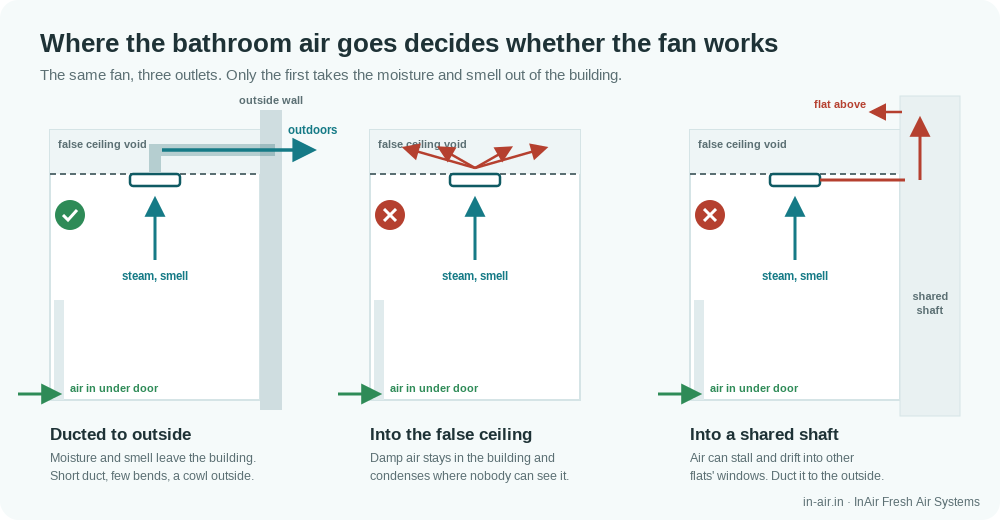
If a shaft is the only route, the answer is to carry the duct through the shaft to an outlet in the open air, sealed along its length, so nothing is released inside the shaft. Whether that is possible depends on the building, which is one of the first things checked on site.
Choosing the fan for the room
Once you know the airflow and the route, the fan almost chooses itself. A wall or window fan suits a bathroom with an outside wall and no duct. Once there is a duct, especially a long one with bends, an inline or mixed-flow fan keeps its airflow and is quieter, because the motor sits away from the room. Our exhaust fan buying guide walks through fan types, noise ratings and motors. ASHRAE 62.2 caps the noise of a bathroom fan used on demand at 3 sones, and of a fan that runs all the time at 1 sone.
InAir's range covers both kinds: wall and ceiling-mounted toilet exhaust fans, and EC inline duct fans with a 10-speed controller and an optional humidity sensor.
The duct route
The duct decides how much of the fan's airflow reaches the outside. ASHRAE 62.2 gives minimum round duct sizes for short runs of up to about 8 m with no more than three bends:
| Airflow | Minimum rigid round duct |
|---|---|
| Up to 85 m³/h (50 cfm) | 100 mm |
| Up to 170 m³/h (100 cfm) | 125 mm |
| Up to 255 m³/h (150 cfm) | 150 mm |
- Flexible duct should be one size larger than rigid, and pulled straight. Sagging flex adds resistance and collects condensate.
- Seal the joints. A leaking duct in a false ceiling has the same effect as no duct.
- Fit a backdraft shutter, so outdoor air, rain and insects do not come back in when the fan is off.
- End at a proper outside terminal or cowl, away from windows and fresh air intakes.
Switch, timer or humidity sensor?
A bathroom fan on the light switch stops the moment you leave, which is when the room is wettest. Three better options:
| Control | How it works | Best for |
|---|---|---|
| Run-on timer | Keeps the fan going after the switch is turned off. UK guidance asks for at least 15 minutes in rooms without an openable window | Most bathrooms, and every windowless one |
| Humidity sensor | Starts or boosts the fan when humidity rises and stops it when the room dries | Bathrooms with showers. Not WC-only rooms, where odour, not moisture, is the problem |
| Continuous low speed with boost | Runs quietly all the time and boosts when in use | Windowless and en-suite bathrooms; needs a quiet fan (1 sone or less under ASHRAE 62.2) |
The UK guidance also asks that any automatic control has a manual override, so you can always switch the fan on yourself. EC fans make the last two options practical, because their speed can be turned down without the motor overheating.
Make-up air: the gap under the door
Every cubic metre the fan removes has to be replaced. If the door is tight to the floor and there is no window, the fan simply builds up suction and gets louder while moving very little. The UK guidance sets the allowance as equivalent to a 10 mm undercut on a 760 mm wide door, which is about 7,600 mm² of open area. A louvred panel or a transfer grille in the door does the same job.
Where the replacement air comes from matters too. Air drawn from an air-conditioned home under the door is already cooler and drier than outdoor monsoon air, so it dries the bathroom faster.
Monsoon damp
The monsoon is when bathroom ventilation is tested. Outdoor air in most Indian cities carries so much moisture that it cannot dry anything below its own dew point. Ten years of ERA5 climate data (2015–2024) show how high that is in the most humid month:
| City | Most humid month | Average dew point | Average humidity |
|---|---|---|---|
| Kolkata | Jun | 26.1 °C | 81.9% |
| Mumbai | Jun | 24.9 °C | 83.4% |
| Delhi | Jul | 24.9 °C | 76.7% |
| Chennai | May | 24.9 °C | 72.4% |
| Hyderabad | Sep | 21.5 °C | 81.5% |
| Bengaluru | Jun | 19.4 °C | 79.0% |
In Kolkata, Mumbai, Delhi and Chennai, any bathroom surface cooler than about 25 °C can collect condensation when it is surrounded by monsoon outdoor air; in Hyderabad and Bengaluru the threshold is about 20 °C. That is why keeping the window open in July often makes a bathroom wetter, not drier. In the monsoon, run the fan with the window closed, let it run on, and draw replacement air from inside the home. The causes and fixes of persistent damp, smell and mould are covered in bathroom smell and dampness; whole-home monsoon humidity in monsoon humidity and fresh air dehumidification.
Common toilet blocks
Offices, schools and malls have toilet blocks rather than single bathrooms. The principle is the same, at a larger scale. ASHRAE 62.1 asks for 50 cfm (85 m³/h) of exhaust per WC or urinal in public toilets. The extract should keep the block at a slight negative pressure, so odour flows in from the corridor side and never out. That usually means one ducted system with an inline or cabinet fan. InAir's toilet exhaust range includes fans sized for common toilet blocks.
How InAir checks this at the site survey
- Measures each bathroom and sets the airflow from the NBC rate or 85 m³/h, whichever is higher.
- Finds the shortest route from the bathroom to the open air, and checks whether a shaft can carry a sealed duct.
- Looks inside the false ceiling for existing fans that discharge into the void, and for damp staining.
- Checks the door gap and whether the replacement air comes from an air-conditioned room or from outside.
- Measures the airflow at the grille after installation, so you know what the fan really delivers.
What it costs
InAir bathroom and toilet exhaust fans, wall and ceiling mounted, start from ₹3,300. Mixed-flow inline fans start from ₹6,600 and EC inline duct fans with a speed or smart controller from ₹15,000. Prices are before GST and installation; ducting is quoted after the survey. See pricing.
Tentative pricing: actual prices may vary based on the site survey.
Common mistakes
- Venting the fan into the false ceiling or a closed shaft.
- Choosing the fan by its free-air rating and then fitting a long, narrow flexible duct.
- Wiring the fan to the light switch with no run-on.
- A door sealed tight to the floor, so the fan just roars.
- Leaving the window open in the monsoon while the fan runs.
- Expecting a bathroom fan to ventilate the bedroom next to it. Fresh air for bedrooms is a separate job.
Sources
- Bureau of Indian Standards, National Building Code of India 2005 (SP 7), Part 3, clause 8.2.5(b): ventilation shafts; Part 8: air changes. SP 7:2005 (PDF). NBC 2016 air-change figures as reproduced in CSIR, Guidelines on Ventilation (2022).
- ASHRAE 62.2-2022 Addendum e: local exhaust rates and fan sound limits. ashrae.org (PDF)
- ASHRAE 62.2-2016 Addendum u: Table 5.3, duct sizing. ashrae.org (PDF)
- UK Approved Document F, Volume 1 (2021): Table 1.1 extract rates, paragraphs 1.36, 1.48–1.51, 2.9 and door undercuts. gov.uk (PDF)
- WHO guidelines for indoor air quality: dampness and mould (2009). who.int
- ERA5 reanalysis, ECMWF/Copernicus, daily data 2015–2024, accessed through Open-Meteo; monthly averages computed by InAir.
What size exhaust fan does a bathroom need in India?
How do I ventilate a bathroom with no window?
Can I vent my bathroom exhaust fan into the duct shaft?
Is it OK to vent a bathroom fan into the false ceiling?
How long should a bathroom fan run after a shower?
Should I keep the bathroom window open in the monsoon?
Our engineers assess your home or building, recommend the right system and the right filter grade for your city, and give you a clear cost estimate. No obligation.