Outdoor vent terminals, cowls and louvres: keeping out rain, insects and stale exhaust air
The few centimetres of a ventilation system outside the wall decide whether rain, insects and your own exhaust air stay out. Here is how to get them right.
Last updated:
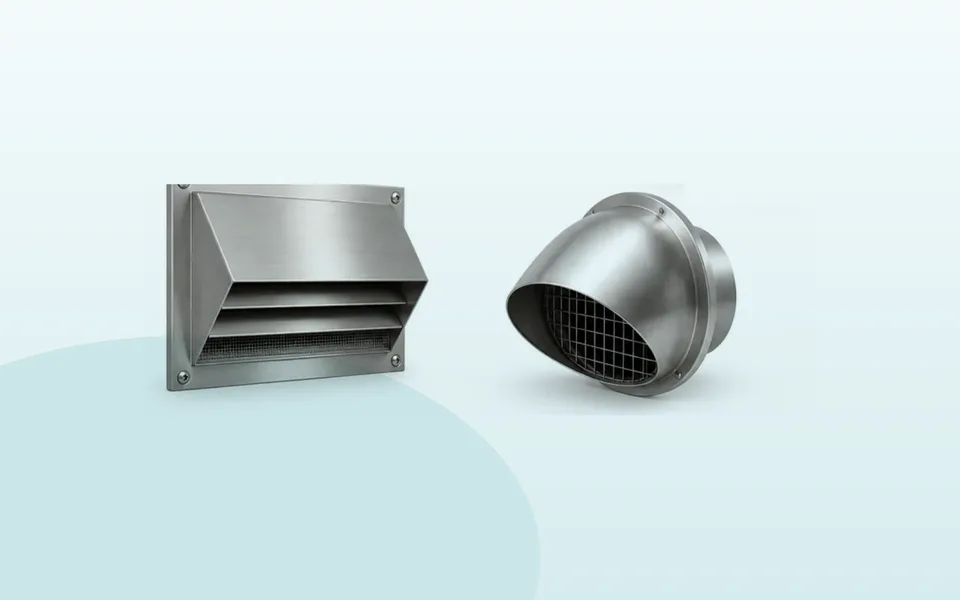
An outdoor wall terminal has four jobs: let air through freely, keep out rain, birds and insects, stop air blowing back in when the fan is off, and sit far enough from exhaust outlets that stale air is not drawn back into the home. For homes, ASHRAE 62.2 asks for fresh air intakes at least 3 m from vents, exhaust hoods and streets.
Key points
- Rain: openings should face downwards or be shielded by a hood; flat louvres alone struggle on exposed walls.
- Insects and birds: ASHRAE 62.2 asks for screens on forced-air inlets with openings no larger than 13 mm.
- Back-draught: a backdraft shutter or non-return valve closes when the fan stops.
- Separation: 3 m from known pollution sources for homes; 1.5 m from the home's own exhaust under strict conditions (ASHRAE 62.2). 5 m or 10 m for strong exhaust from other buildings (ASHRAE 62.1).
- Material: within 5 km of the sea, choose grade 316 stainless steel or better; in strong sun, plastic terminals need UV-stabilised material.
Terminals, cowls, louvres and dampers: what each does
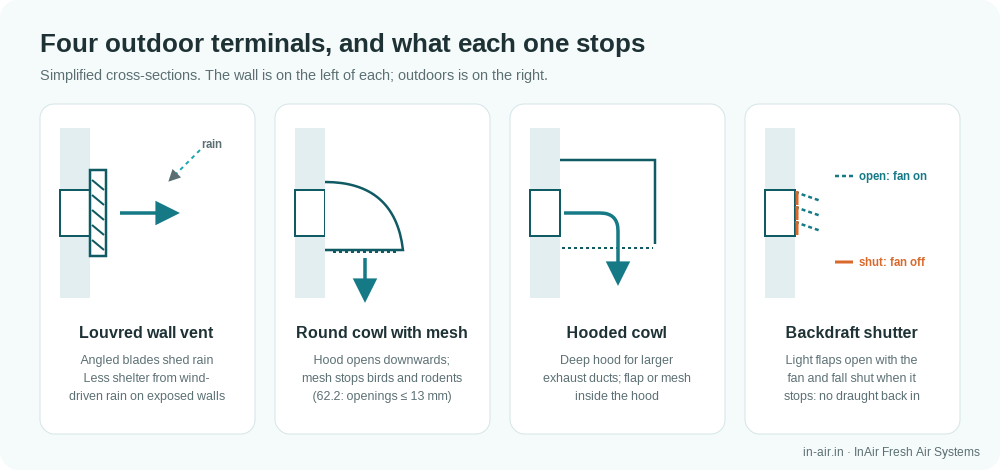
| Part | What it does | Where it suits |
|---|---|---|
| Louvred wall vent | Angled blades shed falling rain | Sheltered walls, low air speeds |
| Round cowl | Hood with a downward opening and mesh | Fresh air intakes and home exhausts, 100–200 mm ducts |
| Hooded cowl | Deeper hood for larger ducts | Commercial and kitchen exhausts |
| Backdraft shutter or non-return valve | Closes when airflow stops | Every exhaust, and any duct exposed to wind |
| Wall sleeve (lintel fitting) | Seals the hole through the wall | Every wall penetration |
The InAir air distribution accessories include round stainless steel cowls from Φ70 to Φ300 mm (INAB164–173), hooded cowls from 8″ to 14″ for commercial exhaust (INAB206–209), external wall vents of Φ110 and Φ160 mm (K304 and K305) and lintel fittings from Φ75 to Φ200 mm. Non-return valves (INAK283–286) are part of the ducting range.
Rain: keep water out of the duct
Monsoon rain driven sideways by wind is the usual problem on Indian walls. A hood that opens downwards protects better than a flat louvre, because water has to travel upwards to get in. Where the wall faces the prevailing monsoon wind, or the terminal sits high on a tower, the hood matters more. Any water that does get past should drain back out, not along the duct towards the ceiling.
Rain also explains why terminals under chajjas and balconies are not as safe as they look. They stay dry, but salt and dust are not washed off, which matters for metal terminals near the coast (see below).
Insects, birds and rodents
ASHRAE 62.2 asks for rodent and insect screens, louvres or grilles on forced-air inlets, with no opening larger than 13 mm (½ inch) in any direction. That stops birds nesting in the duct and rodents getting in. It will not stop mosquitoes. Finer mesh catches more, but it also clogs faster with dust and adds resistance, so on fresh air systems the filters in the unit do the fine work and the outdoor mesh keeps out larger visitors.
When an exhaust fan is off, its duct is an open path into the house. A backdraft shutter, a set of light flaps that lift when the fan runs and fall shut when it stops, keeps out insects, dust and wind-driven air.
Wind: pressure on the outlet
Wind blowing onto a wall pushes against any terminal on that face, so a small exhaust fan can lose airflow on a windy day. UK Approved Document F tells designers to deal with this where an exhaust terminal faces the prevailing wind, for example by ducting to another façade or using constant-flow fans. It also says that where wind often comes from opposing directions, intakes should point the opposite way to exhaust outlets, and where there is a prevailing wind, exhausts should be downwind of intakes.
Placement: how far should an intake be from an exhaust?
This rule is easy to miss in Indian buildings, where bathroom exhausts, kitchen chimneys, AC outdoor units and plumbing vents crowd the same shaft or façade. Two ASHRAE standards set minimum distances.
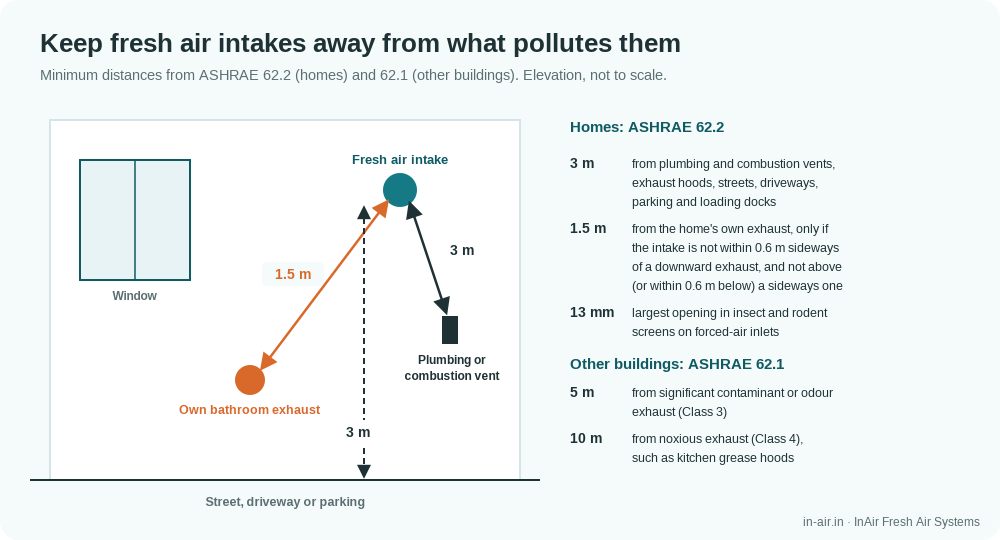
| Rule | Minimum distance | Standard |
|---|---|---|
| Home air inlet to plumbing or combustion vents, exhaust hoods, streets, driveways, parking, loading docks | 3 m | ASHRAE 62.2, section 6.6 (Addendum d to 62.2-2022) |
| Home wall inlet to sources exiting through the roof above it, or to a dryer exhaust | 1 m | ASHRAE 62.2, exception 1 |
| Home wall inlet to the same home's own exhaust terminal, with conditions | 1.5 m | ASHRAE 62.2, exception 5 (Addendum f) |
| Kitchen and bathroom exhaust outlets to windows | No minimum | ASHRAE 62.2, exception 2 |
| Intake to significant contaminant or odour exhaust (Class 3) | 5 m | ASHRAE 62.1-2022, Addendum ag, Table B-1 |
| Intake to noxious exhaust (Class 4) | 10 m | ASHRAE 62.1-2022, Addendum ag, Table B-1 |
The 1.5 m exception has two conditions: the inlet must not be within 0.6 m horizontally of an exhaust that blows downwards, and must not be above, or less than 0.6 m below, an exhaust that blows sideways towards it. It does not apply to vents from fuel-burning water heaters or space heaters. For other buildings, Appendix B of ASHRAE 62.1 also says an exhaust ending in an equipment well that also holds an intake must end at or above the well's highest wall and blow upwards faster than 5 m/s, or end 1 m above that wall.
UK Approved Document F adds practical advice that fits Indian cities well: next to busy roads, put intakes as high as possible on the less polluted side; avoid intakes in courtyards or enclosed spaces where pollutants are discharged; and never let exhausts discharge into courtyards, enclosures or architectural screens. A closed service shaft in an apartment block is exactly that kind of enclosure. Our ventilation duct guide covers the route inside.
Steel or PVC near the coast and in strong sun
Terminals live outdoors for decades, so material matters. The American Galvanizers Association's summary of ISO 9223 gives first-year zinc corrosion rates by environment. The zinc coating on galvanised steel is used up at roughly that rate.
| ISO 9223 category | Typical setting | Zinc loss, first year |
|---|---|---|
| C3, medium | Urban, or 1–30 km from the sea | 0.7–2.1 µm |
| C4, high | Within about 1 km of the sea | 2.1–4.2 µm |
| C5, very high | Within a few hundred metres of the sea | 4.2–8.4 µm |
Stainless steel behaves differently. The Australian Stainless Steel Development Association says brown 'tea staining' is most common within about 5 km of the surf, gets worse closer to the sea, and is worse in hot, humid climates and in places rain does not wash. Its advice is grade 316 as a minimum within 5 km of the surf; grades 304 and 430 will probably stain or corrode in a marine setting. Tea staining is cosmetic, but a stained cowl on a sea-facing flat in Mumbai or Chennai looks neglected.
Plastic terminals do not rust, but sunlight attacks them. A 2024 paper on PVC weathering in the journal Polymers describes how sunlight and oxygen break polymer chains near the surface, leading to discolouration and surface chalking, and how stabilisers in the formulation slow this down. For a south- or west-facing wall in Indian sun, ask whether a plastic terminal is UV-stabilised for outdoor use.
| Material | Coastal (within 5 km) | Strong sun | Notes |
|---|---|---|---|
| Galvanised steel | Coating consumed quickly in C4–C5 | Fine | Galvanising alone becomes marginal in C4–C5; zinc plus paint lasts longer |
| Stainless steel 304 | Likely to stain | Fine | Good inland |
| Stainless steel 316 | Recommended minimum | Fine | Wash where rain cannot reach |
| PVC or ABS | Does not corrode | Needs UV stabiliser | Can discolour and chalk |
How InAir checks this at the site survey
- where every intake and exhaust can leave the building, and the distances between them and from vents, chimneys, AC outdoor units, roads and parking;
- whether the terminal faces the monsoon wind or sits high on a tower, and whether it needs a deeper hood or a backdraft shutter;
- whether the outlet is inside a shaft, courtyard or screened enclosure;
- distance from the sea, to choose the terminal material;
- whether the terminal can be reached for cleaning, and whether rain will wash it;
- the core-cut size and the sealed wall sleeve.
Book a free site survey. If you are choosing between a fan and a full system first, read the exhaust fan buying guide.
What it costs
InAir diffusers, grilles, outdoor cowls and jet nozzles (75–200 mm) start from ₹1,500 each, before GST and installation. Larger hooded cowls and stainless steel finishes are quoted after the site survey.
Tentative pricing: actual prices may vary based on the site survey.
Common mistakes
- Putting the fresh air intake next to the bathroom exhaust because both fit in the same window frame.
- Discharging exhaust into a closed shaft, or behind a decorative screen.
- No backdraft shutter, so the duct lets in dust, insects and wind when the fan is off.
- Grade 304 stainless steel or bare galvanised steel on a sea-facing wall.
- Mesh so fine it clogs in one dusty season.
- No way to reach the terminal for cleaning on a high floor.
Sources
- ASHRAE 62.2-2022 Addendum d: section 6.6 air inlets, 3 m separation, 13 mm screens.
- ASHRAE 62.2-2022 Addendum f: exceptions to section 6.6, including 1.5 m from the home's own exhaust.
- ASHRAE 62.1-2022 Addendum ag: Normative Appendix B and Table B-1 separation distances.
- UK Approved Document F, Volume 1 (2021): paragraphs 1.61 and 2.2–2.9 on wind, intakes and exhaust outlets.
- American Galvanizers Association: HDG corrosion rates for ISO categories C1–CX.
- Hot Dip Galvanizers Association Southern Africa, Info Sheet 8: corrosion of zinc and corrosivity of atmospheres: duplex systems in C4–CX.
- Australian Stainless Steel Development Association: preventing coastal corrosion (tea staining).
- Surface chalking upon weathering of dark-coloured PVC articles, Polymers 2024, 16(8):1047.
How far should a fresh air intake be from an exhaust fan outlet?
Do I need a cowl on a bathroom exhaust outlet?
What mesh size stops birds and rats in a vent?
Is stainless steel or PVC better for outdoor vents near the sea?
Can I put the ventilation exhaust in the building's utility shaft?
What is a backdraft damper?
Our engineers assess your home or building, recommend the right system and the right filter grade for your city, and give you a clear cost estimate. No obligation.