AC fresh air mode vs ERV: how much fresh air does an AC really bring in?
Some ACs now advertise a fresh air or ventilation mode. Here is what the makers' own figures show, what a bedroom actually needs, and where an ERV fits.
Last updated:
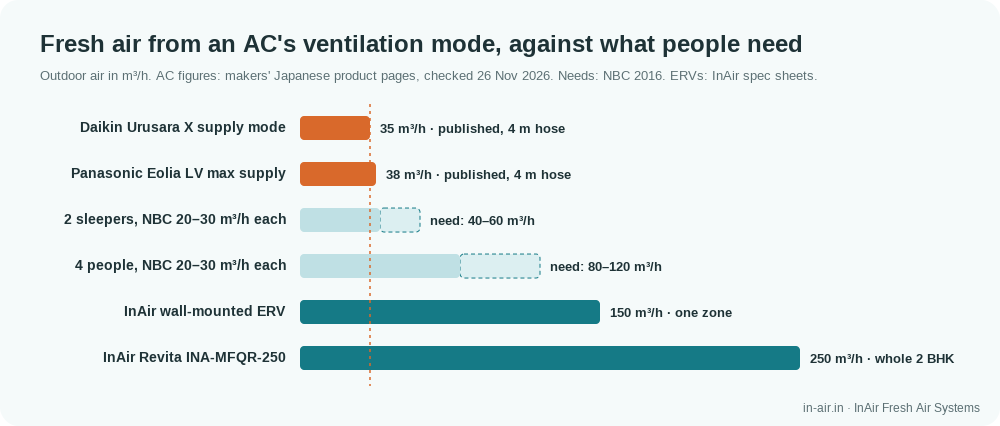
An AC's fresh air mode brings in far less outdoor air than an ERV. Two split ACs that publish a figure, sold in Japan, rate their ventilation at 35 and 38 m³/h. Two sleepers need 40–60 m³/h under India's National Building Code. An ERV supplies 150 m³/h or more and takes the same amount of stale air out.
Key points
- A standard split AC has no outdoor air connection at all. The indoor unit cools the room's own air; only refrigerant pipes and a drain run outside.
- Daikin rates the supply ventilation of its Urusara X range at 35 m³/h and Panasonic its Eolia LV range at up to 38 m³/h, both with a 4 m hose. Longer hoses give less.
- Both makers say on their own pages that the ventilation function alone does not meet the ventilation Japanese building law requires for homes.
- At 35 m³/h, two sleepers settle near 1,111 ppm of CO₂ (our calculation). In a living room with four people at 38 m³/h, CO₂ settles near 1,688 ppm.
- An ERV is balanced: it supplies and extracts the same amount of air, filters it to MERV-13 or better, and passes it through a heat recovery core.
What a normal split AC does with air
A split AC has two halves joined by copper pipes. The indoor unit pulls room air over a cold coil and blows it back. The outdoor unit rejects the heat outside. No outdoor air passes from one to the other. So a split AC cools and partly dries the same air over and over, and anything people breathe out stays in the room. Our guide do I need fresh air if I have an AC? covers what that means overnight.
Many Indian AC product pages use the word "fresh" for filters, self-cleaning cycles or sleep modes. On the Indian brand pages we checked on 26 November 2026, none published an outdoor air intake rate in m³/h. If a brochure promises fresh air, ask for that number.
ACs that really do bring in outdoor air
A few room ACs have a genuine ventilation function. They add a hose from the outdoor unit to the indoor unit and a small fan that pushes outdoor air through it. Two Japanese makers publish their figures:
| Product (maker's page) | Ventilation airflow | Test conditions stated | What the maker adds |
|---|---|---|---|
| Daikin Urusara X (R series), e.g. AN567ARP | 35 m³/h supply | JIS B 8330; "strong" setting; 4 m hose, 5 bends; no pressure difference indoors and out | Airflow falls about 7% for every extra 2 m of hose; supply and exhaust modes switch, they do not run together; does not meet the full legal ventilation for a home on its own |
| Panasonic Eolia LV series, CS-LV566D2 (14–23 tatami, 4.0–7.1 kW) | Up to 38 m³/h supply, 30 m³/h exhaust | JIS B 8330; "strong" setting; 4 m hose, 5 bends | At the longest 15 m hose, about 40% less air; may draw in smells from around the outdoor unit; not for venting gas or kerosene heaters; does not meet the full legal ventilation for a home |
Both pages also advise opening windows alongside the AC's ventilation. That is a fair summary of what these functions are: a top-up, not a ventilation system.
How much fresh air a room actually needs
India's National Building Code gives 20–30 m³/h of outdoor air per person. CO₂ gives a cross-check. A resting adult breathes out about 12 litres of CO₂ an hour, and outdoor air is about 425 ppm, so about 21 m³/h per person holds a room near 1,000 ppm. For a couple in a bedroom that is roughly 42–60 m³/h; for a family of four in a living room, 84–120 m³/h. The bedroom CO₂ guide explains what those levels mean for sleep.
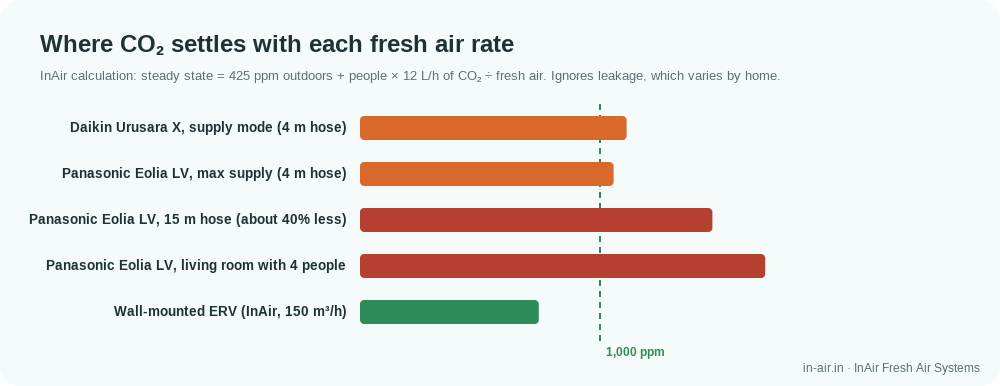
The arithmetic is simple. At 35 m³/h, two sleepers hold the room near 1,111 ppm. With a 15 m hose on the Panasonic unit, about 23 m³/h, it is nearer 1,468 ppm. With four people in the living room at 38 m³/h, about 1,688 ppm. A 150 m³/h ERV serving the same four people holds about 745 ppm.
Fresh air mode vs ERV, side by side
| AC ventilation mode | ERV (ducted or wall-mounted) | |
|---|---|---|
| Fresh air delivered | 35–38 m³/h published, less with longer hoses | 150 m³/h (wall-mounted) to 500 m³/h (Revita) for homes; more for Ventura |
| Stale air out | Supply or exhaust at one time, not both; otherwise leaks out through gaps | Equal amount extracted at the same time (balanced) |
| Filtration of outdoor air | Not published as a MERV or HEPA grade on the pages above | Pre-filter and MERV-13; HEPA-13 optional |
| Heat recovery | None stated | 89–90% (tested) on Revita and Ventura; 92% enthalpy core on the wall-mounted unit |
| Runs when | Only while the AC's ventilation function is on | Round the clock, AC on or off |
| Covers | The one room with the AC | One zone (wall-mounted) or the whole home (ducted) |
An ERV also matters for the AC's work. Outdoor air brought in by any route adds heat and moisture the AC must remove. An ERV's core passes most of the heat back to the outgoing air first. Our AC load savings calculator shows the figures for six Indian cities.
Is there ever a case for the AC's fresh air mode?
Yes, as a top-up in a lightly used room, or where nothing else can be fitted. It is better than a sealed room. But it is sized for a trickle, it works only while the AC is in that mode, and in polluted Indian winters you need to know what filter the outdoor air passes through. For a bedroom used every night, or any room with more than two people, plan proper ventilation.
If the flat is already finished, a wall-mounted ERV needs only a core-cut through an outside wall. If there is a false ceiling, or one is planned, a ducted Revita ERV can feed every room from one unit.
How InAir checks this at the site survey
- How many people use each room and for how long, which sets the fresh air needed.
- What the ACs actually do: whether any have a ventilation function, and its published airflow.
- CO₂, humidity and PM2.5 measured in the main bedroom, using a separate NDIR CO₂ monitor for CO₂.
- Outside walls available for a wall-mounted ERV, or a ceiling route for ducts.
- Where stale air will leave: bathroom extract, kitchen or the ERV's own exhaust.
What it costs
InAir's wall-mounted ERV starts from ₹1.4 lakh per unit and a Revita ducted ERV for a 1–2 BHK from ₹2.1 lakh, before GST and installation. See the price guide.
Tentative pricing: actual prices may vary based on the site survey.
Common mistakes
- Reading "fresh" in an AC brochure as outdoor air. Ask for the outdoor air intake in m³/h.
- Trusting the brochure figure with a long hose. Both makers state that more hose means less air.
- Expecting an AC's ventilation to clear a room of four. The published rates are sized for a top-up.
- Running the AC in dry mode and assuming the air is being changed. Dry mode removes moisture from the same air.
- Fitting an air purifier instead. It cleans particles but brings in no outdoor air and removes no CO₂.
Sources
- Daikin Industries, Urusara X R series product page (2026 model), ventilation footnotes. Checked 26 Nov 2026. ac.daikin.co.jp
- Panasonic, Eolia LV series ventilation feature page (2026 model), airflow table and footnotes. Checked 26 Nov 2026. panasonic.jp
- Bureau of Indian Standards, National Building Code of India 2016, Part 8: 20–30 m³/h of fresh air per person; summarised in InAir's NBC and ASHRAE guide
- InAir spec sheets: wall-mounted ERV INA-WERVG20-150CMH. in-air.in
- InAir spec sheet: Revita INA-MFQR-250. in-air.in
- InAir price guide FY 2026–27. pricing.md
Does a split AC bring in fresh air?
How much fresh air does an AC's fresh air mode give?
Is an AC fresh air mode enough for a bedroom?
Is an ERV better than an AC with fresh air?
Can I use an ERV with my existing split AC?
Does the AC's dry mode bring in fresh air?
Our engineers assess your home or building, recommend the right system and the right filter grade for your city, and give you a clear cost estimate. No obligation.