Do I need fresh air if I have an AC?
Your AC keeps the room cool, but it never changes the air. Here is what builds up overnight, what fresh air adds, and a worked example of what it costs the AC.
Last updated:
Yes. A split AC cools and dries the air already in the room; it does not bring any outdoor air in. With the door and windows shut, the carbon dioxide people breathe out, and the smells and chemicals a home gives off, keep building up. Fresh air is a separate job, and an ERV does it without undoing the AC's work.
Key points
- A split AC recirculates room air. Only refrigerant pipes and a drain run outside.
- In our calculation, two sleepers in a closed AC bedroom reach about 2,540 ppm of CO₂ by morning. With 50 m³/h of fresh air the room settles near 900 ppm.
- India's National Building Code asks for 20–30 m³/h of fresh air per person. About 21 m³/h per person holds a room near 1,000 ppm.
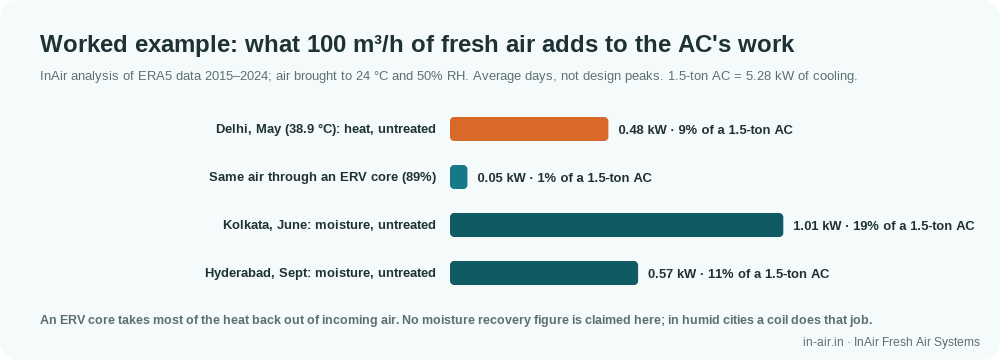
- Fresh air does add to the AC's work: about 0.48 kW of heat per 100 m³/h on an average Delhi May afternoon. An ERV recovering 89% of that heat leaves about 0.05 kW.
- Moisture is the bigger load in monsoon cities. In humid coastal cities a heat-pump ERV or fresh air dehumidifier dries the incoming air.
What a split AC does, and does not do
The indoor unit pulls room air over a cold coil, which cools it and condenses some of its water, then blows it back. The heat goes outside through refrigerant pipes. That is all. No outdoor air comes in, and no room air goes out. A few AC models add a small ventilation hose, but the makers that publish figures rate it at 35–38 m³/h; our comparison of AC fresh air modes vs ERVs looks at them in detail.
| What the room needs | Split AC | Air purifier | Fresh air system (ERV) |
|---|---|---|---|
| Lower temperature | Yes | No | Partly: the core pre-cools incoming air |
| Lower humidity | Partly, while the compressor runs | No | Partly; a heat-pump ERV dries fully |
| Remove PM2.5 from room air | Only through a basic filter | Yes | Filters incoming air to MERV-13 or HEPA-13 |
| Remove CO₂ | No | No | Yes, by replacing room air |
| Dilute smells and VOCs | No | Some (carbon filter) | Yes, by replacing room air |
What builds up in a closed AC room
Four things, mainly.
- Carbon dioxide. Each resting adult breathes out about 12 litres an hour. It is also a sign of everything else people give off.
- VOCs. The US EPA notes that many volatile organic compounds are consistently up to ten times higher indoors than outdoors. Furniture, paints, cleaners and cooking all add to them.
- Moisture. The AC removes it only while its coil is cold. On a mild monsoon night the compressor cycles off and the room can turn clammy.
- Smells. Cooking, bathrooms and people. An AC moves them around the room; it does not remove them.
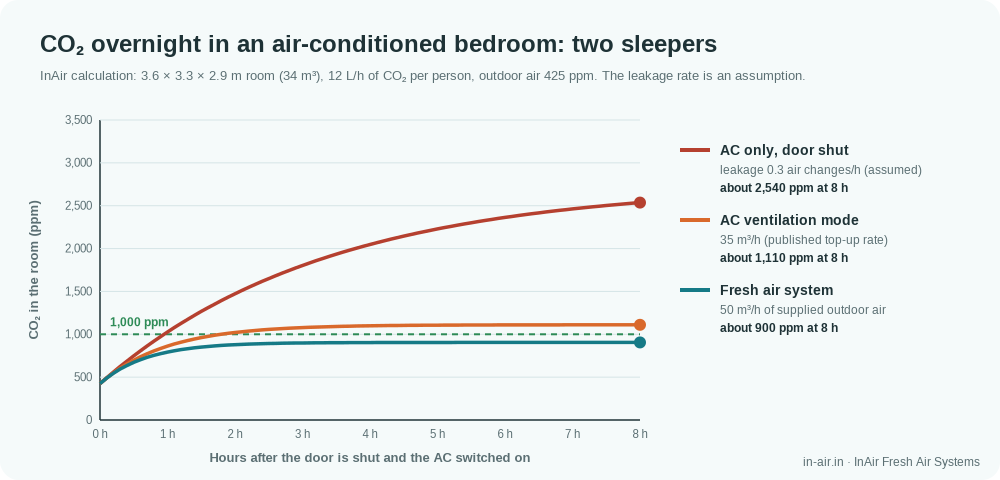
The calculation uses a 3.6 × 3.3 m bedroom with a 2.9 m ceiling. If the only air change is leakage around the door, assumed here at 0.3 air changes an hour, CO₂ climbs past 2,540 ppm by morning. An AC ventilation mode at 35 m³/h ends near 1,110 ppm. A fresh air supply of 50 m³/h holds it near 900 ppm. Indian green building classes allow CO₂ only 350–530 ppm above outdoor air. See bedroom CO₂ and sleep for what the research says about those levels. To check your own room, use a separate NDIR CO₂ monitor.
Won't fresh air make my AC work harder?
Yes, a little, and it is worth putting numbers on it. Every cubic metre of hot, humid outdoor air has to be cooled and dried to room conditions. How much depends on the city and the season. The worked example below uses ten years of ERA5 climate data, analysed by InAir, for a 2 BHK with four people that brings in 100 m³/h, roughly the 84 m³/h the CO₂ rule gives plus a margin.
| Step | Delhi, May afternoon |
|---|---|
| Outdoor air (average daily high, hottest month) | 38.9 °C |
| Room | 24 °C |
| Heat that 100 m³/h brings in, untreated | 0.48 kW |
| Share of a 1.5-ton AC's rated cooling (5.28 kW) | 9% |
| Through an ERV recovering 89% of the heat | 0.05 kW left, 0.43 kW spared |
| Share of the 1.5-ton AC after the ERV | 1% |
The 89% comes from the tested 89–90% heat recovery of InAir's Revita and Ventura ERVs, applied to the temperature part only. In Kolkata's most humid month the same 100 m³/h carries about 1.01 kW of moisture load, more than the Delhi summer heat. No moisture recovery figure is claimed here. In humid coastal cities InAir recommends the RHP heat-pump ERV, which cools and dries the fresh air with its own coil. Try your own city, airflow and AC efficiency in the AC load savings calculator, which also turns the heat into units and rupees.
Opening a window for fresh air brings the full untreated load, plus street dust and noise. An ERV brings the air in filtered and close to room temperature.
What a fresh air system adds
- Steady outdoor air, day and night, whether the AC is on or off.
- Filtration of that air: a pre-filter and MERV-13 as standard on InAir ERVs, HEPA-13 optional for smoggy cities.
- Stale air out at the same rate, from bathrooms and kitchen, so the home is not pressurised or starved.
- Heat recovery through the core, so the AC does not pay for all of the fresh air's heat.
For a finished flat, a wall-mounted ERV serves one room or zone through a core-cut. For a whole home with a false ceiling, a ducted Revita ERV feeds every room. The ERV sizing calculator gives a first airflow.
How InAir checks this at the site survey
- CO₂ (with a separate NDIR monitor), humidity and PM2.5 in the main bedroom, ideally overnight.
- How many people sleep in each room and how the ACs are used.
- Your city's summer heat and monsoon moisture, to choose between an ERV and a heat-pump ERV.
- Whether there is a false ceiling for ducts or an outside wall for a wall-mounted unit.
- Where stale air will leave: bathroom and kitchen extract paths.
What it costs
A Revita ducted ERV for a 1–2 BHK starts from ₹2.1 lakh, for a 3–4 BHK from ₹2.6 lakh, and a wall-mounted ERV from ₹1.4 lakh per unit, before GST and installation. The price guide has the full list.
Tentative pricing: actual prices may vary based on the site survey.
Common myths
- "The AC brings in fresh air." A split AC recirculates. Only a few models add a small ventilation hose.
- "An air purifier is enough." It removes particles, not CO₂. See air purifier or fresh air system.
- "Fresh air will double my electricity bill." In the worked example, 100 m³/h of untreated Delhi summer air is about 9% of a 1.5-ton AC's rated cooling; through an ERV core it is about 1%.
- "Opening the window in the morning is enough." CO₂ builds up overnight while the window is shut, which is when people are in the room.
- "Dry mode ventilates." It removes moisture from the same air. Nothing is exchanged with outdoors.
Sources
- US EPA, Volatile Organic Compounds' Impact on Indoor Air Quality. epa.gov
- Bureau of Indian Standards, National Building Code of India 2016, Part 8: fresh air per person; summarised in InAir's NBC and ASHRAE guide
- ECMWF / Copernicus ERA5 reanalysis 2015–2024, analysed by InAir; method in InAir's home ventilation guide
- InAir AC load savings calculator: method and formulas. in-air.in
- Daikin Urusara X product page: AC ventilation rate of 35 m³/h. Checked 26 Nov 2026. ac.daikin.co.jp
- InAir spec sheet INA-MFQR-250 and price guide FY 2026–27. in-air.in
Does an AC give fresh air?
Is it unhealthy to sleep in a closed AC room?
Will a fresh air system increase my AC bill?
Can I just open the window for fresh air?
Do I need fresh air if I have an air purifier and an AC?
How much fresh air does a bedroom need?
Our engineers assess your home or building, recommend the right system and the right filter grade for your city, and give you a clear cost estimate. No obligation.