Why does my bathroom smell or stay damp? Causes and fixes
Smell and damp have different causes. Drains cause most smells; moisture that is not removed fast enough causes damp and mould. Here is how to tell them apart and fix each.
Last updated:

Bathroom smell and bathroom damp usually have different causes. A smell that is there even when the room is dry usually comes from the drains: a dried-out or broken trap seal, or a leaking WC joint. Damp, mould and a mirror that stays fogged come from moisture the fan is not removing fast enough. Fix the right one first.
Key points
- Smell when dry = drains. NBC requires every fixture to have a water-sealed trap; the seal is what stops sewer air entering the room. A fan masks a drain smell but does not fix it.
- Damp = moisture not leaving. Water condenses on any surface colder than the air's dew point. Shower steam at 32 °C has a dew point above 31 °C, so almost every surface sweats.
- Run-on matters. Even at 8 air changes an hour, it takes about 17 minutes to clear 90% of the steam from well-mixed air. UK guidance asks for at least 15 minutes of run-on in rooms without an openable window.
- Humidity target: US EPA advises keeping indoor humidity below 60%, ideally 30–50%.
- Mould: a patch under about 1 m² (10 sq ft) can usually be cleaned with detergent and water (EPA). Larger growth, or mould that keeps returning, needs the moisture source fixed first.
This page diagnoses the problem. For how a bathroom should be ventilated in the first place (rates, ducts, shafts and door gaps), see the bathroom ventilation guide.
Is it a smell problem or a moisture problem?
Start by noticing when it happens. The table sorts the common symptoms.
| What you notice | Likely cause | Check first |
|---|---|---|
| Sewer or rotten-egg smell, even when nobody has used the room | Dry or broken trap seal; floor trap with no water; loose WC seal | Pour water into every floor trap and basin; look for a gap at the WC base |
| Smell appears when the fan is on | Fan pulling air from a drain with a weak seal, because no air can enter under the door | Door gap; trap water levels |
| Musty smell from the ceiling or light fittings | Damp in the false ceiling, often from a fan venting into it | Where the fan duct ends |
| Mirror stays fogged 20 minutes after a shower | Fan too weak, duct too long, or no run-on | Airflow at the grille; whether the fan stops with the light |
| Black spots in grout and corners | Surface mould from repeated condensation | Humidity after showers; cold surfaces |
| Damp patch that grows on a wall even in dry weather | Leak inside the wall or from the flat above | Call a plumber; ventilation will not fix it |
Drain smells: the water seal
Every basin, shower drain, floor trap and WC has a bend that holds water. That water is the seal. India's National Building Code defines a water seal as the water in a trap that acts as a barrier to the passage of air, and requires trap seals to be maintained to keep sewer gas and vermin out of the building. For single-stack plumbing, it lists a seal depth of 50 mm for water closets and for floor traps.
A seal of a few centimetres does not take much to lose:
- Evaporation. A guest bathroom or a floor trap that gets no water for a few weeks dries out. Pouring a mug of water in every week or two keeps it sealed.
- Siphonage. Poorly vented plumbing can suck water out of a trap when another fixture drains. The code calls for vent pipes partly to prevent this. If a trap keeps emptying, call a plumber.
- Broken seals. A cracked trap, a loose WC connection or an open cleanout lets drain air in directly.
An exhaust fan helps here only in the sense that it keeps the bathroom at slightly lower pressure than the rest of the home, so smells do not spread. If the trap is dry, a strong fan in a sealed room can even draw air from the drain. Fix the seal, then ventilate.
Why bathrooms get damp: dew point
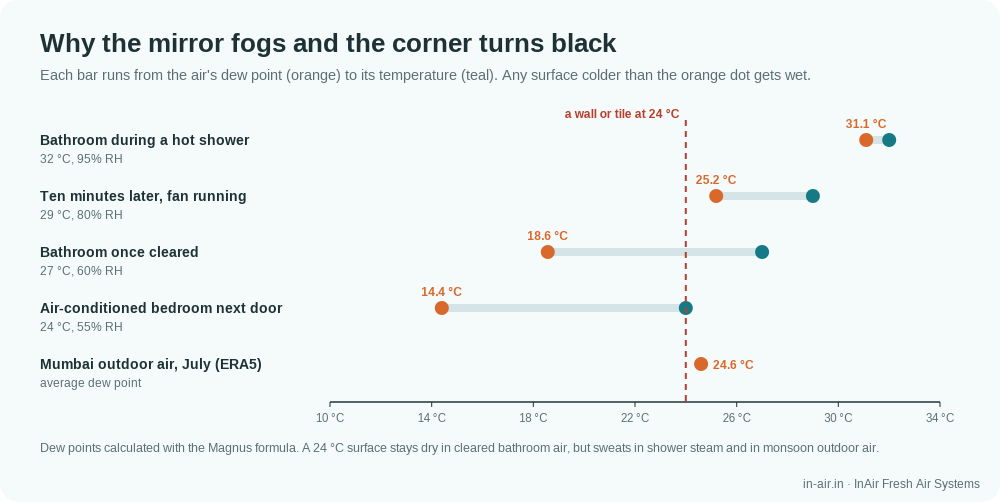
Air holds water vapour. The warmer it is, the more it can hold. The dew point is the temperature at which the air's vapour starts to turn back into water. Any surface colder than the dew point gets wet: the mirror, the tiles, the window glass, a cold water pipe, the underside of the slab.
| Air | Temperature | Humidity | Dew point |
|---|---|---|---|
| Bathroom during a hot shower | 32 °C | 95% | 31.1 °C |
| Ten minutes later, fan running | 29 °C | 80% | 25.2 °C |
| Bathroom once cleared | 27 °C | 60% | 18.6 °C |
| Air-conditioned bedroom next door | 24 °C | 55% | 14.4 °C |
Steam from a hot shower has a dew point above 31 °C, so it condenses on nearly every surface in the room. That is normal. The problem is when the surfaces stay wet for hours, every day. The WHO's guidelines on dampness and mould note that cold water plumbing, thermal bridges and cool parts of air-conditioning units are typical places where surfaces fall below the dew point. In Indian homes, a bathroom wall shared with an air-conditioned bedroom is a common cold spot.
The monsoon makes it harder. In Mumbai in July, outdoor air has an average dew point of 24.6 °C (ERA5, 2015–2024). Air like that cannot dry a 24 °C wall; it wets it. So in the wet months, bathrooms dry best with the window shut, the fan running, and replacement air drawn from the drier, air-conditioned rooms. Our monsoon humidity guide covers the whole home.
How long should the fan run?
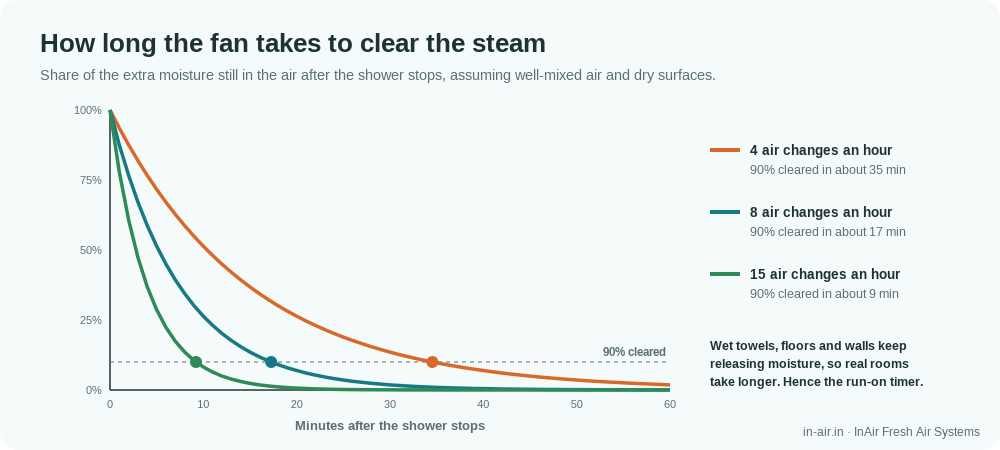
A fan removes moisture gradually. In a well-mixed room, each air change removes a fixed share of what is left, so the moisture falls along a curve rather than a straight line.
| Air changes an hour | 90% of the steam gone | 95% gone |
|---|---|---|
| 4 | 35 min | 45 min |
| 6 | 23 min | 30 min |
| 8 | 17 min | 22 min |
| 10 | 14 min | 18 min |
| 15 | 9 min | 12 min |
A standard 2.4 × 1.5 m bathroom with an 85 m³/h fan gets about 8.7 air changes an hour, so it needs roughly 16 minutes to clear 90% of the steam from the air, before counting the wet towels and floor. A fan on the light switch, which stops when you walk out, leaves most of that moisture behind. That is why the UK's Approved Document F asks for a run-on of at least 15 minutes in rooms without an openable window.
A humidity sensor does this automatically, running the fan until the room is actually dry. UK guidance says humidity control suits bathrooms but not WC-only rooms, where odour rather than moisture is the problem. InAir's EC inline duct fans offer a temperature and humidity sensor option.
Cleaning mould safely
The US EPA's guidance for homeowners is clear and practical:
- If the mouldy area is less than about 10 square feet (roughly 1 m², a 3 ft × 3 ft patch), you can usually clean it yourself.
- Scrub mould off hard surfaces with detergent and water, and dry completely.
- Routine use of bleach or other biocides is not recommended. Never mix bleach with cleaners that contain ammonia; the fumes are toxic.
- Absorbent materials such as ceiling tiles may have to be thrown away if they become mouldy. In Indian homes that often means a section of gypsum false ceiling.
- Wear gloves and goggles. If you do use a disinfectant, ventilate the room and exhaust the air outdoors.
- Dry any leak or spill within 24–48 hours; in most cases mould will not grow.
Above all, cleaning is not the fix. EPA states that if you clean up the mould but do not fix the water problem, the mould will most likely come back. For mould that reappears in the shower, its advice is more ventilation and more frequent cleaning.
Does it matter for health?
Yes. The WHO concluded that there is sufficient evidence that people living in damp or mouldy buildings are at higher risk of respiratory symptoms, respiratory infections and worsening asthma. It sets no safe level of mould; it recommends preventing persistent dampness and remediating it when it appears. UK government guidance for housing providers lists people with asthma, COPD and other lung or heart conditions, children and older people among those more vulnerable.
When to call someone
- A plumber if a smell persists with every trap full, a trap keeps emptying, or there is a damp patch that grows in dry weather.
- A waterproofing contractor if damp comes through from a shower wall, the floor or the flat above.
- A mould remediation specialist if growth covers more than about 1 m², follows water damage, or affects someone with asthma or a weak immune system.
- A ventilation specialist if the fan runs but steam lingers, the fan vents into the ceiling or shaft, or the bathroom has no window.
How InAir checks this at the site survey
- Measures the airflow the fan actually delivers at the grille, not the box rating.
- Traces where the duct ends: outdoors, into the ceiling, or into a shaft.
- Checks the door gap and where replacement air comes from.
- Looks for cold surfaces and damp staining in the false ceiling.
- Notes signs that point to plumbing rather than ventilation, so you call the right trade first.
What it costs
InAir bathroom and toilet exhaust fans start from ₹3,300; EC inline duct fans, which can run on a humidity sensor, start from ₹15,000. Prices are before GST and installation. See pricing.
Tentative pricing: actual prices may vary based on the site survey.
Common myths
- “A stronger fan will fix the smell.” Not if the trap is dry. It may make it worse.
- “Bleach kills mould, so the problem is solved.” The moisture source is still there, and the mould returns.
- “An open window always helps.” In the monsoon, outdoor air can be wetter than the bathroom surfaces can tolerate.
- “Air freshener fixes a bathroom smell.” It only covers the smell; the cause is still there.
- “Five minutes of fan is enough.” At typical airflow, most of the steam is still there after five minutes.
Related reading: exhaust fan buying guide, inline vs wall exhaust fan, and the air changes calculator.
Sources
- Bureau of Indian Standards, National Building Code of India 2005 (SP 7), Part 9, Section 1: definition of water seal (2.1.132), trap seals (3.1.8) and seal depths (5.5.2.4.1). SP 7:2005 (PDF)
- WHO guidelines for indoor air quality: dampness and mould (2009). who.int
- US EPA, A Brief Guide to Mold, Moisture and Your Home. epa.gov; and Mold Cleanup in Your Home. epa.gov
- UK Approved Document F, Volume 1 (2021): paragraphs 1.36 and 1.51. gov.uk (PDF)
- UK Government, Understanding and addressing the health risks of damp and mould in the home (2023). gov.uk
- Sensirion, Introduction to Humidity: Magnus formula coefficients used for the dew points. sensirion.com (PDF)
- ERA5 reanalysis (ECMWF/Copernicus), 2015–2024, via Open-Meteo; averages computed by InAir.
Why does my bathroom smell even when it is clean?
Why is my bathroom always damp?
How do I stop black mould in bathroom corners and grout?
Does an exhaust fan remove drain smell?
How long should I run the bathroom fan after a shower?
Is bathroom mould dangerous?
Our engineers assess your home or building, recommend the right system and the right filter grade for your city, and give you a clear cost estimate. No obligation.