Fresh air system for a Delhi, Gurgaon or Noida home: a buyer's guide
Smog in winter, 40 °C in summer, damp in the monsoon. What a Delhi NCR home needs from a fresh air system, which type fits a finished flat or a villa, and what to ask before you buy.
Last updated:
For most homes in Delhi, Gurgaon and Noida, the right fresh air system is an energy recovery ventilator (ERV) with a HEPA-13 filter: ducted for a home being built or renovated, wall-mounted room by room for a finished flat. It has to handle smog averaging 175 µg/m³ in winter [1], 40 °C summers and monsoon humidity.
Key points
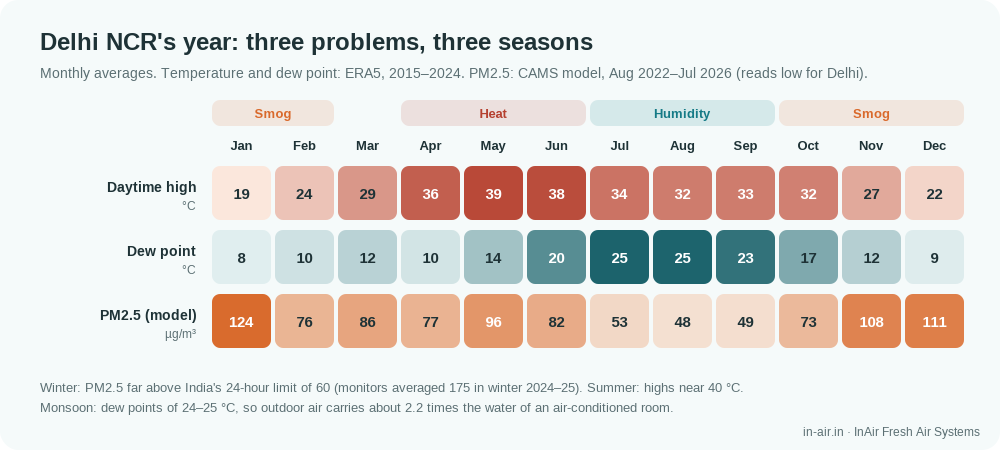
- Delhi NCR needs a system that works in three seasons: winter smog (monitors averaged 175 µg/m³ of PM2.5 in winter 2024–25 [1]), summer highs near 40 °C and monsoon dew points near 25 °C [2].
- An ERV brings in filtered outdoor air and recovers heat and moisture from the stale air it sends out. InAir's Revita and Ventura recover 89–90% of the heat (tested).
- For Delhi NCR, InAir specifies HEPA-13 (at least 99.95% at the most penetrating particle size). The standard MERV-13 captures about 85% of PM2.5.
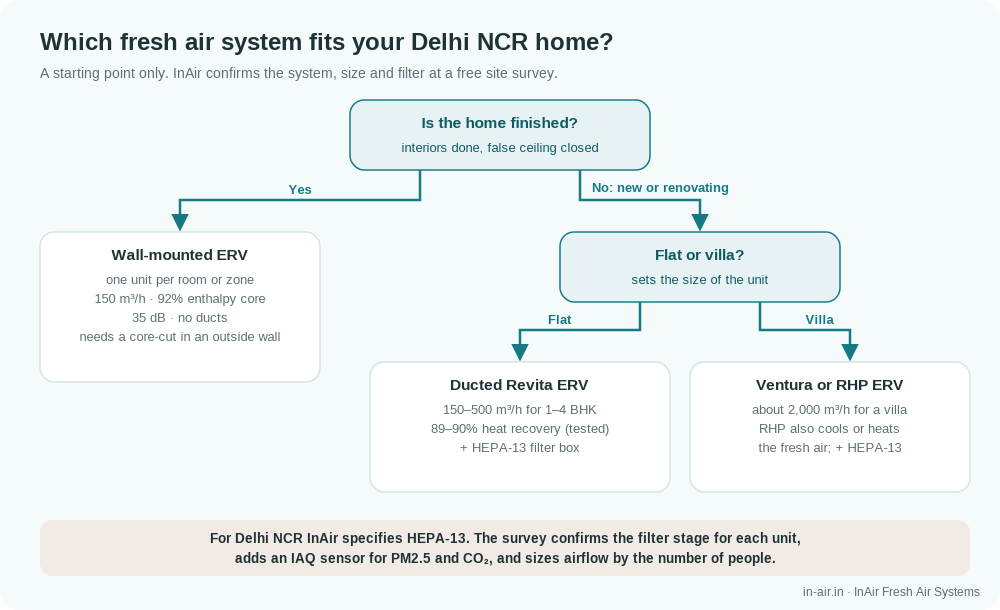
- Finished flat? A wall-mounted ERV per room needs no ducts. Building or renovating? A ducted ERV serves the whole home.
- An air purifier alone cleans room air but brings in no fresh air, so CO₂ keeps rising. Opening windows brings in the smog.
Delhi NCR's climate in numbers
A fresh air system in the capital region has to cope with more than smog. Winter PM2.5 runs many times the WHO 24-hour guideline of 15 µg/m³ [4], but summer heat and monsoon damp matter too. Here is the year, from weather reanalysis and model data for central Delhi:
| Season | What the data shows | What it asks of a fresh air system |
|---|---|---|
| Winter smog (Nov–Jan) | PM2.5 averaged 175 µg/m³ on Delhi's monitors, Oct 2024–Jan 2025; worst day 602 [1]. January nights average about 8.9 °C [2]. | HEPA-13 filtration; heat recovery so fresh air does not chill the room |
| Summer heat (Apr–Jun) | Daytime highs average about 39 °C in May; about 32 days a year reach 40 °C at the reanalysis grid point [2]. | Heat recovery so the AC does not cool outdoor air from scratch |
| Monsoon (Jul–Sep) | Dew point about 25 °C in July; outdoor air holds about 2.2 times the water of an AC room [2]. | Moisture recovery (an enthalpy core); active drying in some homes |
Gurgaon, Noida and Faridabad share Delhi's air. In the model, their average November PM2.5 over 2022–2025 was 104–110 µg/m³, the same range as central Delhi [3]. The model reads low for this region, but it shows no meaningful difference between the cities. What changes the air at your window is local: a main road, a construction site, an industrial area. More on the season in our Delhi winter air data post.
Which system types fit Delhi NCR homes
| Option | Fresh air? | Filters PM2.5? | Best for |
|---|---|---|---|
| Ducted Revita ERV + HEPA-13 box | Yes, to every room | MERV-13 standard; HEPA-13 box added for Delhi | Flats and houses being built or renovated; 150–500 m³/h |
| Wall-mounted ERV | Yes, to one room or zone | Three-stage filtration with charcoal; grade confirmed at survey | Finished flats and rented homes; 250–350 sq ft per unit |
| RHP heat pump ERV | Yes | With HEPA-13 | Villas and large homes; cools or heats the fresh air to 22–28 °C |
| Air purifier only | No | Yes, room air only | A stopgap for one room; CO₂ still builds up |
| Exhaust fans and open windows | Unfiltered | No | Kitchens and toilets; not for smog season |
Ducted ERV with HEPA-13
A ducted ERV sits above a false ceiling and supplies filtered air to each room while drawing stale air from bathrooms and living areas. Adding a HEPA-13 filter box gives Delhi-grade filtration; the box combines a pre-filter, HEPA H13 and activated carbon. A filter box cuts airflow by 15–25%, so the fan has to be selected with it in place. The Revita INA-MFQR-250 shows how much heat recovery does in a Delhi summer: outdoor air at 45 °C leaves the core at about 25.4 °C, with the room at 22 °C.
Wall-mounted ERV for finished flats
Most NCR buyers move into finished apartments, where nobody wants the ceiling opened. InAir's wall-mounted ERV (INA-WERVG20-150CMH) is fixed to an outside wall and needs only a core-cut. It supplies up to 150 m³/h to one room, recovers heat and moisture through a 3D enthalpy core rated at 92%, runs at 35 dB, and has automatic bypass and humidity control. Bedrooms usually come first. Our wall-mounted ERV guide covers it in detail.
RHP heat pump ERV for villas
A villa of 6,000–8,000 sq ft typically needs about 2,000 m³/h. The RHP adds a heat pump to the ERV, so incoming air is cooled or heated to 22–28 °C year round, with energy recovery above 92%. It suits homes where fresh air must arrive conditioned, not just tempered.
Questions to ask before you buy
- What filter grade, tested to what standard? Ask for HEPA H13 to EN 1822, or MERV-13 to ASHRAE 52.2. 'HEPA-type' is not a grade.
- How much air, at what speed, with the filter fitted? A HEPA box reduces airflow; the figure that counts is at the speed you will use.
- Is heat recovery a tested figure? InAir quotes 89–90% (tested) for Revita and Ventura. A fan that only blows filtered air in is not an ERV.
- How loud at the speed you will use? Ask for dB from the spec sheet, not a brochure range.
- Where will the outdoor air intake go? Away from kitchen and toilet exhausts, generators and car parks.
- How often are filters changed in Delhi, and at what cost? Winter loads filters fast.
- Is airflow measured at handover? InAir commissions with measured airflow readings.
- Can you see the air? An indoor air quality sensor shows PM2.5, CO₂ and humidity so you know the system is working.
For a wider list, see how to choose a ventilation company.
How InAir checks this at the site survey
- The number of people in each room, which sets the fresh air needed. ASHRAE 62.2 bases a home's minimum on floor area plus the number of bedrooms.
- Whether the home is finished, and where ducts or wall units can go without breaking finished surfaces.
- The outside wall, balcony or shaft for the air intake and exhaust, and what is nearby: roads, construction, generator exhausts.
- Existing exhaust fans and kitchen hoods, so the home is not pulled into negative pressure.
- Where condensate can drain if an RHP or dehumidifier is needed.
- The filter stage for your location and the extra fan pressure it needs.
You get a sized proposal on the Delhi NCR design figures. To get a feel for airflow first, try the ERV sizing calculator, then book the free survey.
What it costs
- Revita ducted ERV for a 1–2 BHK: from ₹2.1 lakh.
- Revita ducted ERV for a 3–4 BHK: from ₹2.6 lakh.
- Villa, about 2,000 m³/h (Ventura or RHP): from ₹6.4 lakh.
- Wall-mounted ERV for a finished room: from ₹1.4 lakh per unit.
- HEPA-13 filter boxes: from ₹14,800 each.
- Indoor air quality sensor and controller: from ₹53,100.
Prices are equipment only, before GST; installation, ducting and site work are quoted after the survey. See the InAir price guide. Tentative pricing: actual prices may vary based on the site survey.
Myths about clean air in Delhi homes
'An air purifier is enough'
A purifier filters the air already in the room. It does not bring in fresh air, so carbon dioxide from the people in the room keeps rising; keeping a bedroom near 1,000 ppm takes about 21 m³/h of outdoor air per person. Purifiers also have to be sized: the US EPA suggests a clean air delivery rate of at least 65 cfm for a 100 sq ft room and 195 cfm for 300 sq ft [5]. They are useful in a single room. See ventilation vs air purifier.
'Just open the windows for an hour'
In smog season the outdoor air is the problem. Delhi's winter average was 175 µg/m³, and on Diwali night 2024 monitors peaked at 603 [1][6]. If you must air out, do it in the early afternoon, when PM2.5 is lowest, and check the live reading first.
'A fresh air system brings Delhi's pollution inside'
Only if it is unfiltered. With HEPA-13 at 95% or more at system level, outdoor air at 175 µg/m³ arrives at under about 9. Gaps around doors and windows still let some unfiltered air in, which is why the survey looks at how well the home is sealed.
'Heat recovery is pointless in Delhi'
It works in both directions. In summer the core pre-cools hot outdoor air with the cool air leaving; in winter it warms cold air with the heat leaving. On the Revita spec sheet, 45 °C outdoor air leaves the core at about 25.4 °C and 5 °C air at about 19.4 °C.
Sources
- Centre for Science and Environment, Winter air pollution in megacities, briefing note, March 2025 (CPCB real-time data, 1 Oct 2024–31 Jan 2025). https://cseindia.org/MEGACITIES-WINTER-POLLUTION-NOTE-March2025.pdf
- Open-Meteo Historical Weather API, ERA5 reanalysis (Hersbach et al., 2020), Delhi grid point 2015–2025; InAir analysis. https://open-meteo.com/en/docs/historical-weather-api
- Open-Meteo Air Quality API, CAMS PM2.5 model estimates, six Delhi NCR points, 2022–2026, retrieved 26 November 2026. https://open-meteo.com/en/docs/air-quality-api
- World Health Organization, WHO global air quality guidelines (2021). https://www.who.int/publications/i/item/9789240034228
- US EPA, Guide to Air Cleaners in the Home: portable air cleaner sizing for particle removal. https://www.epa.gov/indoor-air-quality-iaq/guide-air-cleaners-home
- Centre for Science and Environment, 2024 Diwali: nature of the first smog event of the season, 2 November 2024. https://cseindia.org/post-diwali-briefing.pdf
Which fresh air system is best for a Delhi flat?
Do I need a HEPA filter for a fresh air system in Gurgaon or Noida?
Can I install a fresh air system in a finished apartment?
How much does a fresh air system cost in Delhi NCR?
Is an air purifier enough during Delhi's smog season?
Will a fresh air system make my home cold in winter or hot in summer?
Our engineers assess your home or building, recommend the right system and the right filter grade for your city, and give you a clear cost estimate. No obligation.