How to choose a ventilation company in India: a buyer's checklist
Seven checks that separate a ventilation company that designs and measures from one that only sells boxes, with the red flags to watch for.
Last updated:

Choose a ventilation company that can prove four things: tested performance data for its units, airflow designed for the people in each bedroom, measured airflow at every outlet when it hands over, and filters and service you can get for years. Price matters, but a system that is sized wrongly or never measured costs more in the end. This checklist shows what to ask, and what a good answer looks like.
Key points
- Ask for test reports, not brochure figures. InAir's 89–90% heat recovery for Revita and Ventura is a tested figure, and the report can be produced.
- Expect a site visit that measures every room and asks who sleeps where.
- Bedrooms are sized by people: about 21 m³/h per person keeps CO₂ near 1,000 ppm. Sizing by air changes is a red flag.
- Insist on commissioning: airflow measured and recorded at each outlet before handover.
- Check the long term: filter availability, a named service contact, AMC and warranty terms in writing, and references you can call.
1. Ask for tested performance data
Every ventilation brochure has numbers: airflow, heat recovery, noise, filter grade. The question is whether they were measured, by what method, and on which model. Energy recovery ventilators are tested under recognised methods, such as ASHRAE Standard 84 with ratings to AHRI Standard 1060, or BS EN 13141-7, which the UK's Approved Document F lists for mechanical ventilation with heat recovery.
Ask for the test report behind any heat recovery figure, and check that it names the model you are buying. InAir's Revita and Ventura ERVs are rated at 89–90% heat recovery on a test, and InAir holds the report. Each model's airflow, fan power, pressure and noise are on its own spec sheet. A company that quotes a single round number for every model, or only a range, should be asked where it came from.
| Ask for | A good answer | A red flag |
|---|---|---|
| Heat recovery figure | A test report for the model, with the test method named | "Up to" figures with no report, or one figure for every model |
| Airflow | A fan curve, or airflow at a stated pressure | Free-air airflow only, with no pressure |
| Noise | dB(A) at a stated speed, per model | A single low figure for the whole range |
| Filter grade | MERV-13, ISO 16890 or EN 1822 class named | "HEPA-type" or "washable HEPA" |
| Fan power | Watts at each speed, from the spec sheet | No figure, or "energy-saving" claims only |
2. Expect a proper site survey
Fresh air cannot be designed from a floor area alone. A good survey visits the home, measures each room, asks how many people sleep in each bedroom, checks the ceiling space and duct routes, looks at where the outdoor intake and exhaust can go, and notes nearby pollution sources such as a busy road or a kitchen exhaust. For a home under construction, the right time is before the false ceiling is closed.
The output should be a written proposal: airflow for each room, the unit and filter grade, where the ducts run, and a price with the unit, installation, GST and service listed separately. If a company quotes a model over the phone without seeing the home, the sizing is a guess.
3. Check how bedrooms are sized
This is where many systems go wrong. A bedroom needs fresh air for the people in it. A resting adult breathes out about 12 litres of CO₂ an hour; with outdoor air at about 425 ppm, about 21 m³/h per person holds a room near 1,000 ppm, and about 32 m³/h holds it near 800 ppm. India's National Building Code asks for 20–30 m³/h of fresh air per person. ASHRAE 62.2 sets a whole-home minimum of 0.03 cfm per sq ft plus 7.5 cfm per person.
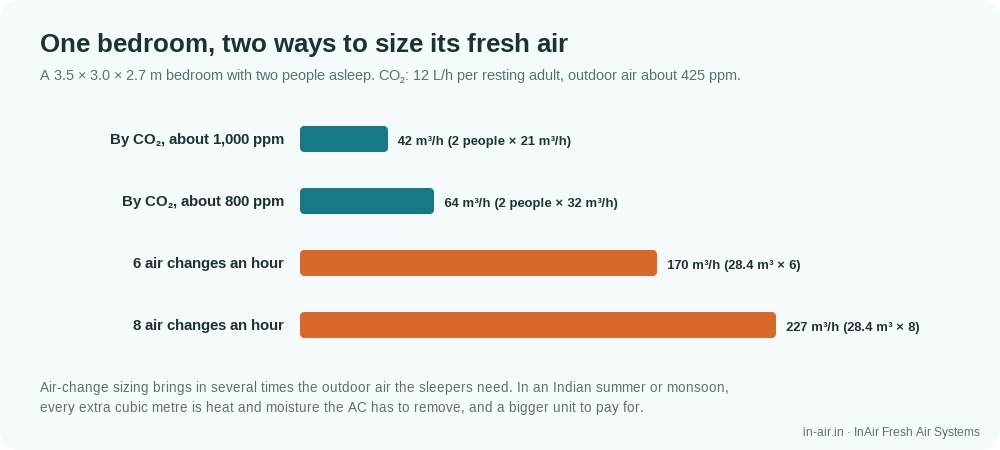
Air changes per hour suit toilets, kitchens and utility rooms, where the aim is to clear moisture and smells. Applied to a bedroom, six or eight air changes is 170–227 m³/h for a typical room, against about 42–64 m³/h by CO₂ for two sleepers. The extra air has to be cooled and dried by your AC. The air changes calculator sizes bedrooms by people and wet rooms by air changes, and the AC load savings calculator shows what each m³/h of outdoor air adds to the AC in your city.
4. Insist on commissioning with measured airflow
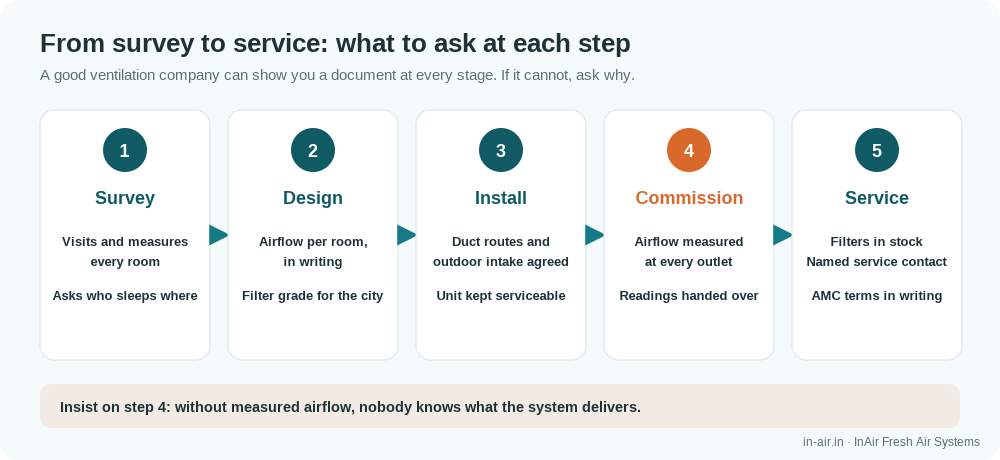
Ducts, bends, grilles and filters all add resistance, so the airflow a system delivers is rarely the airflow on the box. The only way to know is to measure it. In England, Approved Document F requires the airflow of mechanical ventilation in new homes to be measured, and the commissioning sheet given to the owner. There is no equivalent rule for Indian homes, so ask for it in the contract.
At handover you should get a sheet with the design airflow and the measured airflow at every supply and exhaust outlet, the fan speed setting, the filters fitted, and the date. Supply and exhaust should be balanced. Every InAir installation includes commissioning with measured airflow readings before handover.
5. Filters you can actually buy
An ERV is only as good as its next filter. MERV-13 captures at least 85% of particles of 1–3 µm under ASHRAE 52.2; HEPA-13 captures at least 99.95% at the most penetrating particle size under EN 1822. Both are replaced, not washed. InAir's maintenance guide gives typical intervals of about 6–12 months for MERV-13 and about 12 months for HEPA-13, with the pre-filter cleaned every 1–3 months.
Ask which filters the unit takes, their exact size and grade, who stocks them, and how long a replacement takes to arrive. A unit that takes a non-standard filter only one importer can supply becomes a problem in year three. For more on grades, see air filter grades: MERV, HEPA and ISO 16890.
6. Service, AMC and warranty
A fresh air system runs for years and needs a visit at least once a year. Before you sign, get in writing:
- Who services the system in your city, and how quickly they respond.
- What the annual maintenance contract covers: filter changes, core inspection, drain check, airflow check, controls.
- What the warranty covers, for how long, and whether it covers the fans, the core and the controller separately.
- Whether warranty depends on the company doing the service, and what filters cost outside the contract.
Compare these terms as carefully as the price. A cheaper quote with no local service is often the more expensive system over five years.
7. References and case studies
Ask to speak to two or three customers with a similar home, ideally in your city and at least a year after installation. Ask them about noise at night, whether the bedrooms feel fresh in the morning, and how service visits have gone. Read published case studies carefully: a design analysis that shows how the numbers work is useful, but it is not the same as a measured project, and a good company says which is which. InAir's Hyderabad 3BHK case study, for example, is labelled as a design analysis; more are on the case studies page.
How InAir checks this at the site survey
- The survey is free. An engineer works out the airflow from your floor plan and who lives in the home, using ASHRAE 62.2 for homes.
- Checks duct routes and ceiling space, or whether a standalone unit with a core-cut through an outside wall suits a finished home better.
- Names the model that delivers that airflow, with its spec sheet, and the filter grade your city calls for.
- Comes back with an installed price; GST, replacement filters and annual maintenance are shown separately.
- Every installation includes duct design, commissioning with measured airflow readings, and handover.
If you are comparing quotes, the ERV price guide explains which lines should appear on each.
Red flags
- Bedrooms sized by air changes per hour. It signals a design copied from a table, not worked out for the people in the room.
- Washable HEPA claims. MERV-13 and HEPA-13 filters are replaced, not washed. Ask which EN 1822 class the filter was tested to, and whether that test was after washing.
- No measured airflow at handover. If nobody measures, nobody knows.
- Heat recovery quoted with no test report, or one figure for every model in the range.
- A model quoted over the phone with no visit and no floor plan.
- No answer on filters: what size, what grade, who stocks them.
- A unit that cannot be reached for service once the ceiling is closed.
Sources
- AHRI Standard 1060 (I-P)/1061 (SI)-2018, Performance Rating of Air-to-Air Exchangers for Energy Recovery Ventilation Equipment. ahrinet.org
- HM Government, Approved Document F, Volume 1: Dwellings, 2021 edition: Table 1.5 test standards, paragraphs 4.1–4.3 and Appendix C on airflow measurement and commissioning. gov.uk
- ANSI/ASHRAE Standard 62.2-2022, Addendum e: whole-dwelling and local exhaust rates. ashrae.org
- CSIR, Guidelines on Ventilation v2.0 (2022), reproducing NBC 2016 rates. niti.gov.in
- ASHRAE Standard 52.2 (MERV filter classes) and EN 1822 (HEPA classes).
- InAir: Revita and Ventura ERV product page and spec sheets.
How do I choose a good ventilation company in India?
What should a fresh air site survey include?
Should bedrooms be sized by air changes per hour?
What is commissioning, and why does it matter?
Can HEPA filters be washed?
What should an AMC for a fresh air system cover?
Our engineers assess your home or building, recommend the right system and the right filter grade for your city, and give you a clear cost estimate. No obligation.