How to select a ventilation fan: airflow, system pressure, fan curve, efficiency, noise and controls
Most fan problems start with choosing the fan first. Here is the engineer's order: airflow, pressure, type, curve, efficiency, noise and controls.
Last updated:
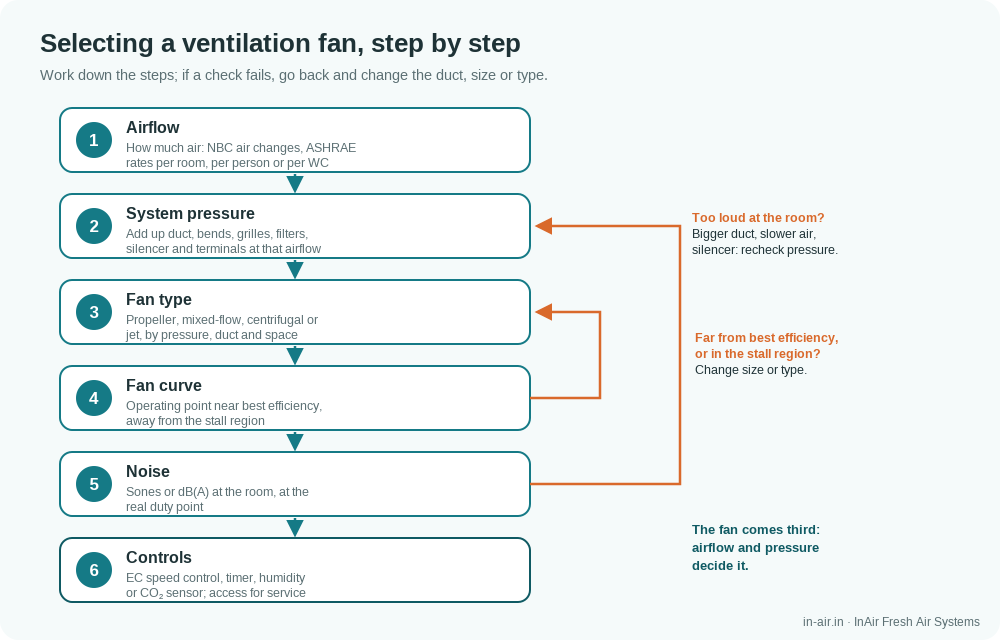
To select a ventilation fan, work in this order: find the airflow the space needs, add up the pressure the duct system will impose at that airflow, choose the fan type that suits that pressure, check the operating point on the fan's published curve, then confirm noise and controls. The fan comes third; airflow and pressure decide it.
Key points
- Airflow first: from the NBC's air changes, ASHRAE 62.2 rates for homes or ASHRAE 62.1 for other buildings, whichever is higher.
- Then pressure: every duct, bend, grille, filter and terminal adds resistance, which rises with the square of airflow.
- Then type: propeller fans for no duct, mixed-flow and inline fans for ducts, centrifugal fans for long runs and filters, jet fans for car parks.
- Then the curve: the operating point should sit near the fan's best efficiency point, not in its stall region.
- Then noise and controls: 1 sone or less for continuous fans (ASHRAE 62.2), and an EC motor if the fan will run for hours.
This method applies to any ventilation fan, from a bathroom extract to a basement system. For a single bathroom or kitchen fan, the exhaust fan buying guide gives the short version.
Step 1: how much air the space needs
Airflow comes from the use of the space, not from the fan catalogue. Take the higher of the rates that apply:
| Space | Rate | Source |
|---|---|---|
| Toilets and bathrooms | 6–10 air changes an hour; at least 85 m³/h (50 cfm) intermittent or 34 m³/h (20 cfm) continuous | NBC; ASHRAE 62.2 |
| Home kitchen | At least 6 air changes; hood at least 170 m³/h (100 cfm) | NBC; ASHRAE 62.2 |
| Bedrooms and living rooms | 20–30 m³/h of fresh air per person | NBC |
| Public toilets | 50 cfm (85 m³/h) per WC | ASHRAE 62.1 |
| Commercial kitchens | 0.70 cfm per ft² of floor | ASHRAE 62.1 |
| Basements and garages | 3–10 and 6–8 air changes an hour | NBC |
| Restaurants, gyms | 8–12 and at least 6 air changes an hour | NBC |
The air changes calculator works this out for each room.
Step 2: the pressure your system adds
A fan has to push air through everything between the inlet and the outlet. The US Department of Energy's fan sourcebook, produced with the fan industry body AMCA, describes this as a system curve: add the pressure loss of each component (ducts, dampers, filters, bends, grilles, louvres) at the design airflow. Because each loss rises with the square of air speed, doubling the airflow through the same system needs about four times the pressure.
- Straight duct, by length and diameter.
- Bends, branches and reducers.
- Supply diffusers and extract grilles.
- Filters, which gain resistance as they load with dust; design for the dirty filter, not the clean one.
- Silencers, dampers and backdraft shutters.
- The outdoor cowl or louvre.
The sourcebook adds a warning about the 'system effect': badly arranged duct right at a fan's inlet or outlet, such as a bend at the outlet, costs more pressure than the component itself, so a fan chosen on paper falls short on site. Leave straight duct either side of the fan.
Step 3: choose the fan type
With airflow and pressure known, the fan type follows. The DOE sourcebook and an RS DesignSpark note on mixed-flow fans describe the main families:
| Fan type | Strength | Limit | Typical use |
|---|---|---|---|
| Propeller (wall, window) | High airflow at low pressure, cheap | Not for extensive ductwork; comparatively noisy | Through-the-wall extract |
| Tubeaxial and vaneaxial | Medium to high pressure, compact, can run in reverse | Pronounced stall region | Ducted extract, emergency ventilation |
| Mixed-flow (diagonal) | Axial-style airflow with centrifugal-style pressure | Moderate pressure | Inline extract and supply in homes and offices |
| Forward-curved centrifugal | Quiet at low speed, compact | 55–65% efficient; not for dirty air | Fresh air units, cabinet fans |
| Backward-inclined centrifugal | High pressure; airfoil blades over 85% efficient | Larger and costlier | Large systems, filters, long runs |
| Jet fan | Thrust, no duct needed | Moves air within the space | Basement car parks |
InAir's fans map onto these: toilet exhaust fans, inline and silent duct fans (120–920 m³/h, up to 382 Pa), mixed-flow, direct duct and circular fans, EC inline fans, cabinet centrifugal fans (1,700–120,000 m³/h, up to 1,300 Pa total pressure) and jet fans for basements, including reversible models that reach rated speed in either direction within 30 seconds. The inline duct fan guide covers the ducted options in detail.
Step 4: read the fan curve
A fan curve plots the pressure a fan makes against the airflow it delivers. Where it crosses your system curve is the operating point, the airflow you will actually get. The box rating is usually the point at zero pressure, which no real installation sees.
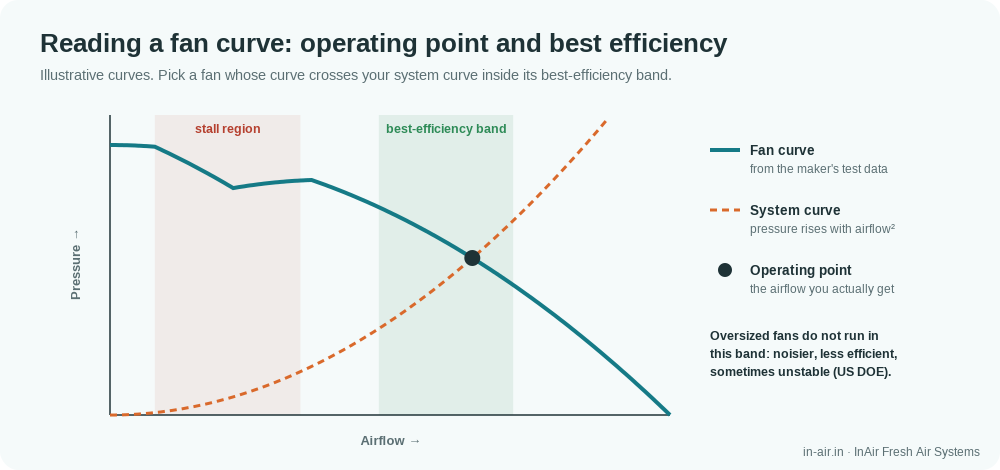
The DOE sourcebook explains why the position on the curve matters. A fan operating near its best efficiency point (BEP) uses the least energy and wears least; moving away from it increases bearing loads and noise. Many axial fans have a stall region at low airflow where they run unstably, noisily and inefficiently. And oversizing is not a safety margin: oversized fans run away from their BEP, generate excess airflow noise, and cost more to buy and run.
If two fans both reach your operating point, prefer the one where it sits closer to the middle of the curve and further from stall, and check the curve was measured to a recognised test method.
Step 5: efficiency and power
The useful work a fan does is airflow multiplied by pressure. Moving 300 m³/h (0.083 m³/s) against 150 Pa needs only about 12.5 W of air power; anything the fan draws above that is lost in the impeller, motor and electronics. Compare fans by the watts they draw at your operating point, not at free air. InAir's spec sheets give this as watts per 100 m³/h; the Revita INA-MFQR-350 ERV, for example, is listed at about 46 W per 100 m³/h at full flow.
For fans that run continuously, the motor matters more than the price tag. EC motors allow stepless speed control, and by the fan laws in the DOE sourcebook, power falls with the cube of speed: at 80% speed, about half the power. The DOE also notes that a motor's efficiency drops sharply below half its rated load, another cost of oversizing.
Step 6: noise at the room
ASHRAE 62.2 limits home ventilation fans to 1.0 sone if they run continuously and 3 sones if they run intermittently. UK Approved Document F asks for 30 dB(A) or less in bedrooms and living rooms from continuous ventilation on its low rate, and 45 dB(A) in kitchens and bathrooms. India's NBC lists 35–40 dB(A) as acceptable indoors in homes. Check the noise figure at your duty point and at a stated distance; a dB(A) figure without a distance cannot be compared. Our quiet ventilation guide explains sones and decibels.
The NBC's guidance on ventilation noise adds a link back to step 4: select a fan to operate as near as possible to its peak efficiency, because an oversized or undersized fan away from that point can be substantially louder.
Step 7: controls and service
- Timer or run-on: for bathrooms used occasionally.
- Humidity sensor: for bathrooms and monsoon damp; runs the fan only while it is needed.
- CO₂ or air quality sensor: for bedrooms and offices on fresh air systems, so fresh air follows occupancy.
- Speed control: EC motors with multi-speed or stepless control; BMS connection for commercial buildings.
- Access: UK Approved Document F asks for reasonable access to replace filters and fans and to clean ducts. A fan nobody can reach is a fan nobody services.
How InAir checks this at the site survey
InAir's engineers follow the same sequence on site:
- room sizes, occupancy and use, to set the airflow;
- the duct route, length, bends and terminals, to estimate the system pressure;
- the fan type and size whose curve meets that duty near its best efficiency;
- the noise at the nearest bedroom or workstation;
- controls, power supply and access for service;
- after installation, measured airflow readings at commissioning.
Send a floor plan or book a free site survey.
What it costs
InAir bathroom and toilet exhaust fans start from ₹3,300, mixed-flow inline fans from ₹6,600, EC inline duct fans from ₹15,000 and cabinet centrifugal fans from ₹47,400, before GST and installation. Jet fans and industrial fans are quoted after the site survey.
Tentative pricing: actual prices may vary based on the site survey.
Common mistakes
- Choosing by the box airflow, which is measured at zero pressure.
- Adding a large safety margin, so the fan runs away from its best efficiency point, noisily.
- Forgetting the filter's dirty resistance.
- A bend right at the fan outlet.
- Comparing dB(A) figures measured at different distances.
- A fixed-speed fan for a duty that varies through the day.
Sources
- US DOE and AMCA, Improving Fan System Performance: A Sourcebook for Industry: system curves, system effect, fan types and efficiencies, best efficiency point, oversizing, fan laws.
- RS DesignSpark: why choose a mixed-flow (diagonal) fan.
- ASHRAE 62.2-2022 Addendum e: home exhaust rates and fan sound limits.
- UK Approved Document F, Volume 1 (2021): noise levels, access for maintenance.
- National Building Code of India 2005, Part 8: indoor noise levels and fan noise guidance. Recommended air changes from NBC Part 8, Section 1, as reproduced for NBC 2016 in CSIR, Guidelines on Ventilation (2022).
- ASHRAE 62.1-2022, Table 6-2: exhaust rates for public toilets and commercial kitchens.
- InAir product pages, spec sheets and price list (FY 2026–27).
How do I choose the right ventilation fan?
What is static pressure in a fan?
Should I buy a bigger fan to be safe?
Axial, mixed-flow or centrifugal: which fan type do I need?
How quiet should a ventilation fan be?
Is an EC fan worth it?
Our engineers assess your home or building, recommend the right system and the right filter grade for your city, and give you a clear cost estimate. No obligation.