What size kitchen exhaust fan or chimney do I need?
Kitchen exhaust is sized by delivered airflow, not the suction on the box. Here are the standard rates, worked examples for Indian kitchens and the duct sizes that make them real.
Last updated:
A home kitchen needs a hood that delivers at least 170 m³/h (100 cfm) through its duct under ASHRAE 62.2, and enough exhaust for 6 air changes an hour under India's National Building Code. Frying on front burners needs more: at least 340 m³/h of real airflow before a hood can catch most of the smoke. Box suction ratings are not real airflow. The air changes and exhaust fan size calculator does the room sums.
Key points
- Minimums: a vented hood of 100 cfm (170 m³/h), or a plain exhaust fan of 300 cfm (510 m³/h); 6 air changes an hour for the room (NBC).
- For Indian frying: lab tests needed about 200 cfm (340 m³/h) of real airflow, plus good coverage, to catch over 75% from front burners.
- Box ratings: chimney suction such as “1200 m³/h” is the most the fan moves with almost no duct. Installed hoods often deliver 70% or less of the figure in their literature.
- Duct: 150 mm rigid duct suits up to about 255 m³/h; 425 m³/h needs 205 mm. Short, straight, few bends.
- Make-up air: above 680 m³/h (400 cfm), the US residential code requires planned replacement air in homes with fuel-burning appliances that are not direct-vent or fan-vented.
The three numbers the standards give
| Standard | What it asks for | In m³/h |
|---|---|---|
| ASHRAE 62.2-2022 (Addendum e) | Vented range hood, run while cooking: 100 cfm | 170 |
| ASHRAE 62.2-2022 (Addendum e) | Other kitchen exhaust fan, run while cooking: 300 cfm, or a capacity of 5 air changes an hour in an enclosed kitchen | 510, or 5 × volume |
| ASHRAE 62.2-2022 (Addendum e) | Continuous exhaust in an enclosed kitchen: 5 air changes an hour | 5 × volume |
| National Building Code of India, Part 8 | Kitchens: at least 6 air changes an hour | 6 × volume |
| UK Approved Document F (2021) | Cooker hood extracting to outside: 30 l/s | 108 |
These are floors, not targets. They describe the least a code will accept, and they assume the fan really delivers its rating. Our air changes per hour by room explains the NBC table for every room.
Worked examples for Indian kitchens
Measure length, width and ceiling height in metres, multiply for the volume, then compare each rule. The ceiling height here is to the false ceiling where there is one.
| Kitchen | Size | Volume | NBC 6 ACH | ASHRAE 5 ACH | ASHRAE hood minimum |
|---|---|---|---|---|---|
| Compact 1–2 BHK kitchen | 2.4 × 1.8 × 2.75 m | 12 m³ | 71 m³/h | 59 m³/h | 170 m³/h |
| Typical 3 BHK kitchen | 3.0 × 2.4 × 2.75 m | 20 m³ | 119 m³/h | 99 m³/h | 170 m³/h |
| Large villa kitchen | 4.0 × 3.0 × 3.0 m | 36 m³ | 216 m³/h | 180 m³/h | 170 m³/h |
| Open kitchen with dining (combined) | 6.0 × 4.0 × 2.75 m | 66 m³ | 396 m³/h | 330 m³/h | 170 m³/h |
Two things stand out. In a small closed kitchen, the air-change rules ask for less than the 170 m³/h hood minimum, so the hood decides. In an open kitchen the volume is large, and the hood alone cannot change all that air; it has to catch the plume at the hob instead, which is a matter of coverage and real airflow.
For Indian cooking the floors are too low. In LBNL tests, about 200 cfm (340 m³/h) of measured airflow was necessary, but not sufficient on its own, to capture over 75% of front-burner emissions. For wok stir-frying on a front burner, hoods on high settings of 109–138 L/s (about 390–500 m³/h) caught 16–70% of fine particles, against 3–11% on low. So for daily tadka and frying, think in terms of 340–500 m³/h delivered at the hob, with a hood that covers the front burners.
Why “1200 m³/h suction” is a free-air number
Chimneys sold in India are labelled with a suction figure: 1000, 1200, 1400 m³/h. If the listing does not say at what pressure it was measured, treat it as the most the blower moves with almost nothing in its way. Real installations add resistance: the grease filter, the duct, every bend, the outlet cowl and the backdraft flap.
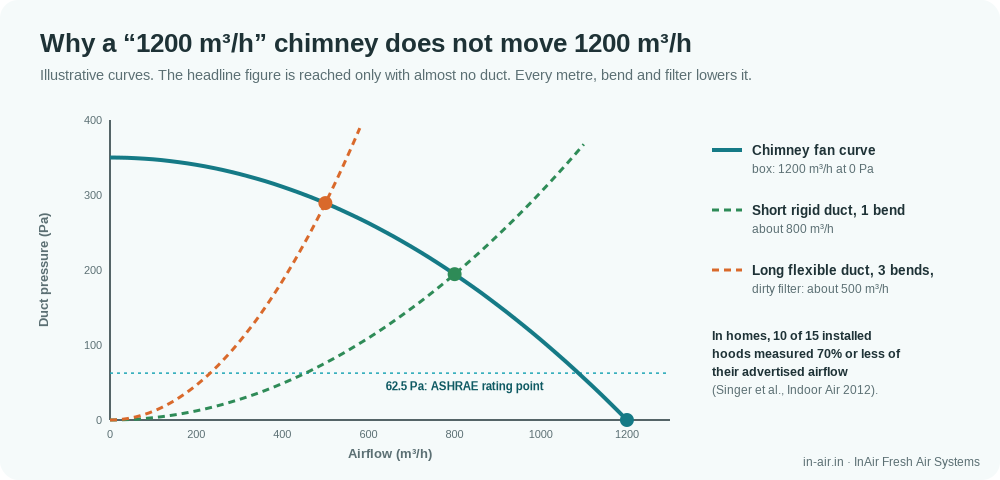
- In a study of 15 installed kitchen exhaust devices, 10 measured 70% or less of the maximum airflow in their product literature.
- In lab tests, the airflow of axial-fan devices dropped more with duct resistance than that of centrifugal (blower) devices.
- ASHRAE 62.2 accepts a fan's rating in place of a measured airflow only if the rating is at 0.25 in. of water (62.5 Pa) and the duct meets its sizing table or the maker's design criteria.
So ask the seller for the airflow at a stated pressure, or for the fan curve. A modest chimney that holds 400 m³/h through your duct will clear more smoke than a 1400 m³/h one choking on a long flexible pipe. The same logic applies to wall and inline fans; see the exhaust fan buying guide.
Duct diameter and run length
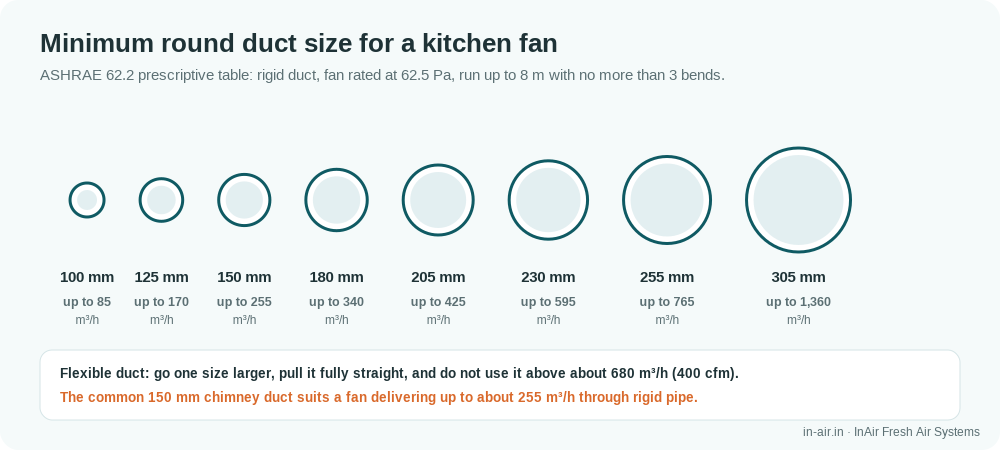
The duct is where most kitchen systems lose their airflow. ASHRAE 62.2's prescriptive table gives the smallest round duct for a fan rated at 62.5 Pa, for runs up to 8 m with no more than three bends:
| Fan airflow (rated at 62.5 Pa) | Minimum rigid round duct |
|---|---|
| Up to 85 m³/h (50 cfm) | 100 mm |
| Up to 170 m³/h (100 cfm) | 125 mm |
| Up to 255 m³/h (150 cfm) | 150 mm |
| Up to 340 m³/h (200 cfm) | 180 mm |
| Up to 425 m³/h (250 cfm) | 205 mm |
| Up to 595 m³/h (350 cfm) | 230 mm |
| Up to 765 m³/h (450 cfm) | 255 mm |
| Up to 1,360 m³/h (800 cfm) | 305 mm |
- Flexible duct goes one size larger, must be pulled fully straight, and the table does not allow it above 400 cfm (680 m³/h).
- Past 8 m or three bends, the table no longer applies; the system needs a pressure calculation or a fan with more pressure.
- The outlet fitting must be at least as large as the duct; a small cowl on a big duct throttles it.
- Rectangular ducts are compared by their hydraulic diameter: four times the area divided by the perimeter. Our planned ventilation duct guide goes further.
The common 150 mm (6 inch) chimney duct fits the table only for a fan delivering up to about 255 m³/h through rigid pipe, or about 210 m³/h (125 cfm) through flexible pipe. That is a long way from 1200.
Make-up air and noise
The more air a hood removes, the more must come in. The US International Residential Code (2024, M1503.6) requires make-up air at roughly the exhaust rate for kitchen exhaust above 400 cfm (680 m³/h) in homes with fuel-burning appliances that are neither direct-vent nor fan-vented. In a sealed Indian flat, a large chimney without a replacement air path simply cannot reach its airflow. The home kitchen ventilation guide explains the options.
Noise limits how high people actually run a hood. ASHRAE 62.2 asks for kitchen fans rated at no more than 3 sones on at least one setting of 100 cfm or more. In the installed-hood study, all 14 devices tested for sound exceeded 56 dB(A) in the kitchen at their highest setting. A fan that delivers enough air at a lower, quieter speed will get used.
How InAir checks this at the site survey
- Measures the kitchen and notes whether it is closed, semi-open or open to living areas.
- Looks at the hob, the burners you fry on and how far the hood reaches over them.
- Traces the duct route: length, bends, diameter, rigid or flexible, and the outlet.
- Checks the make-up air path: door gaps, windows, grilles, or a fresh air system.
- Selects any exhaust fan at the pressure of the real duct, then measures delivered airflow at commissioning.
What it costs
InAir wall and ceiling exhaust fans start from ₹3,300, mixed-flow inline fans for ducted kitchen runs from ₹6,600, and EC inline duct fans with speed control from ₹15,000. InAir's inline duct fans cover 120–920 m³/h with static pressure up to 382 Pa. Prices are before GST and installation.
Tentative pricing: actual prices may vary based on the site survey.
Common mistakes
- Choosing a chimney by its box suction instead of the airflow at your duct's pressure.
- Reducing a hood outlet to a 100 mm or 150 mm flexible pipe with a long run and several bends.
- Sizing an open kitchen by air changes alone and forgetting capture at the hob.
- Buying the biggest chimney for a sealed flat, where it cannot draw replacement air.
- Never cleaning the grease filter, which quietly cuts the airflow.
Sources
- ASHRAE 62.2-2022 Addendum e: local exhaust rates (Tables 5-1, 5-2) and fan sound limits. Link
- ASHRAE 62.2-2016 Addendum u: Table 5.3 prescriptive duct sizing, fan rated at 0.25 in. of water (62.5 Pa). Link
- Bureau of Indian Standards, National Building Code of India, Part 8 Section 1: recommended air changes (SP 7:2005; same table in NBC 2016). Link
- Singer B.C. et al. Performance of installed cooking exhaust devices. Indoor Air 22 (2012) 224–234. Link
- Lunden M.M., Delp W.W., Singer B.C. Capture efficiency of cooking-related fine and ultrafine particles by residential exhaust hoods. Indoor Air 25 (2015) 45–58. Link
- Delp W.W., Singer B.C. Performance assessment of U.S. residential cooking exhaust hoods. Environ. Sci. Technol. 46 (2012) 6167–6173. Link
- International Residential Code 2024, Section M1503.6 Makeup air required (UpCodes text). Link
- UK Approved Document F, Volume 1 (2021): kitchen extract rates and door undercuts. Link
What size chimney do I need for an Indian kitchen?
Is a 1200 m³/h chimney enough?
How do I calculate kitchen exhaust fan size?
What duct size does a kitchen chimney need?
How many air changes does a kitchen need in India?
Does a bigger chimney need make-up air?
Our engineers assess your home or building, recommend the right system and the right filter grade for your city, and give you a clear cost estimate. No obligation.