Home kitchen ventilation in India: chimney, exhaust fan or both?
Most Indian kitchens need a ducted chimney over the hob and a way for air to get in. Here is why, with the research on smoke, gas and capture behind it.
Last updated:
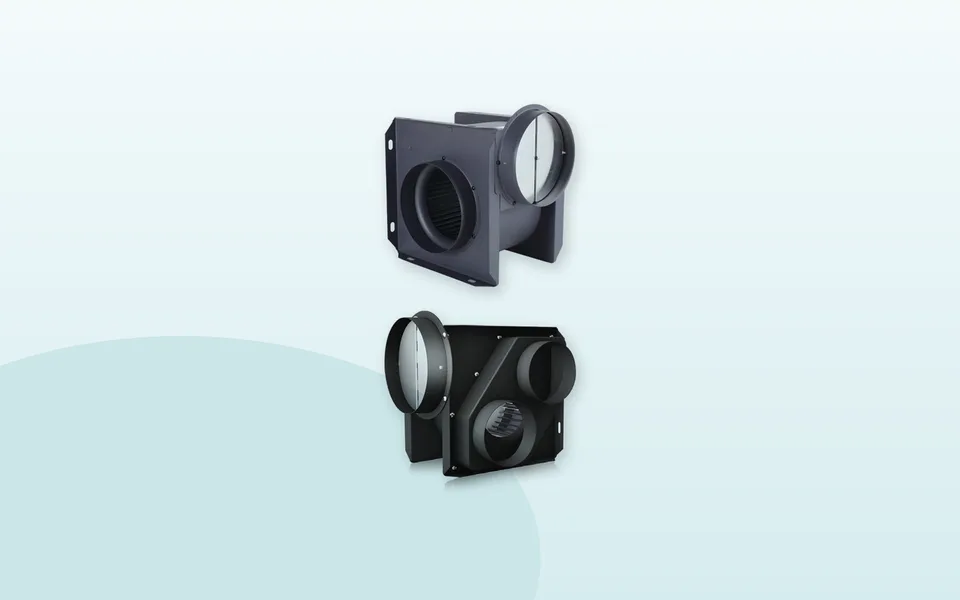
A home kitchen in India needs two things: a ducted chimney (range hood) that catches tadka and frying smoke at the hob and sends it outside, and a path for replacement air to come in. An exhaust fan alone clears steam and heat but catches little smoke at source. A recirculating chimney removes neither. This guide explains why, with the research behind each point. For restaurants and hotel kitchens, see commercial kitchen ventilation.
Key points
- Frying is the biggest particle source in a home kitchen. In a 12-city study, kitchens with mechanical plus natural ventilation had 2.3 times lower PM2.5 than kitchens relying on open doors alone.
- LPG and piped gas flames make nitrogen dioxide (NO₂). Without a vented hood, short-term levels in homes often pass the WHO one-hour guideline of 200 µg/m³.
- A chimney is only as good as its capture. Lab tests found wok stir-frying on a front burner was caught 3–11% on a low setting and 16–70% on high. Cook on the back burners.
- Ducted beats recirculating. Only a hood vented outdoors removes heat, steam and the flame's gases.
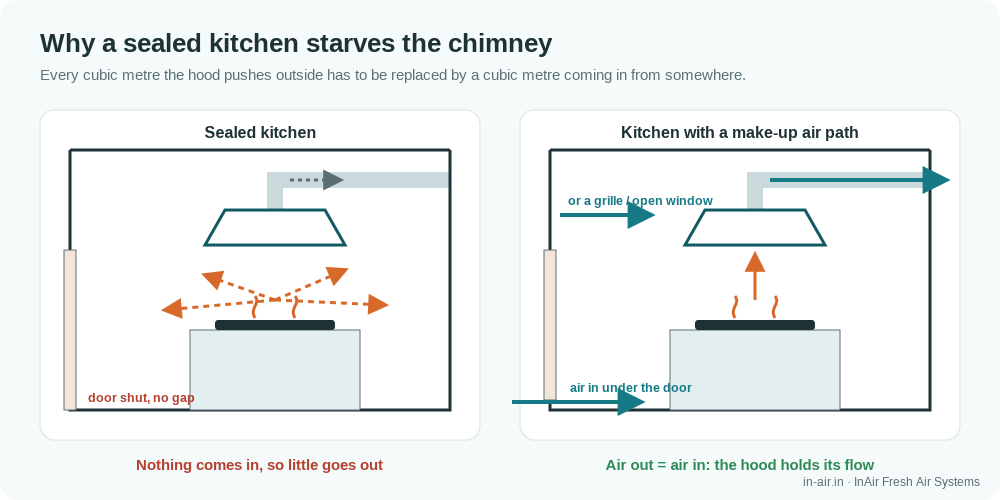
- A sealed kitchen starves the hood. Air out needs air in: a door gap, a grille, an open window or a fresh air system.
What Indian cooking puts into the air
Three things leave the hob when you cook: fine particles and oil droplets from the food, steam and heat, and the combustion gases from the flame. Indian home cooking is heavy on the first. Tadka, shallow frying and deep frying heat oil well past its smoke point, and a pressure cooker or a big pot of dal releases steam for long stretches.
A 2022 study by Kumar and colleagues measured in-kitchen PM2.5 in 60 homes across 12 cities, including Chennai. Frying was the highest particle-emitting activity. Small kitchens under 15 m³ raised exposure, and the highest average, 185 µg/m³ in Dhaka, came from small kitchens, extensive frying and long cooking. Kitchens with both mechanical and natural ventilation, as in Chennai, had average PM2.5 2.3 times lower than those relying on open doors. For scale, the WHO 24-hour guideline for PM2.5 is 15 µg/m³. Our PM2.5 vs PM10 guide explains why the fine fraction matters most.
Gas stoves and nitrogen dioxide
Most Indian city kitchens burn LPG (propane and butane) or piped natural gas. Any gas flame makes nitrogen dioxide, NO₂, an irritant gas that inflames the airways. You cannot see or smell it at these levels, and no grease filter catches it.
- A 2024 Stanford study in Science Advances measured gas and propane stoves in more than 100 homes. With one burner on and no outside-venting hood, NO₂ in over half of the kitchens, living rooms and bedrooms tested passed the WHO one-hour indoor guideline of 200 µg/m³.
- The same study found that gas and propane stoves raise average long-term NO₂ exposure in US homes by 4 ppb, about 75% of the WHO long-term guideline of 10 µg/m³. People in homes under 800 sq ft got four times the exposure of people in homes over 3,000 sq ft, which is a warning for compact Indian flats.
- A meta-analysis of 41 studies found that children in homes that cook with gas had 32% higher odds of asthma (odds ratio 1.32).
The practical answer is the same as for smoke: a hood vented outdoors, switched on before the burner, and left on for a few minutes after. US surveys cited in the Stanford study found hoods are used only 15–39% of the time, so the habit matters as much as the hardware. Induction cooking removes the flame's gases altogether, though not the smoke from the food.
Chimney, exhaust fan or both?
A chimney (range hood) sits over the hob and catches the plume before it spreads. A wall or window exhaust fan pulls air from the whole kitchen, so by the time smoke reaches it, it has already mixed into the room and into your lungs. They do different jobs.
| Ducted chimney | Recirculating chimney | Wall exhaust fan only | Ducted chimney + exhaust fan | |
|---|---|---|---|---|
| Catches smoke at the hob | Yes, if it covers the burners | Yes, then returns the air to the room | No; dilutes it after it spreads | Yes |
| Removes heat, steam and flame gases from the home | Yes | No | Yes, slowly | Yes |
| Grease | Trapped in filter, rest goes outside | Trapped in filter and carbon | Coats the fan and walls | Mostly in the hood filter |
| Counts under ASHRAE 62.2 as a kitchen hood | Yes (100 cfm minimum) | No; the rate is for a vented hood | As an exhaust fan: 300 cfm, or 5 ACH if enclosed | Yes |
| Best for | Most homes | Only where no duct route exists | Background steam and heat | Heavy daily frying, closed kitchens |
So for most Indian kitchens the answer is a ducted chimney first. Add a wall or inline exhaust fan if the kitchen is closed and gets hot, or if there is a utility area with a second burner or a washing machine. How big each should be is in our kitchen exhaust fan and chimney size guide.
Does a chimney actually catch the smoke?
Less than most people think. Researchers at Lawrence Berkeley National Laboratory tested hoods in the lab and in homes. Three results matter for Indian cooking:
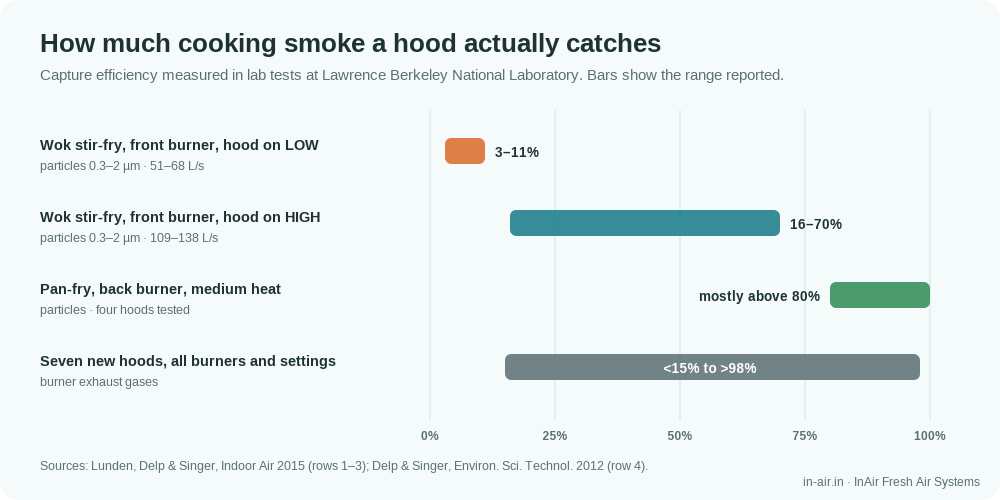
- Front burners escape. For wok stir-frying on a front burner, hoods caught only 3–11% of fine particles on a low setting and 16–70% on high. Pan-frying on a back burner was caught mostly above 80%.
- Coverage matters. The best hood in the 2012 tests had a large, open capture area that covered most of the front burners. Flat-bottomed hoods covered by grease screens or metal panels caught less.
- Installed hoods move less air than the box says. In 15 installed devices, 10 measured 70% or less of the airflow in their product literature. About 340 m³/h (200 cfm) of real airflow was needed, but not enough on its own, to catch over 75% from front burners.
So pick a hood at least as wide as the hob that reaches over the front burners, do the tadka and frying on the back burners where you can, and run the hood on a higher setting while frying.
Ducted vs recirculating chimneys
A recirculating (ductless) chimney pulls air through a grease filter and a carbon filter and blows it back into the kitchen. The carbon takes out some of the smell. Everything else stays: the heat, the steam, the carbon dioxide and NO₂ from the flame, and the fine particles that get past the filters. ASHRAE 62.2, the US residential ventilation standard, sets its 100 cfm (170 m³/h) kitchen minimum for a vented range hood.
Choose recirculating only when a duct to the outside is truly impossible, and then add an exhaust fan to take the heat and steam out. In apartments, the duct usually goes through the outside wall above the window or into the utility balcony. A short, straight duct with a cowl and a backdraft flap beats a long flexible pipe. Our planned wall terminals and cowls guide covers the outlet.
Make-up air: why a sealed kitchen starves the hood
A hood can only push out as much air as can come in. Modern flats with sealed uPVC windows, a shut kitchen door and the AC running give it almost nothing to draw on, so it roars but moves little, and smoke rolls past it into the room.
- The US International Residential Code (2024, M1503.6) requires make-up air roughly equal to the exhaust for any kitchen exhaust above 400 cfm (680 m³/h), in homes with fuel-burning appliances that are neither direct-vent nor fan-vented. Many Indian chimneys are advertised above that.
- For smaller fans, a gap under the kitchen door helps. UK Approved Document F uses a 10 mm undercut on a standard 760 mm door as the reference for letting extract air through.
- Opening a window a few centimetres while frying is the simplest fix. In a smoggy Delhi winter, a filtered fresh air system does the same job without letting in unfiltered air.
Open kitchens
An open kitchen spreads smoke, NO₂ and moisture straight into the living and dining area, and often into an air-conditioned room. ASHRAE 62.2 treats a non-enclosed kitchen strictly: it must have an exhaust that runs when you cook (a vented hood of at least 100 cfm, or another exhaust fan of at least 300 cfm), not just a slow continuous fan. In practice, the hood matters even more here, because there is no door to contain what it misses. The rest of the home still needs its own fresh air; see our home ventilation guide and exhaust fan vs fresh air system.
Grease and the monsoon
Grease that escapes the hood settles on walls, the false ceiling, the exhaust fan blades and the inside of the duct. A clogged grease filter or a greasy duct adds resistance, and the hood moves less air. Wash or change filters on the maker's schedule, and more often with daily deep frying.
The monsoon adds water. Cooking steam meets outdoor air that is already wet: in InAir's analysis of ERA5 climate data for 2015–2024, mean relative humidity is 88.5% in Mumbai in July and 87.2% in Kolkata in September. The US EPA advises keeping indoor humidity below 60%, ideally 30–50%. A kitchen that holds steam grows mould in the corners and on the back of cabinets. Run the hood or exhaust fan through and after cooking, and check that the outlet has a cowl that keeps rain out.
How InAir checks this at the site survey
InAir's free site survey looks at the kitchen as part of the whole home. An engineer notes:
- Kitchen size, ceiling height and whether it is closed, semi-open or open to an air-conditioned room.
- The hob: number of burners, which ones you use for frying, and how far the hood reaches over the front burners.
- The duct route: length, number of bends, duct diameter and where it ends outside, including rain, backdraft and the neighbours' windows.
- Where replacement air will come from: door gaps, windows, grilles or a fresh air system.
- Monsoon damp, grease build-up and smell spreading to bedrooms.
- If you want numbers, an indoor air quality sensor can log PM2.5, humidity and VOCs while you cook. It does not measure NO₂.
After installation, InAir measures the airflow at each fan as part of commissioning, so you know what the system delivers rather than what the box says.
What it costs
InAir's wall and ceiling exhaust fans, which include kitchen and utility exhaust fans, start from ₹3,300. Mixed-flow inline fans start from ₹6,600 and are suited to longer ducted kitchen runs; InAir's inline duct fans are published with static pressure up to 382 Pa. The indoor air quality sensor starts from ₹53,100. Prices are before GST and installation.
Tentative pricing: actual prices may vary based on the site survey.
Common mistakes
- Buying a chimney by its suction rating and fitting it to a long, kinked flexible duct.
- Choosing a recirculating chimney when a duct to the outside was possible.
- Doing tadka and deep frying on the front burner, outside the hood's reach.
- Switching the hood on after the oil starts smoking, and off as soon as the flame goes out.
- Closing every window and door, so the hood has no air to replace what it removes.
- Relying on a wall exhaust fan to clear frying smoke from across the room.
Sources
- Kumar P. et al. In-kitchen aerosol exposure in twelve cities across the globe. Environment International 162 (2022) 107155. Link
- Lunden M.M., Delp W.W., Singer B.C. Capture efficiency of cooking-related fine and ultrafine particles by residential exhaust hoods. Indoor Air 25 (2015) 45–58. Link
- Singer B.C. et al. Performance of installed cooking exhaust devices. Indoor Air 22 (2012) 224–234. Link
- Delp W.W., Singer B.C. Performance assessment of U.S. residential cooking exhaust hoods. Environ. Sci. Technol. 46 (2012) 6167–6173. Link
- Kashtan Y. et al. Nitrogen dioxide exposure, health outcomes, and associated demographic disparities due to gas and propane combustion by U.S. stoves. Science Advances 10 (2024) eadm8680. Link
- Lin W., Brunekreef B., Gehring U. Meta-analysis of the effects of indoor nitrogen dioxide and gas cooking on asthma and wheeze in children. Int. J. Epidemiol. 42 (2013) 1724–1737. Link
- ASHRAE 62.2-2022 Addendum e: local exhaust rates (Tables 5-1, 5-2) and fan sound limits. Link
- International Residential Code 2024, Section M1503.6 Makeup air required (UpCodes text). Link
Is a chimney or an exhaust fan better for an Indian kitchen?
Are recirculating (ductless) chimneys any good?
Is cooking on an LPG stove bad for health?
Why does my kitchen chimney not pull the smoke?
Do I need a chimney in an open kitchen?
What does InAir supply for a home kitchen?
Our engineers assess your home or building, recommend the right system and the right filter grade for your city, and give you a clear cost estimate. No obligation.