Net zero building ventilation in India: IGBC, GRIHA, ECBC and ERVs
Fresh air is one of the largest energy loads in a sealed Indian building. Here is what ECBC, IGBC and GRIHA ask for, and how heat recovery keeps the energy down.
Last updated:
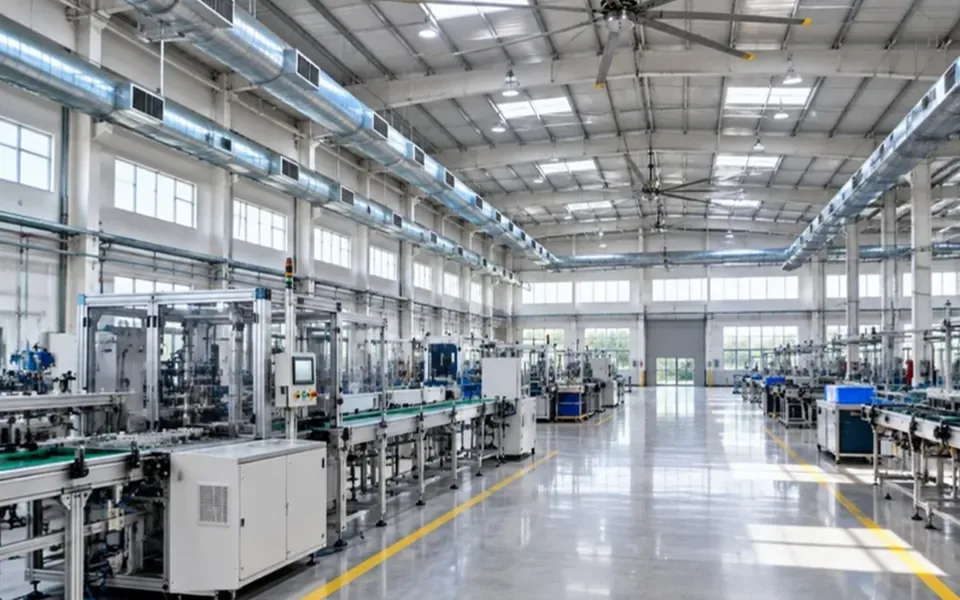
A net zero building has to use so little energy that renewables can cover it, and fresh air is one of the biggest loads in an Indian building. Each cubic metre of outdoor air must be filtered and cooled. An energy recovery ventilator (ERV) takes most of that heat out of the incoming air using the outgoing air, so the building can meet IGBC and GRIHA fresh air rules without a matching jump in cooling energy.
Key points
- ECBC 2017 §5.3.6 makes air-to-air heat recovery of at least 50% compulsory in hotels and hospitals with systems above 2,100 l/s that supply at least 70% outdoor air.
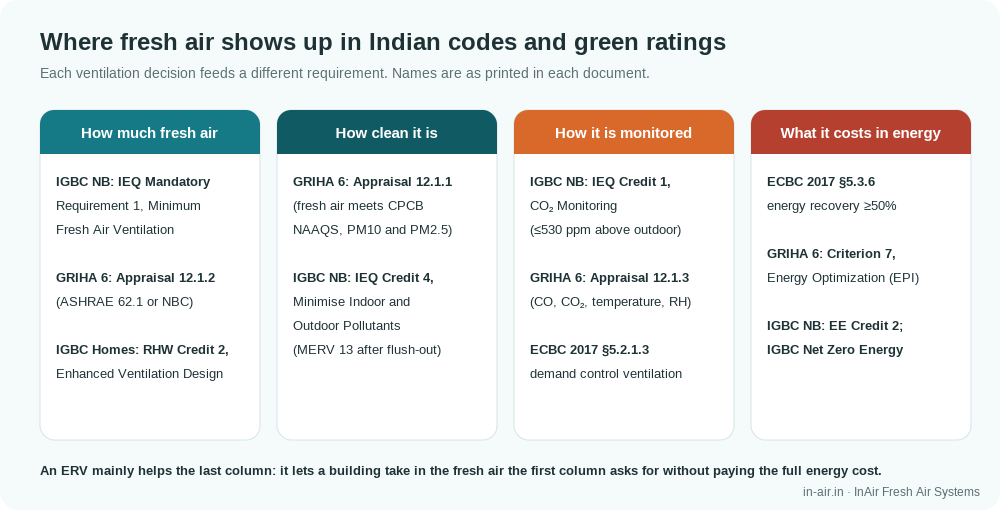
- IGBC Green New Buildings makes fresh air to ASHRAE 62.1-2010 mandatory (IEQ Mandatory Requirement 1) and gives a point for CO₂ monitoring (IEQ Credit 1).
- GRIHA Version 6 gives up to 7 points under Criterion 12 for fresh air quality, quantity and monitoring, and up to 8 points under Criterion 7 for cutting energy use below its benchmark.
- In our Delhi example, 1,000 m³/h of outdoor air at 38.9 °C needs about 5.0 kW of sensible cooling. At InAir's tested 89–90% heat recovery, the sensible load falls to about 0.5 kW.
- IGBC's Net Zero Energy rating asks the building to show net annual energy use of zero; lower ventilation energy shrinks the solar array needed.
What does net zero mean for a building in India?
The Indian Green Building Council's Net Zero Energy rating certifies a building that meets its mandatory requirements and shows that its net annual energy consumption is zero, with renewable energy covering what it uses (IGBC NZEB rating). Two mandatory requirements matter for ventilation:
- Mandatory Requirement 1, Energy Performance: meet the IGBC minimum energy performance, or keep actual energy use at or below the design figure, or meet ECBC 2017 equipment efficiencies for HVAC and lighting.
- Mandatory Requirement 2, Thermal Comfort, Indoor Temperature and RH: hold 26 ± 2 °C and 30–70% relative humidity for 90% of the time, and show that 80% of occupants are satisfied.
The second requirement is where Indian buildings struggle. Monsoon fresh air carries a lot of moisture, and the comfort range has to be held while the energy target is met. The same rating also gives up to 3 points if most fans used for air handling, ventilation and exhaust are at least 70% efficient.
What ECBC 2017 requires for energy recovery
The Energy Conservation Building Code 2017 from the Bureau of Energy Efficiency applies to commercial buildings with a connected load of 100 kW or more, or a contract demand of 120 kVA or more. Private homes are not covered. Two clauses touch fresh air directly (ECBC 2017 text):
| Clause | Applies to | Requirement |
|---|---|---|
| §5.3.6 Energy Recovery | Hospitality and healthcare buildings with systems above 2,100 l/s (7,560 m³/h) and minimum outdoor air supply of 70% | Air-to-air heat recovery with at least 50% recovery effectiveness |
| §5.2.1.3 Demand Control Ventilation | Systems bringing in more than 1,500 l/s of outdoor air to a space over 50 m² with more than 40 people per 100 m², served by an economiser or modulating outdoor air damper | Demand control ventilation. Systems with exhaust air energy recovery are exempt |
| §5.3.6 (generators) | Hospitality, healthcare and business buildings over 20,000 m² with diesel or gas generator sets | Recover at least 50% of generator heat |
ECBC 2017 sets 50% as the floor, not a target. A building aiming for net zero needs far better than the minimum. BEE has since published the Energy Conservation and Sustainable Building Code 2024 for commercial buildings, which the IEA lists as in force (IEA policy database). Adoption is state by state, so check which code your project is approved under. We have not quoted ECSBC 2024 clauses here because we could not open its full text.
Which IGBC credits involve fresh air?
IGBC's Green New Buildings rating (version 3.0 with addenda) is the one most commercial projects use (IGBC Green New Buildings v3.0). Its ventilation items, by their printed names:
| IGBC item | Points | What it asks |
|---|---|---|
| IEQ Mandatory Requirement 1, Minimum Fresh Air Ventilation | Required | Mechanically ventilated spaces meet ASHRAE 62.1-2010 minimum rates in all regularly occupied areas |
| IEQ Mandatory Requirement 2, Tobacco Smoke Control | Required | No smoking, outdoor smoking areas 7.6 m from intakes, or sealed smoking rooms at 5 Pa negative pressure |
| IEQ Credit 1, CO₂ Monitoring | 1 | CO₂ sensors in return air ducts holding no more than 530 ppm above outdoor air in regularly occupied areas |
| IEQ Credit 4, Minimise Indoor and Outdoor Pollutants | 1 | Any two of several measures; one is MERV 13 (or EU 7) filters on fresh air after building flush-out |
| EE Credit 2, Enhanced Energy Efficiency | 1–15 | Energy cost savings in a whole-building simulation against an ASHRAE 90.1-2010 Appendix G baseline (a modelling baseline, not a design requirement) |
For housing, IGBC Green Homes (version 3.0) has RHW Mandatory Requirement 2, Ventilation Design, which asks for at least 5 cfm of fresh air per person in air-conditioned habitable spaces, and RHW Credit 2, Enhanced Ventilation Design, worth 2 points at 6.5 cfm per person (IGBC Green Homes v3.0). Neither IGBC rating has a separate credit named for energy recovery; the ERV counts through the energy simulation and the net zero energy balance.
Which GRIHA criteria involve fresh air?
GRIHA Version 6.0 (September 2025) sets out the criteria below (GRIHA Version 6 manual). Projects registered under GRIHA v2019 can convert to it.
| GRIHA criterion | Points | Ventilation link |
|---|---|---|
| Criterion 7, Energy Optimization | 12 (partly mandatory) | ECBC 2017 mandatory requirements; at least 5% below the GRIHA EPI benchmark is mandatory, with up to 8 points for more than 50% reduction |
| Criterion 12, Maintaining Indoor Air Quality | 7 (optional) | 12.1.1 fresh air meets CPCB NAAQS for PM10 and PM2.5 (1 point); 12.1.2 fresh air quantity to ASHRAE 62.1-2010 or NBC 2016 Part 8 Section 3 (1 point); 12.1.3 monitoring of CO, CO₂, temperature and RH with a CO₂ limit of outdoor + 500 ppm (sensors 1 point, display 1 point) |
| Criterion 11, Thermal & Acoustic Comfort | 2 (partly mandatory) | Comfort conditions that the fresh air system must not upset |
Spaces with operable windows are exempt from appraisals 12.1.1 and 12.1.2, but a sealed, air-conditioned building is not. In a city where outdoor PM2.5 often breaks the CPCB limit, meeting 12.1.1 means filtering the fresh air, which is why MERV-13 or HEPA filters sit in the fresh air path.
How much energy does fresh air use?
Here is our own calculation for 1,000 m³/h of outdoor air, roughly the fresh air for a 50-person office floor, in six cities. Outdoor temperature is the mean daily maximum of each city's hottest month from ERA5 reanalysis data, cooled to 24 °C. The last column is the moisture load at each city's highest monthly mean dew point, dried to about 50% RH at 24 °C.
| City | Hot-month mean max | Sensible load, no recovery | With 50% recovery (ECBC minimum) | With 89% recovery | Monsoon latent load |
|---|---|---|---|---|---|
| Delhi | 38.9 °C | 5.0 kW | 2.5 kW | 0.5 kW | 8.8 kW |
| Hyderabad | 37.1 °C | 4.4 kW | 2.2 kW | 0.5 kW | 5.7 kW |
| Kolkata | 35.6 °C | 3.9 kW | 1.9 kW | 0.4 kW | 10.1 kW |
| Chennai | 35.2 °C | 3.8 kW | 1.9 kW | 0.4 kW | 8.8 kW |
| Mumbai | 32.9 °C | 3.0 kW | 1.5 kW | 0.3 kW | 8.8 kW |
| Bengaluru | 33.7 °C | 3.2 kW | 1.6 kW | 0.4 kW | 4.0 kW |
Two things stand out. First, heat recovery removes most of the sensible load: in Delhi, 5.0 kW falls to about 0.5 kW at 89%. Second, the monsoon moisture load is larger than the summer heat load in every city, and largest in Kolkata at 10.1 kW. The two peaks come in different months, but both must be handled. For humid months, a heat pump unit such as InAir's RHP heat pump ERV AHU (more than 92% energy recovery with active cooling) or a fresh air dehumidifier deals with the water, not just the heat.
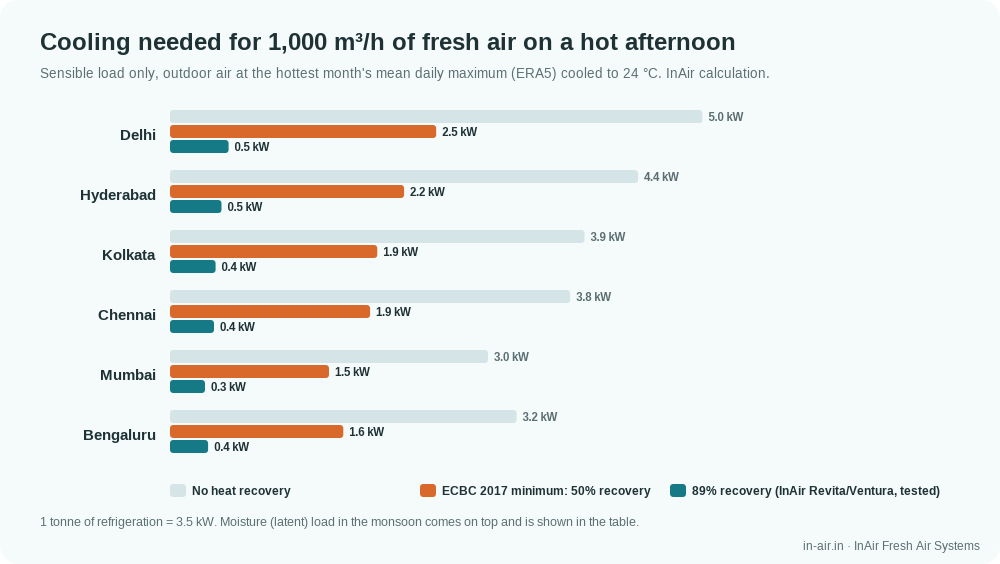
These are design-hour loads, not annual energy. The annual saving depends on running hours, the AC's efficiency and the weather across the year, which the project's energy simulation works out. Our AC load savings calculator gives a first estimate for a home or small office.
How ERVs help a building reach net zero
- Smaller cooling plant. Lower fresh air load means smaller chillers or VRF units, and lower energy use per square metre, which is what GRIHA's EPI benchmark and IGBC's energy simulation measure.
- More fresh air for the same energy. Going from IGBC Green Homes' 5 to 6.5 cfm per person, or holding CO₂ to the IGBC and GRIHA limits, costs much less when the extra air passes through a heat exchanger.
- Simpler compliance. ECBC 2017 exempts systems with exhaust air energy recovery from its demand control ventilation clause.
- Filtration in one place. InAir ERVs carry a pre-filter and MERV-13 filter as standard, with HEPA-13 optional, which supports GRIHA appraisal 12.1.1.
- What ERVs do not do. They add fan power, so fan efficiency matters (IGBC NZEB gives points for fans at 70% efficiency or better). They do not measure CO₂: InAir's IAQ sensor reads PM2.5, temperature, humidity and VOCs, so the CO₂ credit needs separate CO₂ sensors.
Read more about the trade-offs in HRV vs ERV for Indian climates and demand-controlled ventilation.
How InAir checks this at the site survey
- Which rating (IGBC, GRIHA or none) and which energy code the project is approved under, and the target credits.
- Occupancy and floor areas, to calculate fresh air to ASHRAE 62.1 or NBC Part 8 for each zone.
- City climate: hot-season temperature and monsoon dew point, to choose between a plate ERV and a heat pump ERV.
- Outdoor PM2.5 and PM10 at the site, to set MERV-13 or HEPA-13 filtration.
- Where CO₂ sensors and displays will go, and how they link to the building management system.
- The energy consultant's simulation inputs: we give airflow, recovery effectiveness from the spec sheet and fan power for each unit.
What it costs
Published starting prices for commercial fresh air units are: Ventura ceiling-mounted ERVs from ₹3.8 lakh, Ventura floor-standing ERVs from ₹6.4 lakh, and RHP heat pump ERV AHUs from ₹9.4 lakh, before GST and installation. See the price guide for the full range.
Tentative pricing: actual prices may vary based on the site survey.
Common mistakes
- Treating ECBC's 50% heat recovery as good enough for a net zero target.
- Sizing fresh air to the code minimum, then adding air for IGBC or GRIHA points without recovering its heat.
- Ignoring monsoon moisture: a sensible-only heat exchanger leaves the dehumidification load on the AC.
- Counting on a PM2.5 or VOC sensor to earn a CO₂ credit.
- Leaving fan power out of the energy model, which overstates the saving.
- Calling an ASHRAE 90.1 Appendix G baseline a code requirement. It is only the reference model for IGBC's energy credit.
Sources
- Bureau of Energy Efficiency, Energy Conservation Building Code 2017, §2 (scope), §5.2.1.3 and §5.3.6 (ADB-hosted copy). lpr.adb.org
- Indian Green Building Council, IGBC Green New Buildings Rating System v3.0 with Fifth Addendum. igbc.in
- Indian Green Building Council, IGBC Green Homes Rating System v3.0 (abridged). igbc.in
- Indian Green Building Council, IGBC Net Zero Energy Buildings Rating System (pilot, November 2018). igbc.in
- GRIHA Council, GRIHA Version 6.0 manual (September 2025), Criteria 7 and 12. grihaindia.org
- International Energy Agency, policy database: Energy Conservation and Sustainable Building Code 2024. iea.org
- Copernicus ERA5 reanalysis via the Open-Meteo historical weather API (InAir climate analysis for six cities). open-meteo.com
- InAir price guide FY 2026–27 and Revita, Ventura and RHP spec sheets.
Is energy recovery mandatory in India?
Which IGBC credit covers fresh air?
Does GRIHA give points for fresh air?
Can a building be net zero and still have lots of fresh air?
Will an ERV earn the IGBC CO₂ monitoring point?
What does a commercial ERV cost?
Our engineers assess your home or building, recommend the right system and the right filter grade for your city, and give you a clear cost estimate. No obligation.