What is a TFA unit (treated fresh air)?
A TFA unit cools and dries 100% outdoor air before it enters a building. Here is what is inside one, where India uses it, and how it compares with an ERV and an AHU.
Last updated:
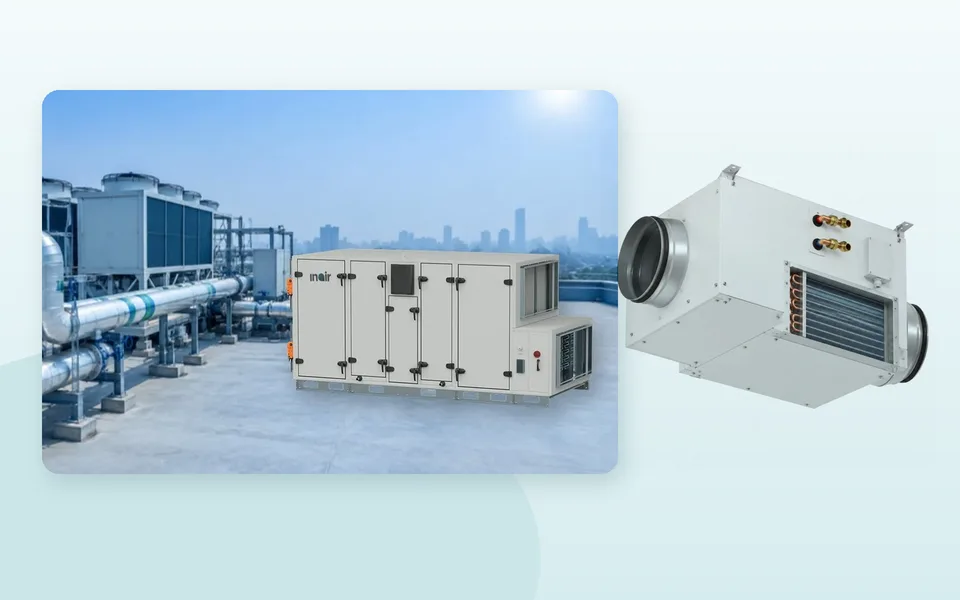
A TFA, or treated fresh air unit, is an air handling unit that takes in only outdoor air, filters it and cools and dries it with its own chilled-water or DX coil before sending it into the building. In India it is the usual way large offices, hotels and hospitals get fresh air. Homes and smaller buildings more often use an ERV or a heat-pump ERV.
Key points
- A TFA treats 100% outdoor air. A normal AHU or fan coil mostly recirculates room air.
- Its main job in India is drying. In our ERA5 analysis, 1,000 m³/h of Mumbai monsoon air carries about 8.8 kW of moisture load against about 3.0 kW of heat in its hottest month.
- A standard TFA has no exhaust connection, so the cooling in the air leaving the building is thrown away unless a wheel or plate is added.
- India's Energy Conservation Building Code (ECBC 2017, §5.3.11) requires heat recovery of at least 50% effectiveness in large hotel and hospital systems that run on 70% or more outdoor air.
- Where there is no chilled-water plant, a heat-pump ERV such as InAir's RHP range does a TFA's job and recovers energy as well.
What a TFA unit is
The name says what it does. Fresh air: the unit draws only outdoor air, never room air. Treated: it filters that air and conditions it, which in Indian weather mostly means cooling it and taking water out of it. The treated air then goes to the floors through ducts, or into the return side of the room units.
Inside, a TFA is built like any air handling unit: an outdoor air damper, a pre-filter and a fine filter, a cooling coil with a drain pan, a supply fan and controls. The coil is fed with chilled water from a central plant, or with refrigerant from a condensing unit (DX, direct expansion). What sets it apart from a recirculating AHU is the air it handles, not the parts.
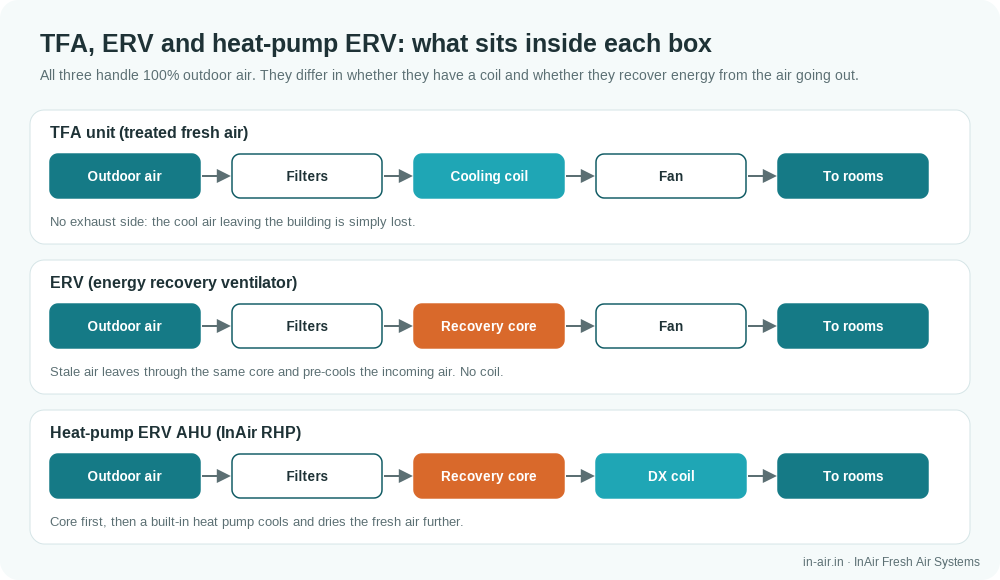
Why Indian buildings use TFA units
Fresh air in India is hot for part of the year and wet for much of it. A room AC or fan coil is sized for the heat from people, lights and sun. It is not sized to dry large volumes of monsoon air, and it only removes moisture while its compressor runs. Putting a separate unit on the fresh air does three things: it takes the moisture out at one place, it lets the room units do only room cooling, and it keeps the building under slight positive pressure so dust and humid air do not leak in.
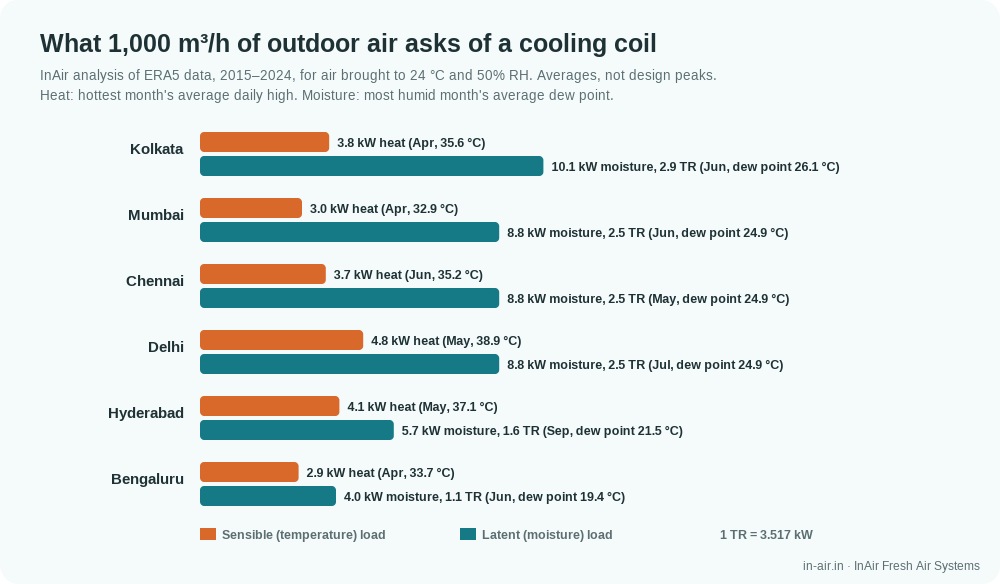
The chart uses ten years of ERA5 climate data, worked out by InAir. In Kolkata, 1,000 m³/h of untreated outdoor air in the most humid month carries 10.1 kW of moisture load, about 2.9 tons of refrigeration (TR), on an average day, not a design peak. A coil removes that water by cooling the air below its dew point. The US Department of Energy uses a 55 °F (12.8 °C) leaving dew point as the test condition for packaged dedicated outdoor air units. Air at that dew point holds about 9.2 g of water per kg, roughly what a room at 24 °C and 50% humidity holds (9.3 g/kg). So a well-run TFA hands the room air that adds almost no moisture.
Where you find TFA units in India
| Building | How fresh air is usually handled | Why |
|---|---|---|
| Large offices and IT parks | Chilled-water TFA per floor or per block, feeding AHUs or VRF indoor units | A chilled-water plant already exists; fresh air volumes are in thousands of m³/h |
| Hotels | TFA supplying corridors and guest rooms, with toilet exhaust taking air out | Steady occupancy, high humidity control needs |
| Hospitals | TFA or 100% outdoor air AHUs for wards, operating theatres and isolation rooms | Infection control needs filtered outdoor air and pressure control |
| Malls and auditoriums | Usually mixed-air AHUs with an outdoor air damper rather than a separate TFA | Large spaces, varying crowds |
| Villas, clinics, schools, small offices | ERV, or heat-pump ERV where humidity is high | No chilled-water plant; smaller airflows |
| Apartments | ERV, ducted or wall-mounted | Small airflows; no central plant |
How much fresh air each space needs comes first. India's National Building Code gives 20–30 m³/h of outdoor air per person; ASHRAE 62.1 sets rates by occupancy and floor area. Our guide to fresh air requirements under NBC and ASHRAE covers both.
TFA vs ERV vs AHU: which is which
| TFA unit | ERV | Heat-pump ERV AHU (InAir RHP) | Recirculating AHU or FCU | |
|---|---|---|---|---|
| Air it handles | 100% outdoor | 100% outdoor in, equal stale air out | 100% outdoor in, stale air out | Mostly room air |
| Cooling coil | Yes (chilled water or DX) | No | Yes (built-in DX heat pump) | Yes |
| Energy recovery | Only if a wheel or plate is added | Yes, through a core | Yes, core first | Optional |
| Dries monsoon air | Yes | Partly; cannot dry below outdoor moisture | Yes | Only room air |
| Needs a chilled-water plant | Chilled-water type only | No | No | Chilled-water type only |
The TFA vs ERV comparison covers the choice between the two in more depth. In short: a TFA cools and dries with a coil but wastes the exhaust air's cooling; an ERV recovers that cooling but has no coil, so it cannot bring wet monsoon air down to room moisture levels on its own. If the core moves only part of the moisture difference, incoming air always arrives wetter than the room.
What about energy recovery on a TFA?
A TFA's biggest running cost is its coil load, and much of that load could be met by the cool, dry air the building is already throwing out through toilets and kitchens. A heat recovery wheel or plate between the exhaust and fresh air streams lets the outgoing air pre-cool the incoming air before it reaches the coil.
India's code makes this compulsory in some cases. ECBC 2017, §5.3.11, says hospitality and healthcare buildings with systems larger than 2,100 litres per second (about 7,560 m³/h) and a minimum outdoor air supply of 70% must have air-to-air heat recovery with at least 50% recovery effectiveness. You will also see an ASHRAE 90.1 energy recovery figure quoted as a requirement. The clause usually cited sits in Appendix G, which sets the baseline building for energy modelling; it is a comparison point, not a rule a building must meet.
When a heat-pump ERV replaces a TFA
Most villas, clinics, schools and small offices have no chilled-water plant to feed a TFA coil. The InAir RHP heat-pump ERV AHU puts a recovery core and a DX heat pump in one box. Outdoor air passes the core first, then the heat pump cools and dries it to a set 22–28 °C. Its spec sheets list energy recovery above 92% and control accuracy of ±2 °C. The range runs from ceiling-mounted INA-HLN-B1 models to floor-standing INA-HLN-A1 models up to 8,000 m³/h, and every model needs a three-phase 380 V supply.
For a single humid room or a small zone, InAir also has fresh air dehumidifiers. The water-coil fresh air dehumidifier (INAD-CW30 and CW50, 300–500 m³/h) is close to a small TFA: it pre-cools outdoor air through a plate exchanger, dries it on a chilled-water coil and passes it back through the exchanger. The rotary model (INAV-HTRW30, 300 m³/h) uses a total heat recovery wheel and its own compressor, so it needs no chilled water.
How InAir checks this at the site survey
- How many people use each space and for how long, which sets the fresh air quantity.
- Whether a chilled-water plant exists and has spare capacity, or whether the fresh air needs its own heat pump.
- Which exhaust air streams (toilets, kitchens, general exhaust) can be brought back past a recovery core.
- The city's monsoon moisture and summer heat, from InAir's city data, to see whether passive recovery is enough or a coil is needed.
- Filter grade for the local AQI: MERV-13 standard, HEPA-13 where pollution is heavy.
- Plant space, duct routes, three-phase power availability and drain points for the coil.
What it costs
InAir RHP heat-pump ERV AHUs start from ₹9.4 lakh for ceiling-mounted models and ₹16.1 lakh for floor-standing models. Ventura ERVs without a coil start from ₹3.8 lakh. These are equipment prices before GST and installation. Fresh air dehumidifiers are quoted after a free site survey. See the price guide for the full list.
Tentative pricing: actual prices may vary based on the site survey.
Common mistakes
- Calling any fresh air fan a TFA. If it has no coil, it does not treat the air; it only moves it.
- Sizing the TFA coil on summer heat alone. In most Indian cities the monsoon moisture load is larger.
- Leaving out the exhaust path. Fresh air pushed in needs a way out, through toilet exhaust or relief air.
- Fitting a TFA with no recovery where the building throws away thousands of m³/h of cool exhaust air.
- Choosing filters by habit. The fine filter decides indoor PM2.5, so it should follow the city's air, not the catalogue default.
Sources
- Bureau of Energy Efficiency, Energy Conservation Building Code 2017 (rev. 2019), §5.3.11 Energy Recovery. lbl.gov copy
- US Department of Energy, Direct Expansion-Dedicated Outdoor Air Systems: 55 °F dew point rating condition. energy.gov
- ECMWF / Copernicus ERA5 reanalysis, 2015–2024, analysed by InAir for six cities (as used in our home ventilation guide). in-air.in
- Bureau of Indian Standards, National Building Code of India 2016, Part 8: fresh air per person; summarised in InAir's NBC and ASHRAE guide
- InAir RHP heat-pump ERV AHU product page and spec sheets. in-air.in
- InAir price guide FY 2026–27. pricing.md
What is TFA in HVAC?
What is the difference between a TFA and an AHU?
Is a TFA the same as an ERV?
Does a TFA need a chilled-water plant?
Is energy recovery compulsory on a TFA in India?
Do homes need a TFA?
Our engineers assess your home or building, recommend the right system and the right filter grade for your city, and give you a clear cost estimate. No obligation.