What does poor ventilation do to your health? What is proven and what is not
Damp and mould, sick building syndrome and indoor pollutants are well proven. The effect of CO₂ itself on thinking is disputed. Here is the evidence, study by study.
Last updated:

Poor ventilation lets what people, cooking, furniture and damp walls give off build up indoors. The strongest evidence links it to damp and mould, which raise asthma and other breathing problems, and to more sick building syndrome complaints. Claims that ordinary CO₂ levels slow your thinking are real in some studies but disputed in others.
Key points
- Proven: damp and mould in homes go with about 30–50% more respiratory and asthma problems (meta-analysis of the studies reviewed by the US Institute of Medicine).
- Proven in offices: below about 10 litres of outdoor air per second per person, sick building syndrome symptoms and complaints about the air rise.
- Proven for pollutants: formaldehyde and many other VOCs are higher indoors than out, and more outdoor air dilutes them.
- Disputed: whether CO₂ itself, at 1,000–1,400 ppm, slows decision-making. Two well-known studies say yes; three later ones found no clear effect.
- Read CO₂ as a gauge of how much outdoor air a room gets. A high reading means everything else that builds up indoors is high too.
This article is general information drawn from published research. It is not medical advice. If you have symptoms, see a doctor.
What “poor ventilation” means
Ventilation is the swap of indoor air for outdoor air. A room is poorly ventilated when too little outdoor air reaches the people in it. India's National Building Code asks for 20–30 m³/h of fresh air per person. A resting adult breathes out about 12 litres of CO₂ an hour, so about 21 m³/h of outdoor air per person holds a room near 1,000 ppm when the outdoor level is about 425 ppm.
In Indian homes the usual cause is simple. Windows stay shut for the AC, for mosquitoes, for noise or for smog, and a split AC only cools and recirculates the same air. Bedrooms with the door shut overnight are the most affected; see CO₂ in a closed bedroom overnight for the arithmetic.
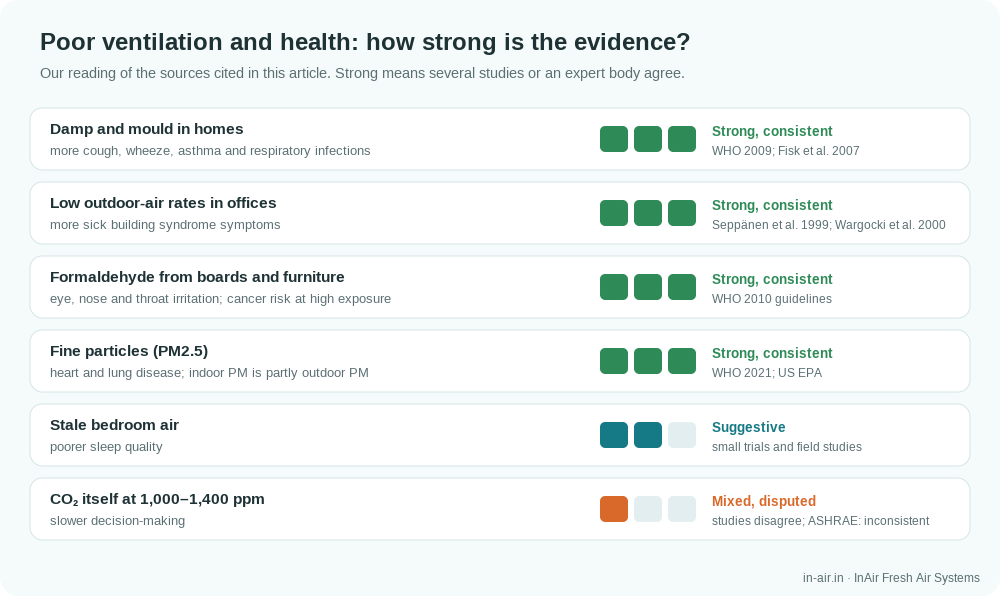
The evidence at a glance
| Effect linked to poor ventilation | Strength of evidence | Main sources |
|---|---|---|
| Damp and mould: cough, wheeze, asthma | Strong | WHO 2009 guidelines; Fisk et al. 2007 |
| Sick building syndrome symptoms (offices) | Strong | Seppänen et al. 1999; Wargocki et al. 2000 |
| Formaldehyde: irritation, cancer at high exposure | Strong (WHO guideline value) | WHO 2010 indoor air guidelines |
| PM2.5: heart and lung disease | Strong (outdoor PM); indoor depends on filtration | WHO 2021; US EPA |
| Poorer sleep in stale bedrooms | Suggestive (small studies) | Strøm-Tejsen et al. 2016 and others |
| Slower thinking from CO₂ itself | Mixed | Satish 2012 and Allen 2016 vs Zhang 2017, Rodeheffer 2018, Scully 2019 |
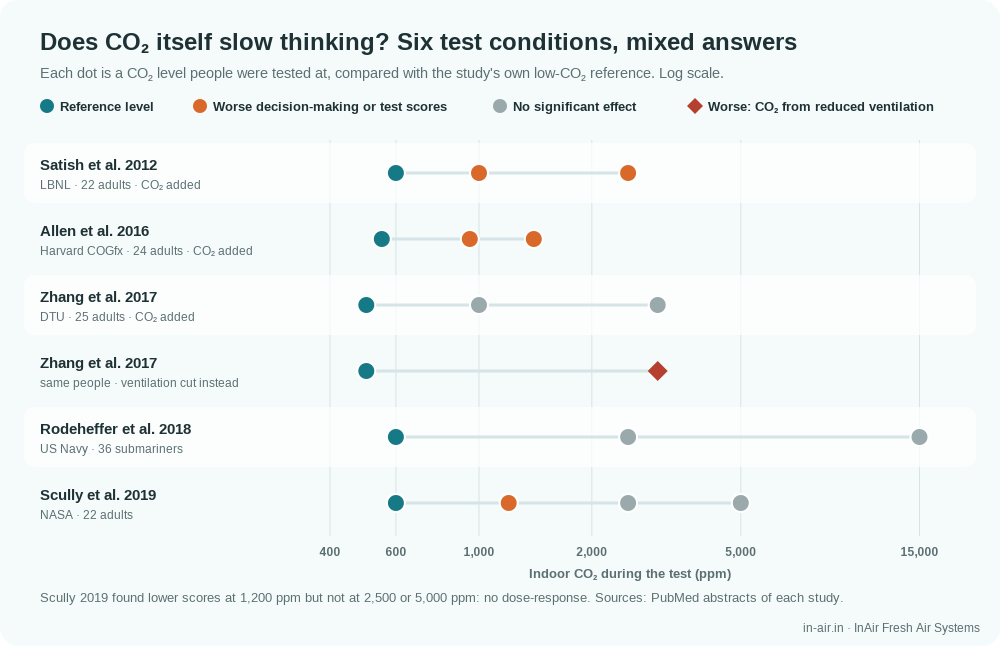
CO₂ and thinking: the studies, and why they disagree
Two studies started the worry about everyday CO₂ levels. In Satish and colleagues (2012) at Lawrence Berkeley National Laboratory, 22 adults sat in an office-like chamber while pure CO₂ was added to the air. Compared with 600 ppm, decision-making scores fell moderately on six of nine scales at 1,000 ppm, and sharply on seven at 2,500 ppm. The authors asked for confirmation.
In the Harvard COGfx study by Allen and colleagues (2016), 24 office workers spent six full days in a controlled office. Cognitive scores were 61% higher on “green” days with low VOCs, and 101% higher on days that also had double the outdoor air, than on “conventional” days with high VOCs. On days when CO₂ alone was raised, scores were 15% lower at about 945 ppm and 50% lower at about 1,400 ppm than on the low-CO₂ days.
Later studies did not find the same thing. Zhang, Wargocki and colleagues (2017) added pure CO₂ up to 3,000 ppm and saw no significant effect on perceived air quality, symptoms or test performance. But when they reached 3,000 ppm by cutting ventilation instead, people reported more headache, fatigue and sleepiness, and did worse on some tasks. A US Navy study (Rodeheffer et al., 2018) found no difference on any of nine decision-making measures in 36 submariners at 600, 2,500 or even 15,000 ppm. A NASA study (Scully et al., 2019) found lower scores at 1,200 ppm but not at 2,500 or 5,000 ppm.
ASHRAE, the engineering body that writes ventilation standards, reviewed this work. Its 2022 position on indoor CO₂ says the evidence for effects on health, learning and work at commonly seen indoor levels is “inconsistent”, and does not yet justify changing standards. It also says CO₂ is a useful tool for judging indoor air if its limits are understood.
So the fair summary is this. Pure CO₂ at 1,000–1,400 ppm may or may not slow thinking. Stale air with high CO₂, which also carries body odours, VOCs and moisture, has more consistent effects on how people feel. Either way the fix is the same: more outdoor air.
Sick building syndrome
The US EPA uses “sick building syndrome” when occupants have headaches, eye, nose or throat irritation, dry cough, tiredness or trouble concentrating that ease soon after they leave the building, and no specific illness is found. It lists inadequate ventilation first among the causes.
A review by Seppänen, Fisk and Mendell (1999) covered studies with about 30,000 people, mostly in offices. Almost all found that less than 10 litres of outdoor air per second per person went with more symptoms or worse perceived air. Some found further gains up to about 20 L/s. In a Danish office experiment by Wargocki and colleagues (2000), raising outdoor air from 3 to 10 to 30 L/s per person reduced dryness of mouth and throat and difficulty thinking clearly, and office-task performance rose by 1.7% for each doubling.
These are office studies. Homes are less studied, but the same pollutants build up in a shut bedroom or a sealed flat.
Damp, mould and breathing
This is the best-established link. The WHO guidelines on dampness and mould (2009) concluded that the main effects are more respiratory symptoms, allergies and asthma, and that the key protection is preventing persistent damp. A meta-analysis by Fisk and colleagues (2007) put the size at roughly 30–50% more respiratory and asthma-related problems in damp or mouldy homes.
Indian monsoons make this a real risk. In ten years of ERA5 weather data, average relative humidity in July and August is 87–89% in Mumbai and 86–87% in Kolkata. The US EPA advises keeping indoor humidity below 60%, ideally 30–50%. Ventilation removes moisture from showers and cooking, but in the monsoon the outdoor air is itself wet, so fresh air may need its moisture removed before it comes in. See monsoon humidity and fresh air dehumidification.
Formaldehyde and other VOCs
Volatile organic compounds come from paints, adhesives, cleaners, air fresheners and pressed-wood furniture. The US EPA says many VOCs are consistently higher indoors than outdoors, up to ten times higher, and its home studies found about a dozen common organic pollutants at 2 to 5 times outdoor levels.
Formaldehyde is the one with a firm health limit. The WHO indoor air guidelines (2010) set 0.1 mg/m³ as a 30-minute average to prevent irritation, a level WHO says also protects against long-term effects, and record that IARC classes formaldehyde as a known human carcinogen. In 96 Quebec homes cited by WHO, formaldehyde was higher where air exchange was lower and where new wooden or melamine furniture had been bought in the past year. That matters in Indian flats fitted out with new modular kitchens and wardrobes: ventilate well after an interior job.
PM2.5: where ventilation helps and where it can hurt
Fine particles harm the heart and lungs, which is why WHO's 2021 guideline for PM2.5 is 15 µg/m³ over 24 hours, against India's national standard of 60. Indoor PM comes partly from outdoors and partly from cooking, incense, candles and smoking, the US EPA notes.
Here ventilation cuts both ways. Opening a window in Delhi, where CSE measured an average winter PM2.5 of 175 µg/m³ in 2024–25, brings the smog in. Mechanical ventilation can filter the incoming air: a MERV-13 filter catches at least 85% of 1–3 µm particles and a HEPA H13 at least 99.95% at its most penetrating size. More in PM2.5 vs PM10 and why indoor air is polluted with the windows closed.
What we still don't know
- No published study has tested CO₂ and thinking in Indian homes or offices. The studies above are from the US, Denmark and China.
- Most CO₂ studies lasted hours or days. Effects of years in under-ventilated rooms are not known.
- Sick building syndrome research is mostly in offices. How much applies to homes is uncertain.
- Sleep studies are small, and they disagree on whether better sleep shows up as better performance the next day.
How InAir checks this at the site survey
InAir does not diagnose health problems. At the free site survey we look at the things that decide how much outdoor air each room gets:
- How many people use each room, and for how long with the door and windows shut, especially bedrooms at night.
- Signs of damp: mould on walls or ceilings, musty wardrobes, condensation on AC ducts or windows, bathrooms with no working extract.
- New interiors: recent modular kitchens, wardrobes and paint, which add formaldehyde and VOCs for months.
- Your city's outdoor PM2.5 and monsoon humidity, which set the filter grade and whether incoming air needs drying.
- Where fresh air can enter and where exhaust air can leave, and what is already there.
We then size the fresh air to ASHRAE 62.2 and NBC rates for your home. You can get a first estimate with the ERV sizing calculator. An indoor air quality sensor shows PM2.5, temperature, humidity and VOCs, so you can see the effect afterwards.
What it costs
A ducted energy recovery ventilator (ERV) for a 1–2 BHK starts from ₹2.1 lakh, and a wall-mounted ERV for one room in a finished home from ₹1.4 lakh per unit. The indoor air quality sensor starts from ₹53,100. Prices are before GST and installation. Tentative pricing: actual prices may vary based on the site survey.
Common myths
- “CO₂ at home is poisonous.” Not at the 1,000–3,000 ppm found in homes. It is a sign that other pollutants are building up.
- “An air purifier fixes stale air.” A purifier recirculates room air. It can remove particles but not CO₂ or moisture. See ventilation vs air purifier.
- “The AC brings in fresh air.” A split AC cools and recirculates the room's own air.
- “A big room never gets stuffy.” A bigger room only takes longer to get there. The level it settles at depends on the outdoor air per person.
- “Opening the window is always healthier.” Not on a smoggy Delhi winter night or a wet monsoon day. Filtered, controlled fresh air is the safer route.
Sources
- Allen JG et al. Associations of cognitive function scores with CO₂, ventilation and VOC exposures in office workers. Environ Health Perspect 2016;124:805–812. https://pmc.ncbi.nlm.nih.gov/articles/PMC4892924/
- Satish U et al. Is CO₂ an indoor pollutant? Environ Health Perspect 2012;120:1671–1677. https://pubmed.ncbi.nlm.nih.gov/23008272/
- Zhang X, Wargocki P, Lian Z, Thyregod C. Effects of exposure to CO₂ and bioeffluents. Indoor Air 2017;27:47–64. https://pubmed.ncbi.nlm.nih.gov/26825447/
- Persily A et al. ASHRAE's new position document on indoor carbon dioxide (NIST, 2022). https://tsapps.nist.gov/publication/get_pdf.cfm?pub_id=934476
- Seppänen OA, Fisk WJ, Mendell MJ. Association of ventilation rates and CO₂ concentrations with health. Indoor Air 1999;9:226–252. https://pubmed.ncbi.nlm.nih.gov/10649857/
- WHO guidelines for indoor air quality: dampness and mould (2009). https://www.who.int/publications/i/item/9789289041683
- Fisk WJ, Lei-Gomez Q, Mendell MJ. Meta-analyses of respiratory health effects with dampness and mold in homes. Indoor Air 2007;17:284–296. https://pubmed.ncbi.nlm.nih.gov/17661925/
- WHO guidelines for indoor air quality: selected pollutants (2010), formaldehyde chapter. https://www.who.int/publications/i/item/9789289002134
What are the symptoms of poor ventilation at home?
Can poor ventilation make you sick?
Is 1,000 ppm of CO₂ harmful?
Does poor ventilation affect sleep?
Will an air purifier solve poor ventilation?
How do I know if my home is poorly ventilated?
Our engineers assess your home or building, recommend the right system and the right filter grade for your city, and give you a clear cost estimate. No obligation.