How to ventilate a room without windows
A room with no window still needs outdoor air in and stale air out. The fix is mechanical: a duct, a wall unit on an outside wall, or a fan with a path for air to follow.
Last updated:
To ventilate a room without windows you have to move air mechanically. Bring filtered outdoor air in through a duct or a wall-mounted unit, take stale air out with an extract fan, and leave a path for air between the two, such as a door undercut or a transfer grille. Which of these suits depends on what the room is used for and whether any of its walls is an outside wall.
Key points
- With no window and the door shut, two sleepers can push a small bedroom past 2,070 ppm of CO₂ by morning (our calculation below). About 21 m³/h of outdoor air per person holds it near 1,000 ppm.
- Bedrooms and home offices need fresh air supplied. Bathrooms, store rooms and cupboards mainly need stale air extracted.
- India's National Building Code expects habitable rooms and bathrooms to have openings to outside air. Where a room cannot meet that, building bye-laws point to mechanical ventilation under NBC Part 8.
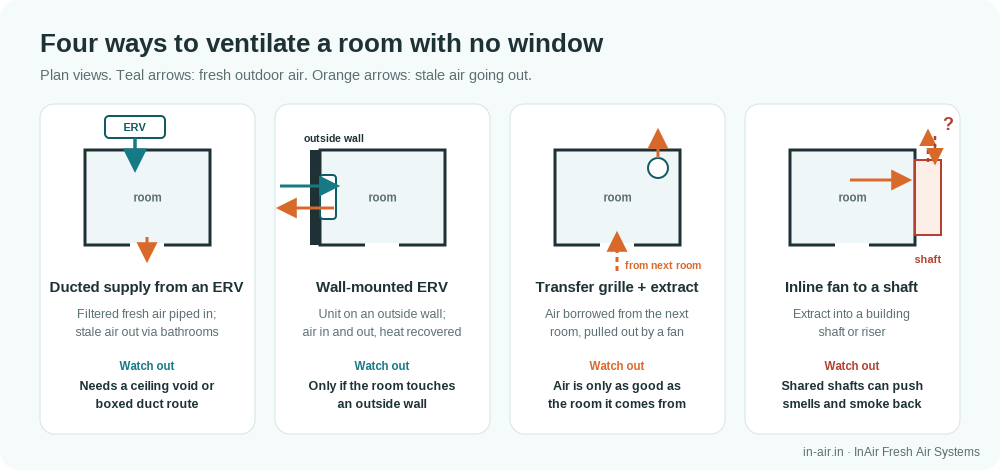
- Four practical options: ducted supply from an ERV, a wall-mounted ERV on an outside wall, a transfer grille with an extract fan, or an inline fan into a shaft. The last one carries real risks.
- An air purifier, an AC or a ceiling fan does not ventilate. None of them brings outdoor air in or takes CO₂ out.
Which rooms end up without a window
Deep apartment plans leave some rooms in the middle of the flat: a third bedroom carved out of the living area, a home office made from a store room, bathrooms that open only onto a shaft, walk-in wardrobes and the cupboard that holds the router or a small server. Each has a different problem, so each needs a different fix.
What builds up in a room with no window
With the door shut, whatever people and things give off stays in the room. Four things matter.
- Carbon dioxide. A resting adult breathes out about 12 litres of CO₂ an hour. In a closed room that adds up quickly, as the chart below shows.
- Moisture. People, wet towels, drying clothes and showers all add water to the air. A study of 101 Finnish homes measured indoor moisture generation of about 1.9 kg a day per person, cited in the WHO guidelines on dampness and mould. With no air change, the humidity climbs and settles on the coolest surfaces as damp and mould. The US EPA advises keeping indoor humidity below 60%, ideally 30–50%.
- Heat. Every watt used by people, lights, laptops and network equipment ends up as heat in the room.
- Smells and chemicals. The US EPA notes that many volatile organic compounds (VOCs) are consistently up to ten times higher indoors than outdoors. Stored paints, cleaners and moth repellents keep releasing them.
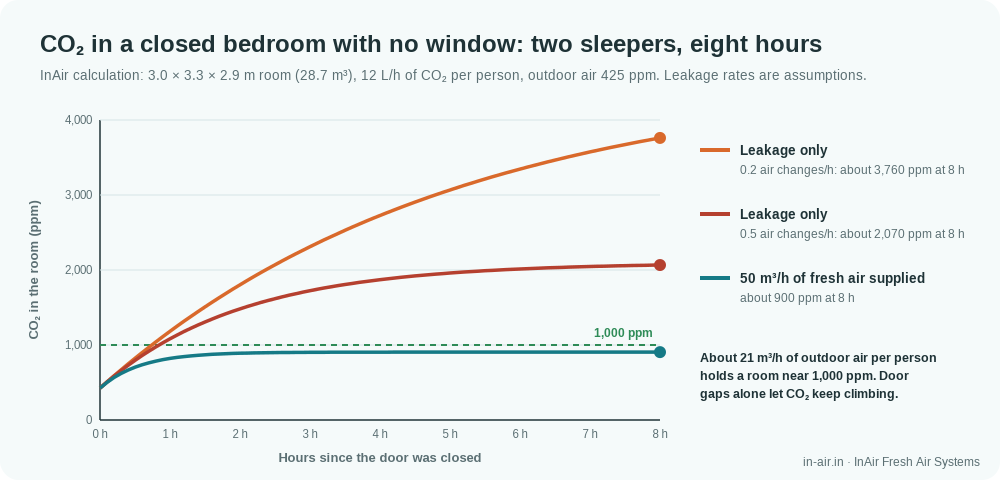
The calculation uses a 3.0 × 3.3 m bedroom with a 2.9 m ceiling and two people asleep. If the only air change is leakage around the door, CO₂ reaches about 2,070 ppm by morning at 0.5 air changes an hour and about 3,760 ppm at 0.2. With 50 m³/h of fresh air it levels off near 900 ppm. The IGBC and ISHRAE indoor classes for India allow CO₂ only 350–530 ppm above outdoor air. Our article on bedroom CO₂ and sleep covers what the research says about those levels.
What each room actually needs
| Room | What builds up | What it needs | Published rate |
|---|---|---|---|
| Bedroom | CO₂, moisture | Filtered fresh air supplied, all night | 20–30 m³/h per person (NBC); about 21 m³/h per person holds 1,000 ppm |
| Home office | CO₂, heat from equipment | Fresh air for each person, plus heat removal | As for a bedroom, per person |
| Bathroom or toilet | Moisture, odour | Extract to outside | 6–10 air changes an hour (NBC); 85 m³/h when in use or 34 m³/h continuous (ASHRAE 62.2) |
| Store room or wardrobe | Damp, stored-product smells | A small, steady extract and a route for air in | No published Indian rate; see our guide to unused rooms |
| Network or server cupboard | Heat | Air flow matched to the equipment's watts | Set by the heat load (table below) |
Bedrooms are sized to people, not floor area. Bathrooms are sized to air changes or a minimum fan flow, whichever is larger; the air changes calculator does that sum. For empty or rarely used rooms, see how to ventilate unused rooms.
What the building code says
The National Building Code of India expects rooms to get light and air from outside. In the 2005 edition, which is freely available, Part 3 clause 15.1.1 says rooms shall have one or more openings, such as windows and ventilators, opening directly to the external air or into an open verandah. Clause 15.1.2 sets the minimum opening area, excluding doors, from one-twelfth of the floor area in cold climates to one-sixth in wet hot climates. Clause 12.4.3 says every bathroom or water-closet should have at least one wall open to external air and a window or ventilator of at least 0.3 m² opening to a shaft or open space.
The code accepts that this is not always possible. Delhi's Unified Building Bye-Laws 2016 (clause 7.20) say that where lighting and ventilation are not fully met by daylight and natural ventilation, they shall be ensured through artificial lighting and mechanical ventilation as given in NBC Part 8, Section 1. NBC 2016 is the current edition, and your city's bye-laws decide what applies to your building.
Your options, compared
| Option | How it works | Best for | Limits |
|---|---|---|---|
| Ducted supply from an ERV | A ceiling-mounted ERV sends filtered outdoor air to the room through a duct and takes stale air out from bathrooms and kitchen | Windowless bedrooms and offices in a home with a false ceiling or room for a boxed duct | Needs a duct route; best planned with the interiors |
| Wall-mounted ERV | A ductless unit on an outside wall supplies and exhausts air through a core-cut, recovering heat and moisture | A room with no window but at least one outside wall, in a finished home | Not possible if every wall is internal |
| Transfer grille + extract fan | A fan pulls air out; replacement air comes through a door undercut or grille from the next room | Store rooms, wardrobes, toilets | Brings in the next room's air, not filtered outdoor air |
| Inline fan to a shaft | A fan in the ceiling or wall pushes air into a duct or shaft that leads out | Bathrooms on internal shafts | Only works if the shaft is open to the sky and the society allows it |
Ducted supply from an ERV
This is the cleanest fix for a windowless bedroom or office. An energy recovery ventilator (ERV) above a false ceiling brings outdoor air through a MERV-13 filter (HEPA-13 optional) and passes it through a heat exchanger with the outgoing stale air. InAir's Revita and Ventura ERVs recover 89–90% of the heat (tested), so the incoming air reaches the room close to room temperature. One unit can feed every room in the flat. Size it with the ERV sizing calculator.
Wall-mounted ERV
A room with no window can still have an outside wall, such as a blank façade. If so, a wall-mounted ERV needs only a core-cut through that wall and a power point. InAir's INA-WERVG20-150CMH moves up to 150 m³/h through a 3D enthalpy core rated at 92%, at 35 dB, with three-stage filtration plus a charcoal filter, and suits one zone of 250–350 sq ft. If every wall of the room is internal, this option is not possible.
Transfer grille or door undercut, with an extract fan
For a store room, wardrobe or toilet, the simplest fix is to pull air out with a small extract fan and let air in from the neighbouring room. The UK's Approved Document F asks for internal doors to have the free area of a 10 mm undercut on a 760 mm door so that air can move between rooms; a louvred door or transfer grille does the same. The catch: the air coming in is the next room's air, and it carries sound too.
Inline fan into a shaft: the risks
NBC lets bathrooms open onto a ventilation shaft sized by building height, from 1.2 m² for buildings up to 10 m to 9.0 m² above 30 m, where mechanical ventilation must be added. The risks are practical. A shaft that is capped or choked with pipes exhausts nothing. Neighbours' fans push into the same shaft, so smells can come back when your fan is off; a backdraft shutter helps. And extracting from a bedroom this way only pulls air in through door gaps from the rest of the flat, never filtered outdoor air. An inline fan is the right tool for the job of extract; it is not a fresh air system.
Network and server cupboards: size the air to the heat
A closed cupboard with a router, switch, NAS or small server mainly has a heat problem. Almost all the power the equipment draws becomes heat. The air needed to carry it away follows from simple physics: air flow = power ÷ (air density × specific heat × allowed temperature rise).
| Equipment power | Air needed if the air may warm by 10 °C | Air needed if it may warm by only 5 °C |
|---|---|---|
| 100 W | 30 m³/h | 60 m³/h |
| 300 W | 90 m³/h | 179 m³/h |
| 600 W | 179 m³/h | 358 m³/h |
So a 300 W cupboard needs roughly 90 m³/h if the air leaving it may be 10 °C warmer than the air entering. If the cupboard opens into an air-conditioned room, the AC removes that heat; if it is sealed, the equipment overheats. InAir's server room ventilation page covers larger rooms.
What does not work
- An air purifier. It cleans particles from room air but does not bring in outdoor air or remove CO₂. See ventilation vs air purifier.
- The AC. A split AC recirculates the room's own air. It removes heat and some moisture, not CO₂.
- Leaving the door open. It helps only if the rest of the flat is well ventilated.
- A fan that blows into the false ceiling. The damp, stale air just moves above the ceiling, where it can cause mould.
How InAir checks this at the site survey
- What the room is used for, how many people use it and for how long, and what equipment is in it.
- Whether any wall is an outside wall, how thick it is and what is on the other side, which decides whether a wall-mounted ERV is possible.
- The depth of the ceiling void and a route for a duct from the ERV, or for a boxed duct in a finished home.
- Where extract air can go: an outside wall, or a shaft that is open at the top and that the building society allows you to use.
- Door undercuts and transfer paths, so supply and extract air can actually flow.
- CO₂, humidity and temperature measured in the room with a sensor, before and after commissioning.
What it costs
InAir's wall-mounted ERV starts from ₹1.4 lakh per unit, and a Revita ducted ERV for a 1–2 BHK home starts from ₹2.1 lakh, both before GST and installation. For extract only, mixed-flow inline fans start from ₹6,600 and EC inline fans with speed or smart control from ₹15,000. The price guide lists the full range.
Tentative pricing: actual prices may vary based on the site survey.
Common mistakes
- Using a windowless room as a bedroom with only an exhaust fan, so all the replacement air comes from the corridor or bathroom.
- Venting a fan into the false ceiling or a capped shaft.
- Fitting a fan but leaving the door sealed, so it roars and moves little air.
- Buying an air purifier for a stuffy room and expecting CO₂ to fall.
- Sizing a fan by the room's floor area instead of by the people in it or the heat it must remove.
Sources
- Bureau of Indian Standards, National Building Code of India 2005, Part 3, clauses 12.4.3, 15.1.1 and 15.1.2 and ventilation shaft table (SP 7:2005, Group 1). archive.org (Public.Resource.Org)
- HUDCO Shelter (October 2022): analysis of NBC 2016 provisions in Delhi's Unified Building Bye-Laws 2016, clause 7.20. hudco.org.in
- ASHRAE 62.2-2022 Addendum e: bathroom exhaust rates. ashrae.org
- UK Approved Document F, Volume 1 (2021): door undercuts, paragraph 1.25. gov.uk
- WHO Guidelines for Indoor Air Quality: Dampness and Mould (2009): moisture generation and health effects. who.int
- US EPA, Volatile Organic Compounds' Impact on Indoor Air Quality. epa.gov
- US EPA, A Brief Guide to Mold, Moisture and Your Home. epa.gov
- InAir spec sheet INA-WERVG20-150CMH and price guide (FY 2026–27).
Can a room without windows be used as a bedroom?
How do I get fresh air into a room with no windows?
Is an exhaust fan enough for a windowless bathroom?
Will an air purifier fix a stuffy room with no windows?
Can I fit a wall-mounted ERV in a room without a window?
What does it cost to ventilate a windowless room?
Our engineers assess your home or building, recommend the right system and the right filter grade for your city, and give you a clear cost estimate. No obligation.