How to ventilate a room with only one window
One window means air must come in and go out through the same gap. Here is how far that reaches, why it fails at night, and how to give the room a second air path.
Last updated:

A room with one window gets single-sided ventilation: air has to come in and go out through the same opening, so the flow is weak and changes with every gust. Design guides treat it as useful only to about 2.5 times the ceiling height into the room. The fix is to give air a second path, with a door undercut or a fan, or to add a fresh air unit.
Key points
- With one window, air is driven only by gusts and small temperature differences at that opening. The WHO calls this kind of ventilation unreliable.
- The CIBSE rule of thumb: single-sided ventilation works to about 2.5 × ceiling height deep (7.2 m for a 2.9 m ceiling); cross ventilation to about 5 × (14.5 m).
- India's National Building Code prefers two windows on that wall to one, where a room has only one outside wall.
- In most Indian bedrooms depth is not the real problem. The window is shut at night for the AC, noise, smog or mosquitoes, so ventilation drops to almost nothing.
- Fixes, from cheapest: a door undercut or transfer grille, a fan in the window, then a window- or wall-mounted ERV that brings in filtered air with the window shut.
Why one window ventilates poorly
Air moves through a building when there is a pressure difference between two openings. With windows on opposite walls, wind pushes on one side and pulls on the other, and air flows straight through. With one window, both the inflow and the outflow share the same opening. What drives them is the turbulence of the wind across the façade and a small stack effect when the room is warmer or cooler than outside.
The WHO guidelines on dampness and mould describe single-sided ventilation through a small opening as driven by random turbulent fluctuations, and at best unreliable. They recommend cross-flow as the basis of good natural ventilation. India's National Building Code (Part 8, Section 1) makes a similar point: where a room has only one wall exposed to outside, two windows on that wall are preferred to a single window. Even good cross ventilation has limits; the same NBC section notes that average indoor air speed does not exceed 40% of the outdoor wind speed even under the most favourable conditions.
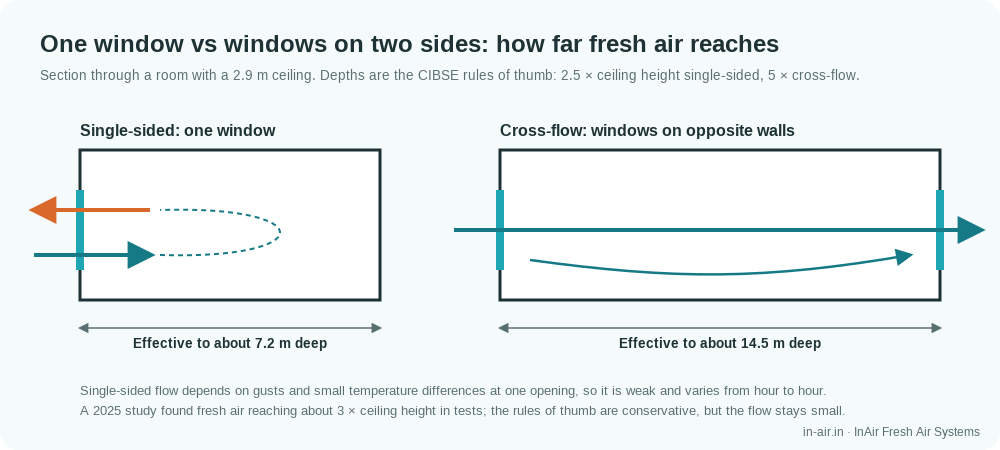
How deep into the room does one window reach?
UK guidance from CIBSE gives a rule of thumb that single-sided natural ventilation is effective up to about 2.5 times the floor-to-ceiling height from the window, and cross ventilation up to about 5 times. California's Title 24 uses a similar limit of 20 ft (6 m) from an operable window. These figures are reported in a 2017 paper by Carrilho da Graça and colleagues for the Air Infiltration and Ventilation Centre.
| Ceiling height | Single-sided, 2.5 × height | Cross-flow, 5 × height |
|---|---|---|
| 2.7 m | 6.8 m | 13.5 m |
| 2.9 m | 7.2 m | 14.5 m |
| 3.0 m | 7.5 m | 15.0 m |
| 3.2 m | 8.0 m | 16.0 m |
Researchers think these rules are cautious. A 2025 study from the University of Bath, published in Building and Environment, found no drop in fresh air reaching up to about three times the room height from a single window in full-scale tests. So in a bedroom 3–4 m deep, depth is rarely the problem. How much air flows, and whether the window is open at all, is.
How big does the opening need to be?
The UK's Approved Document F asks that every habitable room can be purged at four air changes an hour, for example to clear paint fumes or burnt cooking. Its window sizes are based on BS 5925 and assume single-sided ventilation, an urban site and a light wind of 2.1 m/s:
| Room floor area | Window opening 30° or more: 1/20 of floor | Window opening 15–30°: 1/10 of floor |
|---|---|---|
| 10 m² (about 108 sq ft) | 0.50 m² | 1.00 m² |
| 12 m² (about 130 sq ft) | 0.60 m² | 1.20 m² |
| 15 m² (about 160 sq ft) | 0.75 m² | 1.50 m² |
What counts is the area that actually opens. NBC Part 3 says the same: if a window is partly fixed, only the openable area is counted. A two-panel sliding window, common in Indian flats, opens at most about half its size, and a mosquito mesh reduces the flow further. Note also that this is a short boost to clear the air, not continuous fresh air for people sleeping.
Noise, smog and mosquitoes: why the one window stays shut
- Air conditioning. The window closes as soon as the AC goes on.
- Smog. In winter 2024–25, average PM2.5 was 175 µg/m³ in Delhi, 65 in Kolkata and 50 in Mumbai (CSE analysis of CPCB data), against the WHO 24-hour guideline of 15. An open window lets that straight in. See why indoor air is polluted even with the windows closed.
- Noise. One window on a busy road means traffic noise in the bedroom all night.
- Mosquitoes and rain. Mesh keeps out mosquitoes but cuts airflow; monsoon rain shuts the window anyway.
- Safety. Ground-floor and low-floor windows are often kept shut at night.
So the honest answer for many one-window bedrooms is that the window is not a ventilation system. It is a purge opening for the times you can open it. Our bedroom CO₂ article shows how quickly a closed bedroom fills with CO₂.
The fixes, compared
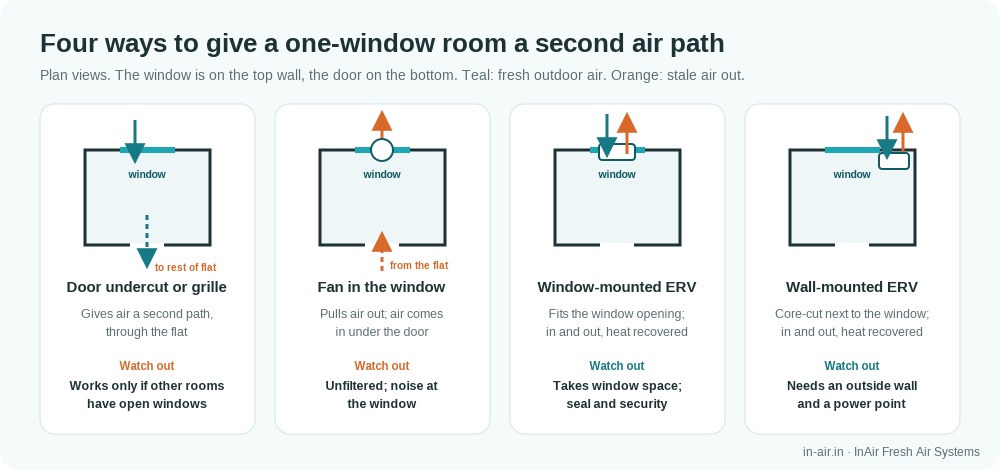
| Fix | What it does | Good for | Limits |
|---|---|---|---|
| Door undercut or transfer grille | Lets air flow from this room's window through the flat to windows on the other side | Daytime, when windows elsewhere are open | Does nothing at night with everything shut; carries sound |
| Fan in the window (extract) | Pulls room air out; replacement air comes under the door | Clearing smells or heat quickly | Brings in unfiltered air from the rest of the flat; noise at the window |
| Window-mounted ERV | Fits into the window opening and exchanges air in both directions through a heat exchanger | Rented homes where walls cannot be cut | Uses part of the window; gaps around it must be sealed; check filter grade and airflow |
| Wall-mounted ERV | Sits on the outside wall beside the window; filtered air in, stale air out, heat and moisture recovered | Bedrooms, studies and living rooms in finished homes | Needs a core-cut through an outside wall |
| Ducted ERV | Supplies filtered air to every room from one unit above the false ceiling | Whole homes, new or being renovated | Needs ceiling space for ducts |
Door undercut or transfer grille
The cheapest fix turns your single-sided room into part of a cross-flow path through the flat. The UK's Approved Document F asks for the free area of a 10 mm undercut on a 760 mm internal door. It only helps when windows on the other side of the flat are open too, so it does little at night with the AC on.
A fan in the window
An exhaust fan fitted in a window pane or the ventilator above it pulls stale air out, and replacement air comes in under the door. It is useful for clearing heat or smells quickly. It does not filter, it is noisy where you sleep, and the air it draws in comes from wherever it can, including the bathroom or kitchen. A window fan blowing in brings unfiltered outdoor air, dust and, in winter, smog. For bathrooms and kitchens, see the exhaust fan buying guide.
Window-mounted or wall-mounted ERV
An energy recovery ventilator supplies filtered outdoor air and removes stale air at the same time, passing heat and moisture between the two streams so the room is not flooded with hot, humid air. Window-mounted units use the existing opening; wall-mounted units need a core-cut. InAir makes a wall-mounted unit, the INA-WERVG20-150CMH: up to 150 m³/h, a 3D enthalpy core rated at 92%, 35 dB, three-stage filtration plus charcoal, and auto bypass and humidity control. It suits one zone of 250–350 sq ft. Whatever the brand, compare airflow at the speed you will use, the filter grade and the tested heat recovery; the wall-mounted ERV guide has a checklist.
For a whole flat, one ducted ERV is usually better than several wall units. InAir's Revita ERVs recover 89–90% of the heat (tested) and feed every room. See InAir ERVs and the ERV sizing calculator.
How InAir checks this at the site survey
- Which way the window faces, how much of it opens, and whether the room has any other outside wall.
- Whether other rooms in the flat have windows that could complete a cross-flow path.
- Outdoor conditions at the site: road noise, winter PM2.5 and monsoon humidity for your city.
- How many people use the room and when, which sets the airflow.
- Wall thickness and what is outside, for a wall-mounted unit, or ceiling space for a ducted one.
- CO₂ and humidity measured in the room with the window shut, before and after.
What it costs
InAir's wall-mounted ERV starts from ₹1.4 lakh per unit, and a Revita ducted ERV for a 1–2 BHK home from ₹2.1 lakh, before GST and installation. Wall and ceiling exhaust fans start from ₹3,300, and grilles and diffusers from ₹1,500 each. InAir does not sell window-mounted ERVs. See the price guide.
Tentative pricing: actual prices may vary based on the site survey.
Common mistakes
- Counting the whole window as the opening when only half of a sliding window opens.
- Relying on the window for night-time fresh air when it is shut every night for the AC.
- Fitting a window fan to blow in outdoor air in a smoggy city, with no filter.
- Undercutting the door but keeping every other window in the flat shut.
- Buying a wall unit by its maximum airflow rather than the airflow at a quiet speed.
Sources
- Carrilho da Graça G, Mateus N, Rebelo R. Experimental evidence of effective single sided natural ventilation beyond 20 ft or 2.5 floor to ceiling heights in open plan office spaces. 38th AIVC Conference, 2017: CIBSE 2.5H and 5H rules and the Title 24 20 ft rule. aivc.org
- Re-evaluating local ventilation effectiveness guidance for single-zone naturally ventilated spaces. Building and Environment 283 (2025) 113406. doi.org/10.1016/j.buildenv.2025.113406
- WHO Guidelines for Indoor Air Quality: Dampness and Mould (2009), section on natural ventilation. who.int
- Bureau of Indian Standards, National Building Code of India 2005, Part 8 Section 1, clause 5.4.3.1, and Part 3, clause 15.1.2 (SP 7:2005). Group 4 and Group 1 (archive.org)
- UK Approved Document F, Volume 1 (2021): purge ventilation Table 1.4 and door undercuts. gov.uk
- Centre for Science and Environment, winter 2024–25 air pollution analysis for six megacities. cseindia.org
- WHO global air quality guidelines (2021). who.int
Is one window enough to ventilate a bedroom?
How do I improve ventilation in a room with one window?
How deep can a single window ventilate a room?
Does a window exhaust fan bring in fresh air?
Is a window-mounted or wall-mounted ERV better?
What does a wall-mounted ERV cost in India?
Our engineers assess your home or building, recommend the right system and the right filter grade for your city, and give you a clear cost estimate. No obligation.