How to keep unused rooms and closed flats fresh
A guest room or a locked flat goes musty because its air never changes. A small, steady trickle of dry fresh air keeps it fresh, and a short routine gets a closed flat ready to live in.
Last updated:

An unused room goes musty because nothing changes its air. Moisture, smells and chemicals from furniture and stored things build up, and in the monsoon damp walls and wardrobes start to grow mould. A small, steady flow of outdoor air prevents it, as long as humidity stays below 60%. By US and UK minimums, that is roughly 7–13 m³/h for a 12 m² guest room.
Key points
- A musty smell is a warning sign. The WHO lists a mouldy odour, with condensation and visible mould, among the indicators of dampness.
- Wood and wood-based materials can support mould at about 75–80% relative humidity. Outdoor air averages 80% or more on 172 days a year in Kolkata and 147 in Mumbai (our ERA5 analysis).
- ASHRAE 62.2 and the UK's Approved Document F set floor-area minimums that apply even with nobody in the room: about 0.55–1.1 m³/h per m² of floor.
- A timer or a humidity sensor is enough to control it. The US EPA advises keeping indoor humidity below 60%, ideally 30–50%.
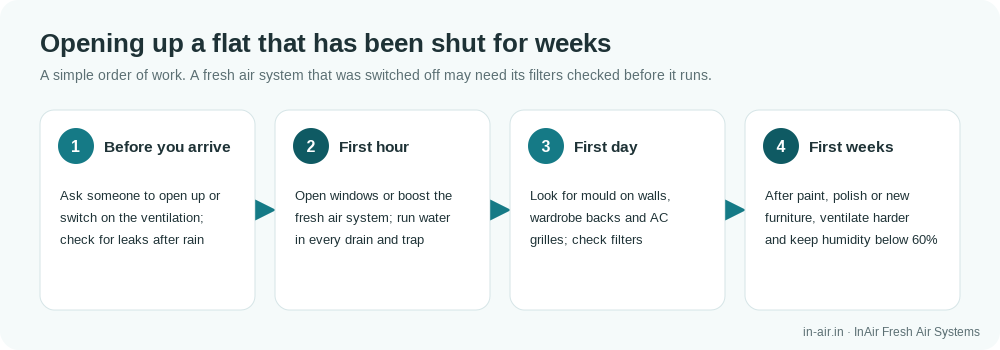
- Before moving into a flat that has been shut for weeks, air it out, run every drain, look for mould and check the filters of any fresh air system.
Why an unused room smells
A guest room, a drawing room kept for visitors or a flat locked while the family is away has the same problem: the doors stay shut and the air does not change. Three things build up.
- Moisture. Monsoon air leaks in, gets trapped and settles on the coolest surfaces: an outside wall, the back of a wardrobe, a mattress against a wall.
- Chemicals. Furniture, paint, polish, mattresses and stored products keep releasing volatile organic compounds (VOCs). The US EPA notes that many VOCs are consistently up to ten times higher indoors than outdoors, and that moth repellents, air fresheners and stored paints are common sources.
- Mould and its smell. Once a surface stays damp, mould grows and gives off the musty smell people notice first. The WHO dampness and mould guidelines treat persistent dampness as the thing to prevent, because it is linked to respiratory symptoms, allergies and asthma.
Drains add one more. In a bathroom nobody uses, the water in the trap can evaporate, and the drain smell comes straight into the room. Running each tap and flushing each toilet refills the traps.
Monsoon humidity and mould
Humidity is the main driver. The WHO guidelines give critical relative humidity levels for common materials: 75–80% for wood and wood-based materials, 80–85% for paper-faced plasterboard and 90–95% for concrete. Above these, mould can grow. Relative humidity also rises wherever a surface is cooler than the air, which is why mould starts behind wardrobes on outside walls and on surfaces next to an AC that runs in the room next door.
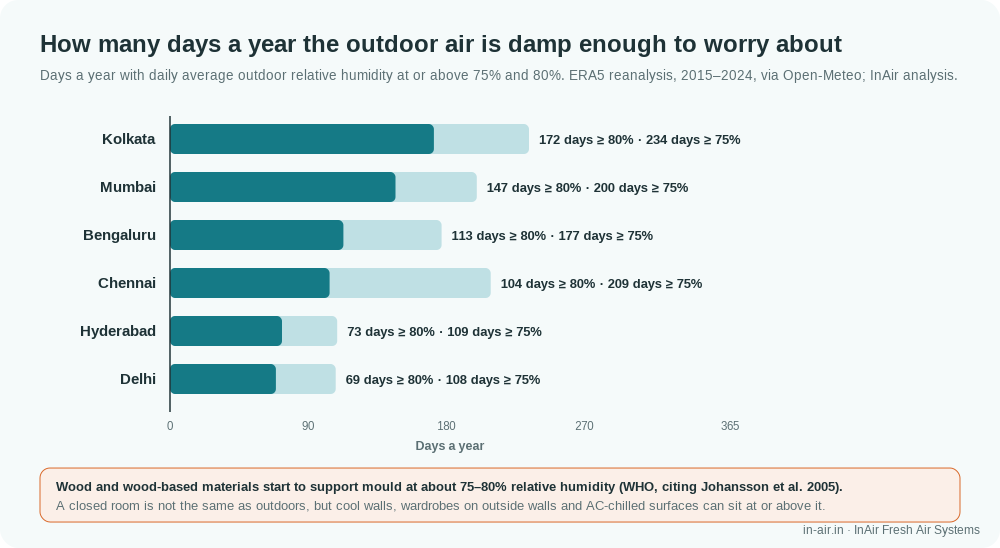
Our analysis of ten years of ERA5 climate data shows how long the risky season lasts. Daily average outdoor humidity is 80% or more on 172 days a year in Kolkata, 147 in Mumbai and 113 in Bengaluru, and even Delhi has about 69. A room that is closed through the monsoon sits in that air for months. City figures are on our city pages, and the monsoon dehumidification guide explains how fresh air can be dried before it comes in.
How much air keeps an unused room fresh?
Ventilation standards split the fresh air a home needs into two parts: one for the people and one for the building itself, which keeps giving off moisture and chemicals when nobody is home. For an empty room, only the building part applies.
- ASHRAE 62.2 (US homes): 0.03 cfm per sq ft of floor, plus 7.5 cfm per person. The floor part is about 0.55 m³/h per m².
- Approved Document F (England, 2021): a whole-home minimum of at least 0.3 litres per second per m² of floor, about 1.1 m³/h per m².
| Space | Floor area | ASHRAE 62.2 floor part | UK ADF minimum | Air changes an hour |
|---|---|---|---|---|
| Guest bedroom | 12 m² (about 130 sq ft) | 7 m³/h | 13 m³/h | 0.19–0.37 |
| Drawing room | 25 m² (about 270 sq ft) | 14 m³/h | 27 m³/h | 0.19–0.37 |
| Closed 2 BHK flat | 90 m² (about 970 sq ft) | 49 m³/h | 97 m³/h | 0.19–0.37 |
That is a trickle: well under half an air change an hour. Once guests arrive, add air for each person; the NBC suggests 20–30 m³/h per person. The air changes calculator converts between airflow and air changes for any room.
The catch in India is the monsoon. Bringing in outdoor air at 85% humidity can make a closed room damper, not drier. In humid months the incoming air needs to be dehumidified, or brought in through an ERV whose core limits the moisture it passes, and the room's humidity checked with a sensor.
Timer, humidity sensor or smart control?
| Control | How it works | Good for | Watch out |
|---|---|---|---|
| Timer | The fan runs for a set time every hour or day | Store rooms, guest bathrooms | Runs whether it is needed or not |
| Humidity sensor | The fan or unit speeds up when humidity rises | Bathrooms, monsoon months | Bringing in humid outdoor air can raise humidity; check the reading |
| IAQ sensor with app | Measures PM2.5, humidity, temperature and VOC; you watch it from your phone | Flats left empty for weeks | Needs Wi-Fi and power left on |
| Always-on low speed | A fresh air system or EC fan runs at its lowest speed all the time | Whole flats with a ducted ERV | Small, steady power use |
InAir's EC inline duct fans offer a ten-speed controller and an optional temperature and humidity sensor. The wall-mounted ERV has humidity control and auto bypass. The INA-SENSOR reports PM2.5, temperature, humidity and VOC over Wi-Fi to an Android or iOS app, so you can see a locked flat's humidity from another city. The UK's ventilation rules note one limit: humidity control suits moisture-producing rooms, not toilets, where the problem is odour.
Preparing a closed flat for occupancy
New buildings are "flushed" before people move in. The WELL Building Standard's air flush calls for 4,500 m³ of outdoor air per m² of floor while keeping the indoor temperature at 15 °C or more and relative humidity below 60%. For a 90 m² flat with a 250 m³/h fresh air system, that would take about 68 days of continuous running. That is why a newly painted or newly furnished flat can smell for weeks: the chemicals come out slowly, and steady ventilation over time does more than a single day with the windows open.
For a flat that has simply been shut, the steps in the diagram are enough. If the flat has a fresh air system that was switched off, check and clean its filters before running it; the ERV maintenance guide explains what to look at. If you find mould, deal with the moisture source first, then clean.
How InAir checks this at the site survey
- Which rooms are used rarely, and how long the home is left closed.
- Signs of damp: stains, peeling paint, mould behind wardrobes, and the humidity in each room measured with a sensor.
- Whether the outdoor air in your city needs dehumidifying before it comes in during the monsoon.
- Whether a ducted ERV can feed the unused rooms on a low setting, or a wall-mounted unit or extract fan suits better.
- What control fits: a timer, a humidity sensor or an app you can check while away.
What it costs
InAir's EC inline fans with speed or smart control start from ₹15,000, the IAQ sensor with app from ₹53,100 and the wall-mounted ERV from ₹1.4 lakh per unit, before GST and installation. InAir's fresh air dehumidifiers are quoted after a free site survey. See the price guide.
Tentative pricing: actual prices may vary based on the site survey.
Common mistakes
- Spraying air freshener over a musty smell instead of finding the damp.
- Leaving the windows open through the monsoon in a humid city, which lets damp air in all day.
- Shutting the AC and every vent in a locked flat, so nothing moves for months.
- Running a fresh air system after months off without checking its filters.
- Moving into a freshly painted flat the next day without ventilating it hard first.
Sources
- WHO Guidelines for Indoor Air Quality: Dampness and Mould (2009): indicators of dampness, critical humidity by material (Table 2). who.int
- US EPA, A Brief Guide to Mold, Moisture and Your Home. epa.gov
- US EPA, Volatile Organic Compounds' Impact on Indoor Air Quality. epa.gov
- ASHRAE 62.2-2022 Addendum e: whole-house ventilation rate. ashrae.org
- UK Approved Document F, Volume 1 (2021): paragraph 1.24 and 1.36. gov.uk
- International WELL Building Institute, WELL v1 Air Flush. wellcertified.com
- ERA5 reanalysis daily data 2015–2024 via the Open-Meteo historical weather API; InAir analysis. open-meteo.com
Why does my guest room smell musty?
How often should I air out an unused room?
Should I leave the windows open in an empty flat during the monsoon?
How do I prepare a flat that has been closed for months?
Can I monitor humidity in my flat while I am away?
What does it cost to keep an unused room ventilated?
Our engineers assess your home or building, recommend the right system and the right filter grade for your city, and give you a clear cost estimate. No obligation.