What is an AHU? Air handling units explained, and how they differ from TFA, ERV and FCU
An AHU filters, cools and moves air through ducts. Here is what is inside one, how it differs from a TFA, ERV, FCU and heat-pump ERV AHU, and what to ask before you buy.
Last updated:
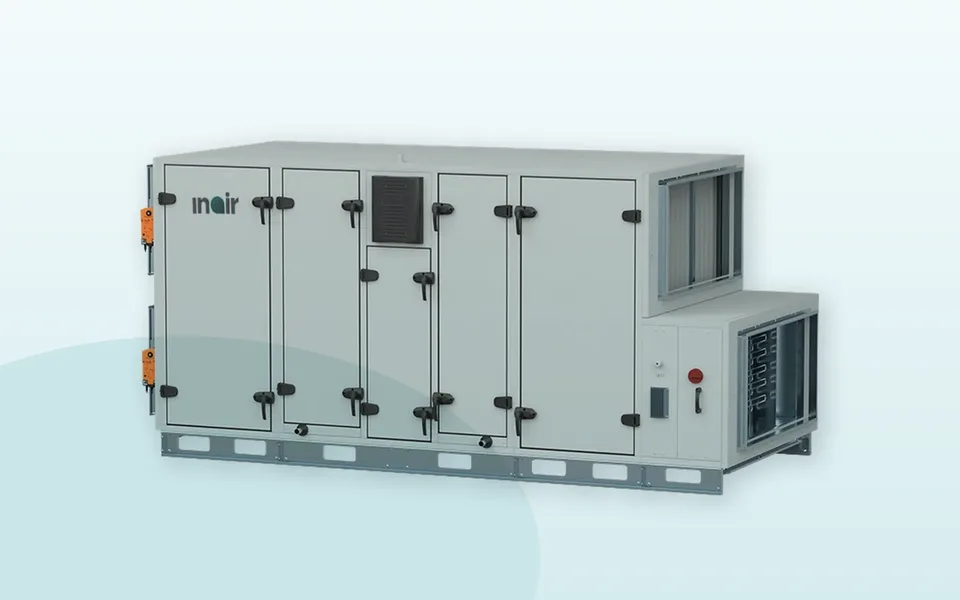
An air handling unit (AHU) is a large cabinet that pulls in air, filters it, cools or heats it over a coil and pushes it through ducts with a fan. It can handle room air, outdoor air or a mix. A TFA unit, an energy recovery ventilator (ERV) and a heat-pump ERV AHU are all specialised kinds of air handler; a fan coil unit (FCU) is its small, duct-light cousin.
If you manage a building, buy HVAC equipment or are comparing quotes for a villa, an office or a school, the names get used loosely. This guide explains what is inside an AHU, how the five common types differ, where each one belongs in India, and what to ask before you choose.
Key points
- An AHU is a box of parts: dampers, filters, a coil, a fan. What it is called depends on which air it treats and which parts it has.
- A recirculating AHU and an FCU mostly cool room air. A TFA unit and an ERV handle outdoor air, which is where fresh air comes from.
- Fresh air is expensive to cool in India because of its moisture. Energy recovery cuts that cost; ECBC 2017 requires it in some hotels and hospitals.
- The filter sets indoor PM2.5. MERV-13 captures at least 85% of 1–3 µm particles; HEPA-13 at least 99.95%.
- Choose by airflow, outdoor air share, humidity, filter grade and static pressure, not by tonnage alone.
What is inside an air handling unit
Every AHU, whatever its badge, is built from the same sections in a line. Air enters at one end and leaves at the other, and each section does one job.
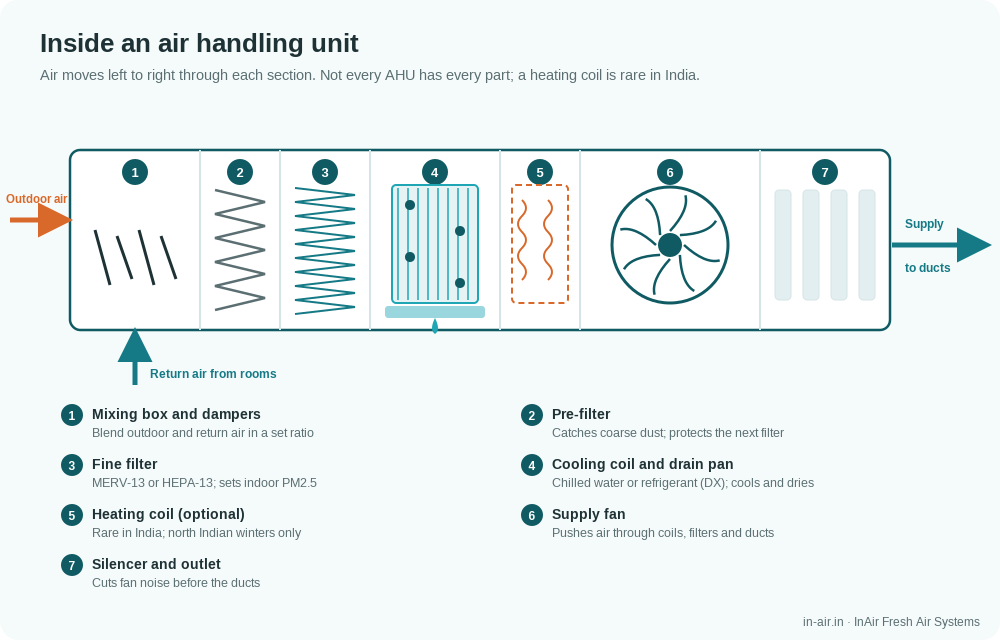
- Mixing box and dampers. Motorised blades set how much outdoor air joins the return air from the rooms. In a fresh air unit this section has an outdoor inlet only.
- Filters. A coarse pre-filter protects the fine filter behind it. The fine filter decides how clean the supply air is.
- Cooling coil. Chilled water from a central plant, or refrigerant from a condensing unit (called DX, direct expansion), cools the air. As air cools below its dew point, water condenses on the fins and runs to a drain pan. That is how an AHU dries air.
- Heating coil. Hot water, electric or heat-pump heating. Rarely needed in most of India; some north Indian and hill-station buildings use it in winter.
- Supply fan. Usually a centrifugal or plug fan. Newer units use EC (electronically commutated) motors, which can change speed.
- Silencer, casing and controls. Double-skin insulated panels stop condensation on the outside; a controller runs the fan, valves and dampers.
AHU vs TFA vs ERV vs FCU vs heat-pump ERV AHU
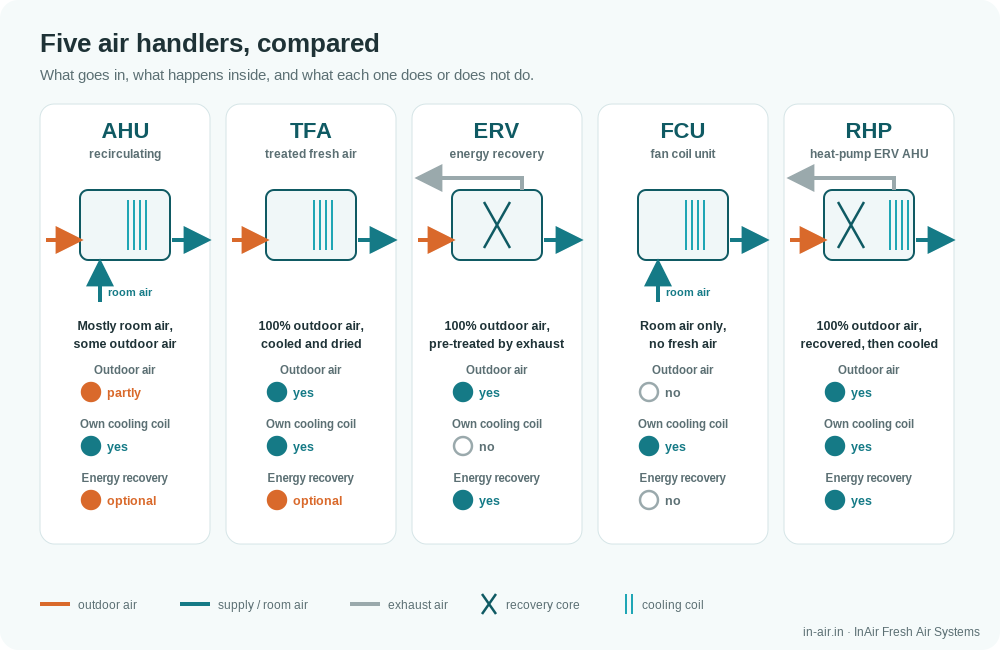
The differences come down to three questions: does the unit bring in outdoor air, does it have its own cooling coil, and does it recover energy from the air being thrown out?
| Unit | Air it handles | Cooling coil | Energy recovery | Where it is used in India |
|---|---|---|---|---|
| Recirculating AHU | Mostly room air, with a share of outdoor air | Yes, chilled water or DX | Optional | Office floors, malls, auditoriums, banquet halls |
| TFA (treated fresh air unit) | 100% outdoor air | Yes, chilled water or DX | Only if a wheel or plate is added | Large offices, hotels and hospitals with a chilled-water plant |
| ERV (energy recovery ventilator) | 100% outdoor air in, an equal amount of stale air out | No | Yes: a core moves heat and moisture between the two streams | Homes, villas, schools, clinics, small offices |
| FCU (fan coil unit) | Room air only | Yes, usually chilled water | No | Hotel rooms, office cabins on a chilled-water system |
| Heat-pump ERV AHU (InAir RHP) | 100% outdoor air in, stale air out | Yes, built-in DX heat pump | Yes, recovery core first | Humid cities, villas, schools, offices, clinics |
Two points trip people up. An FCU, like a split AC, does nothing for fresh air: it only cools the room's own air. And a standard TFA unit throws away the cooling in the air leaving the building unless a recovery device is added. Our TFA vs ERV comparison goes deeper into that choice.
Where a heat-pump ERV AHU fits
A heat-pump ERV AHU puts the two ideas in one box. Outdoor air first passes a recovery core, which takes heat and moisture from it using the cool, dry air leaving the building. A built-in DX heat pump then cools and dries it further. InAir's RHP range delivers fresh air at a set 22–28 °C, its spec sheets list energy recovery above 92% and control accuracy of ±2 °C, and every model needs a three-phase 380 V supply. The models run from INA-HLN-006B1 through the ceiling-mounted INA-HLN-B1 series to the floor-standing INA-HLN-030A1-DC to INA-HLN-080A1-DC, up to 8,000 m³/h.
It does not replace the room air conditioning. It treats the fresh air, so the room ACs or VRF only have to deal with the heat from people, lights and sun.
Why energy recovery matters more in India
Every cubic metre of outdoor air brought into an air-conditioned building has to be cooled and, for most of the year, dried. Our analysis of ten years of ERA5 weather data shows the drying is the bigger job. For each 100 m³/h of untreated outdoor air, an AC must remove about 0.48 kW of heat on an average May afternoon in Delhi, but about 0.88 kW of moisture on an average July day. In Kolkata the moisture load reaches 1.01 kW. Multiply that by the thousands of m³/h a hotel or office needs and the cost is large.
An energy recovery core cuts that load by pre-treating incoming air with the outgoing air. InAir's Revita and Ventura ERVs recover 89–90% of the heat in the outgoing air (tested). The Energy Conservation Building Code 2017 makes recovery a requirement in some cases: hotels and hospitals with systems above 2,100 litres per second that supply at least 70% outdoor air must have air-to-air heat recovery of at least 50% effectiveness (§5.3.11).
In very humid coastal cities, passive recovery alone cannot dry monsoon air enough, which is why a coil is still needed, either in a TFA unit or a heat-pump ERV. See HRV vs ERV for Indian climates for the zone-by-zone picture.
Filtration: the part that decides PM2.5 indoors
An AHU's coil makes the air cool; its filter makes it clean. The grade matters because outdoor PM2.5 in Indian cities is far above indoor targets: CSE's analysis of CPCB data put the winter 2024–25 average at 175 µg/m³ in Delhi and 37 in Bengaluru, against an indoor target of 15–25 in Indian green building classes.
| Filter | What it catches (test standard) | Typical use |
|---|---|---|
| Pre-filter (coarse) | Large dust, insects, fibres | In front of every fine filter |
| MERV-13 | At least 85% of 1–3 µm particles (ASHRAE 52.2) | Standard fine filter for most Indian cities |
| HEPA-13 (H13) | At least 99.95% at the most penetrating particle size (EN 1822) | Delhi NCR and the Indo-Gangetic plain, clinics, sensitive occupants |
For recirculating systems that cannot take more outdoor air, CSIR's ventilation guidelines advise upgrading filters to MERV-14 / F8 or higher, as long as the fan can still deliver its airflow. A finer filter adds resistance, so the fan must be selected for it. More on grades in our planned filter grades guide.
Questions to answer before you choose an AHU
- How much air, and how much of it outdoor air? Fresh air is set by people and use: India's National Building Code gives 20–30 m³/h of fresh air per person, and ASHRAE 62.1 sets rates by occupancy and floor area. Total airflow is set by the cooling load.
- Is there a chilled-water plant? If yes, chilled-water AHUs, FCUs and a fresh air unit fit. If not, DX or heat-pump units avoid building a plant.
- How humid is the city? In Mumbai, Chennai, Kolkata or Kochi, the fresh air needs active drying, not just recovery.
- What filter grade does the location need? MERV-13 for most cities, HEPA-13 where winter smog is heavy.
- What static pressure will the ducts add? Two units with the same rated airflow can deliver very different air through a long duct run.
- Where will it sit, and can it be serviced? Ceiling-mounted units need access panels; floor-standing units need a plant room or terrace space.
- What power is available? InAir's RHP units need three-phase 380 V; Revita ERVs run on single-phase.
- How will it be controlled? ECBC 2017 asks for CO₂-based demand control in large, densely occupied spaces (above 1,500 l/s of outdoor air to a space over 50 m² with more than 40 people per 100 m²). Read our guide to demand-controlled ventilation.
How InAir checks this at the site survey
The survey is free. An InAir engineer looks at the drawings and the building, and records:
- the rooms, their use and how many people they hold, to set the fresh air quantity;
- the existing cooling system (split, VRF or chilled water) and whether it can take treated or untreated fresh air;
- the city's humidity and air quality, which decide between an ERV and a heat-pump ERV AHU, and between MERV-13 and HEPA-13;
- the duct route, ceiling depth and plant space, which set the static pressure and the unit format;
- the power supply, and where the outdoor intake and exhaust can sit apart from each other.
If the building already has enough fresh air, we say so. If not, the quote names the model, the airflow at the measured duct pressure and the filter grade.
What it costs
For InAir's fresh air units, starting prices before GST and installation are: Ventura ceiling-mounted ERVs from ₹3.8 lakh, Ventura floor-standing ERVs from ₹6.4 lakh, RHP ceiling-mounted heat-pump ERV AHUs from ₹9.4 lakh and RHP floor-standing units from ₹16.1 lakh. Recirculating AHUs and FCUs are priced with the main cooling system, so their cost depends on the project. The price guide lists the full range.
Tentative pricing: actual prices may vary based on the site survey.
Common mistakes
- Calling every box an AHU and comparing quotes that are for different jobs: a recirculating AHU and a fresh air unit are not interchangeable.
- Assuming FCUs or split ACs provide fresh air. They recirculate.
- Sizing a fresh air unit by tonnage instead of by the m³/h of outdoor air the occupants need.
- Choosing a filter grade without checking that the fan can push air through it.
- Leaving out energy recovery on a 100% outdoor air system in a hot, humid city, then paying for it in chiller or AC load.
- Placing the outdoor intake next to the exhaust, a kitchen vent or a DG set flue.
Sources
- Bureau of Energy Efficiency, Energy Conservation Building Code 2017 (Rev. 2019): scope, §5.2.1.3 demand control ventilation, §5.3.11 energy recovery. datacenters.lbl.gov
- CSIR, Guidelines on Ventilation of Residential and Office Buildings for SARS-CoV-2 (Version 2.0, 2022): 20–30 m³/h per person; MERV-14 / F8 for recirculating systems. niti.gov.in
- Bureau of Indian Standards, National Building Code of India 2016, Part 8 Building Services. www.bis.gov.in
- US EPA, What is a MERV rating? www.epa.gov
- ERA5 reanalysis 2015–2024 via Open-Meteo, InAir analysis (method in the home ventilation guide). open-meteo.com
- InAir RHP heat-pump ERV AHU product page and INA-HLN-006B1 spec sheet. www.in-air.in
What is an AHU in HVAC?
What is the difference between an AHU and a TFA unit?
Is an FCU the same as an AHU?
Is an ERV an AHU?
What is a heat-pump ERV AHU?
Which filter should an AHU have in India?
Our engineers assess your home or building, recommend the right system and the right filter grade for your city, and give you a clear cost estimate. No obligation.