CO₂ levels in a home: what ppm is good, high or too high?
Outdoor air is about 425 ppm. A well-ventilated room stays under 800, and 1,000 ppm says the room needs more outdoor air. CO₂ is a gauge of ventilation, not a poison at home levels.
Last updated:

Outdoor air holds about 425 ppm of carbon dioxide (CO₂). Indoors, under 800 ppm means a room is getting plenty of outdoor air. Around 1,000 ppm it is getting too little for the people in it. By our calculation, a closed bedroom with two sleepers can pass 2,000 ppm by morning. None of that is toxic: the workplace limit is 5,000 ppm over 8 hours.
Key points
- CO₂ is a gauge of ventilation. It rises when people breathe in a room that gets too little outdoor air.
- IGBC's indoor classes are set above outdoor air: +350, +440 and +530 ppm, or about 775, 865 and 955 ppm today.
- 1,000 ppm is not a health limit. ASHRAE dropped it from its standard because people read it as one.
- Studies on thinking and sleep disagree. The effects seem to come mostly from what builds up with CO₂, not from CO₂ itself.
- About 21 m³/h of outdoor air per person holds about 1,000 ppm; about 32 m³/h holds 800 ppm.
- A low reading does not mean clean air. CO₂ says nothing about PM2.5 or VOCs.
CO₂ ppm chart for homes
The chart and table below put the common numbers in order. Each band is tied to the source it comes from. They are guides to how well a room is ventilated, not limits that make a room safe or unsafe.
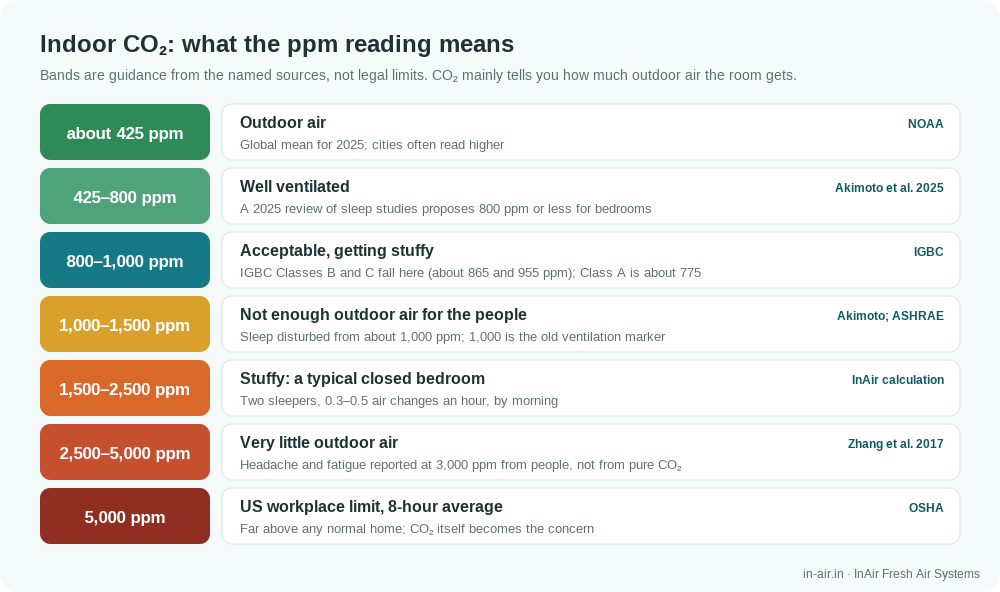
| CO₂ (ppm) | What it means | Source |
|---|---|---|
| about 425 | Outdoor air. The global mean for 2025 was 425.6 ppm. | NOAA |
| up to 800 | Plenty of outdoor air. Proposed as the bedroom target after a review of 17 sleep studies. | Akimoto et al. 2025 |
| 775 / 865 / 955 | IGBC Class A (aspirational), B (acceptable), C (minimum) at 425 ppm outdoors | IGBC Health and Well-being |
| about 1,000 | The traditional marker of too little ventilation; disturbed sleep seen from about here | ASHRAE; Akimoto et al. |
| about 1,830–2,590 | A closed bedroom by morning: two sleepers in a 33.6 m³ room reach about 1,830–2,590 ppm at 0.5–0.3 air changes an hour | InAir calculation |
| 3,000 | Headache, fatigue and slower thinking when the CO₂ came from people with little ventilation; no effect from pure CO₂ at the same level | Zhang et al. 2017 |
| 5,000 | US workplace limit, 8-hour average (30,000 for 15 minutes) | OSHA |
Where the 1,000 ppm number comes from
It is older than air conditioning. ASHRAE's 2025 position document traces it to Max von Pettenkofer in the 19th century, who proposed 1,000 ppm as a marker of poor ventilation indoors and 700 ppm for bedrooms. He did not treat CO₂ as the cause of discomfort. He used it as a stand-in for the other things people give off.
Later research set ventilation rates by body odour, at about 7.5 to 10 litres a second per person. CO₂ served as a marker of that odour, because people give off both at rates tied to their metabolism. ASHRAE's 1989 ventilation standard printed a 1,000 ppm CO₂ limit. It was removed from later editions, in ASHRAE's words, "due to its common misinterpretation". ASHRAE does not recommend a CO₂ level as a measure of ventilation adequacy or infection risk.
India's numbers: IGBC and ISHRAE classes
In India, the IGBC Health and Well-being rating sets CO₂ relative to the outdoor (ambient) level, with inputs from ISHRAE's indoor environmental quality standard. Class A, the aspirational level, is at most 350 ppm above outdoors. Class B, acceptable, is 440 ppm above. Class C, the minimum, is 530 ppm above. At today's 425 ppm outdoors, those come to about 775, 865 and 955 ppm. To earn the credit, 80% of the readings must stay within the class.
Setting the limit above outdoor air makes sense in Indian cities. Readings near busy roads can be higher than the global mean, and ASHRAE notes that urban areas can sit well above it. Measure outdoors with the same monitor and add the class figure.
| IGBC class | Above outdoor air | At 425 ppm outdoors | Outdoor air per person to hold it |
|---|---|---|---|
| Class A | +350 ppm | about 775 ppm | about 34 m³/h |
| Class B | +440 ppm | about 865 ppm | about 27 m³/h |
| Class C | +530 ppm | about 955 ppm | about 23 m³/h |
The last column uses about 12 litres of CO₂ an hour for a resting adult. It is the outdoor air each person needs once the room has settled. It sits close to the NBC's 20–30 m³/h of fresh air per person, which works out at about 1,025 to 825 ppm.
Does CO₂ affect thinking and sleep?
This is where the most confident claims are made, and the evidence is mixed. Four studies show the range.
| Study | What was tested | What was found |
|---|---|---|
| Satish et al. 2012, 22 adults | Pure CO₂ added to an office chamber: 600, 1,000 and 2,500 ppm, 2.5 hours each | Moderate drops in six of nine decision-making scales at 1,000 ppm; large drops in seven at 2,500 ppm |
| Allen et al. 2016, 24 participants | CO₂ raised to about 945 and 1,400 ppm at constant ventilation, with VOCs varied too | Cognitive scores 15% lower at about 945 ppm and 50% lower at about 1,400 ppm than in well-ventilated conditions |
| Zhang et al. 2017, 25 adults | Pure CO₂ at 1,000 and 3,000 ppm, against the same levels reached by cutting ventilation | Pure CO₂: no significant effect. Low ventilation at 3,000 ppm: more headache, fatigue and sleepiness, slower on some tests |
| Akimoto et al. 2025, review of 17 sleep studies | Bedroom ventilation and sleep | Disturbed sleep from about 1,000 ppm, no effect seen at about 850 ppm; proposes 800 ppm or less, about 8 L/s per person |
ASHRAE weighed these and similar studies in 2025. Its conclusion: evidence for direct effects of CO₂ on health, sleep and performance at ordinary indoor levels is inconsistent, and does not yet justify changing ventilation standards. The 2025 review takes the same line from the other side: it treats CO₂ as a proxy for the ventilation rate, not as a pollutant.
For a household, both readings lead to the same place. A high reading means the room's air is not being replaced. Whatever people, cooking, cleaning products and furniture give off is building up with it. More outdoor air lowers all of it together. Our article on bedroom CO₂ and sleep covers the sleep studies in more detail.
What decides the CO₂ level in your room
Three things: how many people are breathing, how big the room is, and how much outdoor air comes in. The room size only sets how quickly the level climbs. Where it ends up depends on the outdoor air per person.
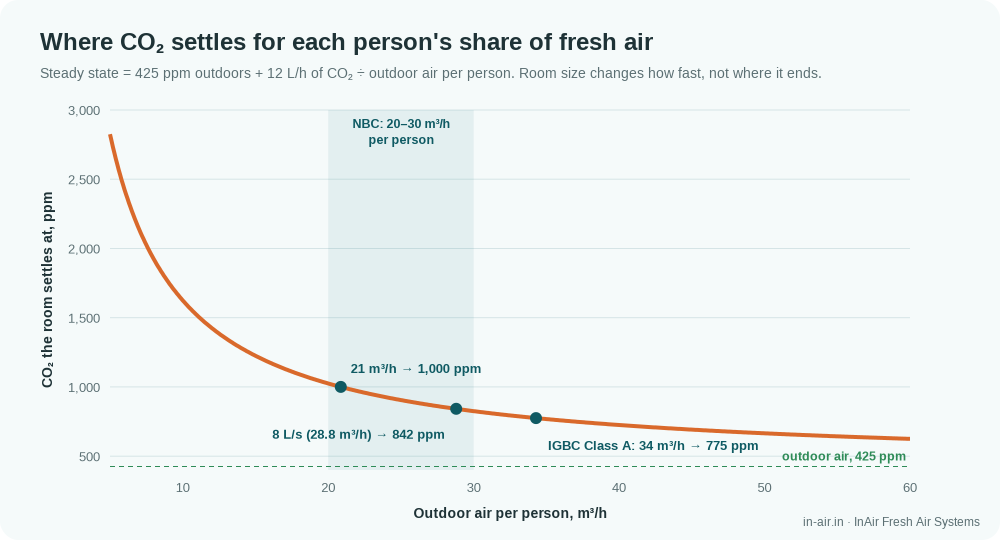
That is why a big master bedroom still gets stuffy by morning. Two sleepers in a 33.6 m³ room with the door and window shut and a little leakage reach about 2,590 ppm after 8 hours. Our bedroom CO₂ calculator runs the same sum for your room, hour by hour, and shows the fresh air needed to stay under your target. For bathrooms and kitchens, where moisture and smells matter more than CO₂, use the air changes calculator.
Reading a CO₂ monitor
- Use an NDIR sensor. It measures CO₂ directly. Cheaper monitors often estimate an "eCO₂" figure from a VOC sensor, which is not the same thing.
- Check it outdoors. A few minutes on a balcony should read close to 425 ppm. Many sensors re-zero themselves on the lowest level they see, so an always-closed room can make them drift.
- Place it at breathing height, away from the pillow, windows, the AC outlet and the door.
- Look at the shape, not one number. A steady climb overnight that falls fast when the door opens is the sign of a room short of outdoor air.
ASHRAE notes that sensor accuracy, position and calibration all affect what a reading means. InAir's own IAQ sensor reads PM2.5, temperature, humidity and VOC. It does not measure CO₂, so use a separate CO₂ monitor. Our air quality monitor buying guide explains what to look for.
Common myths about CO₂
- "Above 1,000 ppm is toxic." No. The workplace limit is 5,000 ppm over a working day. A high home reading is a ventilation warning, not poisoning.
- "1,000 ppm is the ASHRAE limit." It was, in 1989, and it was taken out because it was misread as a health limit.
- "An air purifier will bring CO₂ down." A purifier filters the air already in the room. It does not replace it with outdoor air, so CO₂ keeps rising.
- "The AC gives fresh air." A split AC cools and recirculates room air. It brings in no outdoor air.
- "A bigger room never gets stuffy." It takes longer, but over a full night it ends up close to a smaller room with the same people and the same leakage.
- "Low CO₂ means clean air." ASHRAE points out that pollutants from building materials and from outdoors do not move with CO₂. In a Delhi winter, a room with the window open can read close to outdoor CO₂ and still be full of PM2.5.
How InAir checks this at the site survey
- The bedrooms and study: their size, who sleeps or works there, and the hours the doors stay shut.
- How the rooms leak today: window type, the gap under the door, AC pipe holes and exhaust fans.
- The fresh air each room needs to hold your CO₂ target, and whether a ducted ERV or a wall-mounted unit can deliver it.
- Where stale air leaves: door undercuts, return grilles or a bathroom exhaust.
- Local outdoor air: PM2.5 and humidity, which decide the filters and the type of unit.
- After installation, airflow measured at each bedroom outlet. If you have a CO₂ monitor, we suggest reading it overnight before and after.
InAir's Revita energy recovery ventilators bring in filtered outdoor air with 89–90% (tested) heat recovery, so the closed, air-conditioned room is not traded for a stuffy one. For a single room with an outside wall, there is the wall-mounted ERV INA-WERVG20-150CMH. For the whole flat, start with the ERV sizing calculator.
What it costs
A Revita ducted ERV for a 1–2 BHK home starts from ₹2.1 lakh, and the wall-mounted standalone ERV from ₹1.4 lakh per unit, both before GST and installation. Ducting and site work are quoted after a free site survey.
Tentative pricing: actual prices may vary based on the site survey.
Sources
- ASHRAE Position Document on Indoor Carbon Dioxide, approved 12 February 2025: history of the 1,000 ppm figure, health evidence, OSHA and NIOSH limits. ashrae.org
- Indian Green Building Council, IGBC Health and Well-being Rating System: CO₂ Class A/B/C at 350/440/530 ppm above ambient. IGBC (PDF)
- NOAA Global Monitoring Laboratory, global annual mean CO₂ (425.63 ppm for 2025). gml.noaa.gov
- Satish U et al. Is CO₂ an indoor pollutant? Environ Health Perspect 2012;120(12):1671–1677. pmc.ncbi.nlm.nih.gov
- Allen JG et al. Associations of cognitive function scores with carbon dioxide, ventilation, and volatile organic compound exposures in office workers. Environ Health Perspect 2016;124(6):805–812. pmc.ncbi.nlm.nih.gov
- Zhang X, Wargocki P, Lian Z, Thyregod C. Effects of exposure to carbon dioxide and bioeffluents. Indoor Air 2017;27(1):47–64. pubmed.ncbi.nlm.nih.gov
- Akimoto M et al. Science and Technology for the Built Environment 2025 (review of 17 bedroom ventilation and sleep studies); summary by Waseda University. eurekalert.org
- OSHA Occupational Chemical Database, carbon dioxide: PEL 5,000 ppm (8-hour TWA). osha.gov
Worked figures use a well-mixed single-zone balance with 12 L/h of CO₂ per resting adult and 425 ppm outdoors, as shown on the calculator page.
What is a good CO₂ level in a home?
Is 1,000 ppm of CO₂ bad?
What CO₂ level is dangerous?
Why is CO₂ high in my bedroom in the morning?
How much fresh air keeps CO₂ under 1,000 ppm?
Does an air purifier reduce CO₂ indoors?
Our engineers assess your home or building, recommend the right system and the right filter grade for your city, and give you a clear cost estimate. No obligation.