How much electricity does an exhaust fan use? Watts, units and monthly cost
An exhaust fan's own electricity use is small, but it depends on hours, motor type and speed. Here is how to work it out, with the published figures behind it.
Last updated:
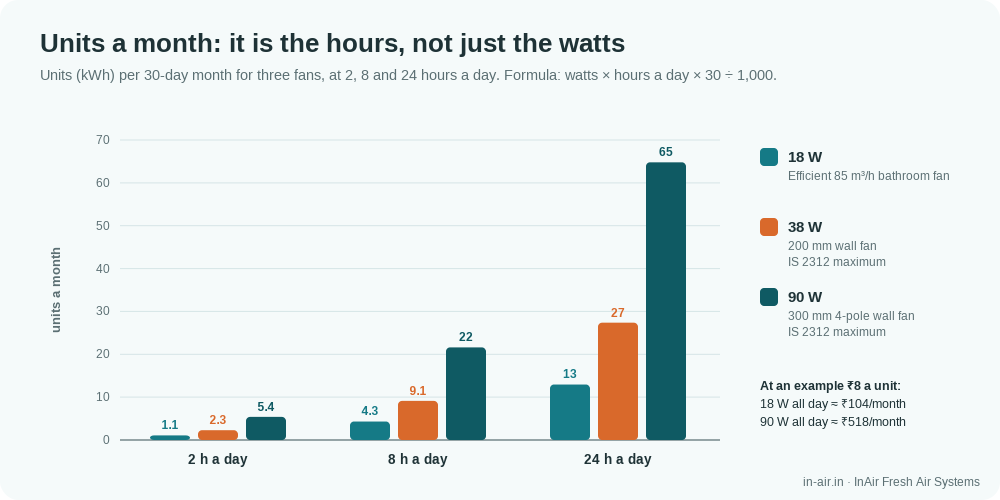
An exhaust fan uses watts × hours a day × 30 ÷ 1,000 units of electricity a month; for the fans on this page, from about 1 to 65 units. A 38 W fan used for 2 hours a day uses 2.3 units a month, about ₹18 at an example ₹8 a unit. The same fan left on all day uses 27 units, about ₹219.
Key points
- Units = watts × hours ÷ 1,000. One unit on your bill is one kilowatt-hour.
- Hours matter more than watts. A fan that runs all day uses 12 times the energy of one run for two hours.
- Motor type matters for always-on fans. In US Department of Energy figures, small shaded-pole fan motors are about 20% efficient, PSC (capacitor) motors about 29% and EC motors about 66%.
- Speed control saves the most. A fan's power falls with the cube of its speed: at 80% speed an ideal fan needs about half the power.
- The bigger hidden cost in an air-conditioned home is the hot outdoor air the fan pulls in to replace what it removes.
How to work out an exhaust fan's units and cost
You need three numbers: the fan's input in watts, the hours it runs, and your tariff per unit.
- Units a month = watts × hours a day × 30 ÷ 1,000
- Cost a month = units × your tariff per unit
Tariffs vary by state, by slab and by how much else the home uses, so take the per-unit rate from your own electricity bill. On this page we use ₹8 a unit as an example only; scale the rupee figures to your own rate.
| Fan input | Hours a day | Units a month | Units a year | Cost a month at ₹8 | Cost a year at ₹8 |
|---|---|---|---|---|---|
| 18 W | 2 h | 1.1 | 13 | ₹9 | ₹104 |
| 18 W | 8 h | 4.3 | 52 | ₹35 | ₹415 |
| 18 W | 24 h | 13.0 | 156 | ₹104 | ₹1,244 |
| 38 W | 2 h | 2.3 | 27 | ₹18 | ₹219 |
| 38 W | 8 h | 9.1 | 109 | ₹73 | ₹876 |
| 38 W | 24 h | 27.4 | 328 | ₹219 | ₹2,627 |
| 90 W | 2 h | 5.4 | 65 | ₹43 | ₹518 |
| 90 W | 8 h | 21.6 | 259 | ₹173 | ₹2,074 |
| 90 W | 24 h | 64.8 | 778 | ₹518 | ₹6,221 |
The three wattages are chosen from published limits, not from any one product. 18 W is what an 85 m³/h (50 cfm) bathroom fan draws at the ENERGY STAR minimum efficacy of 2.8 cfm per watt. 38 W and 90 W are the maximum inputs IS 2312 allows for a 200 mm (4-pole) and a 300 mm (4-pole) propeller ventilating fan.
How to read the wattage on a fan
IS 2312 requires every propeller ventilating fan to be marked with its consumption in watts at test speed, along with its size and rated voltage. The standard allows the measured input to be up to 10% above the rated figure, and the measured air delivery up to 10% below it.
Watts alone do not tell you whether a fan is efficient. You need airflow per watt:
- IS 2312's "service value" is air delivery in m³ per minute divided by input in watts. Higher is better.
- ENERGY STAR's "efficacy" is cfm per watt, measured against a stated duct pressure. For bathroom and utility fans of 10–89 cfm the minimum is 2.8 cfm/W (about 4.8 m³/h per watt); for inline fans it is 3.8.
Compare like with like. IS 2312 delivery is measured at free flow, with nothing in the way; ENERGY STAR measures against duct pressure. A fan's airflow per watt always looks better at free flow than in a real duct, so two numbers taken at different pressures cannot be compared.
AC motor or EC (BLDC) motor?
Most low-cost exhaust fans use a plain AC induction motor, either a shaded-pole motor or a permanent split capacitor (PSC) motor. EC (electronically commutated) motors, often sold as BLDC, use permanent magnets and built-in electronics to drive the rotor.
| Motor | How it runs | Efficiency (small fan motors) | Speed control |
|---|---|---|---|
| Shaded-pole AC | A copper ring on each pole makes the field rotate; simple and cheap | About 20% (9–12 W sizes) | Fixed, or crude steps |
| PSC / capacitor AC | A capacitor-fed second winding starts and runs the motor | About 29% | One to three speeds |
| EC / BLDC | Electronics switch DC through the windings; permanent-magnet rotor | About 66% | Smooth, wide range |
Those figures come from US Department of Energy data on small evaporator fan motors, quoted by Oak Ridge National Laboratory. The exact numbers vary with motor size; for larger air-handler motors, the US Pacific Northwest National Laboratory puts PSC motors at best at 60% and EC motors at about 80%. The ranking is the same in every source we checked.
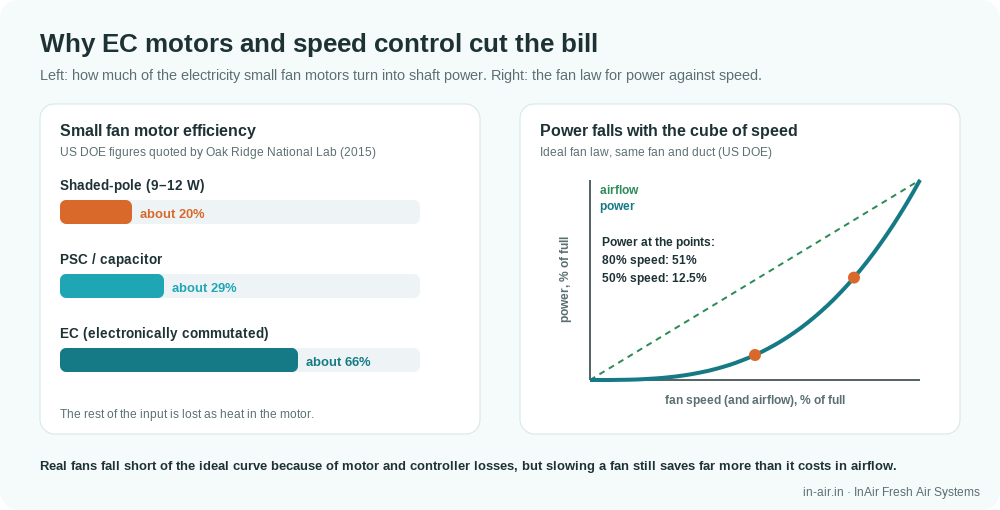
Speed control is where an EC motor really pays. The fan laws in the US Department of Energy's fan sourcebook say airflow rises in step with speed but power rises with the cube of speed. In the ideal case, running at 80% speed needs about 51% of full power, and 50% speed about 12.5%. An EC fan can idle gently all day and boost when someone showers. InAir's EC inline duct fans use PWM speed control with a 10-speed controller option and an optional temperature and humidity sensor, so the fan can boost on steam and fall back afterwards.
Always-on fans: where efficiency adds up
ASHRAE 62.2 lets a bathroom fan run either when needed at 50 cfm (85 m³/h) or continuously at 20 cfm (34 m³/h). A continuous fan runs 720 hours a month, so its efficiency counts. At ENERGY STAR's minimum efficacy, 34 m³/h needs about 7 W, which is 5.1 units a month. A fan of the same airflow at a third of that efficacy, 1 cfm per watt (an illustration, not a product), would draw 20 W and use 14.4 units, every month, for years.
For a fan used 20 minutes after each shower, the gap is a few units a year and noise or build quality matter more. For fans that run all day, in a toilet without a window, a room without windows or a commercial washroom, pick by airflow per watt.
Standby power
Fans with electronics, displays, Wi-Fi or sensors draw a little power even when the motor is stopped. Check the datasheet. The arithmetic is the same: a 1 W standby load (an example figure) left on all month is 0.72 units. A plain switched AC fan draws nothing when off.
The bigger cost: the air the fan pulls in
Every cubic metre an exhaust fan throws out has to be replaced, and in an air-conditioned home that replacement air ultimately comes from outdoors. InAir's analysis of ERA5 weather data in the home ventilation guide puts the heat load of untreated outdoor air at about 0.48 kW per 100 m³/h on an average May afternoon in Delhi. So an 85 m³/h bathroom fan left running in an AC flat adds roughly 0.41 kW of heat for the AC to remove, ten times or more the fan's own power. In the monsoon the moisture load is higher still.
That is why a bathroom fan should run when the room needs it, on a timer or humidity sensor, rather than all day by habit. It is also why whole-home fresh air is better done with heat recovery: InAir's Revita and Ventura ERVs recover 89–90% (tested) of the heat or cooling in the outgoing air. See exhaust fan vs fresh air system.
How InAir checks this at the site survey
- Asks how each fan will be used: occasional, timed, humidity-controlled or continuous.
- Sets the airflow each room needs, then the duct pressure, so the fan is not oversized; an oversized fan wastes power and makes noise.
- Recommends an EC fan with speed or sensor control where a fan will run for long hours.
- Checks where replacement air comes from, so an AC room does not pull hot air through gaps.
- Gives the power figure for the selected model from its datasheet, at the chosen speed.
What it costs
InAir bathroom and toilet exhaust fans start from ₹3,300, mixed-flow inline fans from ₹6,600, and EC inline duct fans with speed or smart control from ₹15,000, before GST and installation. See the pricing page for the full fan list.
Tentative pricing: actual prices may vary based on the site survey.
Common mistakes
- Comparing fans by watts alone. A 30 W fan that moves twice the air of a 25 W fan is the more efficient one.
- Comparing a free-air airflow per watt with one measured against duct pressure.
- Leaving a fixed-speed fan on all day in an AC home and blaming the AC bill on the fan's watts, when the replacement air is the bigger cost.
- Buying a bigger fan than the room needs "to be safe". It uses more power and is louder.
- Ignoring standby draw on smart fans that stay powered all year.
Sources
- Bureau of Indian Standards, IS 2312:1967, Propeller type AC ventilating fans: marking, service value, tolerances, Table 2 maximum watts.
- US EPA, ENERGY STAR Ventilation Fans Key Product Criteria: minimum efficacy in cfm per watt.
- Fricke and Becker, Q-Sync Motors in Commercial Refrigeration, Oak Ridge National Laboratory, ORNL/TM-2015/466: shaded-pole, PSC and EC motor efficiency.
- Pacific Northwest National Laboratory, Building America Solution Center, ECM air handler fans.
- US Department of Energy, Improving Fan System Performance: A Sourcebook for Industry: fan laws.
- ASHRAE, Addendum e to Standard 62.2-2022: intermittent and continuous bathroom exhaust rates.
- InAir product pages and price list, FY 2026–27; InAir analysis of ERA5 reanalysis data.
How many units does an exhaust fan use per month?
How much does it cost to run an exhaust fan all day?
Do BLDC exhaust fans really save electricity?
How many watts is a bathroom exhaust fan?
Is it okay to leave an exhaust fan on all the time?
Does an exhaust fan use power when switched off?
Our engineers assess your home or building, recommend the right system and the right filter grade for your city, and give you a clear cost estimate. No obligation.