How does an exhaust fan work? Pressure, impellers, ducts and make-up air
A fan makes a small pressure difference, and the duct decides how much air that buys. Here is the physics in plain language.
Last updated:
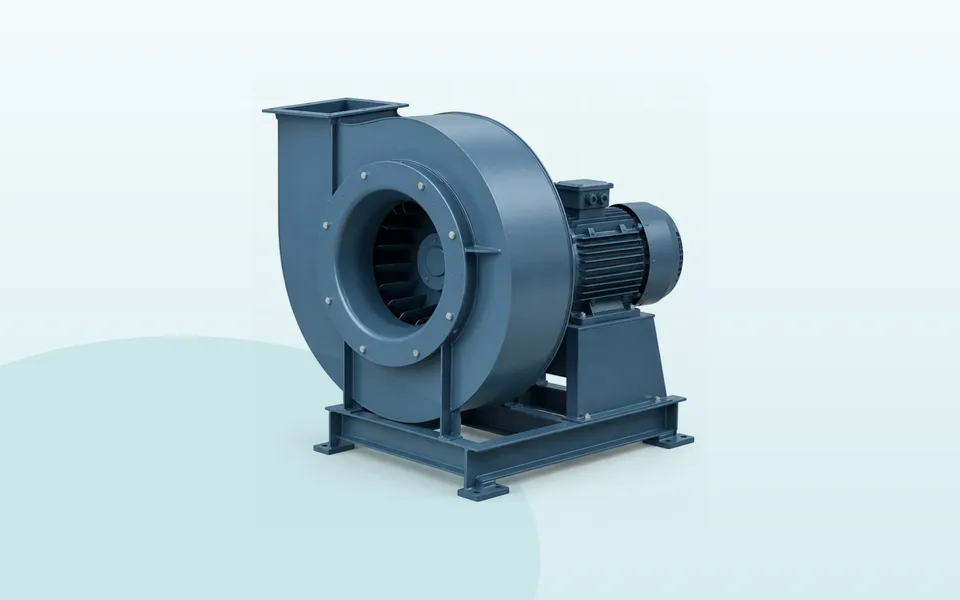
An exhaust fan works by making a small pressure difference. Its spinning impeller lowers the pressure on the room side, so room air flows in, and raises it on the outlet side, pushing that air through the duct to the outside. Replacement air then flows into the room through door gaps and openings. Everything else, from fan type to duct size, follows from that.
Key points
- A fan makes pressure, then pressure makes airflow. The pressures involved are small: ASHRAE rates bathroom fans at 62.5 Pa, about one sixteen-hundredth of atmospheric pressure.
- Three impeller types: axial (propeller) fans move a lot of air at low pressure; centrifugal fans make the most pressure; mixed-flow fans sit in between.
- Every duct, bend, grille and cowl resists airflow, and that resistance rises with the square of the airflow. The fan settles where its curve meets the duct's curve.
- A backdraft shutter stops air and insects coming back in when the fan is off.
- No air out without air in. A fan cannot empty a sealed room; replacement (make-up) air has to get in.
The pressure difference that moves the air
Air moves from higher pressure to lower pressure. A fan's blades push on the air and leave a slightly lower pressure behind them and a slightly higher one in front. Room air drifts towards the low-pressure side, passes through the impeller and is pushed out.
The pressures are tiny. Fan ratings are given in pascals (Pa) or inches of water: ASHRAE 62.2 uses 62.5 Pa (0.25 inch of water) as its rating point for bathroom and kitchen fans, and ENERGY STAR tests bathroom fans at 0.1 and 0.25 inch of water (about 25 and 62 Pa). For comparison, the atmosphere presses at about 101,000 Pa. A fan does not suck air in any forceful way; it tips a very small balance, continuously.
The static pressure a fan can make is the key number. IS 2312, the Indian Standard for propeller ventilating fans, defines it as the difference between the absolute pressure at a point and the pressure of the surrounding air. It is what the fan has available to push air through a duct, past a grille and out of a cowl.
Axial, mixed-flow and centrifugal: how the impellers differ
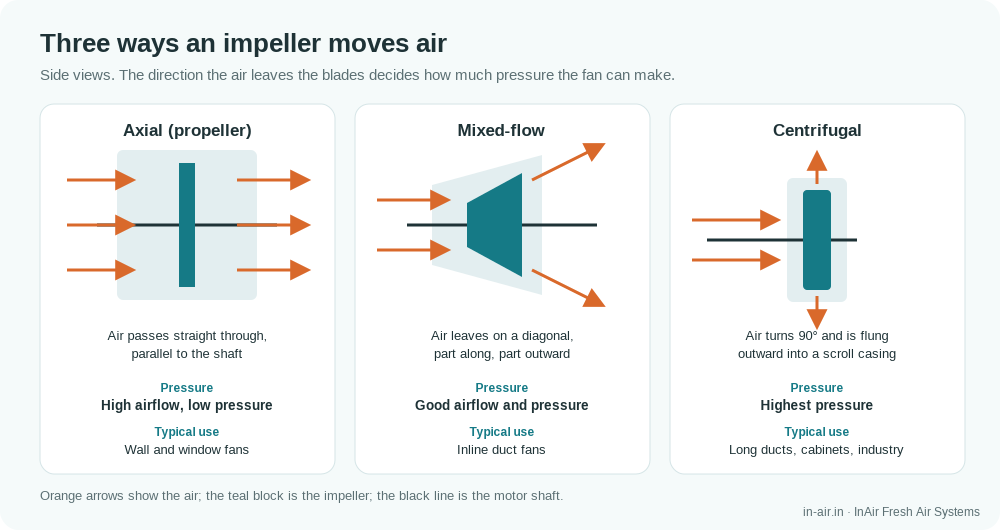
| Impeller | How air moves | Strength | Limit | Where you see it |
|---|---|---|---|---|
| Axial (propeller) | Straight through, parallel to the shaft | High airflow for its size, simple, low cost | Makes little pressure; not suited to extensive ductwork | Wall, window and kitchen exhaust fans |
| Tubeaxial | A propeller inside a short tube | More pressure than an open propeller | Still loses airflow fast as resistance rises | Short duct runs, some inline fans |
| Mixed-flow | Diagonally: part along the shaft, part outward | Good airflow and more pressure than axial, in a round inline body | Larger than an axial fan of the same airflow | Inline duct fans for bathrooms and kitchens |
| Centrifugal | Turned 90° and flung outward into a scroll | Highest pressure; copes with long ducts, filters and dirty air | Bulkier; needs a casing | Cabinet fans, kitchen extract, industry |
The US Department of Energy's fan sourcebook describes the trade-off. Propeller fans "generate high airflow rates at low pressures" and are usually not combined with extensive ductwork. Centrifugal fans accelerate air radially, gaining kinetic energy that is converted to static pressure as the air slows in the casing, which is why they can work against high resistance. Axial fans also have to spin faster than a centrifugal fan of the same airflow, which tends to make them noisier.
Centrifugal impellers come in several blade shapes. Forward-curved blades turn slowly and quietly but are only about 55–65% efficient, according to the same sourcebook; backward-inclined blades are more efficient. InAir's cabinet fans use forward-curved multi-blade impellers for low noise, while its INA73 industrial fans use backward-inclined impellers for high static pressure. Its EC inline duct fans use a mixed-flow design for high airflow at moderate static pressure.
Fan curves and system curves
Every fan has a fan curve: how much air it moves at each pressure. At zero pressure, blowing into open air, it moves the most; as the pressure it must overcome rises, airflow falls until, at the fan's maximum pressure, it stops.
Every duct has a system curve: how much pressure it takes to push each airflow through it. The DOE sourcebook gives the rule: the pressure loss across a duct, bend, grille or louvre rises with the square of the air's velocity. Double the airflow through the same duct and it takes about four times the pressure.
The fan runs where the two curves cross, the operating point. That is the airflow you actually get, and it is almost always less than the number on the box.
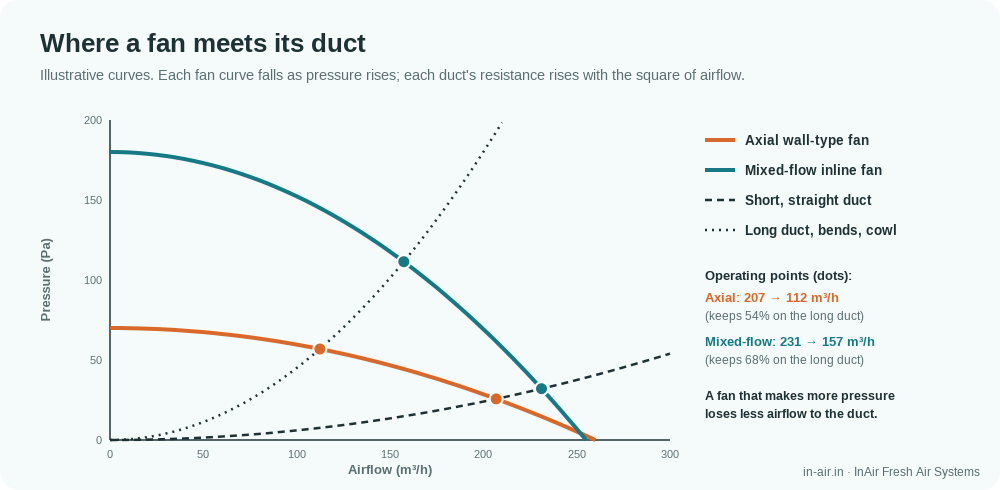
The curves above are illustrative, not from a product. They show the general point: a fan with a steep, low curve, like a propeller fan, loses most of its airflow once the duct gets long. A fan that makes more pressure has a flatter curve over the working range and holds its airflow.
Why ducts reduce airflow
Anything that makes air speed up, turn or rub raises the system curve:
- Length and size. A narrow duct makes air travel faster, and loss rises with the square of the speed. ASHRAE 62.2 lists the smallest duct for each fan airflow, for runs no longer than 8 m with no more than three bends.
- Bends. Each elbow adds loss. One placed right at the fan outlet is worse: the DOE sourcebook says an elbow close to the fan outlet can cut delivered airflow by up to 30%.
- Flexible duct. Its ribbed wall adds friction, and sags add more. ASHRAE requires flexible duct to be fully extended and allows it less airflow than rigid duct of the same size.
- Grilles, mesh, shutters and cowls. Each takes a share of the pressure.
This is why ENERGY STAR requires a certified bathroom fan to deliver at least 70% of its 0.1-inch airflow when tested at 0.25 inch: buyers need to know the fan holds up under real duct pressure. For sizes, see the exhaust fan size guide; for routes and materials, the ventilation duct guide.
Speed: the fan laws
Slow a fan down and its whole curve shrinks. The DOE sourcebook gives the fan laws: airflow changes in step with speed, but power changes with the cube of speed. That is why speed-controlled EC fans save energy; the arithmetic is in exhaust fan power consumption.
Backdraft shutters: stopping air coming back
When the fan stops, wind and the building's own pressure differences can push outdoor air, rain, insects and smells back down the duct. A backdraft shutter or damper prevents this. IS 2312 describes a shutter as something that stops air flowing through the fan when it is not running; it can open automatically under the fan's own air stream or be worked by hand. The DOE defines a backdraft damper the same way: it lets air through in one direction and blocks the reverse.
Gravity shutters are light flaps that the airflow lifts open. They add a little resistance, so a weak fan may only half open them. In a tall building, check that the shutter and the outside terminal suit wind exposure; the wall terminals and cowls guide covers outlets.
Make-up air: why a fan needs a way in
A fan can only remove as much air as can get back into the room. Close every gap and the fan simply makes more pressure and less airflow, and gets noisier. In a bathroom, the replacement air usually comes under the door. The UK's Approved Document F asks for a door undercut equivalent to 10 mm on a standard 760 mm door, or a transfer grille.
For a kitchen hood or a large toilet block, make-up air is planned, not left to chance; InAir's kitchen extraction systems can be paired with make-up air for balanced kitchen pressure. In a home, remember where the make-up air ultimately comes from: outdoors, often unfiltered. That is why an exhaust fan is not a fresh air system; see exhaust fan vs fresh air system.
How InAir checks this at the site survey
- Sets the airflow each room needs from NBC air changes and ASHRAE minimums.
- Measures the duct route, bends and outlet to estimate the pressure the fan must overcome.
- Chooses the impeller type for that pressure: axial for through-wall, mixed-flow or centrifugal for ducted runs.
- Checks the backdraft shutter, outside terminal and the path for make-up air.
- Measures the airflow at commissioning, so the operating point is confirmed, not assumed.
What it costs
InAir bathroom and toilet exhaust fans start from ₹3,300, mixed-flow inline fans from ₹6,600, EC inline duct fans from ₹15,000 and cabinet centrifugal fans from ₹47,400, before GST and installation. See the pricing page.
Tentative pricing: actual prices may vary based on the site survey.
Common myths
- "The fan sucks air out of the room." It creates a small pressure difference; air must be able to flow in for air to flow out.
- "The airflow on the box is what I'll get." Box airflow is usually at zero or low pressure. Through a duct you get the operating point.
- "A bigger propeller fan fixes a long duct." A propeller fan makes little pressure whatever its size; a mixed-flow or centrifugal fan suits ducts.
- "An exhaust fan cools the room." It removes heat and moisture at source, but the replacement air comes from outside at outdoor temperature.
- "A shutter is optional." Without one, outdoor air, insects and smells come back in whenever the fan is off.
Sources
- US Department of Energy, Improving Fan System Performance: A Sourcebook for Industry: fan types, system curves, system effect, fan laws, backdraft dampers.
- Bureau of Indian Standards, IS 2312:1967, Propeller type AC ventilating fans: static pressure, shutters.
- ASHRAE, Addendum u to Standard 62.2-2016: rating pressure and Table 5.3 duct sizing.
- US EPA, ENERGY STAR Ventilation Fans Key Product Criteria: installed fan performance requirement.
- UK Government, Approved Document F, Volume 1 (2021): door undercuts.
- InAir product pages, FY 2026–27 price list.
How does an exhaust fan work in simple words?
What is the difference between an axial and a centrifugal fan?
What is a mixed-flow fan?
Why does my exhaust fan move less air than rated?
Do I need a backdraft shutter on an exhaust fan?
Why is my bathroom exhaust fan noisy but weak?
Our engineers assess your home or building, recommend the right system and the right filter grade for your city, and give you a clear cost estimate. No obligation.