How much fresh air does a home office need?
One person, eight hours, door shut, AC on: what that does to CO₂, what the research on concentration really says, and how to fix it without opening the window.
Last updated:
A closed home office with one person needs about 20–30 m³/h of fresh outdoor air to keep CO₂ near or below 1,000 ppm. With the door and window shut and only the AC running, our calculation puts the room past 1,500 ppm by lunchtime and near 2,000 ppm by evening. Controlled studies have linked such levels to lower decision-making scores, though the evidence is not settled.
Key points
- Fresh air needed: 20–30 m³/h per person (India's National Building Code). About 21 m³/h per person holds a room near 1,000 ppm of CO₂.
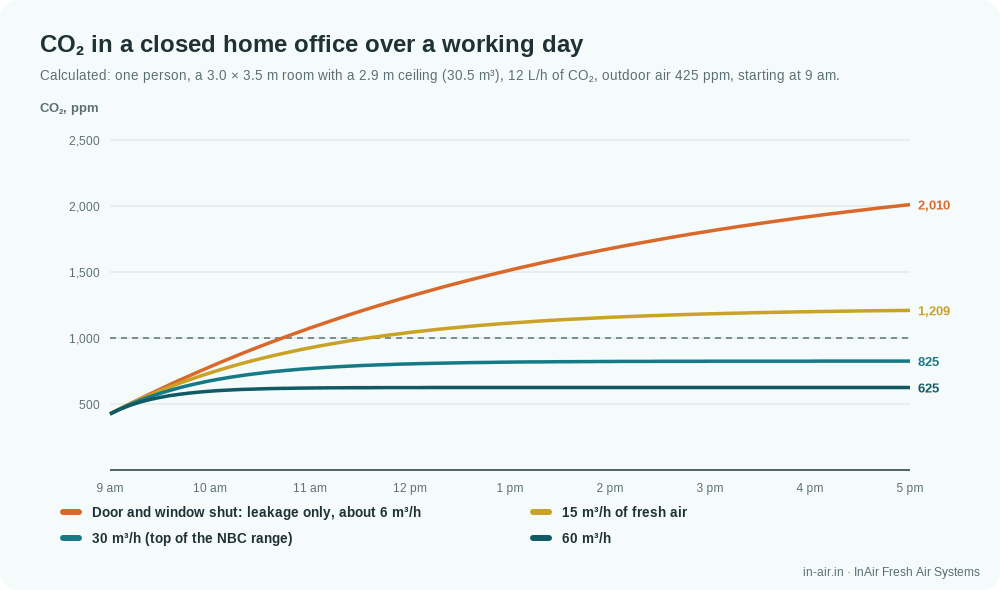
- A sealed 30 m³ study with one person and only leakage reaches about 1,500 ppm in four hours and about 2,000 ppm in eight (calculated).
- Allen et al. (2016, Harvard): cognitive scores were 15% lower at about 945 ppm and 50% lower at about 1,400 ppm than at about 550 ppm.
- Other studies disagree on CO₂ itself. ASHRAE says the evidence for direct effects at common indoor levels is inconsistent; CO₂ is best read as a sign of how much fresh air the room gets.
- InAir's IAQ sensor does not measure CO₂. To check your room, use a separate NDIR CO₂ monitor.
How fast does CO₂ build up in a home office?
A home office is usually the smallest room in use for the longest time with the door shut: one person, eight hours, AC on, window closed against noise and heat. A resting adult breathes out about 12 litres of CO₂ an hour; seated work is a little higher. Outdoor air carries about 425 ppm. With those numbers and a typical 3.0 × 3.5 m study, here is how the day goes:
| Fresh air into the room | CO₂ at 11 am, ppm | CO₂ at 1 pm, ppm | CO₂ at 5 pm, ppm |
|---|---|---|---|
| 6 m³/h | 1,076 | 1,514 | 2,010 |
| 15 m³/h | 926 | 1,113 | 1,209 |
| 30 m³/h | 769 | 817 | 825 |
| 60 m³/h | 621 | 625 | 625 |
The level a room settles at depends on fresh air per person, not on room size. A bigger study only takes longer to get there. For one person, the National Building Code's 20–30 m³/h keeps the room roughly between 825 and 1,025 ppm. Add a second person, or a client on a sofa, and the airflow should double. The CO₂ calculator works for any room, and CO₂ levels explained covers what each level means.
Does CO₂ really affect concentration?
This is where you will read the most confident claims online, so here are the main studies and what they actually measured.
| Study | What was tested | What they found |
|---|---|---|
| Satish et al. 2012, Environmental Health Perspectives | 22 people, 2.5-hour sessions at 600, 1,000 and 2,500 ppm; pure CO₂ added, ventilation constant | At 1,000 ppm, moderate drops on 6 of 9 decision-making scales; at 2,500 ppm, large drops on 7. One scale, focused activity, went up. Authors asked for confirmation. |
| Allen et al. 2016, Environmental Health Perspectives (Harvard COGfx) | 24 office workers over 6 full work days, blinded; ventilation, CO₂ and VOCs varied | Scores 61% higher in low-VOC air and 101% higher with high ventilation than in conventional conditions. With CO₂ added, 15% lower at about 945 ppm and 50% lower at about 1,400 ppm. |
| Zhang, Wargocki et al. 2017, Indoor Air | 25 people, 255 minutes per condition; pure CO₂ added vs CO₂ from people with low ventilation, up to 3,000 ppm | No significant effect from pure CO₂. Stale air from people at 3,000 ppm caused more headache, fatigue and sleepiness and slower performance on some tests. |
| ASHRAE position (brief updated June 2026) | Review of the evidence | Evidence for direct effects of CO₂ on health, learning and work at common indoor levels is inconsistent. CO₂ is useful for checking whether ventilation is working. |
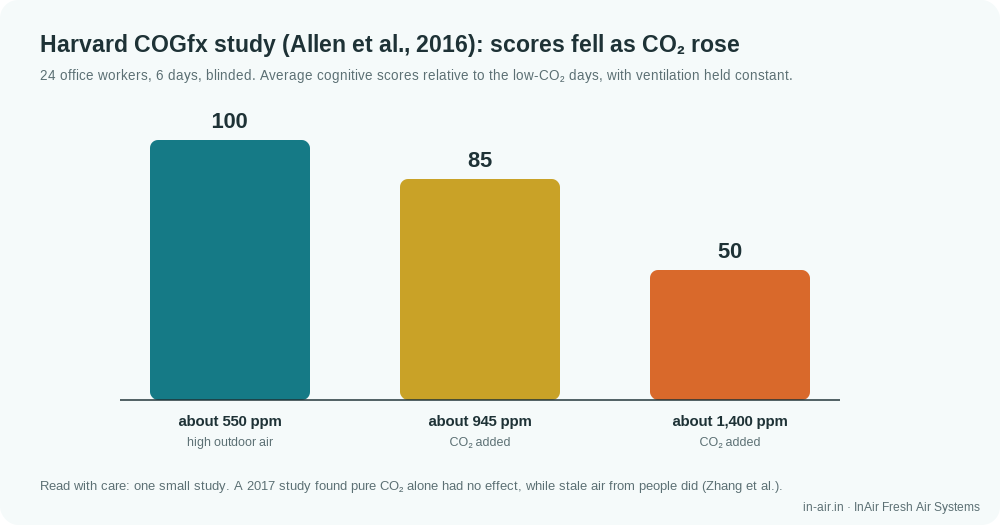
Put together, the safest reading is this. Whether the cause is CO₂ itself or the other things people give off, a room that gets little fresh air during a long working day is the condition all these studies point away from. Bringing in more outdoor air fixes both, and CO₂ is the cheapest way to see whether you have enough.
What InAir's home office case study shows
InAir's home office CO₂ case study is a design analysis, not a measured project. It estimates that a closed, air-conditioned home office with one person can reach 1,500–2,500 ppm by the afternoon, sets out the Harvard and Satish findings above, and sizes a Revita INA-MFQR-250 (250 m³/h, 37 dB at full flow, mounted in the ceiling away from the desk) for a 2 BHK that includes the study. Its design target is to keep the room below about 800 ppm all day without opening windows. Your own figures will differ; that is what the site survey is for.
Other things that matter in a home office
- Noise on calls. The WHO's daytime guideline inside homes is 35 dB(A) for speech intelligibility. A fan you notice on a call is a fan you will turn off. Ask to hear a unit on the speed it will run during work hours.
- Outdoor dust and smog. Opening the window lets in unfiltered PM2.5; in winter 2024–25 the average in Delhi was 175 µg/m³ (CSE). Filtered fresh air avoids that trade-off.
- Heat and humidity. Outdoor air in summer and the monsoon is hot and humid. An ERV passes heat and moisture between the outgoing and incoming air, so the AC works less hard than with an open window or a supply fan.
- Measuring it. ASHRAE stresses that CO₂ sensor accuracy, location and calibration matter. Put an NDIR monitor at desk height, away from your breath and the supply grille.
Which InAir units suit a home office?
| Wall-mounted ERV INA-WERVG20-150CMH | Revita ducted ERV | |
|---|---|---|
| Serves | One room or zone of 250–350 sq ft; the spec sheet lists a study among suitable rooms | The whole home including the study; INA-MFQR-250 suits a 2 BHK of 1,000–1,400 sq ft |
| Airflow | Up to 150 m³/h | 250 / 180 / 160 m³/h for INA-MFQR-250 |
| Energy recovery | 3D enthalpy core rated at 92% | 89–90% heat recovery (tested) |
| Noise (spec sheet) | 35 dB | 37 dB(A) at full flow for INA-MFQR-250 |
| Filters | Three-stage plus charcoal | Pre-filter and MERV-13; HEPA-13 optional |
| Installation | Core-cut through an outside wall; no ducts | Above a false ceiling with ducts |
For a study in a finished flat, the wall unit adds fresh air to that one room. If you are renovating, one ducted Revita covers the study and the bedrooms. See the INA-WERVG20-150CMH and INA-MFQR-250 spec sheets, or size a whole home with the ERV sizing calculator.
How InAir checks this at the site survey
- How many people use the office, for how many hours, and whether clients or colleagues visit.
- CO₂ in the room through a working session with the door and window shut, using a CO₂ monitor.
- Your city's PM2.5 and humidity, to choose the filter and check the AC load.
- Whether a wall unit can go on an outside wall away from the desk, or the study can join a ducted system.
- The fan speed the room needs during work hours and how that sounds during a call.
What it costs
InAir's wall-mounted ERV starts from ₹1.4 lakh per unit. A Revita ducted ERV for a 1–2 BHK starts from ₹2.1 lakh. Prices are for equipment before GST; installation and ducting are quoted after the survey. See the price guide.
Tentative pricing: actual prices may vary based on the site survey.
Common mistakes and myths
- "An air purifier will fix the afternoon slump." A purifier removes particles; it does not change CO₂. Only outdoor air does.
- "The AC brings in fresh air." A split AC recirculates room air. See do I need fresh air if I have AC.
- "Below 1,000 ppm means the air is good." ASHRAE says CO₂ is not an overall measure of air quality; dust and VOCs need checking too.
- Trusting a cheap "CO₂" reading from a sensor that only estimates it from VOCs. Look for NDIR.
- Sizing for one person when two people now work from the same room.
Sources
- Allen JG, MacNaughton P, Satish U, Santanam S, Vallarino J, Spengler JD. Associations of cognitive function scores with carbon dioxide, ventilation, and volatile organic compound exposures in office workers. Environ Health Perspect 2016;124:805–812. doi.org/10.1289/ehp.1510037
- Satish U et al. Is CO₂ an indoor pollutant? Direct effects of low-to-moderate CO₂ concentrations on human decision-making performance. Environ Health Perspect 2012;120:1671–1677. doi.org/10.1289/ehp.1104789
- Zhang X, Wargocki P, Lian Z, Thyregod C. Effects of exposure to carbon dioxide and bioeffluents on perceived air quality, self-assessed acute health symptoms, and cognitive performance. Indoor Air 2017. doi.org/10.1111/ina.12284
- ASHRAE Government Affairs brief, Indoor Carbon Dioxide, Ventilation and Indoor Air Quality (updated June 2026). ashrae.org
- WHO Guidelines for Community Noise (1999), Table 1. who.int
- Bureau of Indian Standards, National Building Code of India, Part 8 Section 1, clause 5.2.2 (SP 7:2005 Group 4). archive.org
- Centre for Science and Environment, winter 2024–25 air pollution analysis for six megacities. cseindia.org
How much fresh air does a home office need?
Does high CO₂ make you tired and less focused at work?
How high does CO₂ get in a closed home office?
Will an air purifier lower CO₂ in my study?
How do I measure CO₂ in my home office?
What does a fresh air unit for a home office cost?
Our engineers assess your home or building, recommend the right system and the right filter grade for your city, and give you a clear cost estimate. No obligation.