Which fresh air machine is best for a bedroom?
Supply-only fan or ERV, how many m³/h per person, how quiet it must be at the pillow, which filter, and which InAir units suit one bedroom or every bedroom.
Last updated:
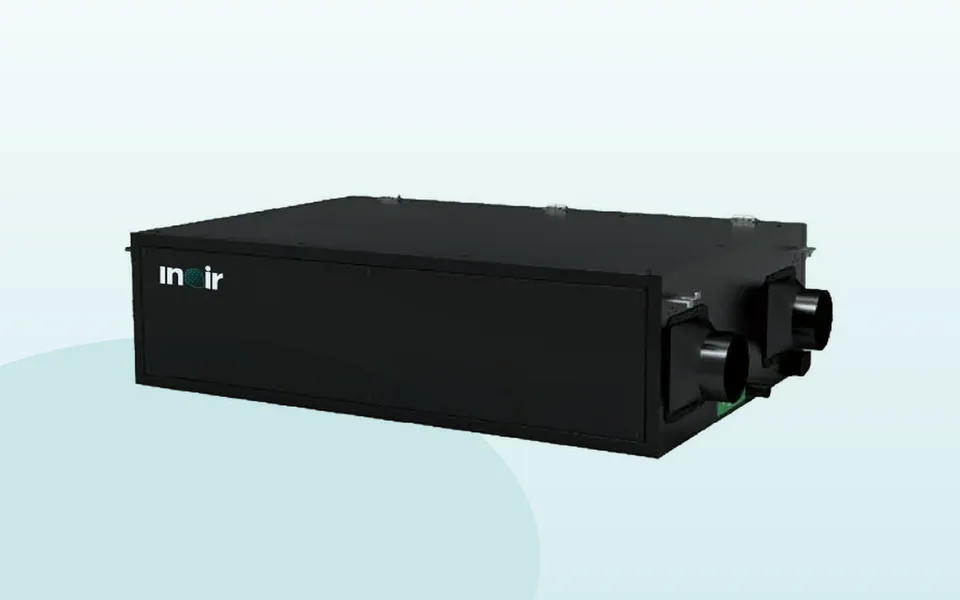
For a bedroom, choose a balanced fresh air machine, an ERV (energy recovery ventilator), that supplies about 20–30 m³/h of filtered outdoor air per person and runs quietly enough for the room to stay near 30 dB(A) at night. For a couple that means 40–60 m³/h. A supply-only or exhaust-only fan moves air, but with no heat recovery and less control over where the air comes from.
Key points
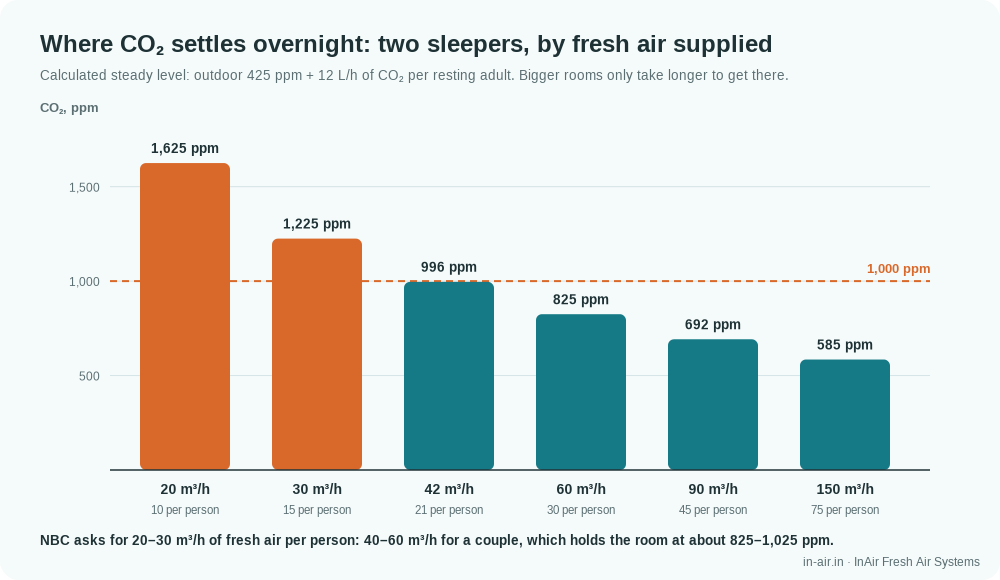
- India's National Building Code asks for 20–30 m³/h of fresh air per person. On CO₂ arithmetic, about 21 m³/h per person holds a room near 1,000 ppm.
- Supply-only fans push air in, exhaust fans pull air out. A balanced ERV does both through one core, so the AC does not have to cool and dry all the incoming air from scratch.
- Noise: the WHO guideline for continuous noise inside a bedroom at night is 30 dB(A), with single events kept below 45 dB(A). UK guidance uses the same 30 dB for ventilation in bedrooms.
- Filter: MERV-13 catches at least 85% of 1–3 µm particles; HEPA H13 at least 99.95% at the most penetrating size. Delhi-level winter smog needs more than a mesh.
- InAir options: the wall-mounted INA-WERVG20-150CMH for one finished room, or a ducted Revita ERV that feeds every bedroom from one unit.
What counts as a fresh air machine?
A fresh air machine brings outdoor air into a closed room. That is different from the two machines most bedrooms already have. A split AC recirculates the same room air; it cools it but adds no outdoor air. An air purifier also recirculates; it removes particles but cannot lower CO₂, because CO₂ is a gas that only fresh air dilutes. See air purifier or fresh air system for the longer comparison.
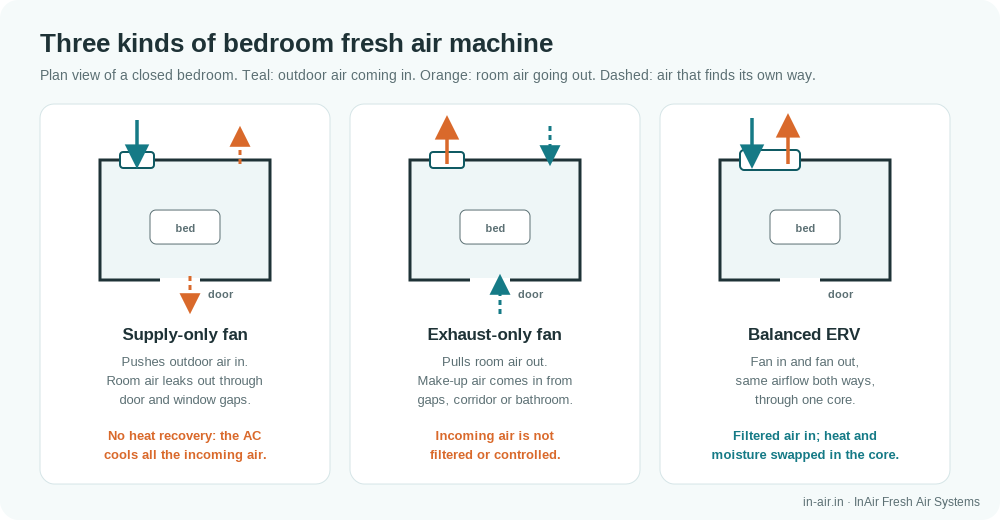
So the real question for a bedroom is how the outdoor air gets in, how much of it, how clean, and how loud the machine is while you sleep. There are three basic designs.
Supply-only, exhaust-only or balanced: which type?
| Type | How it works | What to watch |
|---|---|---|
| Supply-only (positive pressure) fan | A fan, often with a filter, blows outdoor air into the room. Room air is pushed out through gaps. | No heat or moisture recovery. In summer and the monsoon the AC must cool and dry every cubic metre of incoming air. |
| Exhaust-only fan | A fan pulls room air out. Replacement air is sucked in from wherever it can get in. | The incoming air is unfiltered and may come from the bathroom, corridor or a dusty window gap. |
| Balanced ERV | Two fans, one in and one out, at about the same airflow. The two streams pass through a core that transfers heat and moisture. | Needs a core-cut through an outside wall (wall-mounted) or ceiling space for ducts (ducted). Filters need cleaning. |
| AC "fresh air mode" | Some split ACs have a small fresh air tube. | Check the published airflow. See AC fresh air mode vs ERV. |
For a bedroom with the AC on, the balanced ERV is the type that suits Indian homes best. The air coming in is filtered, and the core passes heat and moisture from the incoming stream to the outgoing one, so warm, humid air arrives closer to room conditions. Our how an ERV works guide explains the core.
How much fresh air does a bedroom need?
Size the machine for people, not floor area. CO₂ from breathing is the simplest measure of whether a closed room gets enough fresh air: a resting adult breathes out about 12 litres of CO₂ an hour, and outdoor air carries about 425 ppm. From those two numbers, about 21 m³/h of fresh air per person holds the room near 1,000 ppm.
| Guideline | Per person | Couple (2 people) |
|---|---|---|
| NBC 2016 (India) | 20–30 m³/h per person | 40–60 m³/h |
| CO₂ arithmetic, about 1,000 ppm | about 21 m³/h per person | about 42 m³/h |
| ASHRAE 62.2 people part (US homes) | 7.5 cfm, about 13 m³/h per person, plus a floor-area part for the whole home | about 26 m³/h plus the area part |
Does it matter for sleep? The evidence is small but consistent. In a Danish dormitory study by Strøm-Tejsen and colleagues (2016), rooms averaged 2,395 ppm with the ventilation fan off and 835 ppm with it on; at the lower level, measured sleep quality, next-day sleepiness and a logical-thinking test all improved. A 2023 study in 29 real bedrooms by Fan and colleagues found less deep sleep at lower ventilation rates, though no difference in cognitive tests. Our bedroom CO₂ and sleep article covers these studies, and the bedroom CO₂ calculator works out your own room.
A machine rated at 150 m³/h for one bedroom of two people is generous on airflow. That is useful: you can run it on a low, quiet speed and still meet the per-person rate.
How quiet does it need to be at the pillow?
The WHO Guidelines for Community Noise (1999) set 30 dB(A) as the average level inside a bedroom at night, and 45 dB(A) for single noise events, to protect sleep. The same 30 dB(A) applies to children's bedrooms in pre-schools. The UK's Approved Document F (2021) uses 30 dB for bedrooms when a continuous ventilation system runs at its low rate.
That 30 dB(A) is the level in the room from everything, not the number printed on a machine. A spec sheet figure depends on fan speed and distance, and many sheets do not state the distance. Two things decide what you hear in bed:
- Where the fan is. A wall-mounted ERV sits inside the bedroom. A ducted ERV sits above a false ceiling, usually over a passage or bathroom, and only a grille is in the bedroom.
- What speed it runs at. A unit sized with spare airflow can run on low at night. The Revita INA-MFQR-150, for example, has 150, 120 and 80 m³/h settings; 80 m³/h is still 40 m³/h per person for a couple.
InAir's spec sheets give 35 dB for the wall-mounted INA-WERVG20-150CMH and 35 dB(A) at full flow for the Revita INA-MFQR-150. Ask to hear any unit at its night speed before you buy. Our quiet ventilation guide explains dB(A), sones and why the room level differs from the rating.
Which filter does a bedroom need?
Outdoor air in many Indian cities is not clean enough to bring in unfiltered. In winter 2024–25, average PM2.5 was 175 µg/m³ in Delhi, 65 in Kolkata, 52 in Hyderabad, 50 in Mumbai and 37 in Bengaluru (CSE analysis of CPCB data). The WHO 24-hour guideline is 15 µg/m³.
| Filter grade | What the test standard requires | Suits |
|---|---|---|
| Mesh or coarse pre-filter | Catches insects, lint and coarse dust | Protecting the core; not enough on its own |
| MERV-13 (ASHRAE 52.2) | At least 85% of particles of 1–3 µm | Most cities for most of the year |
| HEPA H13 (EN 1822) | At least 99.95% at the most penetrating particle size | Delhi NCR winters, homes with someone sensitive to smoke or dust |
InAir's Revita ERVs come with a pre-filter and MERV-13, with HEPA-13 as an option. The wall-mounted unit has three-stage filtration plus a charcoal filter. A filter only works while it is clean, so plan for checks every few months; see ERV maintenance and the filter grades guide.
Which InAir units fit a bedroom?
InAir has two ways to ventilate a bedroom. The figures below are taken from InAir's published spec sheets.
| Wall-mounted ERV INA-WERVG20-150CMH | Revita INA-MFQR-150 (ducted) | |
|---|---|---|
| Serves | One room or zone of 250–350 sq ft | A whole 1 BHK of 600–800 sq ft with 2 people; larger Revita models for bigger homes |
| Airflow | Up to 150 m³/h | 150 / 120 / 80 m³/h (high / mid / low) |
| Energy recovery | 3D enthalpy core rated at 92% | Plate core, 89–90% heat recovery (tested) |
| Noise (spec sheet) | 35 dB | 35 dB(A) at full flow |
| Filters | Three-stage plus charcoal | Pre-filter and MERV-13; HEPA-13 optional |
| Controls | Auto bypass, humidity control | Standard; smart control optional |
| Installation | Core-cut through an outside wall; no ducts | Above a false ceiling with ducts to each room |
| Best for | A finished home where only one or two rooms need fresh air | New homes or renovations; every bedroom from one unit |
If two or three bedrooms need fresh air, one ducted unit is usually neater than several wall units, and the fan sits outside the bedroom. If you live in a finished flat and want fresh air in the master bedroom only, the wall unit avoids a false ceiling. Specs: INA-WERVG20-150CMH, INA-MFQR-150, and the full Revita range. The wall-mounted ERV guide compares the wall units in more detail.
Humidity in an AC bedroom
The US EPA advises keeping indoor humidity below 60%, ideally 30–50%. In coastal cities and during the monsoon, outdoor air is often far more humid than that. An ERV's enthalpy core passes part of the moisture from the incoming air to the outgoing air, which a supply-only fan cannot do. It does not replace a dehumidifier in very humid rooms, and InAir checks this for your city at the survey.
How InAir checks this at the site survey
- How many people sleep in each bedroom, and which rooms are used at night, to set the airflow.
- Whether the home has a false ceiling or space for one, or whether a wall unit suits better.
- Which outside walls are available for a core-cut, and what is on the other side.
- Your city's winter PM2.5 and monsoon humidity, to choose MERV-13 or HEPA-13.
- Where the unit and grilles can go so the fan is away from the bed, and what speed it will run at night.
- CO₂, humidity and noise readings in the bedroom with the door and windows shut, before and after.
What it costs
InAir's wall-mounted ERV starts from ₹1.4 lakh per unit. A Revita ducted ERV for a 1–2 BHK starts from ₹2.1 lakh, and for a 3–4 BHK from ₹2.6 lakh. These are equipment prices before GST; installation, ducting and site work are quoted after the survey. See the price guide.
Tentative pricing: actual prices may vary based on the site survey.
Common mistakes
- Buying an air purifier and expecting it to fix a stuffy, high-CO₂ bedroom.
- Fitting an exhaust fan in the bedroom wall and assuming the air it pulls in is fresh.
- Choosing a unit by its maximum airflow, then running it flat out every night because nothing smaller would do.
- Reading the dB figure on the box as the level at the pillow.
- Skipping the filter grade question in a high-PM2.5 city.
- Expecting InAir's IAQ sensor to show CO₂. It measures PM2.5, temperature, humidity and VOCs; for CO₂, use a separate NDIR CO₂ monitor.
Sources
- Bureau of Indian Standards, National Building Code of India, Part 8 Section 1, clause 5.2.2: 20–30 m³ of fresh air per person per hour (2005 text, SP 7:2005 Group 4; carried into NBC 2016). archive.org
- Strøm-Tejsen P, Zukowska D, Wargocki P, Wyon DP. The effects of bedroom air quality on sleep and next-day performance. Indoor Air 2016. doi.org/10.1111/ina.12254
- Fan X et al. A single-blind field intervention study of whether increased bedroom ventilation improves sleep quality. Science of the Total Environment 2023. doi.org/10.1016/j.scitotenv.2023.163805
- WHO. Guidelines for Community Noise (1999), Table 1. who.int
- UK Approved Document F, Volume 1 (2021), clause 1.7 note on ventilator noise. gov.uk
- ASHRAE 62.2-2022 Addendum e: whole-house ventilation rate. ashrae.org
- Centre for Science and Environment, winter 2024–25 air pollution analysis for six megacities. cseindia.org
- US EPA, A brief guide to mold, moisture and your home. epa.gov
Which fresh air machine is best for a bedroom?
How many m³/h of fresh air does a bedroom need?
Is a fresh air machine noisy at night?
Can I use an air purifier instead of a fresh air machine?
Is a wall-mounted ERV or a ducted ERV better for a bedroom?
What does a bedroom fresh air machine cost in India?
Our engineers assess your home or building, recommend the right system and the right filter grade for your city, and give you a clear cost estimate. No obligation.