How IAQ sensors control fresh air (demand-controlled ventilation)
Sensors let a fresh air system match the air to the room: more when it is full or smoky, less when it is empty. Here is which sensor does what, and what the standards require.
Last updated:
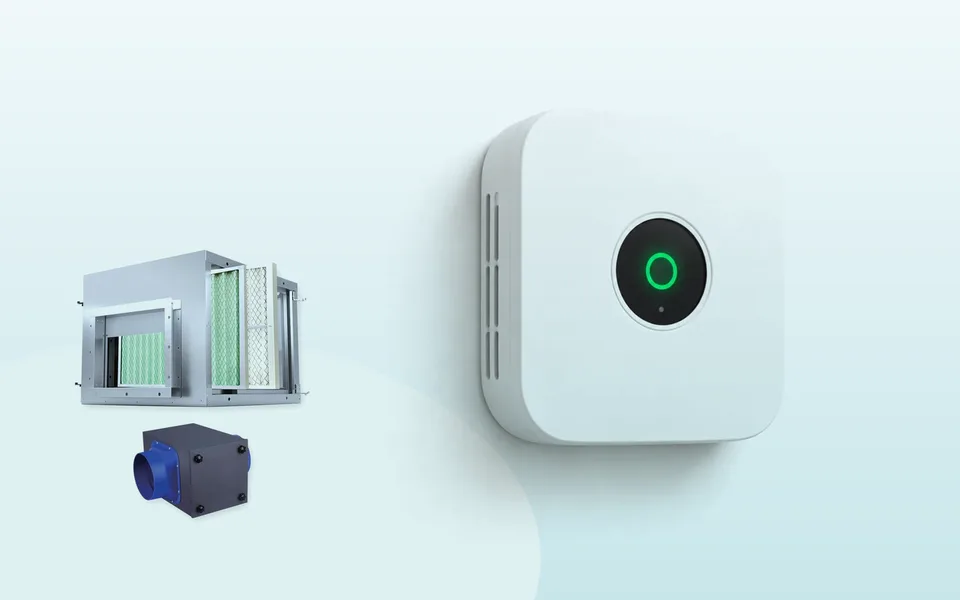
IAQ sensors control fresh air by measuring the room and changing the fan speed or a damper to match. CO₂ tells the system how many people are breathing in the room; PM2.5, VOC and humidity sensors catch smoke, cooking, cleaning and monsoon damp. This is demand-controlled ventilation (DCV): enough air when a room is full, less when it is empty.
Key points
- Four sensors matter: CO₂ (by NDIR, for occupancy), PM2.5 (laser particle counting), VOC (a gas sensor that reacts to many chemicals) and relative humidity.
- InAir's IAQ sensor (INA-SENSOR) measures PM2.5, temperature, humidity and VOC, with Wi-Fi and an Android and iOS app. It does not measure CO₂. For CO₂-based control, add a separate NDIR CO₂ sensor.
- ASHRAE 62.1 permits DCV, but the area part of the ventilation rate (Ra × Az) must always be supplied, and the system must deliver the full design airflow once CO₂ reaches the set point.
- Since Addendum ab (2023), CO₂ sensors used for DCV under 62.1 must be certified accurate to ±75 ppm and need calibration no more than once every five years.
- The energy saving comes from not conditioning outdoor air for empty seats. In our worked example, a 20-seat meeting room with 6 people needs 126 m³/h less outdoor air than at full design.
Which sensors control fresh air, and what each one sees
| Sensor | How it works | What it tells the system | Watch out for |
|---|---|---|---|
| CO₂ | NDIR: infrared light absorbed by CO₂ in a small chamber | How many people are in the room and how well it is ventilated | Needs a certified accuracy; does not see smoke, dust or chemicals |
| PM2.5 | Laser light scattered by particles, counted and converted to µg/m³ | Smoke, smog, cooking and construction dust | Raw readings can read high, especially in humid air |
| VOC / TVOC | Usually a heated metal-oxide surface whose resistance changes with gases | Cooking, cleaning, paint, new furniture, odours | Often a relative index, not a concentration |
| Relative humidity | Capacitive film that absorbs water vapour | Monsoon damp and bathroom or kitchen moisture | Needs a sensible set point, not just 'as low as possible' |
| Occupancy | Motion or presence detector | Whether anyone is there at all | Says nothing about how many people |
CO₂: the occupancy signal
People breathe out CO₂ at a steady rate, about 12 litres an hour for a resting adult, so a room's CO₂ rise above outdoor air shows how many people are in it and how much fresh air they get. About 21 m³/h of outdoor air per person holds a room near 1,000 ppm. ASHRAE's position document on indoor CO₂ (approved 2025) says CO₂ has long been used this way to control outdoor air, and that DCV is required by some energy standards such as ASHRAE 90.1. It also warns that CO₂ is not an overall measure of indoor air quality. For more, see CO₂ levels explained.
For DCV, ASHRAE 62.1 (Addendum ab to the 2022 edition) asks for CO₂ sensors certified by the maker to be accurate within ±75 ppm at 600 and 1,000 ppm, factory calibrated and needing calibration no more than once every five years. Sensors go 0.9–1.8 m above the floor, at least one per ventilation zone, and if a sensor fails the system must go back to full design airflow. Use those as the checklist when you buy a CO₂ sensor for control.
PM2.5: smoke and smog
Laser PM sensors are good at showing when particles rise and fall, less good at exact numbers. A US EPA study of almost 12,000 daily readings from one popular low-cost laser sensor found the raw data overestimated PM2.5 by about 40% in most of the US, and that adding a humidity term to the correction improved it. In a fresh air system, a PM spike indoors often means cooking or smoke inside, or a filter that needs attention. Outdoors it means the filter grade matters more than the airflow.
VOC: chemicals and smells
Most compact VOC sensors are metal-oxide types. The datasheet guide for one widely used module explains that it cannot detect absolute VOC concentration; it reports a VOC index relative to the room's own average over the last 24 hours. That is useful for control, because it flags a sudden rise from cooking or cleaning, but it is not a formaldehyde meter. Our guide to VOCs and formaldehyde in Indian homes covers what to do about chemical sources. A 2022 review of CO₂-based DCV in Building and Environment found that DCV affects VOC levels more than particles or ozone, and pointed to combining CO₂ and VOC sensors as a promising direction.
Humidity: the Indian monsoon signal
The US EPA advises keeping indoor humidity below 60%, ideally 30–50%. In the monsoon, bringing in more outdoor air can raise indoor humidity unless it is dried. So a humidity reading is used two ways: to boost extract from wet rooms, and to tell a heat pump ERV or dehumidifier to work harder, rather than simply pushing in more humid air.
What InAir's IAQ sensor measures
InAir's IAQ sensors and smart controls come in two versions. The INA-SENSOR measures PM2.5 by laser particle counting, temperature, humidity and VOC, with Wi-Fi and an Android and iOS app. The INA-THE-SENSOR adds a thermostat controller that holds 22–28 °C, and it is required for InAir's heat pump ERV (RHP) units. Neither lists CO₂ among its measurements. Both can be integrated with motorised dampers and building management systems for room-level or zone-level control, as in InAir's Bloomingdale International School project.
If you want airflow to follow the number of people, the CO₂ signal has to come from a separate NDIR CO₂ sensor, chosen to the ±75 ppm accuracy above and wired to the same controller or BMS. InAir confirms the sensor set for your system at the survey.
How the control logic works
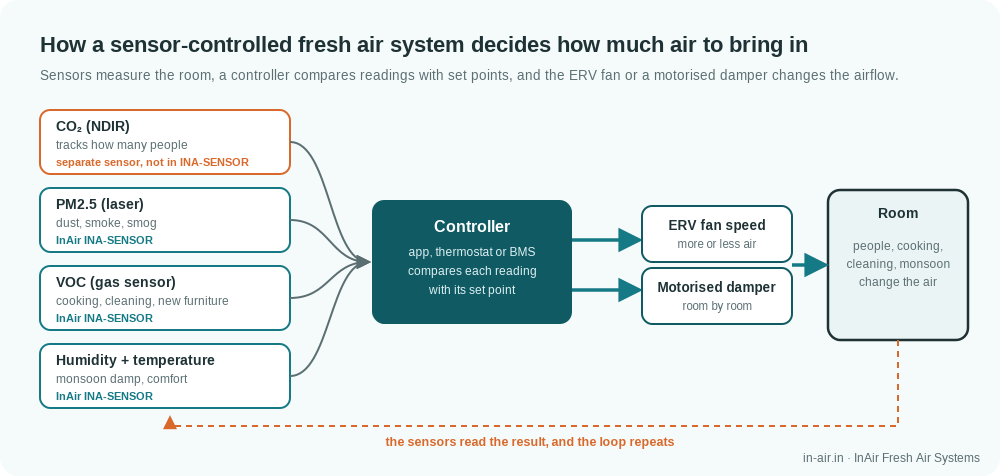
The controller compares each reading with a set point and moves the fan or damper. Typical responses:
- CO₂ rising: more outdoor air, in proportion to the rise. ASHRAE 62.1 now spells this out: at outdoor CO₂ the zone gets its area minimum, and when it reaches outdoor level plus the table's ΔC, it gets full design airflow.
- VOC spike from cooking or cleaning: a boost or purge to flush the space, as InAir's product page describes.
- Indoor PM2.5 rising: keep air moving through the filter; if the outdoor air is the problem, the filter grade, not the fan speed, is the fix.
- Humidity high: boost bathroom and kitchen extract; in a humid spell, call for dehumidification.
- Room empty: drop to the minimum, never to zero for spaces that need a floor rate.
In a home, the simplest useful setup is a steady minimum flow all day, with boosts triggered by the sensors. In offices, schools and meeting rooms, where occupancy swings widely, DCV earns most.
ASHRAE 62.1 DCV basics, checked against the standard
ASHRAE 62.1 sets outdoor air in the breathing zone as a people part plus an area part: Vbz = Rp × Pz + Ra × Az. Section 6.2.6.1 permits DCV as an optional way to reset this as occupancy changes. Three rules matter to a buyer:
- The airflow must follow the current number of people, and may not fall below what the actual population needs, averaged over no more than an hour.
- It may never drop below the building component, Ra × Az, while the space is in occupied mode.
- Table 6-1 now gives a maximum CO₂ above ambient (ΔC) for each space type, rounded to the nearest 300 ppm. ASHRAE states these are only for running CO₂ DCV and are not indoor air quality indicators. Outdoor CO₂ may be taken as 400 ppm or measured near the intake.
| Space (ASHRAE 62.1 Table 6-1) | Per person, Rp | Per floor area, Ra | Default density | Max CO₂ above outdoor, ΔC |
|---|---|---|---|---|
| Office space | 2.5 L/s (9 m³/h) | 0.3 L/s per m² (1.08 m³/h per m²) | 5 per 100 m² | 600 ppm |
| Conference / meeting room | 2.5 L/s (9 m³/h) | 0.3 L/s per m² (1.08 m³/h per m²) | 50 per 100 m² | 1,500 ppm |
| Classroom (age 9 plus) | 5 L/s (18 m³/h) | 0.6 L/s per m² (2.16 m³/h per m²) | 35 per 100 m² | 600 ppm |
| Lecture classroom | 3.8 L/s (14 m³/h) | 0.3 L/s per m² (1.08 m³/h per m²) | 65 per 100 m² | 1,200 ppm |
| Bedroom / living room | 2.5 L/s (9 m³/h) | 0.3 L/s per m² (1.08 m³/h per m²) | 10 per 100 m² | 600 ppm |
Some spaces are marked NA, meaning CO₂ DCV may not be used, such as laboratories and health care spaces. India's National Building Code gives 20–30 m³/h of fresh air per person. Size the base airflow with the ERV sizing calculator.
The energy angle, with the numbers shown
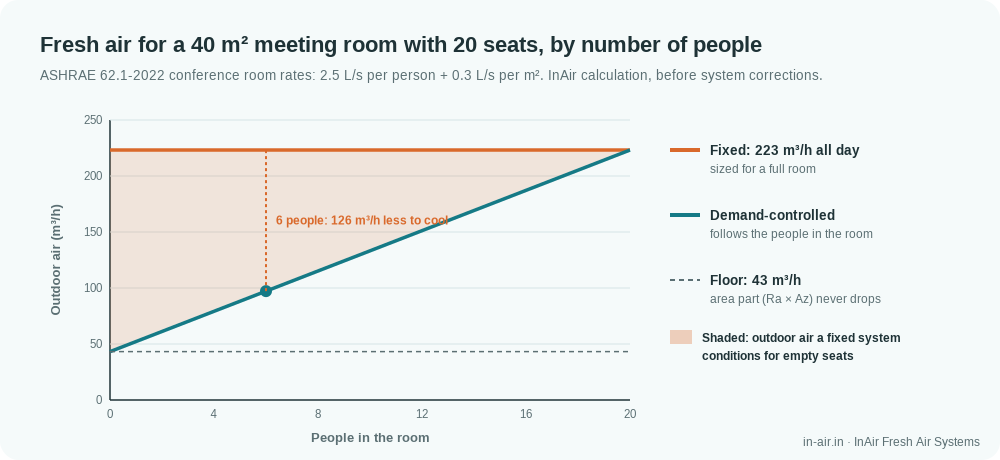
Take a 40 m² meeting room with 20 seats. Using the 62.1 conference room rates, full design is 223 m³/h of outdoor air and the empty-room floor is 43 m³/h. InAir's analysis of ERA5 weather data, used in our home ventilation guide, puts the load from untreated outdoor air at about 0.88 kW of moisture per 100 m³/h on an average June day in Mumbai, and 0.48 kW of heat per 100 m³/h on an average May afternoon in Delhi.
| People in room | Outdoor air needed | Less than fixed design | Moisture load avoided, Mumbai June | Heat load avoided, Delhi May | Ideal fan power vs full |
|---|---|---|---|---|---|
| 0 people | 43 m³/h | 180 m³/h | 1.58 kW | 0.86 kW | 1% |
| 6 people | 97 m³/h | 126 m³/h | 1.11 kW | 0.60 kW | 8% |
| 12 people | 151 m³/h | 72 m³/h | 0.63 kW | 0.35 kW | 31% |
| 20 people | 223 m³/h | 0 m³/h | 0.00 kW | 0.00 kW | 100% |
So with 6 people, DCV avoids conditioning about 126 m³/h, roughly 1.1 kW of moisture load on a monsoon day in Mumbai. The fan saves too: the US Department of Energy's fan sourcebook notes that airflow is linear with fan speed but power follows the cube of speed, so in the ideal case a fan at 44% of full flow draws under a tenth of full power. The same sourcebook notes that motor efficiency falls significantly when a motor runs below half its rating, so real savings are smaller than the ideal. These are worked figures, not measured results, and how much of the day a room is part-empty decides the yearly saving.
An ERV changes the picture. InAir's Revita and Ventura ERVs recover 89–90% of the heat or cooling in the outgoing air (tested), so each cubic metre of outdoor air already costs far less to condition. With an ERV, DCV's cooling saving shrinks, and the fan saving and the better match of air to people matter more.
How InAir checks this at the site survey
- How occupancy varies in each room across the day, which decides whether DCV is worth it or a steady flow with boosts is enough.
- Which rooms need their own sensor and damper, and which can share a zone.
- Where CO₂ sensing is needed, and how a separate NDIR CO₂ sensor will connect to the ERV controller, app or BMS.
- Where to mount sensors: in the occupied zone, away from supply grilles, windows and the kitchen hob.
- The ERV's minimum and maximum airflow, and whether its fan can turn down smoothly.
- Readings before and after commissioning, so you can see the control working.
What it costs
InAir's indoor air quality sensor (PM2.5, temperature, humidity and VOC, with Wi-Fi app) and thermostat controller start from ₹53,100. EC inline duct fans with speed or smart control start from ₹15,000, and a Revita ERV for a 1–2 BHK home from ₹2.1 lakh, all before GST and installation. Motorised dampers, CO₂ sensors and BMS work are quoted after a free site survey. See the price guide.
Tentative pricing: actual prices may vary based on the site survey.
Common mistakes and myths
- "ASHRAE says 1,000 ppm." The ASHRAE position document says 62.1 does not give an indoor CO₂ limit, and that the 1,000 ppm figure is a widespread misreading.
- Using a VOC index to estimate occupancy. It reacts to cooking, perfume and cleaners too. Use CO₂ for people.
- Assuming any air quality sensor measures CO₂. Check the spec. InAir's sensor reads PM2.5, temperature, humidity and VOC.
- Mounting the sensor next to a supply grille. It reads the fresh air, not the room, and the system starves the occupants.
- Letting DCV go to zero. The area part of the airflow still has to be met in an occupied space.
- Boosting fresh air on high outdoor PM2.5 with a weak filter. Fix the filter grade first; see choosing an air quality monitor for reading the numbers.
For the bigger picture of DCV in Indian buildings, read demand-controlled ventilation in India.
Sources
- ANSI/ASHRAE Addendum ab to Standard 62.1-2022 (October 2023): Section 6.2.6.1 DCV and revised Table 6-1. ashrae.org (PDF)
- ASHRAE Position Document on Indoor Carbon Dioxide (2022, reaffirmed 2025). ashrae.org (PDF)
- Lu X. et al. (2022). The nexus of the indoor CO₂ concentration and ventilation demands underlying CO₂-based DCV in commercial buildings: a critical review. Building and Environment 218:109116. par.nsf.gov
- Barkjohn KK, Gantt B, Clements AL (2021). A US-wide correction for PM2.5 data from the PurpleAir sensor. Atmos. Meas. Tech. 14:4617–4637. doi.org
- Sensirion, SGP40 VOC Index for Experts (application note). sensirion (PDF)
- US Department of Energy, Improving Fan System Performance: A Sourcebook for Industry. energy.gov (PDF)
- US EPA, A Brief Guide to Mold, Moisture and Your Home (humidity guidance). epa.gov
- InAir IAQ sensors and smart controls product page; InAir price guide (FY 2026–27); ERA5 reanalysis climate analysis by InAir.
Does InAir's IAQ sensor measure CO₂?
What is demand-controlled ventilation?
Which sensor is best for controlling fresh air?
Does demand-controlled ventilation save energy in India?
Is DCV worth it in a home?
What does an InAir IAQ sensor cost?
Our engineers assess your home or building, recommend the right system and the right filter grade for your city, and give you a clear cost estimate. No obligation.