VOCs and formaldehyde in new Indian homes: sources and fixes
That new-flat smell is mostly VOCs and formaldehyde from boards, paint and glue. Lower-emitting materials, steady fresh air and a flush-out before you move in do the real work.
Last updated:
New flats in India often smell of paint, glue and laminate for weeks. That smell is a mix of volatile organic compounds (VOCs), and the one to watch is formaldehyde from pressed-wood furniture. The fixes, in order: choose low-emitting materials, run steady fresh air, and air the flat out before moving in. A carbon filter is only a helper.
Key points
- The WHO indoor guideline for formaldehyde is 0.1 mg/m³ (100 µg/m³) over any 30 minutes, about 81 ppb. WHO says this also protects against long-term effects, including cancer.
- India's IGBC and ISHRAE indoor classes set TVOC limits of 500, 650 and 800 µg/m³ (Class A, B, C). IGBC's pre-occupancy test for new buildings asks for formaldehyde below 27 ppb and TVOC below 500 µg/m³.
- The main sources in a new flat are particleboard, MDF and plywood (wardrobes, modular kitchens), paints, adhesives and varnishes. WHO notes emissions can last several months, longer in high heat and humidity.
- What works: low-emitting materials first, then continuous ventilation, then a flush-out before you move in. LEED v4's full flush-out is 14,000 cubic feet of outdoor air per square foot of floor area.
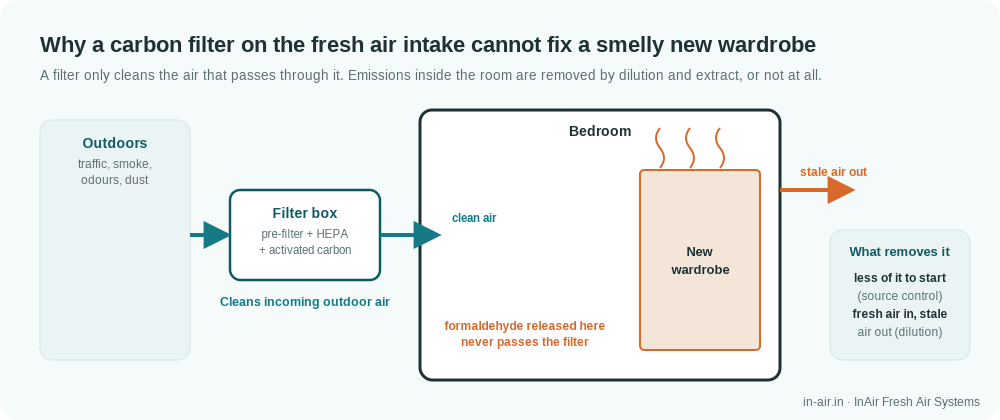
- Plain activated carbon is not especially good at capturing formaldehyde, says the US EPA. A carbon filter on the fresh air intake cleans outdoor air; it never sees what your new wardrobe gives off.
What VOCs and formaldehyde are
VOCs are carbon-based chemicals that evaporate at room temperature. The US EPA lists thousands of products that release them: paints, varnishes, waxes, cleaning and disinfecting products, cosmetics and hobby supplies. It notes that concentrations of many VOCs are consistently higher indoors, up to ten times higher, than outdoors.
Formaldehyde is the simplest and most studied of them. It is a colourless gas with a sharp smell. The EPA says it can irritate the skin, eyes, nose and throat, and that high levels of exposure may cause some types of cancers. WHO set an indoor guideline for it because, in its words, indoor exposure is the dominant contributor to personal exposure by inhalation.
TVOC, or total VOCs, is a single number that adds up many compounds. It is useful for spotting a problem, but it does not tell you which chemical is present. Formaldehyde is usually measured separately.
Where it comes from in a new Indian flat
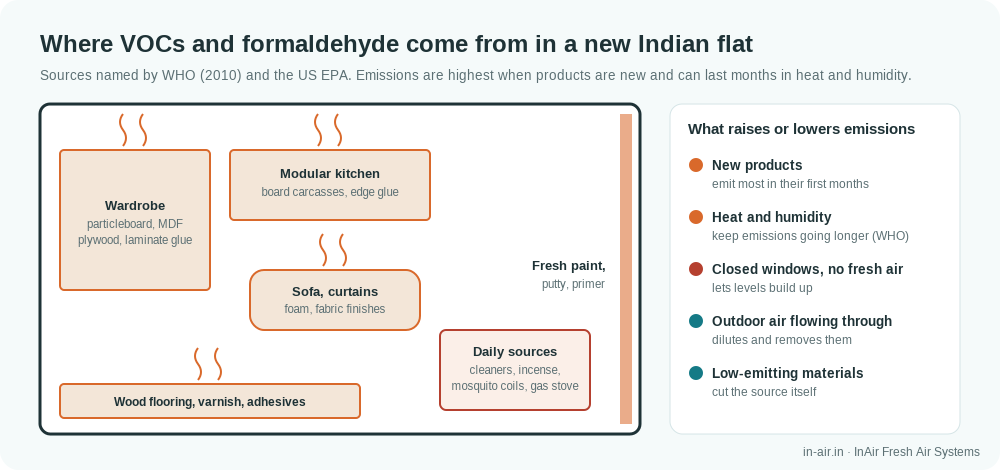
WHO's 2010 indoor air guidelines list the main formaldehyde sources in homes without smokers: furniture and wooden products made with formaldehyde-based resins, such as particleboard, plywood and medium-density fibreboard (MDF); paints, wallpapers, glues, adhesives, varnishes and lacquers; textiles; cleaning products; and electronic equipment. Combustion adds more, from smoking, cooking, and candle or incense burning.
That list describes a typical Indian handover and fit-out closely. Wardrobes, modular kitchens, TV units and bed boxes are mostly board products, and they all go in within a few weeks, along with fresh putty and paint. WHO cites a Quebec study of 96 homes where formaldehyde was significantly higher in homes with new wooden or melamine furniture bought in the previous 12 months, and where painting or varnishing had been done in the room in the previous 12 months.
Why heat and humidity matter here
WHO notes that emissions from new materials can last several months, particularly where relative humidity and indoor temperature are high. Much of India is hot and humid for large parts of the year, so a flat finished just before the monsoon can keep its new-furniture smell longer than the same flat would in a cool, dry climate. In the Quebec study WHO cites, formaldehyde levels were lower in homes with higher air exchange rates, which is the case for steady ventilation.
How much is too much: the limits
| Benchmark | Formaldehyde | TVOC | What it is |
|---|---|---|---|
| WHO indoor air guideline (2010) | 0.1 mg/m³ (100 µg/m³, about 81 ppb), any 30 minutes | No guideline | Health-based guideline; WHO says it also prevents long-term effects |
| IGBC/ISHRAE Class A (aspiration) | <30 µg/m³ | <500 µg/m³ | Indoor class in IGBC Health & Well-being, from ISHRAE 10001:2016 |
| IGBC/ISHRAE Class B (acceptable) | <100 µg/m³ | <650 µg/m³ | As above |
| IGBC/ISHRAE Class C (minimum) | Not listed | <800 µg/m³ | As above |
| IGBC Green New Buildings, test before occupancy | 27 ppb (about 33 µg/m³) | 500 µg/m³ | Credit for testing after construction; flush out and retest if exceeded |
The IGBC TVOC values are measured as isobutylene equivalent, which is how many handheld meters report. A cheap home monitor that shows a TVOC number may use a different reference or only a relative index, so treat its reading as a trend, not a compliance test. Our air quality monitor buying guide explains which sensors give real numbers, and indoor air quality standards in India covers the full IGBC and ISHRAE tables.
What actually helps, in order
1. Source control: buy lower-emitting materials
WHO says the use of low-emitting building materials and products, and avoiding tobacco smoke and other combustion, will minimise exposure; ventilation helps too. IGBC's Green New Buildings rating puts numbers on low-emitting materials: interior flat (matt) paint at no more than 50 g/L of VOC and glossy paint at 150 g/L, wood flooring adhesives at 100 g/L, and composite wood with no added urea-formaldehyde resin. Its new-furniture limits are 50 ppb formaldehyde and 0.5 mg/m³ TVOC for systems furniture. Ask your painter and carpenter for the VOC figure on the tin or the board's emission class, and for products with CII GreenPro certification, which IGBC accepts.
2. Steady ventilation, not just an open window on Sunday
Formaldehyde comes off furniture all day and all night, so the air needs replacing all day and all night. An energy recovery ventilator (ERV) supplies filtered outdoor air continuously and extracts stale air from bathrooms and kitchen. InAir's Revita and Ventura ERVs recover 89–90% of the heat (tested), so running them through an Indian summer does not undo the AC. Size the airflow with the ERV sizing calculator. If you are adding fresh air to a finished flat, see retrofitting fresh air in an existing flat.
3. A flush-out before you move in
A flush-out means pushing a large volume of outdoor air through a finished space before people live in it. The best-known standard is LEED v4's Indoor Air Quality Assessment credit, which WELL v1 also uses: a total of 14,000 cubic feet of outdoor air per square foot of floor area before occupancy, about 4,300 m³ per m². Its two-stage option allows moving in after 3,500 cubic feet per square foot, with the rest delivered afterwards while the system supplies at least 0.3 cfm per square foot. WELL adds that the space should be kept at 15 °C or more and below 60% relative humidity during the flush.
Here is what that means for a 1,200 sq ft flat, running a ducted fresh air system round the clock:
| Fresh air flow | Pre-occupancy stage (3,500 ft³/ft²) | Full flush-out (14,000 ft³/ft²) |
|---|---|---|
| 150 m³/h | about 33 days | about 132 days |
| 250 m³/h | about 20 days | about 79 days |
| 350 m³/h | about 14 days | about 57 days |
InAir's calculation: 1,200 sq ft × 3,500 ft³ is about 119 thousand m³, and × 14,000 ft³ is about 476 thousand m³. A home system cannot do a full commercial flush-out in a sensible time, but the pre-occupancy stage is realistic if the ventilation is commissioned two to three weeks before you move in, with the furniture already installed. Keep the AC or a dehumidifier running in humid months so the flush does not push indoor humidity past 60%. IGBC's version is a test: measure, and if formaldehyde or TVOC is above the limit, flush again and retest.
4. Filters: useful, with limits
Filters come last because they cannot touch the source. The next section explains why.
What carbon filters can and can't do
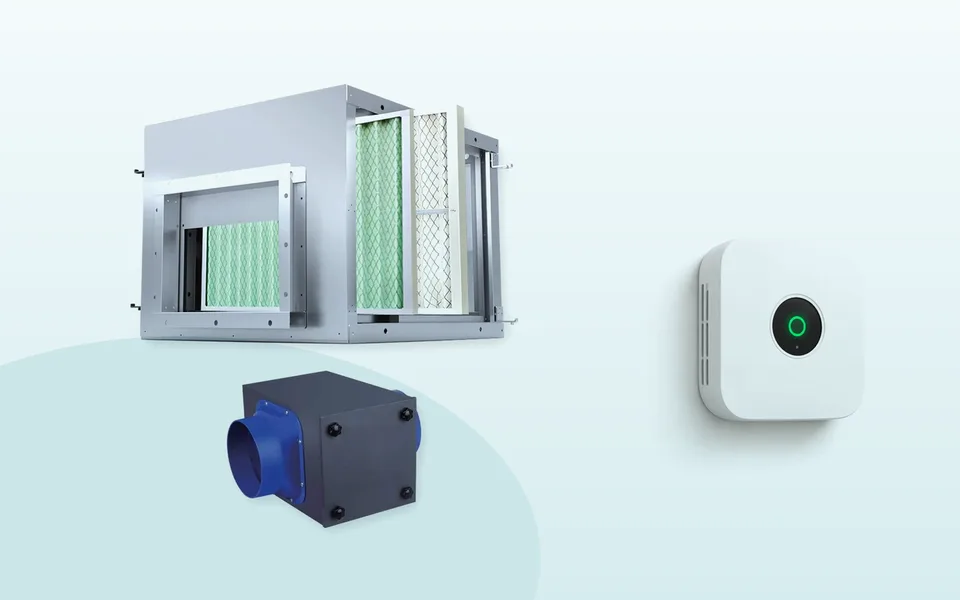
InAir's HEPA and carbon filter boxes combine a pre-filter, a HEPA H13 filter (at least 99.95% of particles at the most penetrating size, EN 1822) and a granular activated carbon stage for odours and gases. They fit in the fresh air duct, in sizes INAGLX-100 to INAGLX-250 for 120–2,600 m³/h, and reduce airflow by 15–25%, which has to be allowed for in the design.
- What carbon does well. The US EPA's technical summary on residential air cleaners says activated carbon can remove most hydrocarbons, many aldehydes, organic acids and ozone. That covers much of the traffic smell, smoke odour and solvent smell in city air coming in.
- Where it is weak. The same EPA report says activated carbon is not especially effective against low-molecular-weight aldehydes such as formaldehyde, or against ammonia and nitrogen oxides. Media impregnated with chemicals such as potassium permanganate work by reaction instead.
- It fills up. All adsorbents have limited capacity. The EPA warns that thin carbon layers can saturate quickly and even release what they collected, so carbon needs replacing on schedule.
- It only cleans what passes through it. On the fresh air intake, carbon cleans outdoor air. Formaldehyde released by a wardrobe inside the bedroom never reaches it; that is removed by the fresh air diluting it and the extract carrying it out.
So, in a new flat, carbon on the intake is worth having in a polluted city, and InAir's product page lists it for AQI-sensitive cities such as Delhi NCR and other urban sites. It is not a substitute for low-emitting furniture and steady air change. For the particle side, see air filter grades: MERV, HEPA and ISO 16890.
How InAir checks this at the site survey
- When the furniture, kitchen and paint went in, and what they are made of, to judge how strong the sources still are.
- Whether you can commission the fresh air system before moving in, so a pre-occupancy flush-out is possible.
- The airflow each room needs for its occupants, and where stale air can be extracted, so fresh air actually sweeps past wardrobes and bed boxes.
- Outdoor air in your area: whether a HEPA and carbon filter box is worth adding, and the airflow loss it brings.
- Indoor PM2.5, temperature, humidity and VOC trends measured with a sensor before and after commissioning. InAir's IAQ sensor reads those four; it does not measure CO₂ or formaldehyde specifically, so a lab test is the way to confirm a formaldehyde level.
What it costs
InAir's fresh air filter boxes start from ₹14,800 each, a Revita ERV for a 1–2 BHK home starts from ₹2.1 lakh, and the indoor air quality sensor starts from ₹53,100, all before GST and installation. The price guide lists the rest.
Tentative pricing: actual prices may vary based on the site survey.
Common mistakes and myths
- "The smell has gone, so the formaldehyde has gone." WHO notes some people can smell formaldehyde below 0.1 mg/m³, so smell is not a reliable gauge either way. Only a measurement tells you the level.
- "Houseplants will clean it." A 2020 review of 196 chamber results in the Journal of Exposure Science & Environmental Epidemiology found you would need 10 to 1,000 plants per square metre of floor to match the VOC removal that normal air exchange already gives.
- "Running an air purifier is enough." A particle purifier does nothing for gases; a carbon one has the limits above. Neither brings in outdoor air. See air purifier or fresh air system.
- Moving in the week the carpenter leaves. Emissions are highest when products are new. Plan time for a flush-out.
- Painting or polishing with the windows shut and the AC on. The EPA says VOC levels during and for hours after some activities, such as paint stripping, can be 1,000 times outdoor background. Ventilate hard while working.
- Stacking new board furniture in a closed, unventilated room. Closed rooms collect whatever is released.
Sources
- WHO Guidelines for Indoor Air Quality: Selected Pollutants (2010), formaldehyde chapter and executive summary. who.int
- IGBC Health & Well-being Rating System: IAQ Credit 1 (TVOC classes) and IAQ Credit 2 (formaldehyde classes), from ISHRAE Standard 10001:2016. igbc (PDF)
- IGBC Green New Buildings Rating System v3.0: IEQ Credit 5 (low-emitting materials) and IEQ Credit 7 (IAQ testing before occupancy). igbc (PDF)
- WELL Building Standard v1, Feature 13: Air flush (citing the LEED v4 EQ credit Indoor Air Quality Assessment). wellcertified.com
- US EPA, Residential Air Cleaners: A Technical Summary, 3rd edition (2018), gas-phase filtration. epa.gov (PDF)
- US EPA, Volatile Organic Compounds' Impact on Indoor Air Quality; and Facts About Formaldehyde. epa.gov · epa.gov
- Cummings BE, Waring MS (2020). Potted plants do not improve indoor air quality. J Expo Sci Environ Epidemiol 30:253–261. doi.org
- InAir HEPA and carbon filter boxes product page, and InAir price guide (FY 2026–27).
How long does formaldehyde last in a new flat?
What is a safe formaldehyde level at home?
Does a carbon filter remove formaldehyde?
How do I get rid of the new furniture smell quickly?
Can my air quality monitor measure formaldehyde?
What does an InAir filter box cost?
Our engineers assess your home or building, recommend the right system and the right filter grade for your city, and give you a clear cost estimate. No obligation.