MVHR vs ERV: what MVHR, HRV, ERV, DOAS and TFA mean
Six names for fresh air machines, from three countries' codes. Here is what each one means, which ones are the same box, and the questions that pin a quote down.
Last updated:
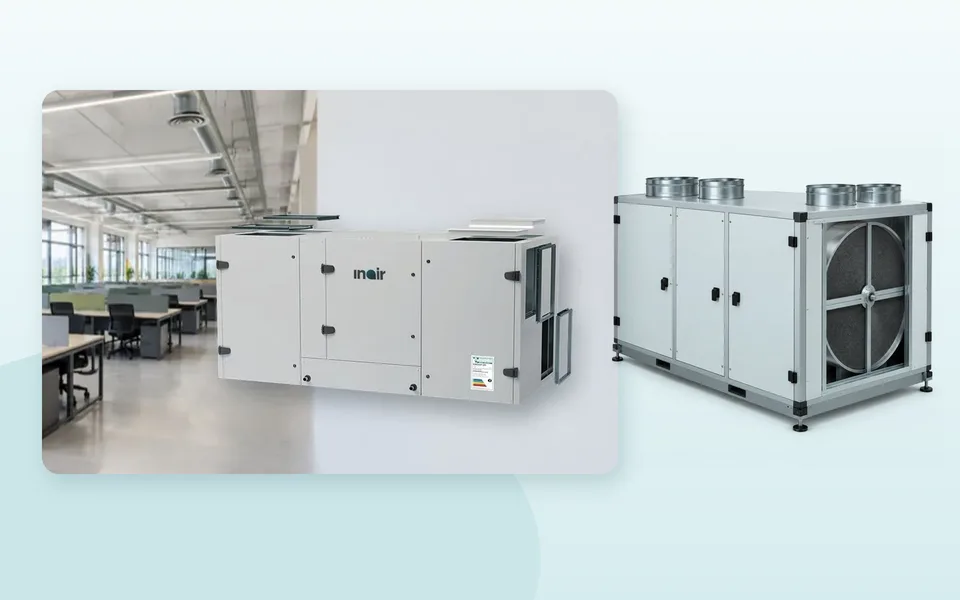
MVHR and ERV usually describe the same kind of machine. MVHR (mechanical ventilation with heat recovery) is the UK term for a balanced system that supplies outdoor air and extracts stale air through a heat exchanger. An ERV (energy recovery ventilator) is the American term for such a unit whose core passes moisture as well as heat. For India, ask for an ERV.
Key points
- MVHR is a UK system name. The UK's Approved Document F defines it as a system that continuously supplies outdoor air and continuously extracts indoor air.
- HRV and ERV are North American unit names. In an HRV only heat crosses the core; in an ERV heat and moisture both cross.
- DOAS (dedicated outdoor air system) and TFA (treated fresh air) describe units that condition 100% outdoor air with a coil. They do not have to recover any energy.
- "Fresh air unit" has no fixed meaning in India. It can mean anything from a supply fan to a heat-pump ERV.
- In humid Indian weather most of the energy in outdoor air is moisture, so the core type matters more than the name on the box.
Why the names are confusing
Ventilation grew up in different countries under different codes. British builders talk about MVHR because that is the system type their building regulations list. American engineers talk about HRVs and ERVs because those are the product categories their standards test. Indian HVAC contractors, mostly working on commercial jobs, say TFA or fresh air unit. Sellers then mix all of these, so two quotes for the same flat can use three names for the same box, or one name for two very different boxes.
MVHR: the UK term
The UK's Approved Document F (2021) lists three ventilation system types for homes: natural ventilation with background ventilators and intermittent extract fans, continuous mechanical extract ventilation, and mechanical ventilation with heat recovery. Its glossary defines MVHR as a mechanically driven system that both continuously supplies outdoor air to the inside of the dwelling and continuously extracts indoor air and discharges it outside.
Two details matter. First, the same definition adds that, for that document, the MVHR guidance applies to supply-and-extract systems with or without heat recovery. So MVHR is really a system category: balanced supply and extract. Second, the units are performance-tested to BS EN 13141-7. The term MVHR says nothing about whether moisture crosses the core, so a UK-style MVHR unit may have a heat-only core or a moisture-passing one.
HRV and ERV: the North American terms
The US Department of Energy's Building America Solution Center describes heat recovery ventilators (HRVs) as units that bring in outdoor air and exhaust indoor air at the same time, with both streams passing through a heat exchanger. It describes energy recovery ventilators (ERVs) as working like HRVs but transferring both heat and moisture. Both may be ducted on their own or joined to a central air handler.
That difference matters more in India than almost anywhere. In our ERA5 analysis, every 100 m³/h of untreated outdoor air adds about 1.01 kW of moisture load in Kolkata's most humid month, against 0.38 kW of heat in its hottest month. A heat-only core cannot touch the moisture part. Our HRV vs ERV guide for Indian climates works through each climate zone.
DOAS, TFA and fresh air unit
A dedicated outdoor air system (DOAS) treats the outdoor air separately from the room cooling. The US Department of Energy defines a packaged direct-expansion DOAS as one able to dry air to a 55 °F (12.8 °C) dew point under the AHRI 920 rating conditions. A TFA, the term Indian engineers use, is the same idea: an air handler that cools and dries 100% outdoor air with a chilled-water or DX coil. Neither term promises energy recovery. Our explainer on what a TFA unit is covers where they are used.
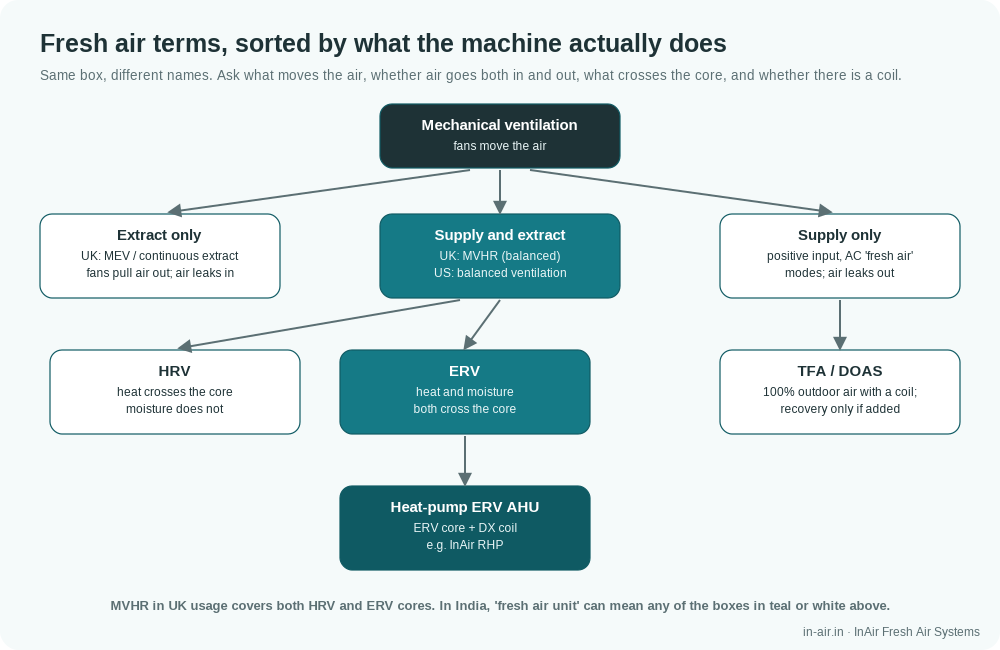
Fresh air unit is a sales term, not a technical one. Ask the seller to say which box on the map above they mean.
The terms side by side
| Term | Where it is used | What it means | Recovers heat? | Recovers moisture? | Cools and dries? |
|---|---|---|---|---|---|
| MVHR | UK (Approved Document F) | Balanced supply and extract system for a home | Yes, when a recovery core is fitted | Depends on the core | No |
| HRV | North America | Balanced unit with a heat-only core | Yes | No | No |
| ERV | North America, India | Balanced unit whose core passes heat and moisture | Yes | Yes | No |
| DOAS | North America, ASHRAE | System that conditions 100% outdoor air separately | Optional | Optional | Yes |
| TFA | India (HVAC trade usage) | Air handler that treats 100% outdoor air with a coil | Only if a wheel or plate is added | Only with a wheel | Yes |
| Heat-pump ERV AHU | InAir RHP and similar | ERV core plus a DX heat pump in one unit | Yes | Yes | Yes |
| MEV / exhaust fan | Everywhere | Extract only; air leaks in through gaps | No | No | No |
How much air each standard asks for
The names differ and so do the rates. For a 1,400 sq ft (130 m²) three-bedroom flat with four people, the references InAir works with give:
| Reference | Rule | Result for the example flat |
|---|---|---|
| UK Approved Document F 2021 | Higher of 0.3 l/s per m² or the bedroom table (31 l/s for 3 bedrooms) | 39 l/s, about 140 m³/h |
| ASHRAE 62.2-2022 | 0.03 cfm per ft² + 7.5 cfm per person (bedrooms + 1) | 72 cfm, about 122 m³/h |
| National Building Code of India 2016 | 20–30 m³/h of outdoor air per person | 80–120 m³/h |
| CO₂ check | About 21 m³/h per person holds a room near 1,000 ppm | about 84 m³/h |
All four land between roughly 80 and 140 m³/h for this flat. Size your own home with the ERV sizing calculator.
What Indian buyers should ask for
Use the words that pin the machine down, not the name on the brochure.
- Balanced supply and extract. Ask how much air the unit supplies and how much it extracts, at the duct pressure of your home, not only at zero pressure.
- An ERV core, not a heat-only core. Ask for both the sensible (heat) and latent (moisture) recovery figures and the test standard behind them. A single "efficiency" with no conditions tells you little.
- A coil, if you live on the coast. In Mumbai, Chennai or Kolkata monsoons, a passive core cannot dry air below the outdoor moisture level. Ask whether a heat-pump ERV or fresh air dehumidifier is needed.
- The filter grade. MERV-13 catches at least 85% of 1–3 µm particles; HEPA-13 at least 99.95%. Ask which one is fitted and what a replacement costs.
- Noise at your airflow. Ask for the dB figure from the spec sheet at the speed you will actually run.
- Controls. Ask what the unit runs on. If you want control by CO₂, check that a CO₂ sensor is included; many IAQ sensors measure PM2.5, humidity and VOC but not CO₂.
InAir's Revita and Ventura units are ERVs in this sense: balanced, with a plate core recovering 89–90% of the heat (tested), a pre-filter and MERV-13 filter (HEPA-13 optional). Revita spec sheets list the core as sensible and latent recovery. The RHP range adds a DX heat pump for humid cities. See the full ERV range.
How InAir checks this at the site survey
- Whether the home needs balanced ventilation or only better extract in bathrooms and kitchen.
- Your city's monsoon moisture, to decide between a passive ERV and a heat-pump ERV or dehumidifier.
- Bedrooms, people and floor area, to set the airflow against NBC and ASHRAE 62.2.
- Duct routes and pressure, so the quoted airflow is what reaches the rooms.
- Filter grade for the local AQI and access for filter changes.
What it costs
A Revita ducted ERV for a 1–2 BHK home starts from ₹2.1 lakh, a wall-mounted ERV from ₹1.4 lakh per unit, and an RHP heat-pump ERV from ₹9.4 lakh, before GST and installation. The ERV price guide explains what drives the total.
Tentative pricing: actual prices may vary based on the site survey.
Common mistakes
- Assuming MVHR means moisture recovery. An MVHR unit may have a heat-only core.
- Buying a supply-only "fresh air" fan and calling it MVHR. Without extract it is not balanced.
- Comparing efficiency figures measured at different conditions or with different standards.
- Expecting an ERV to dry monsoon air. It reduces the moisture load; it does not remove moisture below outdoor levels.
- Ordering a TFA for a flat. It is built for commercial airflows and usually needs a chilled-water plant.
Sources
- UK Department for Levelling Up, Housing and Communities, Approved Document F Volume 1 (2021): Table 1.3, Table 1.5, Table 1.6 and the MVHR definition in Appendix A. gov.uk
- US Department of Energy, Building America Solution Center: Whole-House Ventilation Strategies for New Homes (HRV and ERV definitions). basc.pnnl.gov
- US Department of Energy, Direct Expansion-Dedicated Outdoor Air Systems. energy.gov
- ASHRAE 62.2-2022 Addendum e: whole-house ventilation rate. ashrae.org
- ECMWF / Copernicus ERA5 reanalysis 2015–2024, analysed by InAir for six Indian cities. in-air.in
- InAir spec sheet INA-MFQR-250 and price guide FY 2026–27. in-air.in
Is MVHR the same as an ERV?
What is the difference between MVHR and HRV?
Should I buy an HRV or ERV in India?
What is DOAS in HVAC?
Is a fresh air unit an ERV?
Does an ERV need ducting?
Our engineers assess your home or building, recommend the right system and the right filter grade for your city, and give you a clear cost estimate. No obligation.