ERV price in India: what decides the cost of a fresh air system
Two ERV quotes for the same flat can differ widely. Here is what drives the cost, what recurs every month, and how to compare quotes line by line.
Last updated:
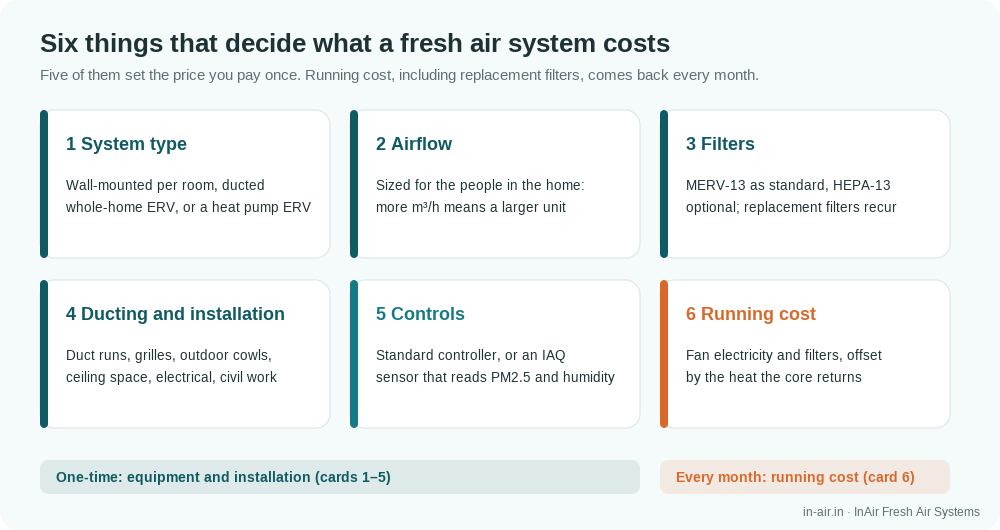
The cost of an ERV fresh air system in India comes down to six things: the type of system, the airflow your home needs, the filter grade, the ducting and installation work, the controls, and what it costs to run. A wall-mounted unit for one room and a ducted system for a whole home are priced very differently, and installation is quoted only after a site survey. This guide explains each factor so you can compare quotes properly.
Key points
- System type sets the base cost: wall-mounted ERVs serve one zone each; a ducted Revita serves the whole home; Ventura and RHP units serve villas and commercial floors.
- Airflow is sized for people, about 21 m³/h per person for 1,000 ppm of CO₂, not by air changes per hour.
- Filters recur: MERV-13 is replaced about every 6–12 months, HEPA-13 about every 12 months.
- Ducting and installation depend on your ceiling space and duct routes, so they are quoted after a free site survey.
- Running cost: an INA-MFQR-350 draws 160 W at full flow; the core returns 89–90% of the heat (tested) in the air it exhausts.
- Compare like with like: unit price, GST, installation, filters and service are separate lines on a proper quote.
1. System type: per room, whole home, or heat pump
This is the biggest single decision. There are three ways to bring filtered fresh air into an Indian home, and each has a different cost structure.
| System | Airflow | Ducting | Heat recovery | Suits |
|---|---|---|---|---|
| Wall-mounted ERV (INA-WERVG20-150CMH) | 150 m³/h per unit | None; a core-cut through an outside wall | 92% 3D enthalpy core (rated) | One zone of 250–350 sq ft in a finished home |
| Revita ducted ERV (INA-MFQR) | 150–500 m³/h for homes | Supply and exhaust ducts above a false ceiling | 89–90% (tested) | Whole apartment, best fitted before the ceiling is closed |
| Ventura ERV (INA-QRXF) | 800–1,500 m³/h ceiling; 2,000 m³/h and up floor-standing | Ducted | 89–90% (tested) | Large villas, offices, schools |
| RHP heat pump ERV (INA-HLN) | 600–8,000 m³/h | Ducted | >92% energy recovery, then active cooling or heating | Humid cities and buildings where fresh air must arrive cooled and dried |
A wall-mounted ERV costs less per unit, but it serves one room or zone. A home with three bedrooms and a living room that all need fresh air needs several units, and the unit count multiplies the cost. A ducted Revita ERV serves every room from one unit, but needs a false ceiling or a boxed soffit for the ducts. The wall-mounted ERV guide compares the two in detail.
A heat pump ERV is a different class of product. After its recovery core, a built-in heat pump cools or heats the fresh air to 22–28 °C before it reaches the rooms. That costs more to buy, but it takes the fresh air load off the room ACs entirely.
2. Airflow: how much fresh air your home needs
Bigger units cost more, so oversizing costs money twice: once at purchase, and again every month in fan power and AC load. Fresh air for bedrooms and living rooms should be sized for the people in them. A resting adult breathes out about 12 litres of CO₂ an hour; with outdoor air at about 425 ppm, about 21 m³/h per person holds a room near 1,000 ppm. India's National Building Code asks for 20–30 m³/h of fresh air per person. ASHRAE 62.2, the US standard for homes, sets a whole-home minimum of 0.03 cfm per sq ft plus 7.5 cfm per person, counting bedrooms plus one.
For a 1,500 sq ft 3BHK, that ASHRAE minimum is 45 + 30 = 75 cfm, about 127 m³/h. InAir usually fits the 350 m³/h INA-MFQR-350 for a 3BHK of 1,400–1,800 sq ft with 4–5 people, so closed bedrooms stay near 800 ppm overnight. The ERV sizing calculator works out the minimum for your home, and the 3BHK sizing guide shows the steps.
| Revita model | Maximum airflow | Fan power at full flow | Noise at full flow | Usually fitted for |
|---|---|---|---|---|
| INA-MFQR-150 | 150 m³/h | 105 W | 35 dB(A) | 1 BHK, 600–800 sq ft |
| INA-MFQR-250 | 250 m³/h | 142 W | 37 dB(A) | 2 BHK, 1,000–1,400 sq ft |
| INA-MFQR-350 | 350 m³/h | 160 W | 38 dB(A) | 3 BHK, 1,400–1,800 sq ft |
| INA-MFQR-500 | 500 m³/h | 255 W | 40 dB(A) | 4 BHK, 2,000 sq ft and more |
Figures from the InAir spec sheets. Fan power and noise fall at the medium and low speeds.
3. Filters: grade and replacement
Every Revita and Ventura ERV has a pre-filter and a MERV-13 filter; HEPA-13 is optional. MERV-13 captures at least 85% of particles of 1–3 µm under ASHRAE 52.2. HEPA-13 (H13) captures at least 99.95% at the most penetrating particle size under EN 1822. A HEPA stage adds to the price and to the fan's work, so it makes most sense in high-AQI cities. CSE's analysis of winter 2024–25 put Delhi's average PM2.5 at 175 µg/m³, against 37 in Bengaluru.
Filters are also a running cost. InAir's ERV maintenance guide sets these typical intervals:
| Part | What happens | Typical interval |
|---|---|---|
| Pre-filter | Vacuum or wash, dry, refit | Every 1–3 months |
| MERV-13 filter | Replace (not washable) | About every 6–12 months, or at the filter alarm |
| HEPA-13 filter | Replace (not washable) | About every 12 months, or at the filter alarm |
| Carbon filter | Replace | About every 6–12 months, when odours return |
| Recovery core, drain | Inspect and clean | At the annual service |
Dusty seasons and busy roads shorten these intervals. Replacement filters and annual maintenance are quoted separately from the unit. For a full comparison of filter grades, see air filter grades: MERV, HEPA and ISO 16890.
4. Ducting and installation
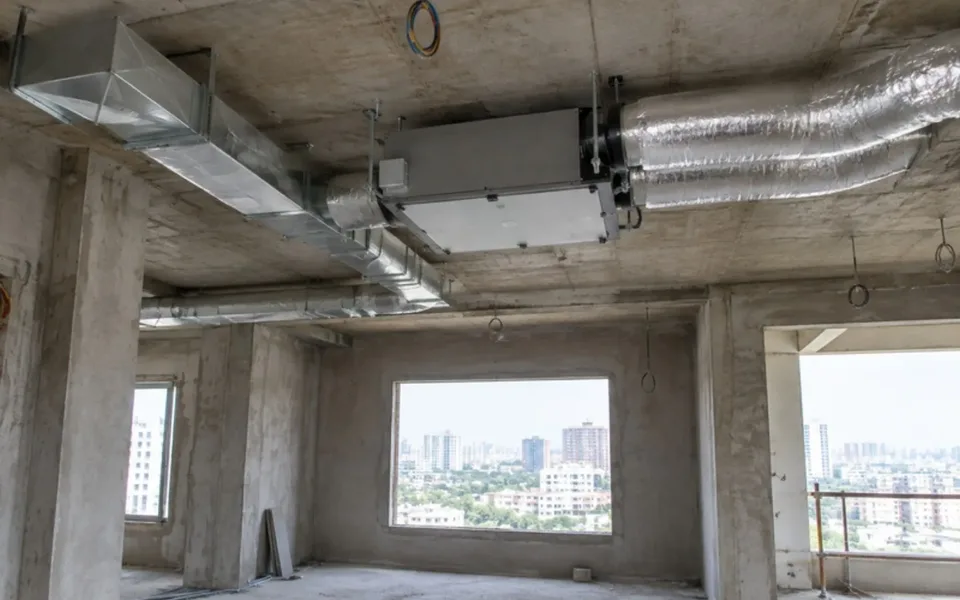
For a ducted ERV, installation is often the line that varies most between two homes of the same size. It depends on where the unit can hang, how long the duct runs are, how many bends they need, where the outdoor intake and exhaust can go, and whether the ceiling is still open. An apartment under construction is the easiest case: ducts go in before the false ceiling. A finished home needs surface-run ducting in a boxed soffit, or wall-mounted units instead.
The installation line usually covers the ducting itself, flat duct and fittings, grilles and diffusers, outdoor cowls, any filter boxes, electrical points and civil work such as core-cuts. InAir quotes all of this after the site survey because it cannot be priced from floor area alone. The ventilation duct guide explains duct sizes and why long, bendy runs cost airflow.
5. Controls and sensors
A standard controller sets the fan speed. An IAQ sensor and controller reads PM2.5, temperature, humidity and VOCs and shows them in a Wi-Fi app. It adds to the cost, but it lets you see whether the system is doing its job, and it tells you when filters are loading up. It is optional; a good system works without it.
6. Running cost, and what the ERV saves
An ERV has two running costs: fan electricity and filters. Fan power is on the spec sheet. The INA-MFQR-350 draws 160 W at full flow. Running it at full flow 24 hours a day uses about 3.8 units of electricity a day; at ₹8.9 a unit, the marginal tariff assumed in a 2025 UC Berkeley working paper on Indian ACs, that is about ₹1,025 a month. Most homes run lower speeds at night, which use less.
Against that, the recovery core cuts the load the fresh air puts on your ACs. On an average May afternoon in Delhi (38.9 °C, ERA5 2015–2024), 350 m³/h of outdoor air brought to 24 °C adds about 1.67 kW of heat. With 89% sensible heat recovery, about 1.49 kW of that never reaches the AC. At an AC efficiency of 3.5 W/W, that saves about 426 W of AC power while it lasts, more than the ERV's fan uses.
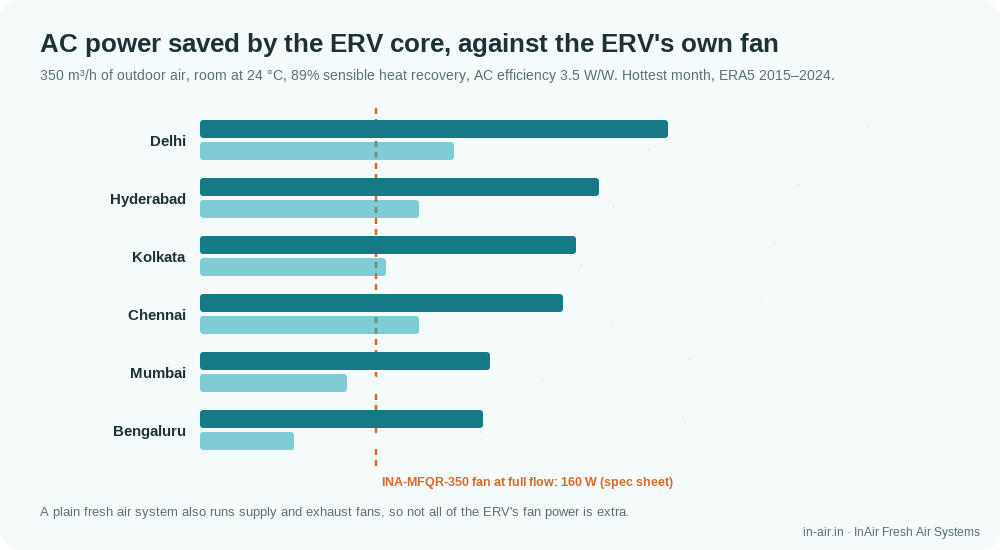
The chart shows the honest picture. The saving is large on hot afternoons and small in mild weather; in Bengaluru, at the daily average temperature, it is smaller than the fan power. Two things balance that. A plain fresh air system also needs supply and exhaust fans, so the ERV's fan is not all extra. And in humid months the Revita's core also handles part of the moisture in the incoming air, which this chart does not count. The AC load savings calculator runs the numbers for your city, airflow, AC and tariff.
How InAir checks this at the site survey
- Works out the airflow your home needs from the floor plan and who lives there, using ASHRAE 62.2 for homes.
- Checks the ceiling space and duct routes for a ducted unit, or whether a finished home is better served by standalone units that need only a core-cut through an outside wall.
- Names the model that delivers that airflow, and the filter grade your city calls for.
- Comes back with an installed price. GST, replacement filters and annual maintenance are separate lines.
Every InAir installation includes a site survey, duct design, commissioning with measured airflow readings, and handover. A typical residential installation is commissioned ten to twelve days from order.
What it costs
InAir's FY 2026-27 list prices for the equipment, before GST and installation, from the InAir price guide:
| Equipment | Airflow | Starting price |
|---|---|---|
| Wall-mounted standalone ERV | 150 m³/h | From ₹1.4 lakh per unit |
| Revita ERV, 1–2 BHK (INA-MFQR-150 / 250) | 150–250 m³/h | From ₹2.1 lakh |
| Revita ERV, 3–4 BHK (INA-MFQR-350 / 500) | 350–500 m³/h | From ₹2.6 lakh |
| Ventura ERV, ceiling-mounted | 800–1,500 m³/h | From ₹3.8 lakh |
| Ventura ERV, floor-standing | 2,000–7,500 m³/h | From ₹6.4 lakh |
| RHP heat pump ERV, ceiling-mounted | 600–5,000 m³/h | From ₹9.4 lakh |
| RHP heat pump ERV, floor-standing | 3,000–8,000 m³/h | From ₹16.1 lakh |
| IAQ sensor and controller | – | From ₹53,100 |
| Fresh air filter box (100–250 mm) | – | From ₹14,800 each |
| Diffusers, grilles, outdoor cowls | – | From ₹1,500 each |
Tentative pricing: actual prices may vary based on the site survey. Larger Ventura units, up to INA-QRXF-15000-FS, are priced on request. Installation, ducting, electrical and civil work are quoted after a free site survey; replacement filters and annual maintenance are quoted separately; GST is extra.
Common mistakes when comparing ERV prices
- Comparing unit prices only. Two quotes can differ more in installation, filters and service than in the unit. Ask for each line separately.
- Sizing bedrooms by air changes per hour. Six to eight air changes in a bedroom brings in several times the outdoor air two sleepers need, and a bigger unit and AC load to match.
- Believing an ERV cuts the AC bill by 90%. The 89–90% figure is the share of heat recovered from the air being exchanged, not of the whole AC load. Sun, people and appliances still heat the room.
- Ignoring filter cost and availability. A MERV-13 filter replaced once or twice a year is part of the price of owning the system.
- Choosing wall units for a home still under construction. If the ceiling is open, a ducted system may serve every room with one unit and fewer wall openings.
- Skipping commissioning. Without measured airflow at each outlet, you cannot tell whether you got the air you paid for.
Sources
- InAir spec sheets: INA-MFQR-350, INA-WERVG20-150CMH (airflow, fan power, noise, heat recovery); InAir price guide FY 2026-27, in-air.in/pricing.md.
- ANSI/ASHRAE Standard 62.2-2022, Addendum e: whole-dwelling ventilation rate. ashrae.org
- CSIR, Guidelines on Ventilation v2.0 (2022), reproducing NBC 2016 fresh air rates. niti.gov.in
- Hersbach H. et al., The ERA5 global reanalysis (2020), daily values 2015–2024 via the Open-Meteo historical weather API; InAir analysis.
- Abhyankar N. et al., India Energy and Climate Center, UC Berkeley: Stronger AC efficiency standards (2025), marginal tariff and ISEER data. iecc.gspp.berkeley.edu
- Bureau of Energy Efficiency, Energy Performance Assessment of HVAC Systems, chapter 9 (heat load from air flow and enthalpy). beeindia.gov.in
- Centre for Science and Environment, winter 2024–25 PM2.5 analysis of CPCB data. ASHRAE 52.2 (MERV) and EN 1822 (HEPA) filter classes.
What decides the price of an ERV in India?
Is a wall-mounted ERV cheaper than a ducted ERV?
Does the price include installation and GST?
How much electricity does an ERV use?
How often do ERV filters need replacing?
Will an ERV reduce my AC bill?
Our engineers assess your home or building, recommend the right system and the right filter grade for your city, and give you a clear cost estimate. No obligation.