How to add fresh air to a finished flat without a false ceiling
No false ceiling, no problem: three ways to bring filtered outdoor air into a flat that is already done up, and what to ask your society first.
Last updated:
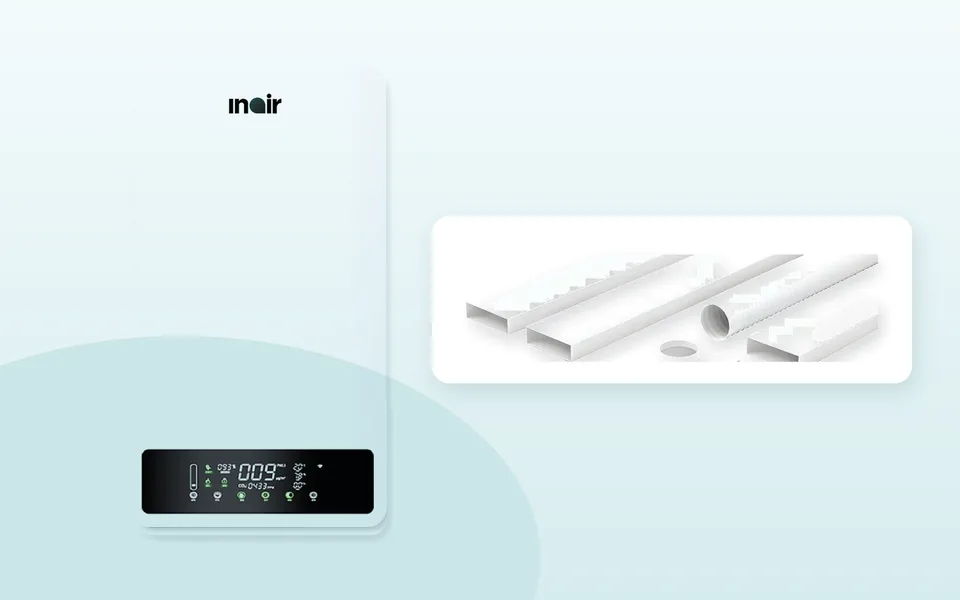
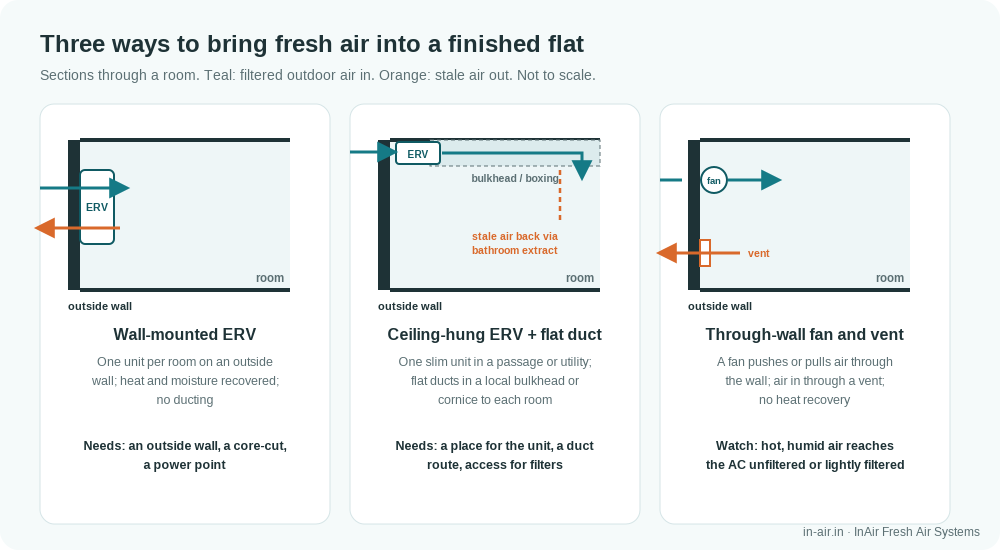
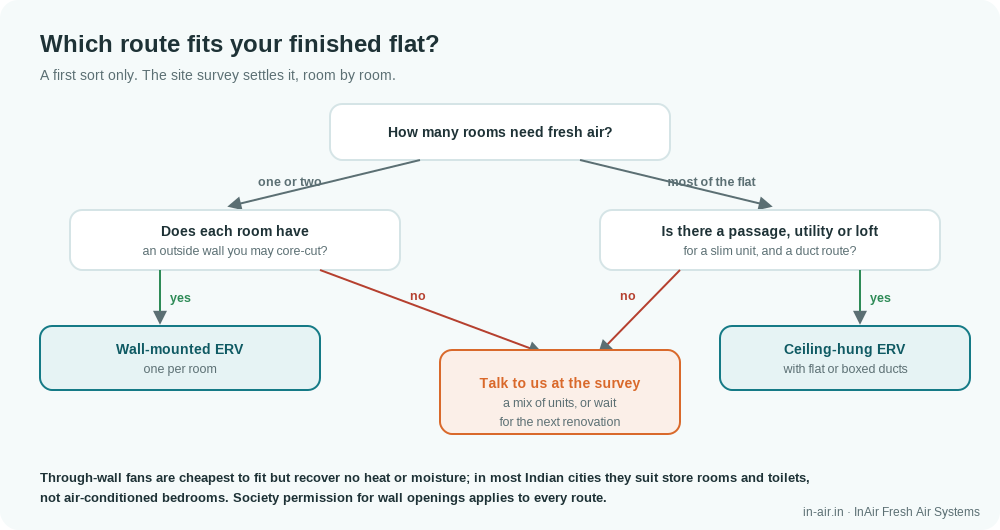
Yes, a finished flat without a false ceiling can get filtered fresh air. There are three routes: a wall-mounted ERV in each room on an outside wall, one slim ceiling-hung ERV feeding rooms through flat ducts boxed into a bulkhead or cornice, or simple through-wall fans and vents. Which one fits depends on your outside walls, a route for ducts, and what your society allows.
Key points
- A wall-mounted ERV needs no ducting: one core-cut through an outside wall and a power point. InAir's unit moves 150 m³/h and suits one room or zone of 250–350 sq ft.
- A ceiling-hung ERV can serve the whole flat from one place, with flat ducts (132 × 30 mm on InAir's system) run in a local bulkhead rather than a full false ceiling.
- Through-wall fans are cheapest but recover nothing. On a Hyderabad summer afternoon, 150 m³/h of untreated outdoor air adds about 0.61 kW of heat to the AC; an 89% heat-recovery core cuts that to about 0.07 kW (our calculation).
- Ask your society before any wall opening. Maharashtra's model bye-laws, for example, need the committee's written permission for additions or alterations to a flat.
- The free site survey checks outside walls, ceiling heights, duct routes, power points and where exhaust air can go.
Why a finished flat is harder, and what changes
A ducted fresh air system usually hides its unit and ducts above a false ceiling. In a flat that is already painted and furnished, nobody wants every ceiling broken. InAir's product pages put it plainly: installation is cheapest during construction or renovation; in a completed interior the same result comes from surface-run ducting in a boxed soffit, or from a standalone unit that needs only a core-cut through an external wall. If you are still buying, see our fresh air checklist for builders first.
The need is the same either way. A closed, air-conditioned bedroom fills with CO₂ overnight, and windows bring in dust, heat and noise. About 21 m³/h of outdoor air per person holds a bedroom near 1,000 ppm of CO₂. Our guide to fresh air machines for bedrooms explains that figure.
Option 1: a wall-mounted ERV in each room
A wall-mounted ERV is a ductless energy recovery ventilator fixed to an outside wall. Two fans move air in and out through one opening, and a core between the streams passes heat and moisture from the outgoing air to the incoming air. InAir's INA-WERVG20-150CMH supplies up to 150 m³/h through a 3D enthalpy core rated at 92%, at 35 dB, with three-stage filtration plus a charcoal filter, automatic bypass and humidity control, on a 220 V single-phase supply. It suits one zone of 250–350 sq ft.
A home usually needs one unit for each bedroom and one for the living room, sized to the people in each room. InAir fits a typical room in one day. The limits: the room must have an outside wall where the unit and its opening can go, and several units cost more than one ducted unit for a whole flat. Our wall-mounted ERV guide compares the options.
Option 2: one ceiling-hung unit with flat ducting
Where most rooms need fresh air, one ducted unit is usually quieter and cheaper than several wall units. The unit does not need a false ceiling across the flat, only a place to hang it and a route for the ducts. InAir's Revita ERVs have a slim casing, 180–272 mm deep according to the spec sheets, and the INA-MFQR-150 and INA-MFQR-250 cover 1 BHK and 2 BHK homes. Common spots are a passage ceiling, a utility area or a loft over a wardrobe.
From there, flat ducting carries the air. InAir's flat duct is 132 × 30 mm ABS, made to be concealed in false ceilings and skirting, with 90° and 45° bends and 10-way or 12-way distribution boxes. In a finished flat it usually runs inside a narrow bulkhead along a passage or a cornice at the wall-ceiling edge, ending at a small grille in each room. Stale air leaves through bathroom and kitchen extract points back to the unit. Our duct guide explains why duct size and bends matter.
Option 3: through-wall fans and vents
The simplest retrofit is a fan in the wall or window that pushes outdoor air in (or pulls room air out), with a vent elsewhere for air to leave or enter. It costs least and fits in a day. It also recovers nothing, and that matters in India.
We worked out the load from ERA5 weather data. On an average afternoon in Hyderabad's hottest month (high 37.1 °C), every 100 m³/h of outdoor air brought into a room at 24 °C and 50% humidity adds about 0.41 kW of sensible heat, and in the most humid month about 0.57 kW of moisture load. These are monthly averages, not design peaks. For one 150 m³/h unit that is about 0.61 kW of heat and 0.85 kW of moisture for the AC to remove. A core that recovers 89% of the sensible heat leaves about 0.07 kW; an enthalpy core also passes moisture back out. A through-wall fan leaves all of it with the AC. The AC load savings calculator runs the same sum for six cities.
Through-wall fans still have a place: toilets, store rooms and kitchens, where the job is extract rather than fresh air. For a bedroom that is air-conditioned most of the year, a unit with heat recovery and a proper filter is the better fit.
The three routes compared
| Wall-mounted ERV | Ceiling-hung ERV + flat duct | Through-wall fan + vent | |
|---|---|---|---|
| Ducting | None | Flat ducts in a bulkhead or cornice | None |
| Walls touched | One core-cut per room | One or two openings for intake and exhaust | One or two openings per room |
| Heat and moisture recovery | Yes (92% enthalpy core on InAir's unit) | Yes (89–90% tested on Revita) | No |
| Filtration | Three stages plus charcoal | Pre-filter and MERV-13; HEPA-13 optional | Depends on the product; often a coarse mesh |
| Rooms covered | One room or zone per unit | The whole flat from one unit | One room per fan |
| Disruption | About a day per room | Bulkhead work and painting | Least |
| Best for | One to three rooms, rented homes | Most of the flat, or a renovation | Toilets, stores, kitchens |
Society and building permissions to ask about
Every route above makes at least one opening in an outside wall, and outdoor hoods change the look of the façade. Before booking work, ask these questions of your society or residents' association, and of your landlord if you rent.
- Do the bye-laws need written permission for alterations to the flat? Maharashtra's model bye-laws for co-operative housing societies (2014), for example, say no member shall make additions or alterations to a flat without the committee's prior written permission, applied for through the Secretary.
- Are structural changes involved? The same bye-laws say structural changes need the prior permission of the competent authority as well. Ask which walls the society treats as structural.
- Are there rules on the façade: the colour and size of outdoor hoods or grilles, and where they may go?
- Who owns and maintains the outside face of the wall, and can an installer reach it safely (balcony, utility ledge or a rope access team)?
- May exhaust air go into a shared shaft, or only through an outside wall?
- Are there working hours for drilling and noisy work?
Rules differ by state and by society, so read your own bye-laws or ask the managing committee. InAir can share the unit and opening details your committee asks for.
How InAir checks this at the site survey
- Which rooms need fresh air, how many people use each, and whether doors stay shut at night.
- Outside walls in each room: thickness, what is on the other side, whether a core-cut would meet a beam or column, and whether there is space inside for a wall unit.
- Ceiling heights, beam depths and a possible place for a slim ducted unit, with a route for flat ducts to each room.
- Power points, and where filters can be reached for cleaning.
- Where stale air can leave: an outside wall, or an extract route through bathrooms and kitchen.
- Your city's air quality, to choose MERV-13 or HEPA-13 filtration.
- Façade and society constraints you tell us about, so the proposal fits them.
- After installation: commissioning with measured airflow readings and a written handover.
What it costs
InAir's wall-mounted ERV starts from ₹1.4 lakh per unit. A Revita ducted ERV for a 1–2 BHK starts from ₹2.1 lakh. Flat duct starts from ₹1,800 for a 2 m length, and fittings and outlet panels from ₹100 each. All prices are before GST; installation, bulkhead work and electrical work are quoted after the free site survey. See the price guide.
Tentative pricing: actual prices may vary based on the site survey.
Common mistakes
- Buying a through-wall fan for an air-conditioned bedroom and then finding the room hot, humid and dusty.
- Fixing a wall unit on a wall that is not an outside wall, or one shared with a neighbour's balcony.
- Fitting several wall units when most of the flat needs fresh air; one ducted unit is often cheaper and quieter.
- Hiding the ducted unit where filters cannot be reached without breaking a ceiling.
- Starting work without society permission, then being asked to remove the outdoor hoods.
- Forgetting where stale air goes. Fresh air in needs an equal path out.
Sources
- Maharashtra Co-operative Department, Model Bye-laws of Co-operative Housing Society (flat owner type, 2014), bye-law 45 on additions and alterations. sahakarayukta.maharashtra.gov.in
- Copernicus ERA5 reanalysis via the Open-Meteo historical weather API, Hyderabad daily values 2015–2024, InAir calculation (loads for air brought to 24 °C and 50% RH). open-meteo.com
- CSIR, Guidelines on Ventilation (2022), reproducing NBC 2016 fresh air and air-change rates. niti.gov.in
- US EPA, What is a MERV rating? epa.gov
- InAir spec sheets INA-WERVG20-150CMH, INA-MFQR-150 and INA-MFQR-250; InAir flat ducting and standalone unit product pages; InAir price guide FY 2026–27.
Can I install a fresh air system in a flat without a false ceiling?
How many wall-mounted ERVs does a 2BHK need?
Do I need society permission to fit a wall-mounted ERV?
Is a through-wall fan enough for a bedroom?
How long does a retrofit take?
What does a retrofit fresh air system cost?
Our engineers assess your home or building, recommend the right system and the right filter grade for your city, and give you a clear cost estimate. No obligation.