Laboratory Ventilation: Fresh Air, Exhaust and Fume Hood Make-up Air
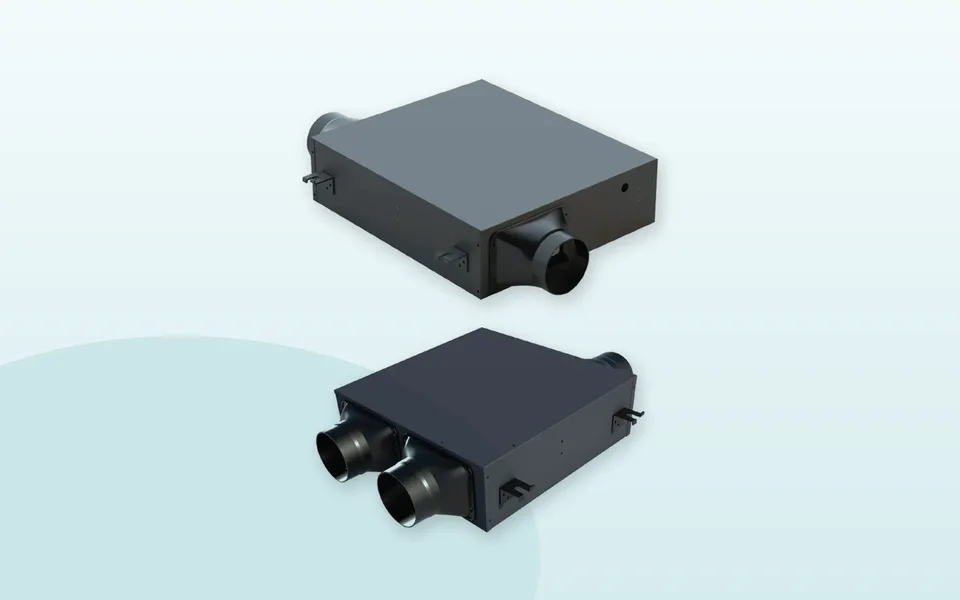
A laboratory needs once-through air: filtered outdoor air in, all air exhausted outside, and the lab kept slightly negative so fumes do not reach corridors. NBC lists 6–15 air changes an hour for laboratories, but fume hoods often set the real airflow. InAir supplies the fresh air and exhaust fans, not the fume hoods.
Why laboratories are ventilated differently
In an office, most of the air is cooled and sent round again, with a share of fresh air mixed in. A laboratory works the other way. Chemicals, solvents and odours mean the air should pass through once and leave the building.
- OSHA's laboratory standard advises that laboratory air should not be recirculated but exhausted directly outdoors, that air in chemical labs should be continuously replaced, and that lab air pressure should be negative to the rest of the building[2].
- ANSI/ASSP Z9.5-2022, the US laboratory ventilation standard, covers hood airflow, supply and exhaust systems, recirculation, commissioning and annual testing. It states that face velocity alone is not enough to prove a hood works; containment is checked by several tests[3].
- Because all supply air is outdoor air, every cubic metre has to be filtered and cooled from outdoor conditions. In Indian summers and monsoons this is a large share of the lab's cooling load.
How much air does a lab need?
There is no single number. Codes and institutions give ranges, and a risk assessment of the work sets the final rate. This table shows the main references.
| Reference | What it says | |
|---|---|---|
| NBC air change table (Part 8, Section 3) | Laboratories: 6–15 air changes per hour | [1] |
| OSHA 29 CFR 1910.1450, Appendix A | No recirculation; continuous replacement; negative pressure to the rest of the building | [2] |
| Arizona State University lab design guide (2017) | General lab: 6 air changes per hour occupied, 4 unoccupied (4 and 2 with demand-controlled ventilation) | [4] |
| University of Edinburgh lab ventilation policy | Aim for 6–8 air changes per hour occupied, set back to 4 out of hours; evidence needed above 12 | [5] |
| Fume hood face velocity (ASU guide) | Traditional hoods: average 80–120 fpm (about 0.4–0.6 m/s); high-performance hoods to the maker's minimum, typically 65 fpm | [4] |
| Low-flow fume cupboards (Edinburgh) | Often safe at 0.35 m/s with suitable sills; checked annually within ±10% of commissioning | [5] |
Fume hoods set the make-up air
A fume hood is an exhaust device, and it exhausts a lot of air. Take a hood with a 1.5 m wide opening and the sash at 18 inches (0.457 m). Our calculation of the exhaust it needs:
| Face velocity | Hood exhaust | Compared with an 8 × 6 × 3 m lab |
|---|---|---|
| 0.35 m/s (low-flow hood) | 864 m³/h | 6.0 air changes per hour on its own |
| 80 fpm (0.41 m/s) | 1,002 m³/h | 7.0 air changes per hour |
| 100 fpm (0.51 m/s) | 1,254 m³/h | 8.7 air changes per hour |
| 120 fpm (0.61 m/s) | 1,505 m³/h | 10.5 air changes per hour |
One hood can pull as much air as the whole room's minimum ventilation. Every cubic metre it removes must be replaced, so the make-up air is sized from the hoods first and the room rate second. On a Delhi afternoon in May, when the average daily maximum is 38.9 °C (ERA5 data), cooling 1,254 m³/h of outdoor air to 24 °C takes about 6.3 kW of sensible cooling, roughly 1.8 tonnes of refrigeration, before any moisture is removed. That is for one hood.
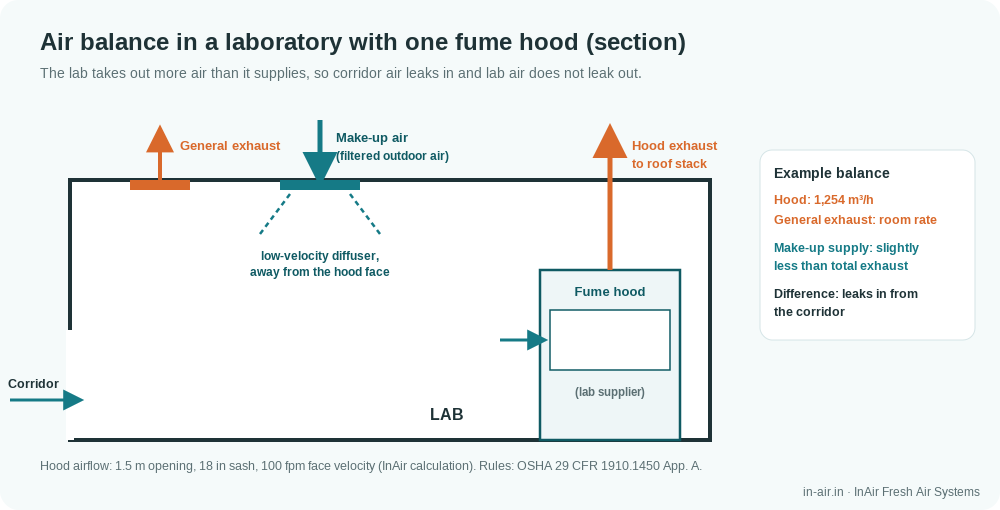
- Supply air diffusers go away from the hood face. Z9.5 requires hoods to be placed so cross drafts do not upset them[3].
- Make-up air is set slightly below total exhaust, so the lab stays negative to the corridor.
- If hoods are variable air volume, the make-up air has to follow them as sashes open and close.
What InAir supplies, and what it does not
| Part of the system | Who supplies it |
|---|---|
| Fume hoods, biosafety cabinets and their controls | The laboratory furniture or hood supplier. InAir does not supply fume hoods. |
| Fume hood exhaust fans and stacks | Specified with the hood supplier for the chemicals in use; InAir matches the make-up air to them |
| Make-up and fresh air supply, filtered | InAir cabinet fans, cabinet fans with filters, and HEPA and carbon filter boxes |
| General room exhaust | InAir cabinet centrifugal or industrial radial fans |
| Offices, write-up rooms and corridors next to the lab | InAir Revita / Ventura ERVs with 89–90% heat recovery (tested) |
| Monsoon humidity in the make-up air | Water-coil fresh air dehumidifier or the building's chilled water coils |
InAir does not route fume hood exhaust, or general exhaust from rooms where hazardous chemicals are handled, through an ERV. OSHA's guidance is to exhaust lab air directly outdoors[2]. Heat recovery from lab exhaust is a decision for the lab's safety officer and design engineer, not a default.
How InAir checks this at the site survey
- The work and the hazards. What the lab does, what chemicals are used, and the safety officer's risk assessment and target air change rate.
- Hoods. Number, size, sash heights, face velocity and whether they are constant or variable volume, from the hood supplier.
- Room data. Floor area, height, doors, and which rooms the lab must stay negative to.
- Outdoor air. Where make-up air can be drawn from, away from hood stacks and exhausts, and the city's dust and humidity.
- Proposal and commissioning. Fan and filter selections, then measured supply and exhaust airflows and the pressure difference at each lab door.
What it costs
Lab ventilation is quoted after the site survey because the hood schedule drives it. Published starting prices for the parts InAir supplies are: cabinet centrifugal fans from ₹47,400, cabinet fans with filter from ₹75,900, and fresh air filter boxes from ₹14,800 each, before GST and installation.
Tentative pricing: actual prices may vary based on the site survey.
Common mistakes
- Sizing supply air from the room's air changes and forgetting the hoods, so the lab goes strongly negative and doors whistle or slam.
- Supply diffusers blowing across the hood face, which pulls fumes out of the hood.
- Returning lab air to a central AHU to save cooling.
- Placing the fresh air intake near a hood stack.
- Bringing in untreated monsoon air, so labs run humid and instruments and samples suffer.
- Treating face velocity as the only test of a hood[3].
Frequently asked questions
How many air changes does a laboratory need?
Can laboratory air be recirculated?
Why is a lab kept at negative pressure?
How much make-up air does a fume hood need?
Does InAir supply fume hoods?
Can an ERV be used in a lab building?
References
- Bureau of Indian Standards, National Building Code of India, Part 8, Section 3: recommended air changes per hour, laboratories (Table 5 in SP 7 Group 4, 2005 edition, Public.Resource.Org copy). https://archive.org/details/gov.in.is.sp.7.4.2005
- US OSHA, 29 CFR 1910.1450 Appendix A, National Research Council recommendations concerning chemical hygiene in laboratories. https://www.osha.gov/laws-regs/regulations/standardnumber/1910/1910.1450AppA
- AIHA, The Synergist (June 2022): the updated ANSI/ASSP Z9.5-2022 laboratory ventilation standard. https://synergist.aiha.org/20220607-lab-ventilation-standard
- Arizona State University EHS, Laboratory Standard and Design Guide: Lab Ventilation (June 2017). https://www.asu.edu/ehs/design-guidelines/laboratory-ventilation.pdf
- University of Edinburgh, Laboratory Ventilation Policy and Guidance (2024). https://sustainability.ed.ac.uk/sites/default/files/2024-10/Lab%20ventilation%20policy%20and%20guidance.pdf
- Copernicus ERA5 reanalysis via Open-Meteo, historical weather API (Delhi May mean daily maximum, InAir analysis). https://open-meteo.com/en/docs/historical-weather-api
Book a free site survey
An InAir engineer will survey your space, size the fresh air and exhaust, and send a written proposal. Available across 15 Indian cities.